‘Non’: Charles De Gaulle vetoes Britain’s entry to EEC
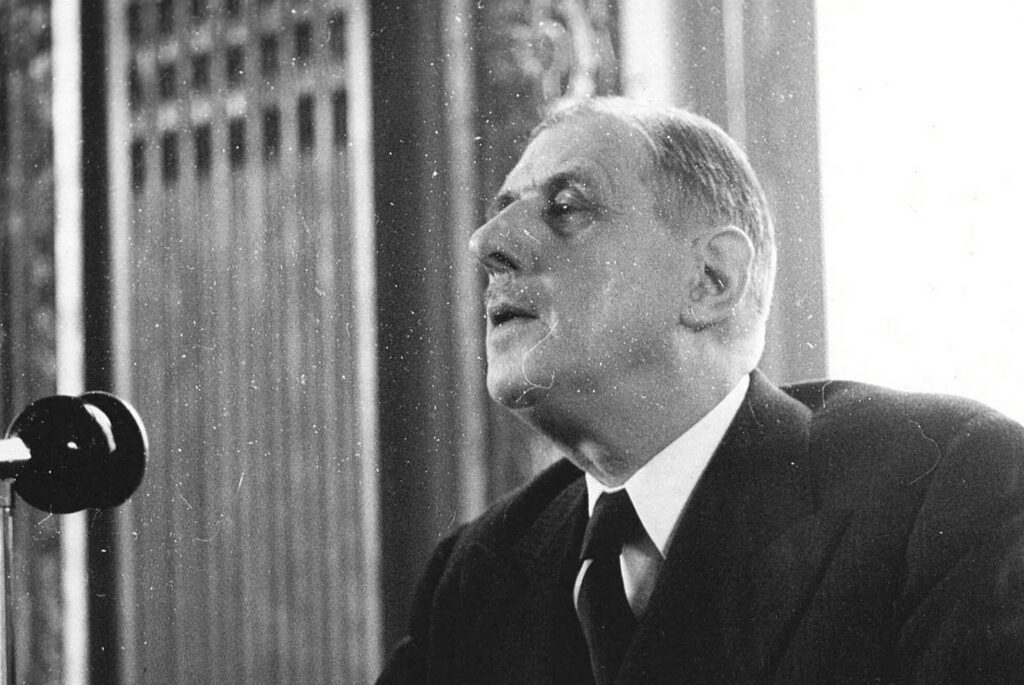
On 14 January 1963, French president Charles de Gaulle unilaterally vetoed Britain’s first application to join the European Economic Community (EEC). De Gaulle famously uttered the single word “Non” towards the television cameras – delivering the first of his two vetoes on Britain’s EEC accession.
The announcement, made at a press conference in Paris, brought an abrupt end to months of intensive negotiations. The Conservative government of Harold Macmillan had applied for membership in 1961.
Macmillan formally announced his decision to apply for Britain’s accession in a commons statement on 31 July 1961.
Addressing MPs, the prime minister referred to Britain’s relationship with the EEC as both a “political” and “economic” issue. He said the Treaty of Rome, which established the EEC in 1957, “has an important political objective, namely, to promote unity and stability in Europe which is so essential a factor in the struggle for freedom and progress throughout the world.”
He added: “I believe that it is both our duty and our interest to contribute towards that strength by securing the closest possible unity within Europe.”
Macmillan then confirmed that the government had “come to the conclusion that it would be right for Britain to make a formal application under Article 237 of the [Treaty of Rome] for negotiations with a view to joining the Community”.
Referring to the coming negotiations, Macmillan said they may be “protracted” and insisted there could “be no guarantee of success.”
The Liberal leader, Jo Grimond, asked Macmillan if he was “confident of success when we go into these negotiations”. The prime minister responded that he was “not confident, but I am hopeful.”
***
De Gaulle’s infamous interdict came at a press conference on 14 January 1963. The French president was asked to set out his position on “Britain’s entry into the common market and the political evolution of Europe”.
In response, De Gaulle posited that the Treaty of Rome had been concluded between six “continental States” which were “economically speaking… of the same nature”. Their geographical proximity, he stated, made it “a fact to group them” so that they would “produce, buy, sell, consume, in preference in their own ensemble”.
He noted that Britain had “earlier refused to participate in the communities we are now building”. He argued that Britain now asking to enter “on her own conditions” posed “problems of a very great dimension” for all parties.
De Gaulle, who spent much of the Second World War in London when France was under occupation, maintained that Britain was not suited for membership. He described Britain as an “insular” nation with “very original habits and traditions”.
He told reporters: “England in effect is insular, she is maritime, she is linked through her exchanges, her markets, her supply lines to the most diverse and often the most distant countries; she pursues essentially industrial and commercial activities, and only slight agricultural ones.
“She has in all her doings very marked and very original habits and traditions.
“In short, the nature, the structure, the very situation that are England’s differ profoundly from those of the continentals.”
De Gaulle was also sceptical of the UK’s so-called ‘special relationship’ with the United States; he viewed Britain as potentially acting as an American “Trojan horse” within the community. Referring implicitly to the UK-US relationship, de Gaulle said that none of the original Treaty of Rome signatories were “bound abroad by any particular political or military accord.”
Britain’s entry, de Gaulle concluded, would impact upon the future cultural, economic and political cohesion of the common market.
The veto was a humiliating political blow to Macmillan, who confided in his diary that “all our policies at home and abroad are in ruins.”
The prime minister added: “The French always betray you in the end.”
In early February, Macmillan advised Princess Margaret to cancel her visit to Paris. Margaret had been expected to have lunch with de Gaulle.
***
Speaking in the commons on 11 February, Macmillan expressed his “deep disappointment” at the position adopted by de Gaulle.
He told MPs: “I will not disguise from the House, as I have not attempted to disguise from the country, the deep disappointment of the government and, I think, of the whole nation, at the turn of events…
“If the European vision has been obscured, it has not been by a minor obstruction on one side or the other. It was brought to an end by a dramatic, if somewhat brutal, stroke of policy.”
Macmillan said he “had always hoped” the French government would be unwilling “to place themselves in the public position of opposing the will of all their colleagues in the Community and, indeed, of disappointing the hopes of every country in the free world”.
He claimed de Gaulle “decided to act” only when it became clear the British government would succeed in carrying out its policy.
He added: “Even so, there was some confusion in the method. So many different reasons were given for Britain’s exclusion – that she is an island; that our people were not sufficiently European-minded; that we do not accept the Treaty of Rome – a statement wholly incorrect…
“It was clear that none of these reasons was the real one.”
He indicated his wish to “continue close relations with France”, but maintained the UK would “bear in mind the loyalty that we owe to the other nations of Europe which have stood so firmly by us”.
He also defended the advice given to Princess Margaret, arguing that overseas royal visits had a “political significance” and that “entertainment at the Elysee seemed hardly timely”.
Kenneth Clarke, the veteran Conservative and europhile, would later recall: “De Gaulle was ferociously anti-American and pretty anti-Anglo-Saxon.”
Clarke added: “He modelled himself a little on Napoleon and wished to have a European Community which was dominated by France and steered by a Franco-German alliance, which was out of touch with the way the world was going. He was a great man, De Gaulle, but slightly unworldly. Sooner or later we were going to join because no-one had any alternative.”
***
De Gaulle’s veto contributed to the difficult political landscape in which Macmillan resigned as prime minister in October 1963 on health grounds.
De Gaulle again vetoed Britain’s EEC accession in 1967, accusing Britain of a “deep-seated hostility” towards European construction. The French president argued that Britain showed a “lack of interest” in the community and would require a “radical transformation” before joining the EEC.
He declared: “The present common market is incompatible with the economy, as it now stands, of Britain.”
The UK launched its third bid to join the EEC in 1969, shortly after de Gaulle’s resignation.
A meeting lasting 12 hours between Edward Heath, the prime minister, and de Gaulle’s successor as French president, George Pompidou, in May 1971 paved the way for Britain’s accession. Speaking after the summit, Heath said: “We both agree that it is not only desirable but possible for our negotiators to find solutions during June. The way is now open for them to do so.”
On 24 May, Heath told the commons that the “French president wants to see Britain in the European Economic Community.”
On 1 January 1973, the UK became a member of the EEC.
To celebrate Britain’s accession in 1973, alongside Ireland and Denmark, Heath launched a two-week “Fanfare for Europe” gala. The festivities involved an investment of £350,000 of public money.
Speaking at the EEC ‘celebration banquet’, Heath stated: “We’ve been accustomed during these years and all these arguments to hear the community described as the common market. I hope that this is a habit which we can now abandon.
“Certainly, the unified market is a matter of enormous significance, but it is only the first step which will carry us well beyond the questions of tariffs and trade – for what we are building is a community, a community, whose scope will gradually extend until it covers virtually the whole field of collective human endeavour.”
Heath regarded joining the EEC as his greatest achievement.

Politics.co.uk Newsletters
DAILY
Politics@Lunch
WEEKLY
Week in Review