Ed Davey wins Liberal Democrat leadership election
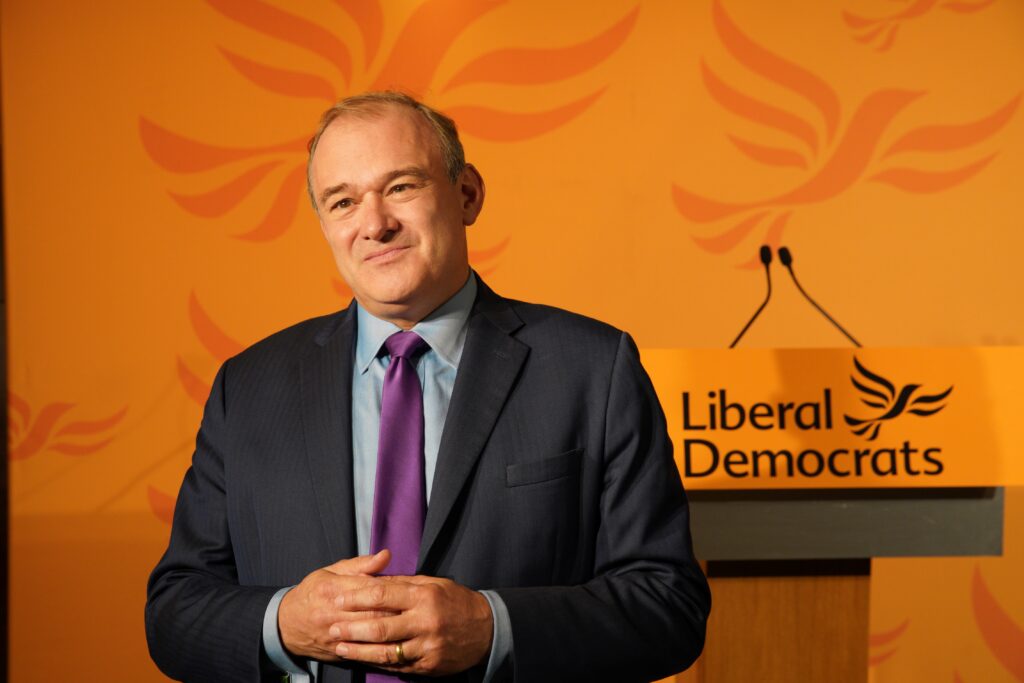
On 27 August 2020, Ed Davey was elected leader of the Liberal Democrats, securing a comfortable victory over his rival, Layla Moran. Davey, the MP for Kingston and Surbiton and a former energy secretary, won 42,756 votes (63.5%) to Moran’s 24,564 (36.5%).
The vacancy was created by Jo Swinson’s resignation as Liberal Democrat leader. She had led her party into the 2019 election campaign to disastrous effect; having styled herself as a prospective prime minister, Swinson ultimately lost her seat. The Liberal Democrat constitution requires the party leader to be a serving MP.
The Liberal Democrats returned a meagre 11 MPs at the 2019 election.
The party had accrued 21 MPs by the end of the 2017-2019 parliament after a series of defections from both the Labour and Conservative parties (including via Change UK). However, the public did not respond to the party’s unequivocal “revoke” (Article 50) position on Brexit, the campaign’s principal issue.
The official Liberal Democrat review into the party’s 2019 campaign described it as “a high-speed car crash”. The “revoke” position, the review held, meant the party “effectively ignored” the biggest group of voters, namely those who were neither fervently Remain or Leave.
Davey praised the report, declaring that in future the party should be “rooted in our communities, putting the interest of our communities first”.
***
The 2020 Liberal Democrat leadership contest was long-delayed by the Covid-19 pandemic.
From December 2019 to January 2020, Davey served alongside Baroness Brinton as acting co-leaders of the Liberal Democrats. The Lib Dem constitution states that, when the leader loses their seat, the party’s deputy leader and president automatically become caretaker co-leaders. Davey was appointed deputy leader in September 2019, having been defeated by Swinson in the recent leadership contest.
Launching his candidacy for the 2020 leadership election, Davey argued that his experience as a carer meant he had a personal stake in the sector amidst Covid-19.
He told the Guardian: “I feel huge empathy with those people who are carers, and who need that care.
“It’s not acceptable for people who are doing the toughest of jobs, either unpaid at home for their loved ones, or in our care homes or in domiciliary care, to be treated in the way they’ve been treated for so long.
“That would be a very big part of what I’d like to see the Liberal Democrats talking about – how we build a more caring society. And if we can make common cause with others for a caring agenda, I’d like to do that.”
Daisy Cooper, the newly elected Lib Dem MP for St Albans, was among those who considered running for the leadership. However, she ultimately declined to stand. In a statement published to social media in May 2020, she commented: “I’m flattered by the messages from Liberal Democrat members and supporters asking me to stand in the leadership election.
“My decision on whether to stand was always going to depend on the timing and as the contest has been brought forward to this summer, l’ve decided that, right now, this isn’t the right time for me.”
https://x.com/libdemdaisy/status/1264156160212570114
(Cooper was subsequently chosen by the Lib Dem parliamentary group to serve as the party’s deputy leader.)
In February 2020, Wera Hobhouse announced she would be standing for the leadership. In an article for The House magazine, Hobhouse called for her party to make a “clean break with the last decade”.
She argued that the Lib Dems “shot ourselves in the foot” in the 2019 general election by attacking the Labour Party instead of focusing exclusively on the Conservatives.
She contended that, as a party of the “centre-left”, the Liberal Democrats’ main opponent should always be the Conservatives, and that attacking a fellow progressive party was a strategic error.
She wrote: “The mistake was to see our party in the political centre, standing equally between right and left. In this day and age, the biggest threat to liberalism – not just in Britain – comes from the right.
“Our reasons for entering coalition with the Conservatives in 2010 were well intended, but we ended up undermining our values. We ultimately legitimised the Conservatives’ long-term illiberal, nationalist agenda.”
Notably, Hobhouse ran against the concept that the Liberal Democrats should be ideologically and politically “equidistant” between the United Kingdom’s two major political parties.
In an article for Lib Dem Voice, published 13 June, Hobhouse insisted that her party should “let go of the coalition.”
It was a comment that was interpreted as a rebuke of Davey’s candidacy.
Davey was the only candidate who had served in the Conservative-Liberal Democrat coalition. He attended cabinet as secretary of state for energy and climate change from 2012 to 2015.
***
Davey’s main rival, Layla Moran, was considered to be the more left-wing of the two final candidates. Like Hobhouse, she did not serve in the Conservative-Liberal Democrat coalition. On 23 June, Hobhouse withdrew from the contest and declared her support for Moran.
Hobhouse described Moran as “the only candidate who can break with our party’s damaging legacy from the coalition and adopt a centre-left position to defeat the Conservatives at the next election.”
Moran was backed by a total of three MPs, namely Hobhouse, Wendy Chamberlain and Jamie Stone.
Davey won the support of fellow MPs Tim Farron (Lib Dem leader from 2015 to 2017), Daisy Cooper, Christine Jardine, Sarah Olney, and Munira Wilson. He was also backed by Lib Dem peer Menzies Campbell, who led the party from 2006 to 2007, and Jim Wallace, the former deputy first minister of Scotland.
During the campaign, Davey’s supporters signed a letter praising his “experience, vision and judgement”.
The letter stated: “Ed has presented a clear, coherent vision for the future of the party that stands for a fairer, greener, more caring country. A country where we give universal free childcare to parents, where we invest £150bn in green jobs and renewable homes and where we give the 10 million carers in the UK a new, better deal.”
In his victory speech, Davey stated that the Liberal Democrats need to “wake up and smell the coffee”.
He said the party “must change” after losing touch with “too many voters”.
Davey declared: “I stand for all the things the Liberal Democrats stand for. Social justice, political reform, equality and protecting our environment. I stand for fairness and for fighting to protect the rights of ordinary people.
“I’m determined our party backs a Britain that works with other countries across the world for peace and prosperity. But it is my love of our party that makes me recognise that we have to change.”
He added: “Nationally, voters have been sending us a message. But we have not been listening. It is time for us to start listening. As leader I am telling you: I have got that message. I am listening now.”
He also paid tribute to Moran’s “passionate campaign”.
***
Davey led his party into the 2024 general election – and emerged as the most electorally successful Liberal since David Lloyd George.
The Liberal Democrats increased its representation to 72 seats – a notional net gain of 64.
Davey’s campaign gained widespread media attention for a series of water-themed stunts. These included repeatedly falling off a paddleboard in Windermere to highlight sewage discharge, going down a large water slide to draw attention to children’s mental health, and undertaking a bungee jump in Eastbourne.
Defending his unconventional campaign, Davey said: “Politicians need to take the concerns and interests of voters seriously but I’m not sure they need to take themselves seriously all the time and I’m quite happy to have some fun”.

Politics.co.uk Newsletters
DAILY
Politics@Lunch
WEEKLY
Week in Review