Boris Johnson’s Conservative Party wins historic 80-seat majority
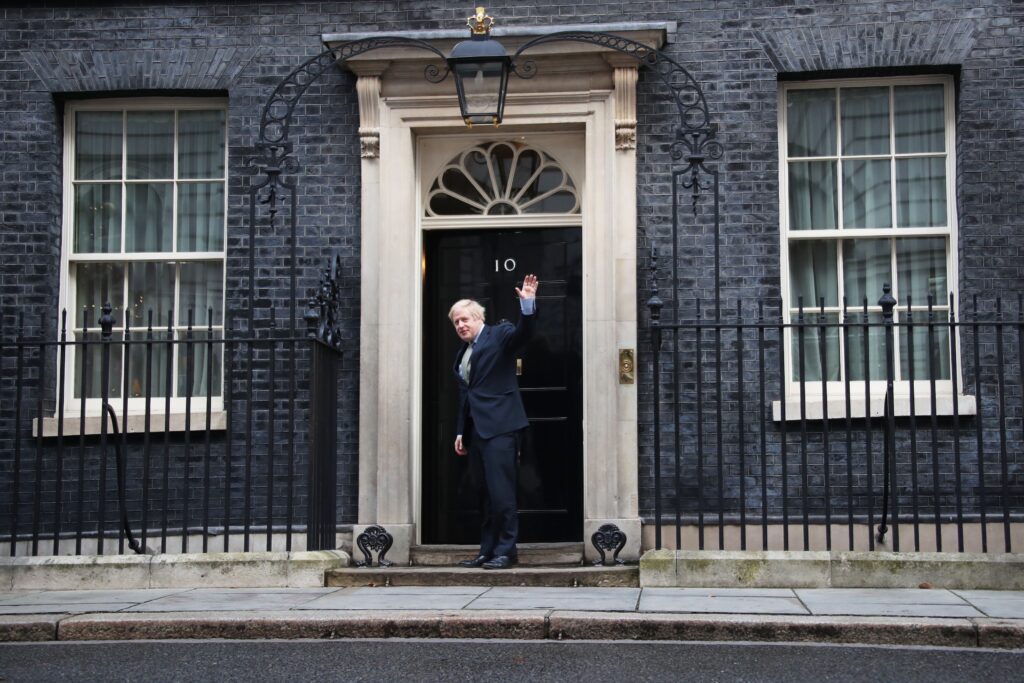
The Conservative Party won a landslide victory in the general election held on 12 December 2019, securing 365 seats and a parliamentary majority of 80. It marked the party’s best result since 1987 and the highest share of the popular vote (43.6%) for any party since 1979.
The result broke the parliamentary deadlock that had paralysed Westminster since the 2017 general election. Prime minister Boris Johnson won a mandate to, in the words of his campaign slogan, “Get Brexit Done”.
The election was the finale to the most turbulent period in recent British parliamentary history. Johnson had succeeded Theresa May in July 2019, inheriting a minority government that relied on support from the Democratic Unionist Party (DUP). The House of Commons had voted on three separate occasions to block May’s withdrawal agreement, which Johnson promised to re-negotiate. The commons constituted by the 2017 election also possessed a majority that was opposed to attempts to deliver a “no deal” Brexit.
***
During the 2019 Conservative leadership election, Johnson spelled out his strategy to force an exit on 31 October “do or die”. This approach inevitably invited resistance in the House of Commons. On 3 September, a rebel alliance of cross-party MPs seized control of the commons order paper to pass the European Union (Withdrawal) (No. 6) Act – known as the Benn Act – which legally compelled the prime minister to seek an extension if no deal was reached.
Johnson responded by withdrawing the whip from 21 Conservative rebels. He controversially referred to the Benn Act as the “Surrender Act”.
The Benn Act was passed shortly after Johnson plunged the commons into further crisis by proposing a five-week prorogation of parliament. On 24 September, the supreme court unanimously ruled the prorogation unlawful and “void and of no effect.”
The prime minister declared he would “rather be dead in a ditch” than ask Brussels for a delay. However, he complied with the terms of the Benn Act on 19 October and an extension was agreed until 31 January 2020.
During this period, the government indicated its desire to break the deadlock with a general election. It tried three times to call an election under the terms of the Fixed-term Parliaments Act, but failed on each occasion to secure the required two-thirds majority of the total membership of the commons.
Finally, Johnson tabled a one-line bill to circumvent the FTPA. The Early Parliamentary General Election Act 2019 passed the House of Commons by 438 votes to 20 on 29 October. This set the stage for the first December election since 1923.
***
The Conservative 2019 election campaign was defined by the relentless repetition of the slogan “Get Brexit Done” – an attempt to exploit widespread Brexit fatigue. The party targeted the so-called “red wall” of traditional Labour seats in the Midlands and North, which had supported ‘Leave’ during the 2016 Brexit referendum.
The Conservative Party’s strategy, masterminded by Dominic Cummings and Isaac Levido, was devastatingly effective. The Tories gained 48 seats, toppling supposed Labour strongholds such as Bishop Auckland (Conservative for the first time in 134 years), Blyth Valley, Workington, and Great Grimsby.
Labour, led by Jeremy Corbyn, suffered its worst defeat in terms of seats since 1935. The party returned just 202 MPs.
Labour went into the election with a promise to re-negotiate the Brexit deal, before putting it to a public vote – a second referendum – which the party would observe neutrally.
The party’s manifesto, It’s Time For Real Change, contained a series of radical policies. It featured pledges to nationalise energy, water, rail and broadband.
The manifesto stated: “We will bring rail, mail, water and energy into public ownership to end the great privatisation rip-off and save you money on your fares and bills…
“We will deliver full-fibre broadband free to everybody in every home in our country by creating a new public service, boosting the economy, connecting communities and putting money back in your pocket.”
The Liberal Democrats ran a catastrophic campaign that resulted in the party’s leader, Jo Swinson, losing her seat in East Dunbartonshire to the Scottish National Party (SNP). Swinson had begun the campaign by declaring herself a candidate for prime minister. The party vowed to revoke Article 50 without a referendum if it won a majority.
Swinson lost her seat as the Liberal Democrats returned just 11 MPs. The party had accrued 21 MPs by the end of the 2017-2019 parliament after a series of defections from both the Labour and Conservative parties (including via Change UK).
The Brexit Party, led by Nigel Farage, won zero seats but played a crucial role in the campaign. The newly established party had been a pivotal factor in persuading the Conservative Party to force Theresa May’s resignation earlier that year. Moreover, in the wake of the 2019 European Parliament elections, Farage vowed to stand Brexit Party candidates at a future general election.
On 1 November, launching the Brexit Party’s campaign, Farage called on Johnson to “build a leave alliance” and drop his renegotiated deal with the EU. Otherwise, he said, the Brexit Party would “contest every single seat in England, Scotland and Wales.”
But on 11 November, Farage announced that the Brexit Party would stand down its candidates in the 317 constituencies won by the Conservatives at the 2017 general election. The decision came amid fears that Farage’s party could split the pro-Brexit vote. Farage had previously announced that he would not stand at the general election, saying he could “serve the cause better” campaigning across the country.
Johnson welcomed the decision, saying that there was “only one way to get Brexit done and that is to vote [Conservative].”
John McDonnell, the shadow chancellor, said he did not think “the electorate like these kind of backroom deals.”
In total, the Brexit Party stood 275 candidates and won 2.0% of the total vote. Reacting to the general election result, a Conservative majority of 80 seats, Farage said: “This victory for Boris was hugely helped by us and is far better than the Marxist Corbyn and a second referendum.”
In Scotland, the SNP secured 48 out of 59 seats, with the party increasing its vote share to 45%. The result fuelled demands, including from first minister Nicola Sturgeon, for a second independence referendum.
In Northern Ireland, for the first time in history, nationalist MPs (SDLP and Sinn Féin) outnumbered unionist MPs.
The campaign also contained some notable controversies relating to disinformation. The Conservatives were criticised for rebranding their press office Twitter (now X) account as “factcheckUK” during a televised debate and for releasing a video of Labour’s Keir Starmer that was edited to make him appear unable to answer a question.
Broadcaster Channel 4 replaced Johnson with a melting ice sculpture when he refused to attend a debate specifically on climate change.
***
Jeremy Corbyn, speaking at his constituency election count in Islington, announced that he would not lead Labour into the next general election and subsequently announced a timetable for the election of a new leader.
Corbyn said Labour had put forward a “manifesto of hope” and criticised the “way the media behaved” towards his party during the campaign.
He added: “Brexit has so polarised and divided debate in this country, it has overridden so much of a normal political debate. I recognise that has contributed to the results that the Labour Party has received this evening all across this country.”
The party’s Brexit strategy came in for considerable criticism in the aftermath of the election. Ian Lavery, the Labour chair, said its traditional voters believed it was “a Remain party”.
Corbyn’s post-election comments also came in for criticism among Labour MPs. Margaret Hodge, a longstanding internal opponent of the Labour leader, posted to social media: “Corbyn talking about a period of ‘reflection’. I’ve reflected. You failed. Please stand down.”
Lucy Powell, a former frontbencher, said she thought “we need to hear a bit more contrition and humility, not just from Jeremy, but from across the party as well”.
Sadiq Khan, the Labour mayor of London, called on Corbyn to stand down “quickly” calling the election result “nothing short of a catastrophe for the Labour party, for London and for the United Kingdom”.
https://x.com/sadiqkhan/status/1205490191793901568
A post-mortem report by Labour Together found that by September 2019, 67% of voters disliked Corbyn, with only 12% viewing him favourably.
In the leadership contest that followed, Keir Starmer was elected with 56.2% in the first round.
The official Liberal Democrat review into the party’s 2019 campaign described it as “a high-speed car crash”. The “revoke” position, the review held, meant the party “effectively ignored” the biggest group of voters – those who were neither fervently remain or leave. In August 2020, Sir Ed Davey was elected as the new leader of the Liberal Democrats, securing a comfortable victory over his rival, Layla Moran.
Johnson addressed the nation at 7:00 am on 13 December. He said that the “irrefutable, irresistible, unarguable decision of the British people” had settled the Brexit question.
He thanked Labour voters, many of whom, he said, had backed the Conservatives for the first time.
Johnson vowed to fulfil the “sacred trust” placed in him, adding: “You may intend to return to Labour next time round, and if that is the case, I am humbled that you have put your trust in me, and I will never take your support for granted”.
He vowed to get Brexit done by 31 January “no ifs, no buts, no maybes”.
He continued: “I frankly urge everyone on either side of what was, after three and a half years, after all an increasingly arid argument, to find closure and to let the healing begin.”
In a call with Sturgeon, Johnson reiterated “his unwavering commitment to strengthening the union.”
The victory ultimately led to the passage of Johnson’s Withdrawal Agreement Act and the UK’s formal departure from the EU on 31 January 2020.
Politics.co.uk Newsletters
DAILY
Politics@Lunch
WEEKLY
Week in Review