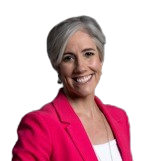
Daisy Cooper is the Liberal Democrat MP for St Albans, and was first elected at the 2019 general election. She gained the seat from the Conservative Party, becoming the first Liberal or Liberal Democrat MP for St Albans since 1904.
Cooper currently serves as the deputy leader of the Liberal Democrats and the party’s Treasury spokesperson.
In the 2024 general election, Cooper won 29,222 votes, representing 56.6% of the vote. The Conservative candidate, James Spencer, received 9,388 votes (18.2%), while the Labour candidate, Sophia Bhatti, secured 5,189 votes (10.1%). Daisy Cooper was duly elected with a majority of 19,834 votes.
The St Albans constituency covers the wealthy cathedral city and surrounding areas in Hertfordshire. While historically often held by the Conservatives, the seat was won by Labour in 1945, 1997 and 2001. It was Conservative from 2005 until Cooper’s victory for the Liberal Democrats in 2019.
Political Career
Cooper serves on the Liberal Democrat frontbench as deputy leader and treasury spokesperson. She has served as deputy leader since September 2020 and Treasury spokesperson since September 2024.
Previously, Cooper held spokesperson roles covering health, wellbeing and social care from (October 2021 – September 2024), education (September 2020 – October 2021), justice (January – September 2020), and digital, culture, media and sport (January – September 2020).
Cooper considered running for the leadership of the Liberal Democrats in 2020, mere months after her election as an MP for the first time. However, she ultimately declined to stand. In a statement published to social media in May 2020, she commented: “I’m flattered by the messages from Liberal Democrat members and supporters asking me to stand in the leadership election.
“My decision on whether to stand was always going to depend on the timing and as the contest has been brought forward to this summer, l’ve decided that, right now, this isn’t the right time for me.”
https://x.com/libdemdaisy/status/1264156160212570114
Cooper was subsequently chosen by the Lib Dem parliamentary group, then composed of 11 MPs, to serve as the party’s deputy leader.
Upon becoming deputy leader, Cooper outlined that the Liberal Democrats should woo “soft conservatives” repulsed by the “thuggish” values allegedly expressed by then-prime minister Boris Johnson and his chief adviser Dominic Cummings.
She told the Independent: “I think the Tory party has been moved so far to the right that there are swathes of ‘soft conservatives’ in the country who don’t see the current party under Boris Johnson as representing anything like their views and their values whatsoever.”
She added: “And I don’t think it’s just on rule of law issues. It is this kind of thuggish behaviour around giving contracts to their mates, threatening the independence of the judiciary, the double standards emanating from Dominic Cummings, the mixed messaging, the chaos that we’re getting week in week out, the staggering incompetence.”
In the 2021-22 session, Cooper introduced a bill under the 10-minute rule procedure calling for an independent public inquiry into the government’s response to concerns about fire and building safety.
Cooper has also introduced bills seeking to ensure the provision of safe and secure accommodation for all women leaving prison (Women Leaving Prison (Safe Accommodation) Bill 2021-22); ensure equal access to maternity services for people living in rural and coastal areas to those living in other areas (Maternity Services (Rural Areas) Bill 2021-22); and require ambulance services to provide more accessible and localised reports of response times (Ambulance Waiting Times (Local Reporting) Bill 2021-22).
Cooper delivered her maiden speech on 13 January 2020 during a debate on Britain in the world. She said: “From martyrdom to Magna Carta and the uprising of Iceni’s Boudicca, St Albans has a timeless tradition of being at the heart of our country’s fights for greater democracy, liberties and freedoms.”
She added: “Close international collaboration and alliance between Britain and our international cousins is essential if we are to tackle the biggest threat of all: the climate crisis…
“We believe we should work with our closest international neighbours to tackle the global climate crisis. We believe in our responsibility to take in those fleeing persecution and war, as Alban himself did and as St Albans has continued to do, taking in children and families from 1940s London to 21st-century Syria.”
Prior to entering parliament, Cooper stood unsuccessfully for the position of president of the Liberal Democrats in 2014. She came second to Sal Brinton.
Cooper also unsuccessfully contested the St Albans seat in 2017, Mid Sussex in 2015, and Suffolk Coastal in 2010. She finished second (32.4%), fourth (11.5%) and second (29.8%) respectively. In her first contest in Suffolk Coastal, Cooper was bested by Conservative candidate Thérèse Coffey, who would go on to serve as deputy prime minister under Liz Truss.
Cooper served as a Liberal Democrat councillor on Lewes District Council in Sussex from 2015 to 2016.
Within the Liberal Democrats, Cooper is reported to have been a driving force behind the “One Member One Vote” internal policy, as well as measures to improve diversity in the party’s candidates.
In an article for Liberal Democrat Voice, published 2015, Cooper said her 2014 run for party president had been on a platform of “party reform, with a focus on diversity.”
She added: “Now that all eight of our remaining MPs are white, middle-aged, middle class men, that reform agenda is even more important than before.”
She went on to call for the party’s then leadership candidates, Tim Farron and Norman Lamb, to commit to a series of measures focused on promoting diversity within the Lib Dems.
Cooper was previously an elected member of the Liberal Democrats’ diversity engagement group and a member of the party executive.
Political views
In her capacity as Treasury spokesperson, Cooper has led the Liberal Democrats in responding to the government’s economic and fiscal policies since 2024. In an article for the New Statesman, published November 2024 after the Labour Party’s first budget in office, Cooper outlined a series of alternative measures that she claimed would fuel economic growth.
She wrote: “The changes to employer’s national insurance – an increase in the rate and a lowering of the threshold – could be the straw that breaks the camel’s back.
“For all of the chancellor’s assurances that the very smallest firms will be shielded, nearly a million businesses will pay thousands more in tax, including many SMEs [small and medium-sized enterprises].”
She added: “The chancellor should have looked for answers to economic growth that lie beyond our borders: beginning to fix our broken relationship with Europe.
“Reams of red tape and countless trade barriers erected by the Conservatives are costing the UK investment, jobs and tax revenue.”
In early 2026, Cooper proposed a plan to abolish the Treasury and replace it with a new “Department for Growth” based in Birmingham.
Cooper endorsed Sir Ed Davey’s candidacy in the 2020 Lib Dem leadership election. That was seen as a setback for Davey’s rival, Layla Moran, who like Cooper was considered to be more on the left of the party.
In her statement addressing speculation she would run for leader in May 2020, Cooper said: “All Liberal Democrat members have an important role to play in protecting our open, internationalist, and egalitarian values and to fight against the rise of ‘illiberal democracy’ at home and abroad. I will certainly be playing my part.”
Before becoming an MP, Cooper reportedly ran the successful 2019 Liberal Democrat leadership campaign of Jo Swinson.
Brexit and Europe
Cooper voted Remain in the 2016 referendum on Britain’s membership of the European Union (EU). In the 2019 general election, she stood on a manifesto that pledged to revoke Article 50 and cancel Brexit.
Customs union vote (2025): In December 2025, Cooper voted in favour of the UK-EU Customs Union (Duty to Negotiate) Bill. The bill, introduced under the 10-minute rule procedure by Liberal Democrat Europe spokesperson Al Pinkerton, sought to mandate the government to enter into negotiations with the European Union to establish a bespoke customs union. In total, 13 Labour MPs joined the Liberal Democrats in supporting the motion, while the majority of the party abstained.
Electoral reform
Proportional representation bill: In December 2024, Cooper voted in favour of the Elections (Proportional Representation) Bill – introduced by Liberal Democrat frontbencher Sarah Olney under the 10-minute rule procedure. The bill sought to “introduce a system of proportional representation for parliamentary elections and for local government elections in England”.
A total of 138 MPs supported the bill – with 136 opposed. Notably, 59 Labour MPs backed Olney’s bill.
Introducing the bill, Olney told the House: “First past the post is a broken and unfair system. This summer, the Labour party won a landslide election victory, securing 63% of seats in the House of Commons in return for just 34% of the vote.
“The system leaves millions of voices unheard and creates a divisive, adversarial political climate where collaboration is discouraged and accountability is often sidestepped.”
Assisted dying
Cooper voted in favour of the Terminally Ill Adults (End of Life) Bill, better known as the assisted dying bill, at both second reading (November 2024) and third reading (June 2025).
In an open letter to constituents, issued November 2024, Cooper expressed cautious support dependent on robust safeguards, particularly regarding mental capacity assessments, and voted in favour of the Bill proceeding.
In the statement, she said: “Having researched this issue, I have concluded that it is not an ‘either or’ question. Some (albeit not all) jurisdictions that have introduced a form of assisted dying have seen their palliative care improve.
“And just in the last few weeks, I’ve been struck by the fact that the issue of good palliative care – which has been long ignored here in the UK – is now finally being spoken about and perhaps finally getting just some of the attention it deserves.”
She added: “I have also read and heard powerful testimony about people who died in deeply traumatic and undignified circumstances where palliative care could only do so much: whilst it reduced pain it could not ultimately stop the mechanical cause of death.”
Palestine
Palestinian recognition letter (July 2025): In July 2025, Cooper was among the over 254 MPs to sign a cross-party letter calling for the government to immediately recognise the state of Palestine. The letter called on the prime minister and foreign secretary to recognise Palestine at the UN Conference then taking place in New York.
Ceasefire vote (November 2023): Cooper voted for a Scottish National Party (SNP) amendment to the king’s speech in the House of Commons calling for an “immediate ceasefire” in the Israel-Hamas war. Labour had tabled a rival motion, making a more moderate appeal for a “humanitarian pause” in the conflict.
Social values and conscience issues
Abortion decriminalisation (2025): Cooper voted in favour of a backbench amendment to the Crime and Policing Bill that sought to decriminalise abortion in England and Wales in June 2025. The amendment, which was passed by a majority of 242 votes, removed women from the threat of prosecution for ending a pregnancy at any stage. As an issue of conscience, MPs were allowed to vote according to their personal beliefs.
Civil liberties
Covid passes campaign (2021): Cooper was one of over 70 MPs and peers who launched a cross-party campaign against the “divisive and discriminatory use” of Covid passes in April 2021. The campaign was triggered by government reviews into “vaccine passports”, which signatories argued would create a two-tier society and infringe upon fundamental civil liberties.
Covid passes vote (2021): Cooper was one of 126 MPs to vote against Covid passes in England in December 2021. The measure, introduced by Boris Johnson’s government, was carried by 369 votes to 126.
Before Politics
Born on 29 October 1981 in Bury St Edmunds, Suffolk, Daisy Cooper was educated at state schools in Suffolk before attending Framlingham College.
She studied Law (LLB) at the University of Leeds, followed by a master’s degree (LLM) in public international law at the University of Nottingham.
She also holds qualifications in psychotherapy and counselling, and mediation.
Before entering parliament, Cooper worked for organisations including the Commonwealth Secretariat, the Institute of Commonwealth Studies, and Voluntary Service Overseas (VSO).
She was campaigns director for the cross-party group More United and also worked for Hacked Off, the campaign set up in the wake of the phone hacking scandal which campaigns for press regulation reform.
She founded and runs an independent local rail users’ campaign group.
Personal Life
Daisy Cooper is married, her husband works as a data scientist. The couple live together with their two cats.
Cooper revealed at the 2024 Liberal Democrat conference that she has Crohn’s disease. She said she was told 12-years ago that “without major surgery I had just four days left to live. My weight had dropped to around seven stone, my eyesight was failing.”
She added: “I sobbed and I sobbed and I sobbed for 17 hours straight. It felt like my world had fallen apart. As a campaigner, I have always found my meaning and purpose in my work.
“As is the case with so many millions of people, the NHS didn’t just save my life, the people who make our NHS what it is gave me my life back.”
Trivia
Cooper plays both violin and piano.
She is the first ever Liberal Democrat elected as the MP for St Albans. A Liberal MP, John Slack, represented the seat from 1904 to 1906.
Cooper was named “Pub Parliamentarian of the Year” in 2024 by the APPG for beer. In her 2019 maiden speech, the new MP said her constituency of St Albans “has more pubs per square mile than any other place in Great Britain”.
Stewart McDonald, then the Scottish National Party (SNP) MP for Glasgow South, responded: “Let’s all head to St Albans.”
Cooper added: “The war of the roses started on the doorstep of The Boot, and Oliver Cromwell stayed the night at the inn now known as Ye Olde Fighting Cocks. [But] these two pubs and many more in St Albans and around the country are under threat like never before.”
Upon her election to parliament in 2019, Cooper was highlighted as one of the new MPs to watch by the Guardian.
Daisy Cooper has not written for Politics.co.uk.