MPs back post-Brexit deal after emergency recall
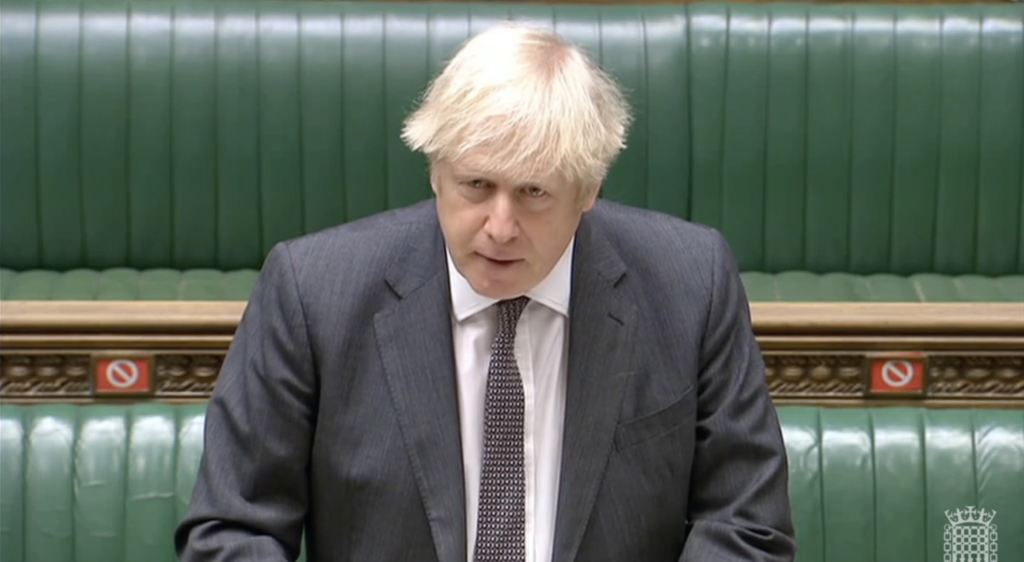
On 30 December 2020, with just 24 hours remaining before the end of the post-Brexit transition period, the House of Commons was recalled from its Christmas recess to approve the European Union (Future Relationship) Bill.
Legislation was required to implement the Trade and Cooperation Agreement (TCA), which had been agreed between the UK and the European Union (EU) on Christmas Eve. The timing of the vote meant there was little time for detailed scrutiny or amendment. MPs, faced with a choice of approving the deal or face a chaotic ‘no deal’ departure at 11pm the following day, overwhelmingly supported the bill by 521 votes to 73.
The legislation received royal assent just after midnight on 31 December.
***
Following the 2016 referendum and the formal withdrawal on 31 January 2020, the UK had remained within the EU’s single market and customs union under a transition period. The TCA, negotiated by Michel Barnier, representing the EU, and David Frost, for the UK, was finally announced on 24 December.
Boris Johnson, the prime minister, claimed the TCA would allow the UK “to take back control of our laws, borders, money, trade and fisheries”. Nigel Farage, the Brexit Party leader, paid tribute to Johnson as “the man that finished the job.”
In an article for the Daily Telegraph, he wrote: “On the big stuff, the war is over.”
The legislation granted ministers sweeping delegated powers (or Henry VIII powers) to amend domestic legislation via statutory instruments to give effect to the deal reached with the EU. The bill’s explanatory notes said it would create powers “to make secondary legislation, where appropriate, to enable the agreements to be implemented domestically or for domestic law to be interpreted in light of the agreement”.
The House of Lords delegated powers and regulatory reform committee later described section 31 of the bill/act as an “exceedingly wide Henry VIII power” that allowed ministers to make regulations they considered appropriate to implement the agreements.
Clause 31 of the bill provided “relevant national authorities” with the power to make regulations that it considered necessary to implement the TCA or “any relevant agreement”.
The Hansard Society described it as “a framework – or skeleton – bill, in which broad delegated powers are conferred on Ministers in the absence of policy detail.”
The 80-page bill was published by the government shortly before 2:00 pm on 29 December – less than 24 hours before parliament started to debate its contents. In order to secure its swift passage, section 36 of the bill disapplied the Constitutional Reform and Governance Act 2010 (CRAG). The 2010 act brought the ‘Ponsonby Rule’ onto a statutory footing, requiring a 21-day period to give parliament the opportunity to scrutinise and potentially delay treaties.
***
Lindsay Hoyle, the speaker of the House of Commons, began the session on 30 December 2020 by way of thanking those staff members who had worked through the holidays. Hoyle said that his own office had been working “very late Christmas eve, Boxing day and all the way through.”
Due to the pandemic, the speaker announced a “return to virtual participation”. It came after Westminster moved into Tier 4 Coronavirus restrictions, the highest level.
Hoyle said: “I should inform honourable members that when a speaking limit is in effect for backbenchers, a countdown clock will be visible on the screens of honourable members participating virtually and on the screens in the chamber.”
The leader of the House, Jacob Rees-Mogg, then moved a programme motion to fast-track all stages of the bill through the commons in a single day.
Rees-Mogg defended the expedited schedule as a necessary measure to meet international obligations. He described the bill as “merely the final little bit of icing being put on the Christmas cake that the prime minister so efficiently delivered for the nation.”
Valerie Vaz, the shadow leader of the House, supported the motion to prevent a no-deal scenario but labelled the lack of scrutiny as “unacceptable.”
Patrick Grady of the Scottish National Party (SNP) moved an amendment to extend the debate. He told the House: “Brexit is diminishing the UK’s role in the world, and this programme motion diminishes the role of Parliament in the UK.”
Grady’s amendment was defeated by 362 votes to 60. One Conservative MP, William Wragg, rebelled and backed the amendment.
***
Johnson, moving the second reading, declared that the deal allowed the UK to forge a relationship with neighbours based on “free trade and friendly co-operation.” He promised that exporters would face “zero tariffs and zero quotas”.
He told the House: “The central purpose of the bill is to accomplish something that the British people always knew in their hearts could be done, yet which we were continually told was impossible – we were told that we could not have our cake and eat it.”
Johnson argued the treaty banished “old concepts of uniformity and harmonisation” and ensured that British laws would be interpreted “solely by British judges sitting in British courts.”
He claimed the bill facilitated a “comprehensive Canada-style deal worth over £660 billion.”
The prime minister concluded: “What we wanted was not a rupture but a resolution – a resolution of the old, tired, vexed question of Britain’s political relations with Europe, which has bedevilled our post-war history.”
The leader of the opposition, Keir Starmer, confirmed Labour would support the bill to avoid the “avalanche of checks, bureaucracy and red tape” associated with a no deal scenario.
He criticised the agreement as “thin”, but added: “A thin deal is better than no deal, and not implementing this deal would mean immediate tariffs and quotas with the EU, which would push up prices and drive businesses to the wall.”
Starmer said Johnson’s claim that there would be no non-tariff barriers was “plain wrong”.
The Labour leader said: “It is somewhat ironic that for years the Conservative party has railed against EU bureaucracy, but this treaty imposes far more red tape on British businesses.”
Ian Blackford, the SNP leader, denounced the deal as “economic vandalism, pure and simple.”
Sammy Wilson of the Democratic Unionist Party (DUP) stated that his “euphoria” at leaving the EU was “tinged with sadness”, because the agreement would not apply equally in the United Kingdom as a whole.
Theresa May, the former prime minister, argued that while sovereignty had underpinned negotiations, it should not mean “isolationism” or “exceptionalism”.
She said it was time “to put aside personal and party political interests, which sadly too many have followed in the past, to vote in the interests of the whole UK and to support this bill.”
Bill Cash, a veteran Conservative eurosceptic and member of the hardline European Research Group (ERG), compared Boris Johnson to Pericles and Alexander the Great. He argued the prime minister had “cut the Gordian knot”, delivering the nation from “48 years of subjugation to EU laws.”
He added: “Churchill and Margaret Thatcher would have been deeply proud of his achievements, and so are we.”
Winding up the debate for the Labour party, the shadow chancellor of the Duchy of Lancaster, Rachel Reeves, said: “The alternative, the chaos of no deal, is not something any responsible government could facilitate – and neither could a responsible government-in-waiting.”
The bill received its commons second reading at 2.30 pm by 521 votes to 73.
The Labour leadership had imposed a three-line whip, directing its MPs to vote for the legislation.
One Labour MP, Bell Ribeiro-Addy, voted against the proposed legislation – but several more defied the whip and abstained. In total, 36 Labour MPs abstained – including some frontbenchers who were forced to resign their positions.
Tonia Antoniazzi, Helen Hayes and Florence Eshalomi resigned from their roles to abstain over the European Union (Future Relationship) Bill.
The SNP, the Liberal Democrats, Plaid Cymru and all sitting Northern Ireland parties voted against the bill.
The bill was then subjected to its committee stage, comprising the whole House, that lasted four minutes. Eleanor Laing, the deputy speaker, referred to the “unusual circumstances” and clarified that MPs could only reject or pass the bill in its entirety.
Laing dismissed a point of order from SNP David Linden, who asked: “Can you verify the last time that a committee of the whole House sat for a mammoth four minutes?”
The bill passed its third reading by the same margin as its second – 521 votes to 73.
***
In the Lords, Baroness Evans of Bowes Park, the leader of the House, described the bill as the opening of a “new chapter for our country.”
Baroness Hayter, a Labour peer, was among those who condemned the limited scrutiny afford to the bill. She said: “Never again should we stumble into a profound shift in our international, security and trading relationships without full debate of the options and the paths to be taken.”
Lord Judge, the convenor of the crossbench peers, argued the legislation represented an “unwanted tendency… of the executive to command, and to expect to command, the legislative process, rather than to defer to it.”
Lord Anderson, a crossbench peer, described it as an “essay crisis bill” and condemned the “exorbitant” Henry VIII powers.
He declared: “Henry VIII has been on the steroids again.”
The European Union (Future Relationship) bill achieved its final passage at 11.34 pm in the Lords.
It received royal assent as the European Union (Future Relationship) Act 2020 at 12.25 am on 31 December.
Britain completed its separation from the EU at 11:00 pm on 31 December as the transition period came to an end, four and half years after the 2016 referendum.
In its March 2025 forecast, the Office for Budget Responsibility (OBR) stated that the “post-Brexit trading relationship between the UK and EU, as set out in the ‘Trade and Cooperation Agreement’ (TCA) that came into effect on 1 January 2021, will reduce long-run productivity by 4% relative to remaining in the EU.”
It added: “Both exports and imports will be around 15% lower in the long run than if the UK had remained in the EU.”

Politics.co.uk Newsletters
DAILY
Politics@Lunch
WEEKLY
Week in Review
