Tory MPs vote to end Lloyd George coalition at Carlton Club
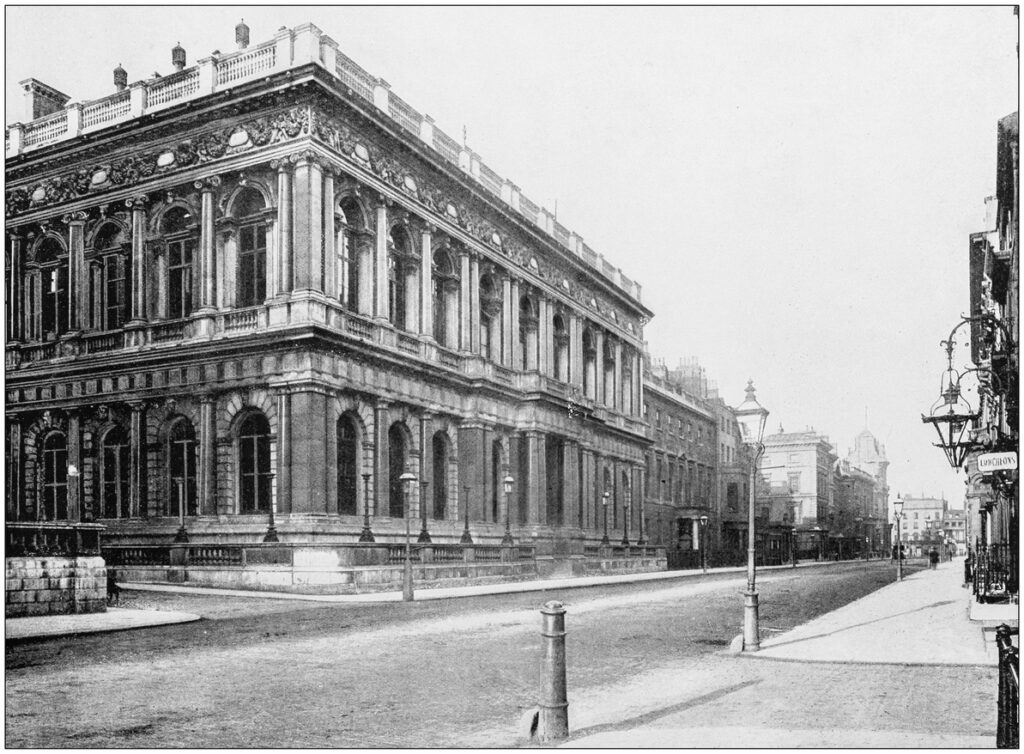
On 19 October 1922, Conservative MPs assembled at the Carlton Club in Pall Mall and voted to fight the next general election as an independent party. The result marked the end of David Lloyd George’s coalition government and forced the resignation of Austen Chamberlain as party leader, restoring Bonar Law to the leadership and precipitating his appointment as prime minister.
The meeting began at 11:00 am at 94 Pall Mall with at least 286 MPs in attendance.
The central motion, moved by E.G. Pretyman and seconded by George Lane-Fox, stated: “That this meeting of Conservative members of the House of Commons declares its opinion that the Conservative Party, whilst willing to cooperate with Coalition Liberals, fights the election as an independent party, with its own leader and its own programme.”
Voting was conducted by cards marked with each member’s name.
The overwhelming outcome brought about the deposition of Lloyd George, who drove to Buckingham Palace that afternoon to resign, and reshaped the face of the Conservative Party for a generation.
***
The Lloyd George coalition assumed power in December 1916 after a combination of senior government figures turned on the incumbent prime minister, H.H. Asquith. The move against Asquith, orchestrated by Lloyd George as secretary of state for war, Bonar Law as colonial secretary, and Sir Edward Carson, the leading Irish Unionist figure, was fuelled by dissatisfaction with the prime minister’s governing style and the progress of the First World War – notably the catastrophic losses on the Somme from July to November 1916.
Lloyd George’s reputation for administrative versatility and dynamism was bolstered by his tenure as minister for munitions in the Asquith coalition, which governed from May 1915. His appointment as prime minister came on 7 December 1916.
As a result, the Liberals bisected: the Lloyd George-supporting faction allied with the Conservatives, while Asquith continued to lead the Liberal Party from the opposition benches.
This state of affairs remained in place at the time of the watershed 1918 general election, which the coalition contested as a united bloc. A total of 478 coalition candidates, identified by special “coupons”, were returned to parliament on a wave of war fever.
During the campaign, Lloyd George was hailed by voters as the “man who won the war.” Such was his immense popularity, that around this time Bonar Law remarked: “He can be prime minister for life if he likes”.
But the crushing coalition victory concealed a latent source of political instability. In the event, the Conservatives won 335 seats, establishing a dominant position in the government that was then reconstituted. Lloyd George was drastically outnumbered in his own coalition; his Liberal faction secured 133 seats.
At the same time, Lloyd George – the Welsh radical who opposed the Boer War and former chancellor responsible for the People’s Budget – remained a figure of suspicion among Conservative MPs.
Against this backdrop, the governing tensions that emerged during the 1918-1922 parliament increasingly called Lloyd George’s position as prime minister into question.
Unionist MPs found cause for grievance with Lloyd George over the settlement in Ireland, which granted dominion status to the South. The political honours scandal, concerning the unprecedented number of gongs distributed to supporters of Lloyd George, further eroded the prime minister’s authority.
Lloyd George’s standing in his coalition worsened drastically with the onset of the Chanak Crisis in September 1922. In the absence of George Curzon, the leading Conservative and foreign secretary, Lloyd George’s cabinet allies endorsed a bullish response to Turkish forces antagonising British and French troops at Çanakkale. Curzon ultimately secured a last-minute armistice, but Conservative MPs held the prime minister responsible for provoking a diplomatic crisis.
With internal tensions at a new height, the cabinet resolved to fight the next election on a joint platform – a repeat of the 1918 agreement.
The coalition planned to take a united stand against the insurgent Labour Party. Austen Chamberlain, who succeeded Law as Conservative leader in March 1921, referred to the Labour Party as the “common foe” in a speech delivered on 16 October.
***
A Conservative meeting to endorse the leadership’s position was organised for 19 October.
The timing was deliberate. Chamberlain anticipated that the Newport by-election on 18 October would result in Labour capturing a Coalition Liberal seat; he believed that this symbolic outcome would strengthen his pro-government argument. In the event, Reginald Clarry, the Conservative candidate in Newport, was elected. A critic of the Lloyd George government, Clarry’s victory was interpreted as a rejection of the coalition.
The days leading up to the Carlton Club meeting were also dominated by speculation concerning Bonar Law’s position and health. Law, who held the Conservative leadership for a decade until his resignation in 1921 on the grounds of ill-health, had penned a Times article during the Chanak Crisis criticising Lloyd George’s conduct and attempts to “alone act as the policeman of the world”
Law ultimately did attend on 19 October. And he had resolved to oppose the coalition.
Chamberlain began his speech at 11.15 am and spoke for 20 minutes. According to the Earl of Crawford’s account of events, recorded in his diary, the Conservative leader was unconvincing and “rigid” in his argument.
Chamberlain was followed by Stanley Baldwin, who led the Conservative rebels in opposing Lloyd George’s government. He threatened to stand as an independent Conservative at the next election if the coalition continued.
In his address, Baldwin drew from the description of Lloyd George as a “dynamic force”.
He declared: “The prime minister was described this morning in the Times, in the words of a distinguished aristocrat, as a live wire. He was described to me, and to others, in more steady language, by the lord chancellor [Lord Birkenhead], as a dynamic force, and I accept those words.
“He is a dynamic force, and it is from that very fact that our troubles, in our opinion, arise. A dynamic force is a very terrible thing; it may crush you, but it is not necessarily right.
“It is owing to that dynamic force, and that remarkable personality, that the Liberal Party, to which he formerly belonged, has been smashed to pieces; and it is my firm conviction that, in time, the same thing will happen to our party.”
Law spoke towards the end of the meeting. He appealed to party unity, warning that Chamberlain’s proposed course would repeat the split over the Corn Laws in 1846 and cast the Conservatives into the wilderness for a generation.
The Earl of Balfour, the former prime minister and leading figure in Lloyd George’s government, argued in favour of the coalition. But he was reportedly met with cries of “Bonar Law!”.
***
The final vote count is disputed.
The Conservative Central Office’s account, which recorded 187 votes against to 87 in favour, is the most commonly cited. But whatever the exact tally, the outcome was aptly characterised by one contemporary as a “revolution within the Conservative Party against its own leaders.”
The Lloyd George coalition was destroyed. Ministers who voted against the government of the coalition resigned immediately, followed by Chamberlain and Balfour.
Upon Lloyd George’s resignation, King George V responded by summoning Law to take office. Law insisted that he should be formally elected as Conservative leader first, and a hastily arranged party meeting at the Hotel Cecil confirmed him unanimously.
Law, the new prime minister, immediately called a general election for 15 November.
The 1922 general election resulted in another watershed outcome. The Conservatives under Law, promising a period of “tranquillity and stability”, secured a clear overall majority.
The Carlton Club motion had been phrased in moderate terms, expressing a willingness to “cooperate with the Liberals”. But the party’s victory meant Law could govern without relying on Liberal MPs or even the minority Conservative clique that had supported the continuance of the Lloyd George coalition.
Meanwhile, the Labour Party under J.R Clynes established itself as the Conservative Party’s main rival for the first time, surpassing the combined strength of the Liberal factions allied to Lloyd George and Asquith. (Clynes was deposed as Labour leader shortly after the election in favour of Ramsay MacDonald.)
The Liberal rift between candidates allied to Lloyd George and Asquith was carried into the election campaign.
It was Lloyd George’s faction that appeared to fare the worst, however. In a matter of weeks, Lloyd George was relegated from the office of prime minister and status of international statesman to the leader of a minority Liberal tendency.
The famous 1922 committee of Conservative MPs was set up following the general election to help new members navigate parliament and the new political landscape. Its founding purpose was to foster “mutual co-operation and assistance in dealing political and parliamentary questions and in order to enable new [MPs] to take a more active interest and part in parliamentary life.”
In the end, Law served only seven months as prime minister. He resigned in May 1923 and died later that year of throat cancer.
Stanley Baldwin succeeded Law and led the party for most of the interwar period.
Baldwin served three terms as prime minister from 1923-1924, 1924-1929 and 1935 to 1937.
***
The 1922 general election was the last to be contested with the Liberals divided between factions allied to Asquith and Lloyd George. It was Asquith who led the reunited party into the 1923 general election and took the momentous decision to prop up Ramsay MacDonald’s minority Labour government.
The 1924 general election saw the anti-Labour vote rally around Baldwin, who was returned as prime minister at the head of a majority Conservative government. Asquith’s Liberal Party was reduced to 40 seats – a net loss of 118. Asquith lost his seat for a second time in six years and Lloyd George was soon returned to the Liberal leadership.
Lloyd George remained a prominent political figure in the 1920s, buoyed by predictions that he could still return to power. He led the Liberals into the 1929 general election.
During the 1929 campaign, Lloyd George was described as the “most aggressive and positive” of the party leaders. The Liberals campaigned on a bold, Keynesian programme of public works to tackle unemployment, entitled We Can Conquer Unemployment. This platform, based on the proposals of its Yellow Book (1928), contrasted sharply with Baldwin’s somewhat uninspiring “Safety First” slogan. However, the extent of the Liberal revival in 1929 was considerably more limited than many of its leading figures had anticipated. The party won 59 seats and 23.6% of the vote. (It would mark the last time when a third party polled more than one-fifth of the popular vote until 1983.) Labour emerged as the largest party with 287 seats on 33.3% of the vote. The Conservatives under Baldwin secured 260 seats on 38.1%.
The 1929 election thereby resulted in a hung parliament, and the Liberals – once again holding the balance of power in the commons – tentatively agreed to prop up a minority Labour administration.
In August 1931, Ramsay MacDonald’s second ministry split, fatally, over a proposed package of austerity measures, leading to the formation of the National Government. Lloyd George was absent from the political frontline at the time due to a serious prostate operation, but the former prime minister offered his support to the new administration. Herbert Samuel, acting leader of the Liberal Party at the time, assumed office as home secretary.
The crisis eventually shattered the Liberal Party, however. It split into three factions over support for the administration, the adoption of protectionist trade policies and the prospect of a general election. Lloyd George, who was vehemently opposed to the prospect of a general election, established a small, largely familial group known as the Independent Liberals.
The 1931 election resulted in a crushing landslide victory for the National Government, and Lloyd George spent the 1930s on the margins of British politics.
Nearly two decades after leaving office for the final time, Lloyd George’s intervention in the historic Norway Debate in May 1940 helped undermine Neville Chamberlain’s government, as he urged the prime minister to “give an example of sacrifice” by resigning. He was then offered a post in Winston Churchill’s government, formed in May 1940, but declined.
Lloyd George died of cancer on 26 March 1945, aged 82. He remains the last Liberal to have held the office of prime minister.

Politics.co.uk Newsletters
DAILY
Politics@Lunch
WEEKLY
Week in Review