Lords reject ‘People’s Budget’, sparking constitutional crisis
On 30 November 1909, the House of Lords rejected the Liberal government’s ‘People’s Budget’ by a decisive margin of 350 votes to 75.
This move precipitated a protracted constitutional crisis, defined two general election campaigns and culminated in the overhaul of the relationship between the two Houses of Parliament.
***
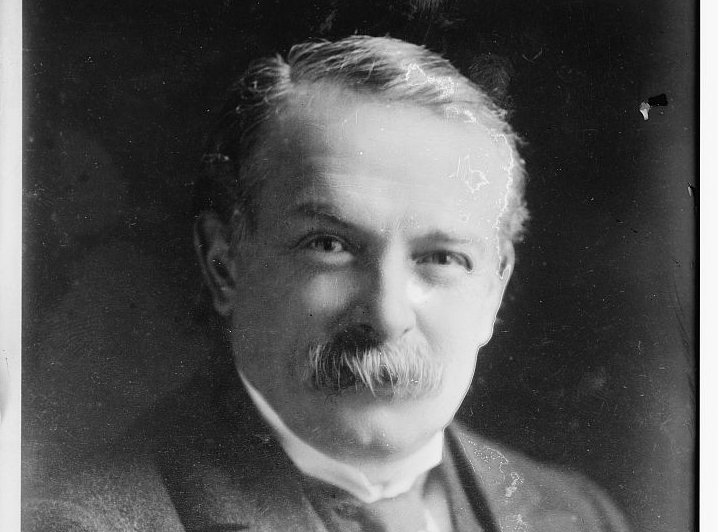
David Lloyd George, the chancellor of the exchequer, introduced the People’s Budget to the House of Commons on 29 April 1909. It was a radical fiscal package designed to fund naval expansion with the construction of new Dreadnought battleships, as well as sweeping new social welfare programmes.
Addressing MPs, Lloyd George declared that money had to be raised to ensure the “inviolability of our shores” and to “prevent unmerited distress within those shores”. He insisted that while it was necessary to provide for the defence of the country, it was “equally imperative that we should make it a country even better worth defending for all and by all.”
In 1908, the chancellor warned that he would have to “rob somebody’s hen roost next year”. He now revealed that the government was facing a larger than expected deficit of £15,762,000. The ‘People’s Budget’ thereby championed a series of controversial revenue-raising measures. To pay for his progressive budget measures and tackle the deficit, Lloyd George introduced a “supertax” on incomes over £5,000, hiked alcohol duties, increased ‘death duties’ (inheritance taxes) and levied new taxes on landowners.
In his budget statement, Lloyd George recognised the observation that no chancellor had ever imposed such “heavy taxes in a time of peace”. But he described his proposals as a “war budget” that would raise “money to wage implacable warfare against poverty and squalidness”.
He said that he hoped poverty would become “as remote to the people of this country as the wolves which once infested its forests.”
Lloyd George’s oration lasted a full five hours. The sitting was suspended for 30 minutes at around 6:00 pm to allow the chancellor to recuperate; the Liberal statesman returned to the commons floor having been supplied with a cup of beef tea.
The title of ‘People’s Budget’ is said to originate in a famous speech Lloyd George delivered in Limehouse, East London, in July 1909. Addressing a 4000-strong crowd, the chancellor said his budget placed burdens on those with the “broadest shoulders”. He was utterly unapologetic.
He declared: “Why should I put burdens on the people ? I am one of the children of the people. I was brought up amongst them. I know their trials; and God forbid that I should add one grain of trouble to the anxieties which they bear with such patience and fortitude.
“When the prime minister did me the honour of inviting me to take charge of the national exchequer at a time of great difficulty, I made up my mind, in framing the budget which was in front of me, that at any rate no cupboard should be barer, no lot should be harder.
“By that test, I challenge you to judge the budget.”
The most contentious element of the People’s Budget was the introduction of land value duties. Lloyd George justified this measure by questioning whether it was really “unfair” or “inequitable” that the government should demand a contribution “from these fortunate [land] owners towards the defence of the country and the social needs of the unfortunate in the community, whose efforts have so materially contributed to the opulence which they are enjoying”.
The budget sparked fierce and unyielding opposition – spearheaded by the Conservative leader in the commons, Arthur Balfour. Speaking at third reading, Balfour said the budget’s tax rises had been “arbitrarily selected on the fiat of the chancellor of the exchequer.”
Lloyd George’s fiscal package, he argued, was “socialistic” because it “undermine[d] private property”.
In total, the Finance Bill was subjected to 70 days of debate and 554 divisions in the commons. Lloyd George, addressing the House at third reading, said he was pleased with the experiment “of carrying this bill through without anything in the nature of guillotine closure… although we are sitting here in the month of November, we have, at any rate, succeeded in doing that.”
On 4 November, some six months after Lloyd George’s budget statement, the Finance Bill cleared the commons by 379 votes to 149. It then made its way to the House of Lords.
***
For over 250 years, it had been a constitutional convention that the House of Lords did not amend Money Bills. In 1671, the commons resolved “that in all aids given to the king by the commons, the rate or tax ought not to be altered by the Lords”. A broader resolution in 1678 asserted the “undoubted and sole right of the commons” with respect to financial legislation.
Financial privilege had become an established convention. It was widely recognised that to reject a budget meant denying the government the supply necessary to govern – effectively forcing a dissolution of parliament.
It was also the case that conflict with the Lords – a Conservative dominated chamber – was only a problem for Liberal governments. The Conservative and Unionist forces had dominated the chamber since the Liberal home rule schism in 1886, when a “Liberal Unionist” bloc of peers allied with their Tory colleagues to thwart the establishment of an Irish parliament in Dublin. As a result, the upper chamber now boasted an entrenched Conservative-Unionist majority – an in-built impediment to a Liberal legislative programme. In his final commons speech, Gladstone warned of “tremendous contrariety and incessant conflict” with the Lords, arguing the upper chamber’s treatment of recent bills – notably the 1892 Irish Government Bill – raised “a question of the gravest character.”
The last Liberal administration, led by the Earl of Rosebery from 1894 to 1895, had been regularly thwarted by the Conservative-dominated upper chamber. This was the cause of considerable political acrimony, but peers still did not reject the budget set out by William Harcourt as chancellor in 1894 – despite its controversial introduction of death duties.
On 22 November 1909, the Conservative leader in the Lords, the Marquess of Lansdowne, broke with precedent. He moved a reasoned amendment to the Finance Bill at its second reading. He posited that the Lords was “not justified in giving its consent to this bill until it has been submitted to the judgment of the country.”
Lansdowne argued that the government was abusing the privileges of the commons by “tacking” non-financial legislation onto a Finance Bill. He pointed out that the Lords had previously rejected a Land Valuation Bill and a Licensing Bill. Now, the government had “grafted” these rejected measures onto the budget. He called this a “cynical invasion” of the upper chamber’s historic rights, asking: “What self-respecting second chamber would tolerate such treatment?”
Lansdowne also invoked Oliver Cromwell, who established an upper chamber “for the express purpose… of protecting the people of England against ‘an omnipotent House of Commons – the horridest arbitrariness that ever existed in the world’.” Lansdowne said he detected “this horrid arbitrariness in the measure which we are now discussing.”
He added: “In all seriousness, my Lords, we have a right to ask where this kind of thing is going to stop.
“If you can graft Licensing Bills and Land Valuation Bills and measures of that kind on the Finance Bill, what is to prevent your grafting on it, let us say, a Home Rule Bill – setting up an authority in Ireland to collect and dispense all the taxes of that country?”
Lansdowne argued that there was “no limit to the abuses which might creep in if such a practice were allowed to go on without restriction”.
He argued that the insistence of the prime minister, H.H. Asquith, that the budget has “far-reaching political and social results”, amounted to proof that the Finance Bill moved beyond dealing solely with merely financial matters.
Lansdowne addressed those who would have raised the “consequences to this House” if peers followed through in rejecting the budget. He argued that “the people of this country will think worse and not better of us if we have not the courage of our opinions, and do not, as I conceive it to be our duty to do, appeal from you to them.”
He added: “I believe that the worst and the most damaging thing that you could do would be that you should fail those who look to you as the guardians of their greatest constitutional right, the right to be consulted when fundamental political changes are demanded by the government of the day.”
The lord chancellor, Lord Loreburn, warned Lansdowne not to go down this path. Loreburn labelled his recommended course of action as “unprecedented” and “subversive of the traditions of parliament”.
The lord chancellor stated: “If I am asked whether you can do it lawfully, according to law, I answer undeniably yes; and the best test of that is that a court of law would not give effect to any tax which had been refused by the House of Lords and was not ultimately embodied in an act of parliament.
“But if I am asked whether this House can do it constitutionally, I say – in my opinion, no.
He said the difference between what “can be done according to law and what can be done in accordance with the constitution under which we live is notorious and fundamental.”
He concluded: “We have not produced this conflict. We have not provoked it, nor at any time desired it, but we are not afraid of it, and I hope that we shall none of us fail to do our duty in preserving the constitution of our country.”
Among the opponents of the budget was the Earl of Rosebery, prime minister from 1893 to 1895. He saw the budget “a revolution: a social and political revolution of the first magnitude”.
He stated that Gladstone, the Grand Old Man of Victorian politics and his predecessor as prime minister, would have rejected Lloyd George’s proposals because “in his eyes, and in my eyes, too as his humble disciple, Liberalism and Liberty were cognate terms; they were twin-sisters.”
He added: “This budget seems to establish an inquisition, unknown previously in Great Britain, and a tyranny, I venture to say, unknown to mankind… I think my friends are moving on the path that leads to Socialism.”
But, in his speech to the Lords on 24 November, he said he would not vote for Lansdowne’s amendment. He said that in “hanging up or in rejecting the budget the House of Lords is doing exactly what its enemies wish it to do”.
Rosebery warned: “I doubt whether you are choosing the best battlefield on which to risk the attributes and perhaps the existence of this House…
“I think you are playing for too heavy a stake on this occasion. I think that you are risking in your opposition to what I agree with you in thinking is an iniquitous and dangerous measure, the very existence of a second chamber.”
The Archbishop of York also counselled peers against rejection. He acknowledged the criticism of the Finance Bill, but said he had not “heard arguments sufficiently persuasive to prove that the budget is bad enough to justify the unprecedented course which the noble Marquess has commended.”
He said that never before had the Lords “rejected a Finance Bill sent up by an overwhelming majority from the other House; never before has it refused supply to the king’s government.”
He maintained that “precedent” was the very basis of Britain’s parliamentary system and “the only bulwark which we possess against the encroachments of those sudden impulses, however strong and natural, which, if they were unchecked, would make the working of an unwritten constitution impossible.”
Peers did not follow the archbishop’s advice. On 30 November, after a week of debate, peers in the Conservative-dominated chamber divided. They rejected the bill by a decisive margin of 350 votes to 75.
***
The rejection was unsurprisingly met with fury in the commons. On 2 December 1909, Asquith moved a motion that declared the action “a breach of the constitution and a usurpation of the rights of the commons.”
The prime minister described the rejection of the People’s Budget in the House of Lords as “unexampled in the history of the British parliament”. For the first time in English history, he declared, “the grant of the whole of the ways and means for the supply and service of the year” had been “intercepted and nullified”.
He said the rejection of the Finance Bill amounted to the “greatest indignity, and I will add the most arrogant usurpation, to which, for more than two centuries, [the commons has been asked to submit.”
He referred to “the course – the only course – which, in the circumstances, it is open to the government, without either breaking the law or sacrificing constitutional principle, to pursue.”
Asquith said the king had accepted his advice that parliament should be dissolved “at the earliest possible moment”. He framed the forthcoming election not just around the People’s Budget, but also the nature of the Lords veto.
The question before the country, he argued, would be whether, “when the Tory Party is in power the House of Commons shall be omnipotent, and whether when the Liberal Party is in power the House of Lords shall be omnipotent.”
The resolution was carried by 349 votes to 134, and parliament was dissolved shortly thereafter. The Liberal government, having been elected with a landslide majority at the 1906 election, would, all else being equal, have faced an election in 1913. Britain was then subject to septennial (seven year) parliaments. But the unelected Lords had forced the commons, in the face of a bill it opposed, to refresh its mandate.
The Liberals fought the January 1910 general election on a peers vs the people platform. The Conservatives, meanwhile, campaigned on “tariff reform” (protectionism) as the alternative to the “socialist budget”.
Asquith, in a campaign speech at the Albert Hall, insisted that the “absolute” veto of the House of Lords must go. He said the commons had been asked to choose between “legislative sterility and dissolution”.
Asquith added: “The people must be able to feel, what they cannot, feel now, that they are sending to Westminster men who will have the power, not only of proposing and debating, but of making laws. The will of the people, as deliberately expressed by their elected representatives, must, within the lifetime of a single parliament, be made effective.”
He referred to the House of Lords as a “body which has no pretensions or qualifications to be the organ or the interpreter of the popular will.”
Lloyd George asked: “Should 500 men, ordinary men, chosen accidentally from among the unemployed, override the judgement – the deliberate judgement – of millions of people who are engaged in the industry which makes the wealth of the country?”
The result was a hung parliament. The Liberals won 274 seats – just two more than their Conservative/Unionist opponents. Asquith was able to remain in power with the support of Labour and Irish nationalists MP.
***
The speech from the throne in February 1910 set out a limited legislative programme. The government would seek to pass the People’s Budget, having secured the endorsement of the electorate, and reform the upper chamber.
The king’s speech promised proposals “to define the relations between the Houses of Parliament, so as to secure the undivided authority of the House of Commons over finance, and its predominance in legislation”. These measures, it detailed, would ensure that the Lords was “so constituted and empowered as to exercise impartially, in regard to proposed legislation, the functions of initiation, revision, and, subject to proper safeguards, of delay.”
John Redmond, the leader of the Irish Parliamentary Party (IPP), used his party’s influence to secure commitments from Asquith. Redmond refused to pass the People’s Budget until he had been assured that power of the Lords would be broken. This outcome, Redmond figured, would remove the final obstacle to Irish home rule.
Redmond called on the prime minister to give the IPP “reasonable assurances that he would be able to carry his veto bill into law this year”. Then, he said, “we will not abstain from voting on the budget. We will vote for it.”
Redmond’s “assurances” were a reference to the suggestion that King Edward VII should pack the Lords (appoint hundreds of Liberal peers under the royal prerogative) to force through reform.
Asquith insisted that he has “received no such guarantee” from the monarch. Rather, he argued that to “ask in advance for a blank authority for an indefinite exercise of the royal prerogative… is a request which, in my judgment, no constitutional statesmen can properly make.”
The prime minister insisted that the “first act of the new House of Commons must be to deal with all the exigencies of the financial situation.”
But Asquith, who relied on the IPP’s votes, later appeared to relent. He proceeded to press both measures – on the budget and Lords veto – concurrently.
On 14 April, when the Parliament Bill received its first reading in the commons, Asquith supported it with a “declaration of policy”. Asquith told the House that, were the Lords to reject the government’s policy, “we shall feel it our duty immediately to tender advice to the crown as to the steps which will have to be taken if that policy is to receive statutory effect in this parliament.”
He added: “If we do not find ourselves in a position to ensure that statutory effect shall be given to this policy in this parliament, we shall then either resign our offices or recommend a dissolution of parliament.”
Balfour ridiculed the government’s bargain with Redmond. He said that the IPP would now “accept a budget they dislike… because they think that that policy conduces to that larger object they have in view, namely, home rule for Ireland.”
Balfour added: “[Asquith] has bought the Irish vote for his budget, and has bought it successfully. The price he has paid is the price of the dignity of his office, and of all the great traditions which he, of all men, ought to uphold.”
Redmond, meanwhile, was denounced for endorsing the budget by William O’Brien, the leader of the All-for-Ireland League of Irish nationalist MPs. O’Brien said the IPP leader was willing to see Ireland “sold for a shadow”.
He declared: “I will not leave the future of Irish nationality in the ignominious position of depending for its subsistence upon the funeral bakemeats of a land war which, thank God, is dead and gone, or, at all events, would have been dead and gone by this time but for the folly of Irishmen.”
The Finance Bill was reintroduced to the House of Commons for its first reading on 20 April. This time the Liberal government made considerable use of the parliamentary guillotine to foist the bill into the Lords as swiftly as possible. On 27 April, seven days after its re-introduction, the People’s Budget secured its commons third reading by 324 votes to 231.
It was thereby returned to the Lords.
Lansdowne argued that the election result, which saw the Liberal Party’s standing greatly reduced, vindicated his stance in the last parliament. He also accused the government of “capitulation” to the Redmonite Irish nationalist bloc, “to whom it has been intimated, that you are ready to overturn the constitution by unconstitutional means”.
But Lansdowne conceded that he was no longer in a position to block the financial package.
He told the House: “Last year we withheld our concurrence from this bill solely with the object of obtaining a reference of it to the constituencies, and now that the constituencies… have expressed themselves favourably to the bill, we are… given in and out of this House to acquiesce in the passage of the bill through all its stages tonight.”
He claimed that Conservative and Unionist peers in the Lords had conducted themselves with “clear consciences and clean hands”.
As such, on 28 April, the Lords passed the budget without a division.
***
But peers had crossed a constitutional Rubicon and Asquith was now committed to seeing the struggle through. The introduction and passage of the Parliament Bill ensured the continuance of the constitutional crisis.
The death of Edward VII on 6 May 1910, however, delayed its passage. Asquith, wanting to avoid a constitutional crisis so early into the reign of King George V, convened a conference to consider the issue. Discussions continued for some months. But after 21 meetings, the constitutional conference ended on 10 November without agreement.
Asquith resolved to call another general election for December. It did not change the parliamentary arithmetic. The Liberals lost two seats; the Conservatives gained one. The Lords remained a “Tory caucus”.
In the end, it was Asquith’s threat to pack the Lords – reluctantly accepted by the new king – that precipitated Lansdowne’s capitulation.
On 10 August 1911, the Parliament Bill passed the Lords by 131 votes to 114 – a majority of 17. It received royal assent eight days later.
Parliament Act introduced two key changes. It established a new legal category of bills called money bills. These bills could be passed without the Lords’ consent after a maximum delay of one month. Secondly, for other public bills, it replaced the Lords’ absolute veto with a power to delay legislation for a maximum of two years, spread over three parliamentary sessions.
The act also reduced the maximum duration of a parliament from seven years to five.

Politics.co.uk Newsletters
DAILY
Politics@Lunch
WEEKLY
Week in Review