MacDonald forms National Government after Labour split
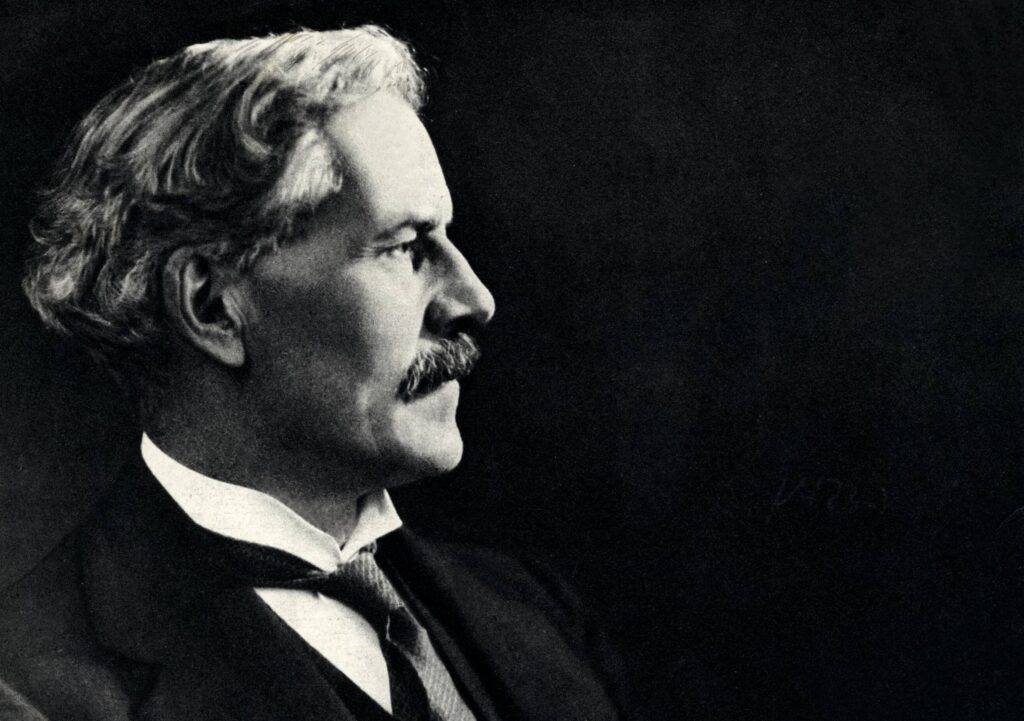
On 25 August 1931, the formation of a new ‘National Government’ was announced, with the Labour prime minister, Ramsay MacDonald, remaining in office at the head of a coalition ministry drawn from the Conservatives, Liberals and, to a lesser extent, his own party.
Labour emerged as the largest party for the first time at the 1929 general election with 287 seats on 33.3% of the vote. The Conservatives under Stanley Baldwin secured 260 seats on 38.1%. The Liberal Party, led by David Lloyd George, won 59 seats on 23.6% of the vote. (It would mark the last time when a third party polled more than one-fifth of the popular vote until 1983.)
In the hung parliament, Lloyd George’s Liberals held the balance of power and tentatively agreed to prop up a minority Labour administration. On 13 June 1929, Lloyd George told a meeting of Liberal parliamentarians that the “mandate of the government would end as soon as it failed to pursue a Liberal policy.”
He clarified that his party’s attitude to the government would “be influenced by the line which it took up on the question of electoral reform.”
Several Liberal MPs, led by former home secretary John Simon, opposed the Liberal Party’s support for the minority Labour government. Simon subsequently resigned the Liberal whip and sat as an independent over Labour’s proposal to introduce a new land tax.
MacDonald, who briefly led a minority administration in 1924, appealed to the commons to act as a “council of state”.
In his opening speech of the parliament on 2 July, the prime minister declared: “I wonder how far it is possible, without in any way abandoning any of our party positions, without in any way surrendering any item of our party principles, to consider ourselves more as a council of state and less as arrayed regiments facing each other in battle.”
He called on MPs to put “our ideas into a common pool”, from which parliament could draw “legislation and administration that will be of substantial benefit to the nation as a whole.”
These comments have been taken as an early hint of MacDonald’s preparedness to consider cross-party schemes.
***
The second MacDonald ministry survived from 1929 to 1931 with ad hoc support from Lloyd George’s Liberal bloc. In return, the government introduced the Representation of the People (No. 2) Bill, which proposed the introduction of the alternative vote (AV) for elections to the House of Commons. The bill ultimately secured its third reading in the House of Commons on 2 June 1931, by 278 votes to 228.
However, MacDonald’s government soon split, fatally, over a proposed package of austerity measures.
The report of the May Committee on National Expenditure, published July 1931, recommended drastic cuts to public spending, including a significant cut to unemployment benefit, to balance the budget. In response, the cabinet appointed a five-member economy committee, including MacDonald, Philip Snowden (chancellor) and Arthur Henderson (foreign secretary), to consider the findings.
On 8 August, while on holiday, MacDonald was informed by the Bank of England that there was a run on the pound. The bank expressed alarm “at the outflow of deposits and the danger to gold reserves”. The whole cabinet met from 20 August, but was unable to form a collective position on the May Report’s austerity proposals. In the end, nine ministers, including Henderson, opposed the cuts; MacDonald and Snowden were among the 11 who signalled their support.
With the government paralysed, unable to steer Britain through the Great Depression, MacDonald travelled to Buckingham Palace on 24 August to tender his resignation to King George V.
The usual procedure would have seen the king accept MacDonald’s resignation and send for Baldwin as leader of the opposition. But in a crucial, constitutionally innovative intervention, George V persuaded MacDonald to stay on as prime minister. He was urged to construct and lead a cross-party government in the national interest, tasked with steering the country through the financial emergency.
The king then summoned the leaders of the Conservative and Liberal parties to Buckingham Palace. The meeting’s conclusion came with the following notice: “His Majesty the King invited the Prime Minister, Mr. Stanley Baldwin, and Sir Herbert Samuel to Buckingham Palace this morning, and the formation of a National Government is under consideration.
“A public announcement will be made later.”
Later that afternoon, MacDonald once again left Downing Street, telling the assembled crowd: “The crisis is ended”.
The new, smaller emergency cabinet announced on 25 August was composed of 10 members. It comprised MacDonald and three other senior Labourites, Snowden, JH Thomas, and Lord Sankey – alongside four Conservatives, including Baldwin and Neville Chamberlain, and two Liberals.
Baldwin was appointed leader of the House of Commons. Snowden remained as chancellor, having served in the role since 1929 and during the short-lived Labour minority administration in 1924. Herbert Samuel, acting leader of the Liberal Party at the time, became home secretary. Lloyd George was absent from the political frontline due to a serious prostate operation; but the former prime minister offered his support to the new National Government.
***
The Labour Party denounced MacDonald’s decision as an act of betrayal. The first Labour prime minister, who first stood for the party at the 1895 election, was excoriated as a traitor and expelled by his erstwhile comrades.
Henderson took over as Labour’s new leader, having previously threatened to resign rather than accept the May Report position. MacDonald became leader of the new pro-government National Labour Organisation.
The National Government’s first test came in a House of Commons debate on the economic situation, which was treated as a vote of confidence in the new ministry.
MacDonald, entering the commons for the first time as leader of a cross-party government, was loudly cheered from the government benches – now composed of Conservative, Liberal and former Labour MPs. His welcome from the opposition benches, comprising the bulk of the Labour Party, was rather more sour.
MacDonald began the session by introducing a message from the king, announcing the outline of the government’s economic programme.
It read: “The present condition of the National finances, in the opinion of His Majesty’s ministers, calls for the imposition of additional taxation and for the effecting of economies in public expenditure. His Majesty recommends the matter to the consideration of His faithful Commons, and trusts that they will make provision accordingly.”
The motion before the House said MPs should resolve into a committee, in order to fast-track the government’s emergency financial legislation. The debate, MacDonald said, would show by “at the end of the day, whether the government have or have not the confidence of the House of Commons.”
Addressing the House, MacDonald described the “extraordinary incidents” that led to the new government’s accession.
“Every now and again, things happen which require courage to face”, he declared. “States get into a condition when an immediate remedy is required, even when it is not a complete remedy, which is unpleasant and unpopular, and when leadership is required, not merely to follow what is easy, but to face what is difficult.
“Against dangers of this kind – sudden crises which may be of a vital nature to the state – democracy has not always been successful in saving itself; but there is nothing that is more heartening, there is nothing that gives one a deeper sense of justification, than the way in which, wherever democracy rules, wherever parliamentary institutions exist from one end of the country to the other, this country and this House have braced themselves up to meet the serious crisis.
“The proof that [the National Government] has been welcomed and heralded with great gladness is one of the best justifications for the action that has been taken.”
MacDonald then turned to the economic crisis, depicting a nation on the brink of collapse.
He told the House: “I am not scaremongering…
“If there is a real panic, the value of money may not sink slowly and by small percentages but may wither to nothing. War pensions, old age pensions, health and insurance benefits become worth, as they became in Germany [when it suffered hyperinflation], only the price of a newspaper.”
Finally, he presented his actions as a matter of “courage”.
He concluded: “As for ourselves, the government, whether our life be long or short, it has already been useful. It has been necessary…
“It is a team of men belonging to all parties who believe that until this emergency is over party strife should not appear here, and I ask the House of Commons to uphold our hands in our work.
“Will it be long, will it be short? I do not know. One definite thing I can say is that it is our duty to remain here, and it is your duty to keep us here, until the crisis has passed; until the world is convinced once again that the sterling is unassailable, until the wages and incomes of our people are freed from the destructive influences which have been threatening them recently.”
Henderson said he addressed the House in a state of “embarrassment”.
He added: “No one who knows anything about the history of the party with which I have been so long associated and who knows anything of the almost day to day collaboration between the prime minister and myself will expect me to have a feeling other than one of difficulty in finding myself called upon to reply to his speech.”
He went on to deny the government’s political legitimacy, rejecting the term “national government”.
Henderson declared: “We have the largest party on this side of the House, notwithstanding the bakers dozen of defections which have taken place, and how a government can be described as a national government which lacks the support of the party representing the largest number of members of this House I fail to understand.”
Godfrey Collins, a National Liberal MP, referred to MacDonald’s decision to form the National Government as a “larger, straighter, and a more courageous act than the act of Sir Robert Peel many years ago.”
MPs agreed the motion before them by 309 votes to 249, expressing confidence in MacDonald’s administration.
Snowden then delivered his budget speech on 10 September, immediately instituting a round of cuts in public spending and wages. Public sector wages and unemployment pay were cut by 10%, and income tax was raised from 22.5% to 25%.
These pay cuts were met with immediate opposition – both from Labour MPs and in the non-violent “mutiny” by sailors in the Royal Navy at Invergordon, who protested the reduction in their wages.
***
The crisis also shattered the Liberal Party, which eventually split into three factions over support for the administration and the adoption of protectionist trade policies.
Initially, in the spirit of the times, both the official Liberals under Samuel and the breakaway bloc under John Simon expressed their support for the National Government. But splits emerged over the prospect of a general election, which MacDonald was convinced to call by his new Conservative allies.
Samuel threatened to resign from the National Government over the prospect of a snap election, fearing it would entrench Conservative dominance and usher in a turn towards protectionism. In the end, Samuel remained in the National Government on the condition that the official Liberal Party could stand on a separate, pro-free trade election platform. This arrangement gave rise to the first formal “agreement to differ” in British political history; the temporary, targeted suspension of collective responsibility allowed Samuelite Liberal ministers to dissent from the National Government’s position on free trade and protection.
At the same time, Simon’s Liberal group remained closely allied to the government, willing to back MacDonald’s ministry even if it meant accepting protectionist measures. Simon soon established the Liberal National Party (later National Liberal Party) to contest the 1931 election as an effective extension of the Conservative Party.
Meanwhile, Lloyd George was vehemently opposed to the prospect of a general election. He established a small, largely familial group known as the Independent Liberals, who opposed the National Government outright. Of the six Independent Liberals who stood in the 1931 election, four were either members of, or married into, the Lloyd George clan. Like Samuel, Lloyd George was motivated by his support for free trade – a longstanding Liberal shibboleth.
In this way, the government constituted on 25 August 1931 as a temporary measure was prolonged by the momentous decision to call a snap general election for October 1931. MacDonald was convinced to take this path by his new Conservative allies; at this stage, he had no route back into mainstream Labour politics.
The 1931 general election produced a crushing landslide victory for the National Government, campaigning for a so-called ‘Doctor’s mandate’ to rescue Britain from the Great Depression. The coalition captured two-thirds of the votes cast and won 554 (90.1%) of the 615 available commons seats.
MacDonald, the first Labour prime minister, bore witness to the near-total destruction of the party he had led into power. Henderson was one of over 200 Labour MPs who lost their seats.
Simon’s Liberal Nationals won 35 seats. Samuel’s official Liberal Party won 33 seats. Lloyd George’s Independent Liberals won four seats.
Following the election, Simon was appointed as foreign secretary. (Subsequent attempts to reunite the official Liberal and Liberal National factions proved unsuccessful.)
***
MacDonald served as prime minister until June 1935, when he was succeeded by Baldwin. The pair swapped roles and MacDonald, suffering from ill health, became commons leader.
In December 1932, MacDonald wrote in his diary of the National Government’s formation: “Was I wise? Perhaps not, but it seemed as though anything else was impossible.”
That was not MacDonald’s public stance, of course.
In September 1933, MacDonald launched a remarkable defence of his decision to form and lead the National Government.
He maintained he had no regrets, declaring: “I shall never apologise.”
MacDonald added: “I see no reason in the events that have taken place since then for fearing that later on, when the past can be surveyed with more calm, I ever shall have to apologise or feel I did wrong when I joined the national government.”
The comments came during the campaign for the 1933 Kilmarnock by-election. Taking aim at his former party, Labour, MacDonald proclaimed: “I am not going to allow the great movement in the making of which I had a little hand to be misled…
“Would we have done our duty if, seeing what was going on, we had conspired to say nothing but just have gone down to catastrophe? Is that serving the country and trade? I say it is not.
“Boldness, honesty and courage were required to face the situation and the first preliminary was to put an end to partisan strife and all come together to find a national solution for national problems.”
The National Labour candidate, Kenneth Lindsay, won a 2,653-vote majority over the official Labour Party.
The National Government continued in one form or another, led for the latter part of its life by the dominant Conservative Party, until the collapse of Chamberlain’s government in 1940.
***
Snowden chose not to stand at the 1931 general election and was elevated to the peerage as Viscount Snowden. He served as lord privy seal until 1932, before resigning over the government’s embrace of protectionism.
In his memoirs, Snowden excoriated MacDonald.
The former chancellor wrote that MacDonald welcomed the opportunity to associate with Tory political leaders “with whom he was more in sympathy than he had ever been with his Labour colleagues.”
Snowden added: “His mind a long time before this crisis arose had been turning to the idea of a new party orientation and government by what he called a council of State. He set about the formation of a national government with an enthusiasm which showed the adventure was highly agreeable to him…
“The day after the National Government was formed he came into my room in Downing Street in very high spirits. I remarked to him he would now find himself very popular in strange quarters. He replied gleefully, rubbing his hands, ‘Yes, tomorrow every Duchess in London will be wanting to kiss me.’”
In the collective memory of the Labour Party, MacDonald has never been fully rehabilitated for his alleged apostasy.

Politics.co.uk Newsletters
DAILY
Politics@Lunch
WEEKLY
Week in Review