Lloyd George coalition wins landslide as Sinn Féin sweeps Ireland
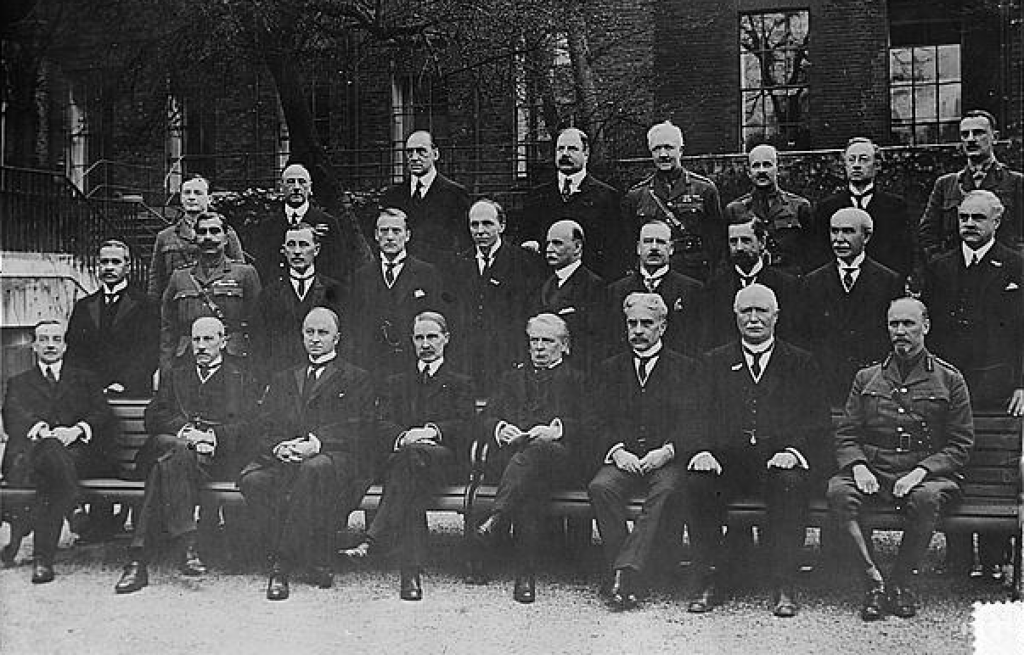
The general election held on 14 December 1918 resulted in a landslide victory for the wartime coalition government led by David Lloyd George as prime minister and Conservative leader Bonar Law. The contest, the first election to be held in eight years, redrew the political map of the British Isles.
The independent Liberal Party, led by former prime minister H.H. Asquith, won just 36 seats – a net loss of 236. In Ireland, the republican Sinn Féin wiped out the constitutional nationalists of the Irish Parliamentary Party (IPP). The Labour Party won 57 seats on 20.8% of the vote.
The coalition, with its candidates identified by special “coupons”, won 478 seats and the largest majority since the 1832 Reform Act. Lloyd George was returned to office on a wave of war fever.
***
The 1918 general election was called following the Armistice of 11 November 1918. Addressing the commons, Lloyd George told the MPs that “at eleven o’clock this morning came to an end the cruellest and most terrible war that has ever scourged mankind.”
He added: “I hope we may say that thus, this fateful morning, came to an end all wars.”
Asquith echoed this sentiment, expressing his hope that war would now be recognised as “an obsolete anachronism, never to be revived.”
Lloyd George was known as the “man who won the war”. Such was his immense popularity, that around this time Bonar Law remarked: “He can be prime minister for life if he likes”.
On 14 November, the coalition government set out the timetable for a general election. Bonar Law, in his capacity as leader of the House of Commons, announced the election would take place on 14 December. He said the vote count “could be postponed” until 28 December so that the ballots cast by soldiers serving overseas could be included in the tallies.
The ‘war parliament’ met for the final time on 21 November to hear a message from King George V. The king thanked MPs for their “unfailing patriotism” and looked forward to an “honourable and enduring peace”.
George added: “The exertions which have carried us to victory in the field must in no wise be abated or slackened until the ravages of war have been repaired and the fabric of our national prosperity has been restored.”
He referred to the passage of the Representation of the People Act 1918, which granted the vote to all men over 21 and, for the first time, to women over the age of 30 who met property qualifications. The legislation tripled the electorate from 7.7 million to 21.4 million.
The king said that through “the extension of the suffrage, which this parliament has carried into effect, all classes of my people will have an opportunity of inspiring and guiding this beneficent undertaking.”
The Parliament (Qualification of Women) Act 1918, a statute of just 27 operative words, was rushed through parliament in the days before dissolution. It held that women could stand as candidates. In total, 17 women stood for election, including Christabel Pankhurst for the Women’s Party in Smethwick, Charlotte Despard for Labour in Battersea North, and Mary Macarthur for Labour in Stourbridge.
***
The 1918 general election campaign was defined by the so-called “coalition coupon” – a letter of endorsement signed by Lloyd George and Bonar Law sent to candidates deemed loyal to the government.
The coupon read: “We have much pleasure in recognising you as the coalition candidate for (name of constituency). We have every hope that the electors will return you as their representative in parliament to support the government in the great task which lies before it.”
This mechanism was a direct consequence of the Liberal split in December 1916. Asquith, under intense pressure from Lloyd George and Bonar Law to reconstitute the war cabinet, ultimately refused and resigned as prime minister. Lloyd George entered office with the support of the Conservative-Unionist Party and a minority of Liberal MPs
As a result, the Liberals bisected: the Lloyd George-supporting faction was now allied with the Conservatives. (Winston Churchill joined the government in 1917.) Asquith continued to lead the Liberal Party from the opposition benches. In a meeting on 8 December attended by loyal Liberal MPs, Asquith described his defenestration as “a well-organised, carefully engineered conspiracy”.
The term “coupon”, which identified pro-government candidates, was a term borrowed from the vernacular of wartime rationing. It was Asquith who, disparagingly, first employed the “coupon” label.
Coupons were issued to 364 Conservatives and 159 Liberals, following negotiations between Freddie Guest, the coalition chief whip, and George Younger, chairman of the Conservative Party. This process effectively cemented the Liberal Party’s wartime split.
Some Liberal MPs who did not receive the coupon found they were branded as anti-war or unpatriotic. An endorsement from the war-winning prime minister, meanwhile, was seen as a mark of a candidate’s patriotism and contribution. This lingering wartime sentiment meant the contest has been described as a “khaki election”. In this atmosphere, the coupon has been described as “an almost certain passport to the House of Commons.”
Lloyd George campaigned on a platform of reconstruction, delivering a famous speech to this effect on 24 November. He spoke of building a country “country for heroes”.
The prime minister declared: “What is our task? To make Britain a fit country for heroes to live in. I am not using the word ‘heroes’ in any spirit of boastfulness, but in the spirit of humble recognition of fact. I cannot think what these men have gone through.
“I have been there at the door of the furnace and witnessed it, but that is not being in it, and I saw them march into the furnace. There are millions of men who will come back. Let us make this a land fit for such men to live in.
“There is no time to lose.”
The coalition election manifesto stressed that the “unity of the nation” should not be “relaxed if the many anxious problems which the war has bequeathed to us are to be handled with the insight, courage, and prompritude which the times demand”.
It added: “We appeal, then, to every section of the electorate, without distinction of party, to support the coalition government in the execution of a policy devised in the interests of no particular class or section, but, so far as our light serves us, for the furtherance of the general good.”
The coalition platform also featured a pledge to reform the House of Lords. The Manifesto of Lloyd George and Bonar Law called for an upper chamber with “direct contract with the people”, which would be “representative enough adequately to perform its functions.”
The campaign also took on a vengeful quality, with public anger calling for the government to punish Germany. Lloyd George and the coalition government were quick to harness – and even encourage – this.
In an election address, Unionist minister Auckland Geddes declared: “Today is the day of reckoning for our enemies, and they will have to pay the uttermost farthing that it is possible to wring out of them.”
In a campaign speech on 10 December, Eric Geddes, Unionist candidate and first lord of the Admiralty, echoed the sentiment of his brother.
Geddes proclaimed: “The Germans, if this government is returned, are going to pay every penny, they are going to be squeezed as a lemon is squeezed – until the pips squeak.”
The coalition was later characterised as campaigning on a “Hang-the-Kaiser platform”. Punishing Germany certainly featured highly in the coalition’s election messaging. Lloyd George summed up his government’s platform in “five points”:
- Punish the Kaiser;
- Make Germany pay;
- Get the soldier home as soon as possible;
- Fair treatment for the returned soldier and sailor;
- Better housing and better social conditions
The “Welsh Wizard” was renowned for his political versatility and dynamism. His unique position as a prime minister unshackled by party politics allowed him to embrace a broad platform of reconstruction and retribution.
The independent Liberal manifesto appeared as a first-person election address penned by Asquith. The former prime minister’s non-committal tenor could not compete with Lloyd George’s roaring rhetoric. Asquith said he was “not bound (as none of us should be) to any cut-and-dried programme.”
He added: “The best security for the successful prosecution of such a policy is that, in accordance with our traditions, it should be subject to full scrutiny in the free atmosphere of a representative House of Commons.
“For that purpose it is essential that every elector should claim and should exercise unfettered liberty of choice.”
The wartime coalition, once the results were declared on 28 December, secured a crushing victory. The Conservatives won 335 seats, establishing a dominant position in the post-war government that was then reconstituted. Lloyd George was drastically outnumbered in his own coalition; his Liberal faction secured 133 seats.
For Asquith’s independent Liberals, the result was nothing short of a catastrophe. They were reduced to a rump of roughly 28 seats. Former leading Asquithian cabinet ministers Reginald McKenna, Herbert Samuel and John Simon all lost their seats.
Asquith himself lost his seat of East Fife, which he had held since 1886, by a margin of 2,002 votes. The coalition did not stand in East Fife, but the former prime minister found himself bested by a non-couponed Unionist candidate.
Asquith is said to have received a hostile reception during the campaign, captured by placards which read: “Asquith nearly lost you the War. Are you going to let him spoil the Peace?”
A report published on polling day read: “Asquith addressed eight meetings in East Fife and was heckled at all of them.”
The 1918 general election effectively confirmed the decline of the Liberal Party.
Asquith returned to parliament in 1920 and the Liberals reunited in time for the 1923 general election. But any sense of revival was ultimately fleeting.
Asquith later wrote: “The disintegration of the Liberal Party began with the coupon election of 1918.
“It then received a blow from which it never recovered. I myself was turned out of a seat which I had held against the Tories for 32 years. All my leading colleagues in the House of Commons suffered the same fate.”
The Labour Party, fighting independently, won 57 seats and polled 2.3 million votes. Two of the party’s leading figures, however, Ramsay MacDonald and Arthur Henderson, lost their seats. MacDonald in particular was targeted for his initial opposition to the war.
In terms of vote share, Labour placed second in the 1918 election – surpassing both Liberal factions.
Labour’s William Adamson was initially recognised as the leader of the opposition by the speaker. This role, however, was contested by Donald Maclean, the leader of the Asquithian Liberals in parliament.
In his first major contribution, Adamson told the House: “We have reached that stage when the working classes of the country will refuse longer to continue to be treated as cogs in the machinery for mere profit-making purposes.”
Maclean addressed the House on behalf of the remaining non-couponed Liberals. He lamented the “unprecedented result of an unprecedented election”.
Maclean paid tribute to the defeated Asquith and defended him against the charges levelled against the Liberal leader during the campaign.
He stated: “My right honourable friend Mr Asquith is a man whose devoted service to his country, whose high magnanimity and splendid public services will yet have full credit given to them”.
Turning to one of the campaign’s central themes, Maclean added: “As to the punishment of the kaiser, that was one of the questions on which, as far as I could gather, candidates all over the country were fully pledged.
“I only say about that that while there must be enormous difficulties in connection with it, yet what a precedent it would be for any ruler, be he president or prime minister, crowned king or emperor, who plunges the nation into war, to be brought to judgment, and dealt with according to his deserts.”
***
The 1918 general election in Ireland was a revolutionary moment. The constitutionalist Irish Parliamentary Party (IPP), which had dominated Irish politics since the 1880s and secured the passage of the 1914 Home Rule Act, returned just 6 MPs – down from 84.
John Dillon, the IPP leader, lost his seat of East Mayo.
Sinn Féin, led by Éamon de Valera, won 73 seats.
In Ulster, Cardinal Michael Logue brokered a limited electoral pact between Sinn Féin and the IPP in three seats to prevent Unionist victories. The Irish Labour Party, meanwhile, stood aside completely, presenting the Irish electorate with a clear choice on the national question.
It was the Easter Rising on 24 April 1916 that created the conditions for Sinn Féin’s replacement of the IPP as the spokesperson for Irish nationalism. The rising was initially met with bemusement and even hostility from many Dubliners. However, the week of fierce fighting, the destruction of much of central Dublin by artillery fire, and the British government’s hardline response – including large-scale arrests, the killing of civilians and the execution of rebel leaders – radicalised public opinion.
At the 1918 election, Constance Markievicz was returned as the Sinn Féin MP for Dublin St Patrick’s, making her the first woman ever elected to the British House of Commons. Like her colleagues, however, Markievicz refused to take her seat in line with Sinn Féin policy.
On 21 January 1919, those Sinn Féin MPs returned at the 1918 election (who were not imprisoned) convened at the Mansion House in Dublin to form the first Dáil Éireann.
The first act of Dáil Éireann was to declare Irish independence, ratifying the Irish Republic proclaimed in 1916.
The Sinn Féin representatives resolved: “Now, therefore, we, the elected representatives of the ancient Irish people in national parliament assembled, do, in the name of the Irish nation, ratify the establishment of the Irish Republic and pledge ourselves and our people to make this declaration effective by every means at our command.”
The revolutionary parliament declared that a state of war existed “between Ireland and England”. The Irish Volunteers, formed in 1913 to reinforce nationalist demands for home rule, were restyled as the Irish Republican Army (IRA).
The Dáil’s formation coincided with the beginning of the Irish War of Independence (1919-1921).

Politics.co.uk Newsletters
DAILY
Politics@Lunch
WEEKLY
Week in Review