Parliament debates Lloyd George ‘cash for honours’ scandal, forcing concession
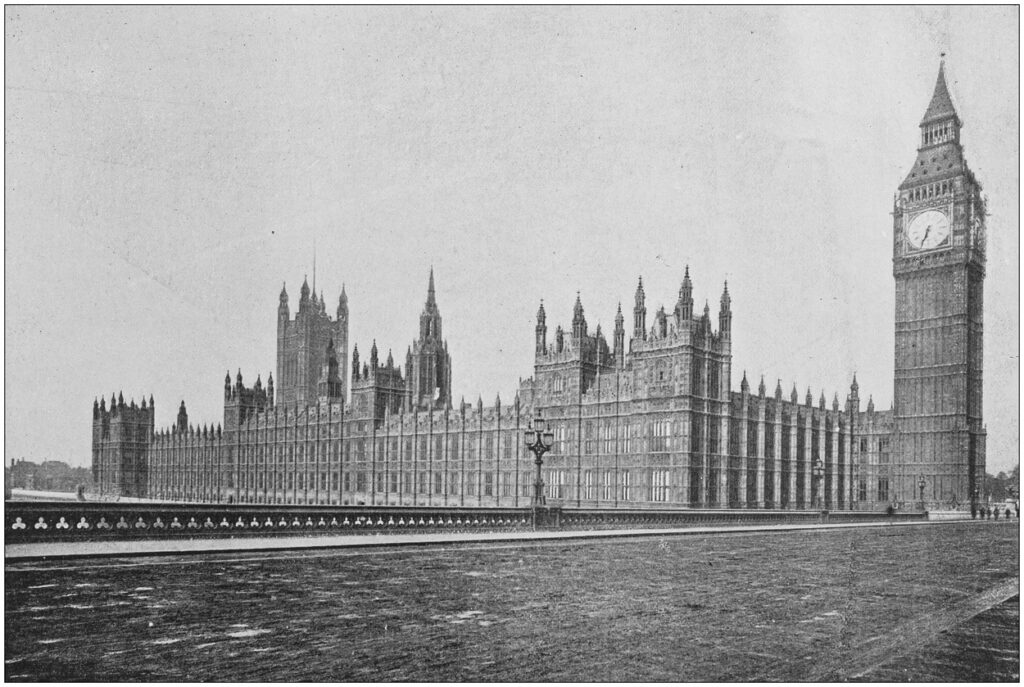
On 17 July 1922, simultaneous and highly damaging debates took place in both the House of Commons and the House of Lords concerning the growing scandal surrounding the sale of honours by prime minister David Lloyd George’s government.
The political mauling forced Lloyd George onto the defensive and marked a step towards the collapse of his post-war coalition.
***
Suspicions had been mounting for years about the unprecedented scale of honours distributed since Lloyd George took office.
The scandal supposedly stemmed from the nature of Lloyd George’s accession. In late 1916, Lloyd George forced H. H. Asquith, the last prime minister of an all-Liberal government, from office. As a result, the Liberals bisected: the Lloyd George-supporting faction was now allied with the Conservatives. (Winston Churchill joined the government in 1917.) Asquith continued to lead the Liberal Party from the opposition benches.
Lloyd George’s new faction, however, had neither funds nor any form of party apparatus.
The dawn of universal suffrage following the Representation of the People Act 1918 bode ill for unprepared/underfunded parties.
As such, it was widely believed that titles were being systematically sold through morally dubious middlemen or “honours touts” like Maundy Gregory, with a view to building a party chest. Rewarding political donors was nothing new, but the sheer number of honours handed out – 26 peerages, 74 baronetcies and 294 knighthoods in 18 months – often to individuals of questionable reputation or service, provoked outrage.
As early as 1917, during a debate in the Lords on the alleged sale of honours, Lord Beresford argued that the ongoing war “will be celebrated in history for the large numbers of honours, rewards, promotions, and even office given to people who have disastrously failed.”
He added: “Many of these people who have received honours have no earthly right to them except that they were lucky enough to be plutocrats.”
Between 1916 and 1922, 120 hereditary peerages and more than 1,500 knighthoods were awarded.
In January 1921, Lloyd George made Sir Rowland Hodge, a shipbuilder who had been convicted of hoarding food during the First World War, a baronet.
***
The tipping point came with the June 1922 birthday honours list. It included Samuel Waring, a war profiteer who reorganised his company to avoid paying his shareholders while making a fortune during the war through government contracts; William Vestey, who moved his meatpacking business to Buenos Aires to avoid paying income tax in 1915; and Archibald Williamson, whose oil firm, Williamson, Balfour and Co, had been accused of trading with the enemy during the war.
The inclusion of Sir Joseph Robinson, a South African diamond magnate recently fined £500,000 for fraud, was seen as especially egregious. Robinson was listed for a barony “for national and imperial services”, having paid £30,000 for the privilege.
King George V is said to have been furious. In a letter to Lloyd George, he wrote: “The case of Sir Joseph Robinson… must be regarded as little less than an insult to the Crown and to the House of Lords and may, I fear, work injury to the prerogative in the public mind.”
Sitting peers simply refused to countenance the prospect that this convicted fraudster would be one of them.
The government was forced to announce Robinson’s decision to decline the honour. In a Lords debate on 29 June dedicated to the matter, the lord chancellor conceded that the secretary of state for the colonies, and by extension the government of South Africa, “was not consulted” on the peerage. He read a letter from Robinson, which noted the “ill-feeling” in the House and insisted he had not in “any way sought the suggested honour”.
The Marquess of Lansdowne (Conservative Henry Petty-Fitzmaurice) responded that Robinson’s letter had “not entirely removed the cloud of uneasiness”.
The Duke of Northumberland (Alan Percy), an ultra-conservative opponent of the prime minister, stated that “the mass of the public do believe that there is direct traffic in honours, and for very good reasons.”
The public outcry – coupled with disquiet among Lloyd George’s Conservative coalition partners – led to further debate and damaging revelations. On 17 July, the Lords and commons jointly considered a motion calling for a “select committee… to consider the present methods of submitting names of persons for dignities and honours for the consideration of His Majesty”.
The committee would report “what changes, if any, are desirable in order to secure that such dignities and honours shall only be given as a reward for public service.”
The most stinging attack came in the Lords from the Duke of Northumberland. He accused Lloyd George of amassing an “enormous party chest, variously estimated, at anything from £1,000,000 to £2,000,000”.
He told the Lords: “The prime minister’s party, insignificant in numbers and absolutely penniless four years ago, has, in the course of those four years, amassed an enormous party chest, variously estimated at anything from one to two million pounds.”
He alleged this coincided with a period when “less care has been taken with regard to the services and character of the recipients than ever before”.
He brandished evidence suggesting titles were being explicitly marketed to fund the fight against “Labour and Socialism”, referred to as an “expensive matter”.
Northumberland produced the correspondence of an alleged “tout”, suggesting a knighthood could be secured for £12,000 and a baronetcy for £35,000. The middleman urged quick action as “it is not likely that the next government will give so many honours”.
He also claimed Lloyd George had used honours to buy the silence of newspaper proprietors, referring to the “method of using honours to influence the press”. The prime minister had in fact ennobled several proprietors over the recent period, including Lord Beaverbrook (Daily Express) and Lord Rothermere (Daily Mirror).
Lloyd George took to the floor of the House of Commons very much on the defensive. He responded to the charges made by the Duke of Northumberland by condemning any explicit “bargain and sale” as “discreditable”.
He told MPs: “As to the question of bargain and sale, I agree with everything that has been said about that. If it ever existed, it was a discreditable system. It ought never to have existed. If it does exist, it ought to be terminated, and if there were any doubt on that point, every step should be taken to deal with it.”
Crucially, Lloyd George bowed to pressure and announced his support for the appointment of a royal commission to “consider and advise on the procedure to be adopted in future to assist the prime minister in making recommendations… of the names of persons deserving special honour”. He suggested an inquiry would assuage the “unrest… created in the public mind”.
But having declared his support for an inquiry, Lloyd George dedicated the largest part of his address to a robust historical and political defence of the honours system. He dismissed the idea that the scandal was recent, citing a previous debate in 1894 and another from 1907-8 which used identical phrases like “trafficking in honours”.
He warned moreover that any retrospective inquiry would inevitably concentrate “on what are called bad cases” while the “999 cases which are unexceptional” would be ignored.
He declared: “It is a mistake to assume that all rich men contribute [to funds] – even strong party men… There are men who have rendered other services also.
“Prime ministers judge upon the records of service which are placed before them. Which of them contributes no prime minister has the slightest idea.”
He added: “The point is, does parliament really wish to terminate the system by which service to party is rewarded in this country?”
He defended the system of rewarding party service as essential, warning that its abolition would lead to “political chaos”. He suggested that Germany’s “sudden collapse” in 1918 would never have happened had the country possessed “political organisation, skilled and trained and organised for the purpose of appealing to the national sentiment, and arousing the national spirit”.
Asquith dismissed his successor’s speech as an effort “in the demolition of propositions which no rational person would ever uphold.”
***
The royal commission published its report in December 1922. It did not pass judgement on Lloyd George – reflecting its limited remit. But the report acknowledged that “there is no doubt that there have been for some time, and recently in increasing numbers, persons who, for want of a better name, we may stigmatise as touts, who have been going about asserting that they were in a position to secure honours in return for specified payments.”
The majority report said a political honours scrutiny committee should be established to investigate potential candidates for honours. Any future nomination, it added, should be accompanied with a citation and a statement from the political party that “no payment or expectation of payment… was directly or indirectly associated with the recommendation.”
The commission recommended legislation. The Honours (Prevention of Abuses) Act 1925 subsequently made it an offence to accept a monetary award in exchange for an honour.
The underlying structure of the honours system, however, remained intact.
Arthur Henderson, Labour’s first cabinet minister and member of the commission, broke with the majority, issuing a one-man minority report that called for the wholesale abolition of political honours.
Henderson, the only member of the commission not to have a title himself, wrote: “In a democratic country it is a distinguishing mark of the good citizen that he interests himself according to his opportunity in the well-being of the community.
“It is indisputable that public service of great value has been rendered by men and women whose thoughts have never dwelt upon titled reward, and in view of the difficulty of keeping the honours list pure, I do not believe that the abolition of political honours would in any way diminish either the volume or quality of the services given to the community by its citizens.
“If it were desirable to give public recognition to individuals of outstanding merit, it could be given without recourse to titles and the inclusion of the names of honoured persons in a list of miscellaneous quality and distinction.”
***
Only one person has ever been convicted under 1925 act: Maundy Gregory.
Gregory continued to ply his trade for some years after marauding as Lloyd George’s middleman. Having diversified into the distribution of papal gongs, he was convicted in 1933 over his attempts to broker the selling of Vatican knighthoods in the UK. He was fined £50 and jailed for two months.
Gregory remains the only person to have been convicted under the act. He may also have been involved with the fake Zinoviev Letter which smeared the Labour Party in the 1924 election, as well as the unexplained disappearance of Labour’s Victor Grayson. The Labour MP for Colne Valley had discovered the extent of the honours scandal some years before the 1922 debate – and thus came to the attention of the “monocled dandy”.
Some 80 years later, the 1925 act was cited in the ‘cash for peerages’ police investigation involving Tony Blair’s government.
As for Lloyd George, his ‘cash for honours scandal’ played a not insignificant role in the Conservative Party’s decision to withdraw from the coalition at the Carlton Club meeting in October 1922, which directly precipitated his resignation as prime minister.

Politics.co.uk Newsletters
DAILY
Politics@Lunch
WEEKLY
Week in Review
