Asquith resigns in protest at Lloyd George’s ‘war council’ scheme
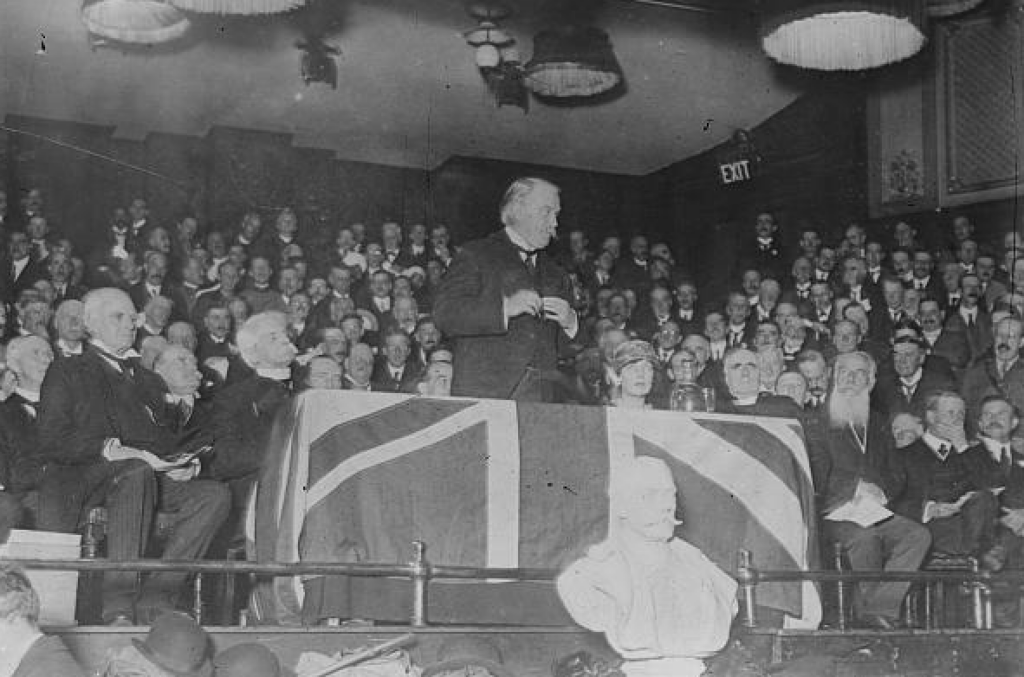
On 4 December 1916, the political crisis engulfing the British wartime coalition reached its breaking point, resulting in the resignation of H.H. Asquith as prime minister. Asquith’s downfall represented the gravest political crisis that Britain faced during the First World War. A fatal debate over the reconstruction of the executive paved the way for the succession of David Lloyd George and a decisive split in the Liberal Party.
The crisis was fuelled by dissatisfaction with Asquith’s governing style and the progress of the war – notably the catastrophic losses on the Somme from July to November 1916.
Senior figures, including Lloyd George, the secretary of state for war; Bonar Law, the colonial secretary and leader of the Conservative-Unionist bloc; and Sir Edward Carson, the leading Irish Unionist figure, had grown frustrated with Asquith’s alleged lethargy and indecision.
***
In May 1915, the shell and Dardanelles crises precipitated the formation of a wartime coalition government, with a prominent position afforded to Lloyd George as minister of munitions. In this capacity, Lloyd George oversaw a marked increase in the production of shells, from 70,000 a week in May 1915, to 238,000 a week by January 1916 – to 1,125,660 a week by July 1916.
Lloyd George’s mobilisation of British industry displayed both his political dynamism and administrative acumen. In July 1916, after Lord Kitchener was killed along with 736 others when HMS Hampshire struck a German mine while en route to Russia, Lloyd George was appointed secretary of state for war.
Carson resigned as attorney general on 19 October 1915 in protest at the government’s policy regarding the Balkans and the Gallipoli campaign. In his resignation statement, he suggested the government lacked a “clearly defined, well thought out and decisive policy”.
Lloyd George, speaking in December 1915, stated the government was often “too late” with its war policy. The remark came as the minister defended his approach to accelerating munitions production.
He told the commons: “The contract was entered into with labour. We are carrying it out. It can be done. I wonder whether it will not be too late? Ah! two fatal words of this War! Too late in moving here. Too late in arriving there. Too late in coming to this decision.
“Too late in starting with enterprises. Too late in preparing.”
He argued that unless the government could “quicken our movements, damnation will fall on the sacred cause for which so much gallant blood has flowed.”
As secretary of state for war, Lloyd George endeared himself to senior Conservatives with his support for conscription and opposition to mediation efforts (infamously advanced by Asquith ally Lord Lansdowne). Instead, he called for the defeat of the Central Powers with a “knock-out blow”.
These debates exacerbated the divide between Lloyd George and Asquith, while cementing the former chancellor as a rival locus of power in the wartime coalition.
Lloyd George and Asquith’s power struggle also implicated Liberal doctrine. The latter was denounced for adhering excessively to laissez-faire principles at the expense of the war effort. Asquith’s allies accused Lloyd George of betrayal and abandoning core liberal beliefs.
Leading Asquithians, notably John Simon, the home secretary, and Reginald McKenna, the chancellor, were opposed to conscription on these terms. The former resigned in January 1916 when conscription was eventually introduced for single men.
Bonar Law, the Unionist leader, was motivated in significant part by ructions in his party. The Unionist revolt over the sale of captured German assets in Nigeria, which were advertised beyond the empire, inspired his support for a more efficient government machine. The Unionist rebels, led by Carson, criticised any attempt to “hand over the fruits of the war to neutrals”.
***
These political tensions came to a head in November-December 1916.
Max Aitken (later Lord Beaverbrook), owner of the Daily Express, emerged as an active interlocutor for a new triumvirate comprising Lloyd George, Law and Carson. He served to reconcile political rivalries and coordinate their criticisms of Asquith’s administration.
Events moved rapidly. The triumvirate demanded a streamlined ‘war council’ of three or four members, independent of the cabinet, to prosecute the war with greater vigour. Crucially, they insisted that Asquith should not chair this body. This condition seemed designed to sideline the prime minister while retaining him as a figurehead.
On 1 December, Lloyd George presented a memorandum to Asquith outlining the war council proposal. It stated that the war committee would “have full powers, subject to the supreme control of the prime minister, to direct all questions connected with the war.”
It added: “Unless the cabinet, on reference by the prime minister, reverses the decision of the war committee, that decision to be carried out by the department concerned.”
Asquith initially rejected the idea. The prime minister said he did not share Lloyd George’s “dark estimate and forecast of the situation”, and rejected the suggestion that he should not chair the committee. Asquith maintained that the head of government “cannot be relegated to the position of an arbiter in the background or a referee to the cabinet”, and that the council’s decisions should be “subject to appeal to the cabinet”.
He insisted: “The cabinet would in all cases have ultimate authority.”
Lloyd George sent Asquith’s letter of refusal to Law, adding: “The life of the country depends on resolute action by you now.”
By 3 December, a tentative compromise appeared to have been reached. Asquith would retain supreme control but delegate daily operations to the council. The chairman, Lloyd George, would report directly to him. He could attend the meetings at his discretion – presiding when he did attend and setting the agenda when he did not.
A press notice was produced, stating: “The prime minister, with a view to the more effective prosecution of the war, has decided to advise His Majesty the king to consent to a reconstruction of the government.”
But political tensions were inflamed on the morning of 4 December by a leading article in the Times. The editorial provided a comprehensive account of the ongoing negotiations and portrayed the proposed arrangement as a humiliation for Asquith. Lloyd George was lavished with praise for having “finally taken his stand against the present cumbrous methods of directing the war.”
The editorial added that “the inclusion of Sir Edward Carson is believed to form an essential part of Mr Lloyd George’s scheme”. The former chancellor was entirely absolved of any accusations of “intrigue” or “personal ambition”.
The editorial concluded: “It was only a question of time before [Lloyd George] found it impossible to work with the old digressive colleagues under the old unwieldy system”.
Asquith was enraged. In a letter to Lloyd George, he said that the Times article showed “the infinite possibilities for misunderstanding and misrepresentation of such an arrangement as
we considered yesterday”.
He added: “Unless the impression is at once corrected, that I am being relegated to the position of an irresponsible spectator of the war, I cannot possibly go on.”
Lloyd George denied responsibility for the article. He expressed his hope that the prime minister would “not attach undue importance to these effusions”.
The former chancellor added: “I cannot restrain or, I fear, influence [owner of the Times Viscount] Northcliffe. I fully accept in letter and in spirit your summary of the suggested arrangement – subject of course to personnel.”
Asquith, emboldened by the support of loyal Liberal colleagues, decided to fight on. He reneged on his previous commitment and rejected the war council proposal entirely. In a second letter written to Lloyd George on 4 December, Asquith said he had decided to “accept the resignation of all my colleagues, and to form a new government on such lines as I should submit [to the king].”
He said that after a full consideration of the war committee proposal, he had come “decidedly to the conclusion that it is not possible that such a committee could be made workable and effective without the prime minister as its chairman”. Any other arrangement, he added, would be “incompatible with the retention of the prime minister’s final and supreme control.”
Lloyd George, writing the following day, responded that he had received Asquith’s letter “with some surprise”. The former chancellor observed that his longtime colleague had reneged on his “own proposals”.
He reiterated his “profound dissatisfaction” with the government’s prosecution of the war effort, observing that, “with the road to victory open in front of us, we have delayed and hesitated whilst the enemy were erecting barriers that finally checked the approach.”
He added: “There has been delay, hesitation, lack of forethought and vision.”
Lloyd George, strengthened by the support of senior Unionists, stated that he would not take up a post in Asquith’s new ministry. This effective resignation came as he wanted to “inform the people of the real condition of affairs and to give them an opportunity, before it is too late, to save their native land from a disaster which is inevitable if the present methods are longer persisted in.”
He concluded: “As I am fully conscious of the importance of preserving national unity, I propose to give your government complete support in the vigorous prosecution of the War; but unity without action is nothing but futile carnage, and I cannot be responsible for that. Vigour and vision are the supreme need at this hour.”
In response, Asquith said he could not accept Lloyd George’s account of events. He urged his departing colleague not to publish any part of their correspondence. Lloyd George said that he would not make this commitment, insisting that he should “give reasons for the grave step I have taken”.
Faced with the collapse of his coalition, Asquith’s response was to resign. It was a decision born of political aggression, not submission: he did not believe that either Lloyd George or Bonar Law could form a viable administration. Asquith therefore travelled to Buckingham Palace at 7:00 pm and tendered his resignation to King George V.
Over the course of four days, the apex of government had witnessed political challenge, attempted accommodation, acrimonious abrogation and the resignation of the government’s two most senior figures.
***
The king convened a conference at Buckingham Palace on 6 December in an attempt to broker a new coalition. Asquith refused to serve under anyone else, and Law could not command the support of the commons. The king therefore turned to Lloyd George as the only possible premier.
On the evening of 7 December, Lloyd George was appointed as prime minister.
He formed a small, five-member war cabinet, excluding most of the old Liberal leadership. The council featured three Conservatives, including Law as chancellor of the exchequer and commons leader, and one senior Labour politician in Arthur Henderson. That left just Lloyd George to make up the numbers.
Carson was appointed first lord of the Admiralty, but did not take up a seat on the war council.
As a result, the Liberals bisected: the Lloyd George-supporting faction was now allied with the Conservatives. (Winston Churchill joined the government in 1917.) Asquith continued to lead the Liberal Party from the opposition benches.
Northcliffe’s Daily Mail welcomed the change of government with the headline: “The Passing of the Failures.”
In a meeting on 8 December attended by loyal Liberal MPs, Asquith described his defenestration as “a well-organised, carefully engineered conspiracy”. The meeting concluded with a unanimous vote of confidence in Asquith as the leader of the Liberal Party.
In the House of Commons on 19 December, Lloyd George sought to justify his actions and the construction of his new administration. “You cannot run a war with a Sanhedrim”, he told MPs.
Asquith emphatically dismissed allegations that there had been “slackness or lethargy, infirmity of purpose, … want of thoroughness and want of whole-heartedness in our concentration upon our common task” in his administration.
He added: “Critics in time of war – I refer not merely to irresponsible slingers of mud, but honest and patriotic lookers-on – critics in time of war have the enormous dialectical advantage that, while they are free to speak and to write – some people think a little too free – the men whom they are attacking are of necessity, by the responsibilities of their position, by their duty to our military and naval advisers, by their obligation to our allies, to a large extent tongue-tied…
“I am quite content, when all the facts come to be disclosed, to leave my administration, and the part which I myself played in it, to the judgment of history.”
This new executive structure centralised power to an unprecedented degree. Lloyd George presided over the victory of the Allied Powers, and was heralded as “the man who won the war”.
The Liberal split, meanwhile, was not remedied in time for the watershed 1918 general election. A total of 127 coalition Liberals, identified by special coupons, were elected – alongside 379 Conservatives. Asquith’s Liberal opposition won just 36 seats.
***
Lloyd George resigned as prime minister on 19 October 1922, having been turfed out of office by his critics in the Conservative Party. He remains the last Liberal to have held the office of prime minister.
The controversy surrounding the Liberal statesman’s succession, and the methods he deployed to effectively defenestrate Asquith, remained live for some decades. Lloyd George’s death on 26 March 1945, aged 82, was an invitation for some of his former colleagues to reflect on his remarkable career.
Winston Churchill, the prime minister, hailed his predecessor for launching “the broad stream of social betterment and social security along which all modern parties now steer” – a reference to the 1909/1910 ‘People’s Budget’. But the Conservative prime minister raised eyebrows when he remarked that Lloyd George had “seized” power in 1916.
Churchill added: “I think it was Carlyle who said of Oliver Cromwell: ‘He coveted the place; perhaps the place was his.’…
“He was the greatest Welshman which that unconquerable race has produced since the age of the Tudors.”
Willie Gallacher, the Communist Party of Great Britain MP, cited Lenin, who “held the opinion that David Lloyd George was the greatest political leader this country had known.”

Politics.co.uk Newsletters
DAILY
Politics@Lunch
WEEKLY
Week in Review