‘Dementia tax’: Conservative manifesto launch sparks social care controversy
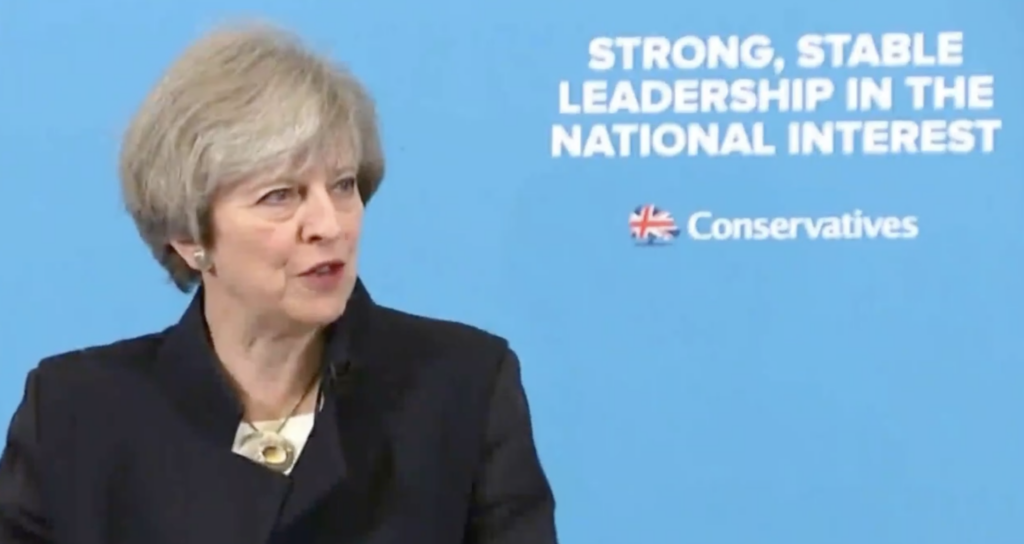
On 18 May 2017, Theresa May launched the Conservative Party manifesto for the snap general election, containing a major overhaul of social care funding. The policy, which was quickly dubbed the “dementia tax” by opponents, is widely regarded as an immense political error on the part of the incumbent prime minister.
***
May called a snap election on 18 April 2017, despite previous insistences she would not, with a view to capitalising on the Conservative Party’s large poll lead (as high as 20 points) over Labour. May calculated that an election would see her majority increase, thus strengthening her hand in the forthcoming Brexit negotiations.
The Conservative manifesto launch in mid-May, the third week of the election campaign, emphasised a shift away from the politics of austerity. The manifesto, entitled Forward, Together, appeared to reject the laissez-faire policies of the Tory-Liberal Democrat coalition and featured pledges for greater state involvement.
It stated: “We do not believe in untrammelled free markets. We reject the cult of selfish individualism. We abhor social division, injustice, unfairness and inequality. We see rigid dogma and ideology not just as needless but as dangerous.”
Speaking at the manifesto launch, staged in the Labour-held marginal constituency of Halifax, May vowed to tackle the five “giant challenges” of modern Britain, namely a strong economy, Brexit, healing social divisions, the ageing society, and technological change.
It was the manifesto’s policies to tackle the fourth “challenge” – the ageing society – that caused the greatest controversy.
The Conservatives vowed to replace the “triple lock” guarantee for the basic state pension and cut the winter fuel allowance. There was also May’s social care funding plan.
The manifesto proposal sought to “align” the funding systems for care at home and residential care. Under the plans for England, the value of an individual’s property would be included in the means test for receiving care in their own home.
The threshold, or “single capital floor”, below which people did not have to pay for care, was to be raised from £23,250 to £100,000. But the manifesto included no overall cap on the total amount an individual could be forced to pay for their care over their lifetime. Under these proposals, opponents argued, individuals with long-term conditions could have seen the vast majority of their assets, including their family home, consumed by care costs after their death.
The manifesto stated: “We believe this powerful combination maximises protection for pensioner households with modest assets, often invested in the family home, while remaining affordable for taxpayers.”
The policy, which would hit traditional Tory voters in the south of England hardest, suggested May was confident of victory come polling day. At the time of the manifesto announcement, Labour was reportedly trailing May’s party by 18 points in the polls.
The manifesto’s preparation was also secretive, with even cabinet ministers kept in the dark about its contents. The controversial social care funding policy was said to have been inserted at the last minute by May on the advice of Nick Timothy, her co-chief of staff.
***
May maintained that her manifesto was “upfront and honest” on the challenges Britain faced. But the backlash was immediate and severe.
John McDonnell, the shadow chancellor, said the “dementia tax” was part of a “Tory triple whammy for pensioners” – including the winter fuel allowance cut and abolition of the “triple lock”.
Norman Lamb, the Liberal Democrat health spokesman, said “elderly people the length of Britain will shudder at these care cost proposals”.
Andrew Dilnot, the author of the social care reforms accepted by the previous government, said he was disappointed by the proposals.
Dilnot stated: “There’s nothing you can do to protect yourself against care costs, you can’t insure it because the private sector won’t insure it, and by refusing to implement the cap that Conservatives are now saying they’re not going to provide social insurance for it.
“So people will be left helpless knowing that what will happen is if they’re unlucky enough to suffer the need for care costs, they’ll be entirely on their own until they’re down to the last £100,000, all of their wealth including their house.
“The analogy is a bit like saying to somebody you can’t insure your house against burning down, if it does burn down then you’re completely on your own, you have to pay for all of it until you’re down to the last £100,000 of all your assets and income.”
Conservative MP Bob Blackman said: “Clearly, there needs to be a limit on how much any individual or family should be required to pay.”
Tory candidates encountered a negative reception from voters on the doorstep.
May herself was confronted, politely, by a voter who said they were “unnerved” about the proposed changes.
The prime minister responded: “We think this is the best way, having looked at it, to enable people to stay in their homes because they won’t be worried about the cost of care because they know that will be sorted after they have died. But there will be a sum to pass on to their children.”
The Conservative-supporting press was similarly unconvinced. “Good deal or an Alz tax?”, the Sun asked. The Daily Mail reported a “backlash as social care shake-up is branded a dementia tax”.
***
Just four days after the manifesto launch, on 22 May, the prime minister was forced into an extraordinary U-turn. During a campaign event, she announced that a proposed green paper on social care would now include an “absolute limit” on care costs.
She claimed that the Conservative manifesto said “that we will come forward with a consultation paper, a government green paper. And that consultation will include an absolute limit on the amount people have to pay for their care costs… We will make sure there’s an absolute limit on what people need to pay.”
May also hit out at the “fake claims” issued criticising the policy.
Attempting to downplay the reversal, she famously insisted: “Nothing has changed. Nothing has changed.”
Labour scented blood and relentlessly assailed May over the U-turn.
Significantly, the Labour Party manifesto, entitled For the Many Not the Few, was well-received. It featured pledges to scrap tuition fees, nationalise England’s nine water companies, guarantee the triple lock for pensioner incomes, end to zero hours contracts, and re-introduce the 50p rate of tax on the highest earner.
Labour’s policy platform was published alongside a costings document, which was conspicuously lacking when it came to the Tory manifesto.
The Conservative Party’s botched manifesto launch severely damaged May’s standing; commentators and political opponents alike noted the glaring contradiction with her oft-repeated slogan, which promised “strong and stable” leadership. It also appeared to typify the Tory campaign’s misplaced overconfidence.
In the end, the Conservatives lost a net 13 seats and their majority at the 2017 election. Labour, meanwhile, made a net gain of 30 seats to finish on 262.
In the aftermath of the election, May’s two key political advisers, her joint chiefs-of-staff Fiona Hill and Nick Timothy, both resigned. Timothy took responsibility for the party’s botched social care announcement.
In an article for ConservativeHome, published on 10 June, he wrote: “I take responsibility for my part in this election campaign, which was the oversight of our policy programme. In particular, I regret the decision not to include in the manifesto a ceiling as well as a floor in our proposal to help meet the increasing cost of social care.
“But I would like to make clear that the bizarre media reports about my own role in the policy’s inclusion are wrong: it had been the subject of many months of work within Whitehall, and it was not my personal pet project.”
To remain in power, May entered into negotiations with the Democratic Unionist Party (DUP) over a confidence and supply agreement.
The prime minister resigned in May 2019 after failing – on three occasions – to gain the support of parliament for her Brexit deal.

Politics.co.uk Newsletters
DAILY
Politics@Lunch
WEEKLY
Week in Review
