Labour secures majority of three in second election of the year
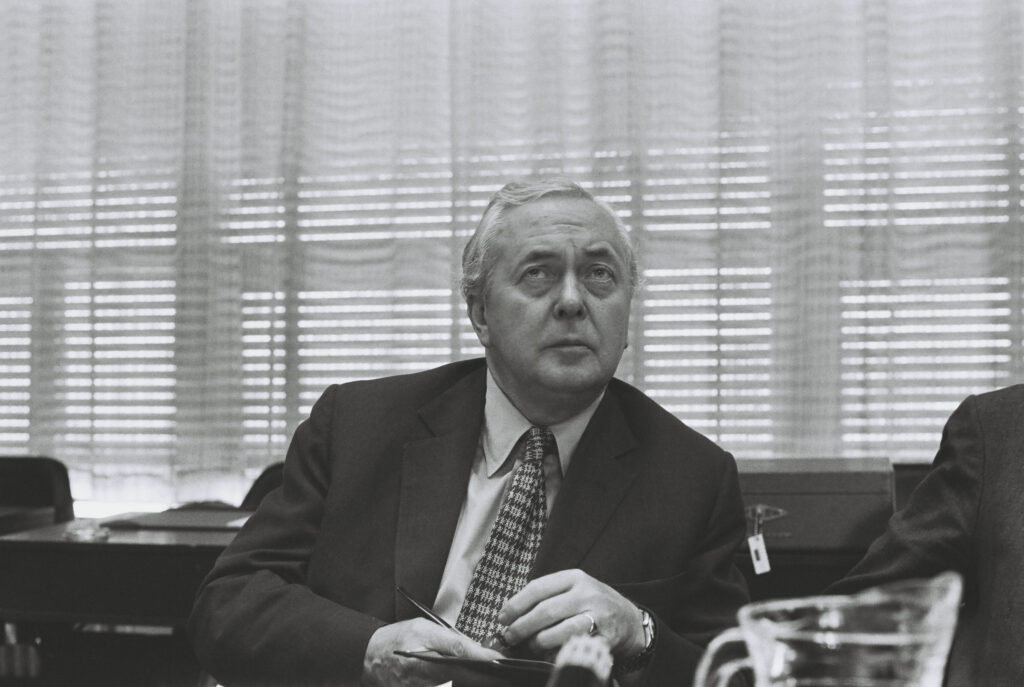
On 10 October 1974, the United Kingdom held its second general election of the year – the first time since 1910 that the country had gone to the polls twice within 12 months. The prime minister, Harold Wilson, called the election in an attempt to secure a working majority, having led a minority Labour administration since the February 1974 election.
The October election resulted in a frail Labour majority of three.
***
The February contest, called by Edward Heath as prime minister, produced the first hung parliament in the UK since 1929. The Conservatives won a slightly larger share of the popular vote (37.9%) than Labour (37.2%). But Wilson’s party secured four more seats, winning 301 seats. The Conservatives stood on 297.
The parliamentary arithmetic, with Labour 17 seats short of a majority, forced Wilson into a minority government – the first since 1929. It made another election effectively inevitable.
Announcing the snap election, Wilson acknowledged that the second national poll in a year represented a situation “very few people, politicians or not, would want to see at a time of grave economic difficulties.”
But he said that the February election made “the calling of another inevitable, and sooner rather than later.”
He added: “The economic crisis Britain faces is the gravest since the war – that was what we warned before and during the February campaign. We have to meet this crisis in a mood of determination, not in a spirit of pessimism or writing Britain down, and that is what this election is about.
“We in Britain have it in us to win through, and there is now evidence each week to show that the fight back has begun.”
The campaign was notably more subdued than the contest earlier in the year – which Heath, facing widespread industrial strife, fought on a “who runs Britain?” platform.
Turnout fell markedly, by six points (78.8% to 72.8%), from February 1974 to October 1974. This figure reflected an electoral fatigue in the country at large. The Conservative manifesto, Putting Britain First, was also leaked to the press before Wilson had even called the October election.
In the final days of the campaign, Heath – who remained leader of the Conservative Party despite its recent defeat – called for a government of “national unity”. The Tory leader vowed to form a coalition government even if his party won an overall majority. But this proposition did not take off.
Wilson retorted that coalition “would mean Con policies, Con leadership by a Con party for a con trick.”
Heath had kept a relatively low profile since his defeat in February, which had weakened his position significantly. In the 1974 electoral interregnum, the Tory leader had come under criticism within his party; Keith Joseph worked alongside one Margaret Thatcher, then the shadow environment secretary, to set up the Centre for Policy Studies (CPS).
Joseph, seen on the right of the Tory party as a possible leadership challenger, called for a break with the dominant Keynesian economic consensus.
Enoch Powell, the firebrand former Conservative MP, repeated the intervention he delivered in February, urging voters to support Labour. Powell supported Wilson’s promise to hold a referendum on Britain’s membership of the European Economic Community (EEC).
The Labour manifesto read: “The Labour government pledges that within 12 months of this election we will give the British people the final say, which will be binding on the government – through the ballot box – on whether we accept the terms and stay in or reject the terms and come out.”
Powell endorsed Labour in Britain while standing as a candidate for the Ulster Unionist Party (UUP) in Northern Ireland.
The UUP had broken with the Conservative Party over the imposition of direct rule in 1972, which briefly established a nationalist-unionist power-sharing executive.
Labour touted its record on industrial action, having settled the miners’ strike that helped collapse Heath’s government in February. The party also pointed to a “Social Contract” with the trade unions and measures to control inflation, which stood at around 20%.
The Labour manifesto read: “At the heart of this manifesto and our programme to save the nation lies the Social Contract between the Labour Government and the trade unions, an idea derided by our enemies, but certain to become widely accepted by those who genuinely believe in government by consent.”
Wilson’s party remained divided, however, over the matter of Europe. The issue split cabinet ‘big beasts’ including Roy Jenkins, Tony Benn, Shirley Williams and Michael Foot into europhile and eurosceptic blocs.
***
The results delivered a fragile victory for Wilson. Labour won 319 seats with 39.2% of the vote, while the Conservatives were reduced to 277 seats on 35.8%. It marked the Conservative Party’s worst performance since the 1918 general election.
Labour’s showing resulted in an overall parliamentary majority of just three seats. The Liberal Party, led by Jeremy Thorpe, saw its support dip slightly, returning 13 MPs. After advancing in the February election, Thorpe had hoped to break “the stranglehold of the present class-ridden two-party system.”
The October 1974 contest was a landmark moment for the Scottish National Party (SNP), which capitalised on its “It’s Scotland’s Oil” slogan to win 30% of the Scottish vote and 11 seats. Labour won 36.6% of the vote and 41 seats in Scotland.
The SNP’s strong performance presaged the fraught constitutional debates of the 1974-1979 parliament.
The racist National Front party stood 90 candidates and won 113,843 votes (0.4%).
Powell, having rejected an offer to stand for the National Front, returned to parliament as UUP MP for South Down.
Responding to the result, Heath called on the government to recognise “that 60% of the voters are against their policies of socialism.”
Heath’s latest electoral defeat, his third as Conservative leader, was ultimately fatal. He initially refused to stand down, but agreed to a rule change to enable a challenge to his leadership.
Keith Joseph did not stand for leader after he delivered a controversial speech on 19 October, suggesting that economically disadvantaged people should stop having so many children. Thatcher, his ideological ally, prevailed in the contest that followed. She became the party’s first female leader.
Notwithstanding the small margin of victory, the October 1974 contest produced Wilson’s fourth general election victory. He previously triumphed in 1964, 1966 and February 1974.
But Wilson and Labour, their microscopic parliamentary majority meant the party remained vulnerable to the exigencies of by-elections and defections.
The October 1974 election was also the fourth and final time Heath and Wilson did battle at the ballot box.
***
In March 1976, Wilson announced that he was resigning from office – a decision that took the country and most of his cabinet colleagues by surprise.
In a statement setting out his reasoning, Wilson first pointed to his long service as prime minister – “longer than that of any of my peacetime predecessors in this century”.
James Callaghan succeeded Wilson as PM after winning the second and final ballot of the 1976 Labour Party leadership contest. The 64-year-old foreign secretary defeated the candidate of the party’s left, employment secretary Michael Foot, by 176 votes to 137 following a swift two-week contest.
Callaghan inherited a precarious political and economic situation.
The country was in the grip of an economic crisis with high inflation; Labour, meanwhile, stood on the cusp of losing its majority in parliament. Shortly after entering Downing Street, Callaghan was forced to negotiate a deal with the Liberal Party, known as the Lib-Lab pact. He also came to rely on the votes of SNP MPs.
The collapse of these arrangements in 1979 precipitated a successful vote of no confidence in the Labour government.
Wilson remained in the House of Commons until retiring in 1983 when he was elevated to the House of Lords.
Upon his death in May 1995, Tony Blair described Wilson as “Labour’s most successful leader ever”.

Politics.co.uk Newsletters
DAILY
Politics@Lunch
WEEKLY
Week in Review