UUP
The Ulster Unionist Party (UUP) is a unionist political party in Northern Ireland. It is the oldest and was historically the most dominant unionist party, governing Northern Ireland continuously from 1921 until 1972.
The UUP’s electoral influence has diminished since the 1998 Good Friday Agreement, an accord it was instrumental in creating.
The party’s core ideology is based on civic unionism, promoting Northern Ireland as an integral part of the UK for the benefit of all its citizens. It is positioned as a more moderate alternative to its main unionist rival, the Democratic Unionist Party (DUP).
House of Commons representation: The UUP won one out of Northern Ireland’s 18 parliamentary constituencies and 12.2% of the vote in the 2024 UK general election.
House of Lords representation: There are three UUP peers in the House of Lords.
Northern Ireland Assembly: The UUP won nine out of 90 seats and 11.2% of the vote in the 2022 NI assembly election.
Local government representation: The UUP won 54 councillors across Northern Ireland’s 11 councils in the May 2023 local government elections, making it the fourth-largest party at local government level.
Who is the UUP leader?
The current leader of the Ulster Unionist Party is Jon Burrows, who took up the role in January 2026. Burrows, a former member of the Police Service of Northern Ireland (PSNI), represents North Antrim in the NI Assembly. He is a “co-opted” member of the assembly, having been selected to replace Colin Crawford as the MLA for North Antrim in July 2025. Under the co-option process, political parties fill vacancies in the Northern Ireland Assembly without holding a by-election.
Burrows contested the 2026 Ulster Unionist Party leadership election unopposed, following the resignation of incumbent Mike Nesbitt.
Nesbitt, who previously served as leader from 2012 to 2017, was himself elected unopposed to lead the UUP following a leadership contest in 2024. Upon standing down as leader, Nesbitt said he had completed the “short-term job of getting the party match fit for the forthcoming election campaign”.
He added: “That job is now done so the time is right to select the politician who will lead us into the May 2027 polls promoting our brand of confident, responsible unionism.”
Nesbitt was first elected to represent Strangford in the Northern Ireland Assembly in 2011. He was appointed to serve as Northern Ireland’s minister of health in May 2024.
The UUP has struggled to field leadership candidates in recent years, with the last contested leadership election having taken place in 2012. Burrows was the fifth Ulster Unionist leader in a row to take the position without a challenge since Mike Nesbitt beat John McCallister in 2012.
Doug Beattie, who led the UUP from 2021 to 2024, resigned after “irreconcilable differences” arose between himself and party officers over the party’s future direction. This followed a period of internal tension. His leadership was associated with a more progressive and liberal brand of unionism.
The process for electing the party leader is overseen by the Ulster Unionist Council, the party’s ruling body. If only one candidate is nominated, as has been common in recent years, they are deemed elected and are formally ratified at a meeting of the Ulster Unionist Council.
What does the UUP stand for?
The UUP’s foundational principle is the maintenance and promotion of Northern Ireland’s position within the United Kingdom. The party was a key architect of the Good Friday Agreement and the power-sharing institutions it established.
The party vision for unionism is generally said to be more inclusive and pluralistic than its rivals, such as the DUP and the Traditional Unionist Voice (TUV) party.
In its 2024 general election manifesto, the UUP said the union had “provided stability, security and a framework for progress, enabling Northern Ireland to thrive within the broader British family.”
The UUP’s manifesto for the 2022 NI assembly election argued that the party could unite “people regardless of religion, race, sexual orientation, class or traditional community background to build a better Northern Ireland.”
From 1905 to 1972, UUP peers and MPs took the Conservative Party whip at Westminster. During David Cameron’s leadership of the Conservative Party, the UUP formed an electoral alliance with its former close partners. Launched in 2009, the “Ulster Conservatives and Unionists” alliance stood candidates for the 2009 European Parliament election. The alliance soon collapsed, owing to a lack of electoral success and internal friction within the UUP.
A survey of UUP members conducted in January 2019 found that 67% were supportive of the Conservative Party.
Unlike the DUP and TUV, the UUP officially supported Remain in the 2016 referendum on the United Kingdom’s membership of the European Union (EU).
In a statement at the time of the referendum, the party declared: “The Ulster Unionist Party believes that on balance Northern Ireland is better remaining in the European Union, with the UK government pressing for further reform and a return to the founding principle of free trade, not greater political union.
“The party respects that individual members may vote for withdrawal on the 23rd of June.”
The UUP subsequently opposed the post-Brexit trading arrangements that were introduced under the Northern Ireland protocol, and amended by the Windsor framework. However, the party took a more pragmatic approach on these issues and opposed the DUP’s decision to collapse power-sharing in February 2022. “Northern Ireland has to have a say in that. We’ll only have a say if we have a government”, the then UUP leader, Doug Beattie, said at the time.
The UUP has since referred to the Windsor framework, which was negotiated to address issues with the original protocol, as a “broken system failing Northern Ireland”.
The party’s economic policy focuses on fiscal responsibility and reforming public services. The party’s 2024 election manifesto referred to an “aim to work with Westminster to gradually reduce corporation tax in Northern Ireland to 15%.”
The party added: “Furthermore, we advocate for a progressive approach to taxation, ensuring that the burden is distributed equitably and that those with the means to contribute more do so responsibly.”
In 2024, The UUP also called for the abolition of the two-child benefit cap.
The UUP supports the expansion of integrated education for children from all community backgrounds to foster “a culture of inclusivity and mutual respect.”
The party’s 2022 manifesto acknowledged “the persistent and unacceptable attainment gap at GCSE between Protestant and Catholic pupils entitled to free school meals and those not entitled to free school meals.”
The party generally adopts a more liberal stance on social issues than the DUP. The party’s 2024 manifesto expressed its support for “equality for the LGBTQ community” and “banning the practice of conversion therapy”.
Who votes for the UUP? (Demographics of support)
The following data is drawn from the 2022 Northern Ireland Life and Times (NILT) survey conducted by ARK, regarding first preference votes in the 2022 assembly election.
Age: Support for the UUP is higher among older age groups. The party secured 16% of the vote among those aged over 65, and 15% among the 55-64 age bracket.
The UUP performed relatively more poorly among younger voters, winning just 10% of the vote from 18-24 year olds. The party outperformed the DUP in this bracket, who secured 8% of the vote.
Gender: The UUP’s support was evenly matched at 12% among both men and women, according to the NILT survey.
Religion: The UUP’s voter base is almost entirely concentrated within the Protestant community. The UUP won 24% of the vote among Protestants, making them the second most popular party within that community (behind the DUP at 35%).
By contrast, the UUP secured only 1% of the vote among Catholics and 8% among those with no religion.
History of the UUP and emergence as a major force
1905-1922
The Ulster Unionist Council (UUC) was constituted formally at a meeting in the Ulster Hall, Belfast, on 3 March 1905. This event marked the effective inauguration of the Ulster Unionist Party as a permanent organisation, separate from existing Irish unionist political bodies. The body came to being with the express purpose of organising resistance to Irish home rule.
A powerful and enduring political institution, the UUC today serves as the UUP’s ruling council.
The party’s formation was the culmination of decades of opposition to the growing movement for Irish self-government. Following the defeat of the first two Gladstonian home rule bills in 1886 and 1893, unionists – who were predominantly Protestant and concentrated in the industrialised province of Ulster – sought to create a permanent organisation to defend the constitutional union with Great Britain.
A preliminary meeting, born of this opposition to home rule, was convened in December 1904.
Organised by North Armagh MP William Moore and Mid Armagh MP John Brownlee Lonsdale, the meeting passed the following resolution: “That an Ulster Unionist Council be formed, and that its objects shall be to form an Ulster union for bringing into line all local Unionist associations in the Province of Ulster with a view to consistent and continuous political action, to act as a further connecting link between Ulster Unionists and their parliamentary representatives; to settle in consultation with them the parliamentary policy, and to be the medium of expressing Ulster Unionist opinion as current events may from time to time require, and generally to advance and defend the interests of Ulster Unionism in the Unionist Party.”
In line with this mandate, on 3 March 1905, the first meeting of the UUC was convened. Formed under the presidency of James Hamilton, 2nd Duke of Abercorn, the original UUC consisted of 200 members, of which 100 were nominated by local unionist associations, 50 were nominated by the influential Orange Order and more than 50 were co-opted as “distinguished Unionists”. The council was served by a standing committee of 30 – 10 of whom were appointed by the leader of the Ulster Unionist Party at Westminster, and with 20 elected by the council.
It soon became the dominant force and focus of resistance in the Irish unionist community.
The UUC called for the “Unionists of Ireland” to “close up their ranks” in “emphatically declaring” their “determination… to oppose any scheme . . . that would place the loyal minority at the mercy of the disloyal majority”. Council members were also instructed to consider “all minor differences” subordinate to the all important question of the maintenance of the Union”.
In this regard, the alliance incorporated the diverse elements of opposition (Conservative, Liberal Unionist, and Irish Unionist), united by their shared dread of a semi-autonomous parliament situated in Dublin. Such an institution, the unionists feared, would threaten Ulster’s traditional freedom, religion and laws.
The initial Irish Unionist leadership was derived from beyond what would later become Northern Ireland. Colonel Saunderson, who died in 1906, was simultaneously leader of the Irish Unionist Alliance MPs and leader of the Ulster Unionist Council in Belfast. The foundation of the UUC marked a decisive reorientation of Unionism towards Ulster.
Under the leadership of figures such as Sir Edward Carson and James Craig, the UUC and UUP became the main vehicle for opposition to the Third Home Rule Bill (Government of Ireland Bill), which was introduced by H. H. Asquith’s Liberal government in April 1912.
On 28 September 1912, almost half a million Ulster Unionists signed the ‘Solemn League and Covenant’, pledging to resist Irish home rule by “all means which may be found necessary”. This covenant, orchestrated by Carson, demonstrated the depth of Ulster’s opposition to a Dublin-based parliament. Ulster unionists feared home rule would threaten their cultural and social position. This anxiety was captured by the slogan, first articulated by radical MP John Bright, that home rule would mean “Rome rule”.
The covenant was effectively formed of two parts: a declaration for men and a corresponding declaration for women. The 237,368 male signatories of the covenant pledged to use “all means which may be found necessary to defeat the present conspiracy to set up a home rule parliament in Ireland”.
The covenant solidified Unionist opposition to home rule and directly precipitated the formation of the Ulster Volunteer Force (UVF) in January 1913. The Ulster volunteers, a 100,000-strong force, provided the covenant with paramilitary support. It marked the first step in the signatories upholding their vow to resist home rule by “all means which may be found necessary”. The covenant and surrounding theatre effectively triggered what is now known as the home rule crisis, which brought Ireland to the brink of civil war.
In March 1914, the government’s authority and ability to manage the crisis was curtailed by the “Curragh incident”, when British army officers stationed in Ireland threatened to resign rather than move against the UVF.
In April, the Larne gun-running armed the UVF with a further 25,000 rifles and 3-5 million rounds of ammunition – all smuggled from the German Empire.
Eventually, the Liberal government was convinced that any home rule scheme should provide for some form of exclusion or partition.
From 21-24 July 1914, representatives of nationalism and unionism were invited to Buckingham Palace to consider the crisis. The Buckingham Palace Conference, convened by George V, was attended by Asquith (Liberal), David Lloyd George (Liberal), John Redmond (nationalist), John Dillon (nationalist), Carson (Unionist), James Craig (Unionist), Bonar Law (Conservative) and Lord Lansdowne (Conservative).
But the Buckingham Palace Conference, and indeed the home rule crisis as a whole, was overtaken by developments on the continent. The Third Home Rule Bill, which became the Government of Ireland Act 1914, was successively suspended in a series of six month periods until 1920, when it was repealed by new home rule legislation.
The Government of Ireland Act 1920, or Fourth Home Rule Bill, envisioned that Northern Ireland (six north-eastern counties in Ulster) and the south of Ireland (the 32 counties that would later constitute the Irish free state) would separately exercise self-government in the United Kingdom.
However, the Irish War of Independence (1919-1921) ultimately resulted in the Anglo-Irish Treaty 1921 and the Irish Free State Constitution Act 1922.
Northern Ireland had the option to opt in or out of the Irish Free State. The unionist government, led by James Craig as prime minister, chose the latter option.
On 7 December 1922, the parliament of Northern Ireland agreed on the wording of the following message: “We, your Majesty’s most dutiful and loyal subjects, the Senators and Commons of Northern Ireland in Parliament assembled, having learnt of the passing of the Irish Free State Constitution Act, 1922… do, by this humble Address, pray your Majesty that the powers of the Parliament and Government of the Irish Free State shall no longer extend to Northern Ireland.”
1963-1972
The UUP enjoyed hegemonic control of the Northern Ireland state apparatus.
Discrimination at the expense of the Catholic minority community – notably in housing, policing, employment and electoral practices (gerrymandering) – was embedded in Northern Ireland’s governance and public life. These practices helped sustain unionism’s control, and the UUP’s position as the sole and effectively unchallenged party of government in Northern Ireland.
Terence O’Neill took office as Northern Ireland prime minister and UUP leader in 1963, succeeding Basil Brooke (1st Viscount Brookeborough).
O’Neill, a reforming prime minister and Unionist, set out to transform Northern Ireland’s economy and social structure with a programme of modernisation.
In 1965, O’Neill established the Ministry of Development to this end. He also initiated cross-border talks with the Republic of Ireland, culminating in his historic meetings with Irish Taoiseach Seán Lemass in January 1965. Two years later, O’Neill travelled to Dublin to meet Lemass’ successor, Jack Lynch. These marked the first official meetings between leaders from both parts of Ireland since the 1920s.
O’Neill’s programme of reform and gestures provoked a backlash within unionism from figures like Ian Paisley, the leader of the Free Presbyterian Church. In 1967, O’Neillite unionist MP George Forrest was pulled from a Twelfth of July platform in Coagh and kicked unconscious by members of the Orange Order.
O’Neill’s reforms also coincided with, and responded to, an increasingly assertive civil rights movement, which demanded reform and an end to discrimination.
On 5 October 1968, a civil rights demonstration organised by the Northern Ireland Civil Rights Association (NICRA) and the Derry Housing Action Committee (DHAC) marched through Derry. The march, which had been banned by William Craig, the minister of home affairs, was violently suppressed by the Royal Ulster Constabulary (RUC). Footage of the baton charges were broadcast worldwide.
The British prime minister, Harold Wilson, summoned O’Neill to Downing Street. He applied pressure on O’Neill to go further in his reforms, threatening to introduce direct rule from Westminster if order could not be restored.
O’Neill responded with his five-point reform programme on 22 November 1968. This included concessions such as an independent ombudsman to investigate complaints against government departments, a new ‘development corporation’ to replace the Londonderry corporation (which was known for gerrymandering), and new guidelines for housing allocations based on need. However, it notably failed to include “one man, one vote” for local government elections – a key demand of the civil rights movement.
O’Neill, standing between the growing demands of the civil rights movement and the intransigence of hardline Unionist opposition, followed this reform programme with a famous televised address. His “Ulster stands at the crossroads” broadcast was an appeal to moderate, especially unionist, opinion.
In aristocratic tones, the UUP prime minister began: “Ulster stands at the crossroads. I believe you know me well enough by now to appreciate that I am not a man given to extravagant language. But I must say to you this evening that our conduct over the coming days and weeks will decide our future.”
He concluded: “And now a further word to you all. What kind of Ulster do you want? A happy and respected Province, in good standing with the rest of the United Kingdom? Or a place continually torn apart by riots and demonstrations, and regarded by the rest of Britain as a political outcast?…
“If you should want a separate, inward-looking, selfish and divided Ulster, then you must seek for others to lead you along that road. For I cannot and will not do it.”
Two days later, on 11 December 1968, Craig was sacked as minister of home affairs over his known opposition to O’Neill’s programme.
The Northern Ireland civil rights movement remained active. On 1 January 1969, a group named People’s Democracy, associated with the activism of Bernadette Devlin, began a four-day march from Belfast to Derry. On the fourth day, it was attacked by a loyalist mob at Burntollet Bridge. The RUC officers failed to intervene.
Brian Faulkner resigned as minister of commerce on 24 January 1969. He opposed O’Neill’s establishment of an inquiry (the Cameron commission) to investigate the causes of “the violence and civil disturbance in Northern Ireland on and since 5 October 1968”.
Faced with collapsing support in his own party, O’Neill made a final gamble. He called a surprise general election in February 1969. A total of 27 pro-O’Neill unionists were elected, versus 12 who were either undecided or considered anti-O’Neill unionists.
The result meant O’Neill had failed to secure a clear majority to pass his reforms.
Paisley, standing in O’Neill’s Bannside seat, came within 1,414 votes of defeating the prime minister. It marked the first time the seat had been contested since 1945. O’Neill, who was first elected to the Northern Ireland House of Commons in 1946, had never before faced a challenge.
On 23 April, the proposal to introduce universal adult suffrage in local government elections in Northern Ireland was passed by 28 votes to 22, accepting the demand for “one man, one vote”. James Chichester-Clark, the minister of agriculture, resigned in protest.
On 28 April 1969, O’Neill resigned as prime minister. It came after a series of bomb explosions carried out by the Ulster Volunteer Force (UVF).
O’Neill was succeeded by Chichester-Clark, who defeated Faulkner in the 1969 UUP leadership election.
On 14 August 1969, the British government deployed troops onto the streets of Northern Ireland, marking the beginning of the British Army’s longest continuous operation, Operation Banner. The preceding days had seen intense street fighting in Derry/Londonderry between nationalist residents of the Bogside area and the RUC.
Initially, nationalists welcomed the army’s deployment. The arriving forces were viewed as an impartial peacekeeping force, and even as protectors against the RUC and loyalist rioters. Such sentiment was symbolised by scenes of cheering and singing as the soldiers entered Derry. This warm welcome was short-lived. Nationalist hostility to the British army was fuelled by the Falls Curfew (1970), Operation Demetrius (the introduction of internment in 1971) and Bloody Sunday (1972).
Operation Banner was initially intended as a “limited operation” to restore order. But it signalled the beginning of a larger role for the UK government in Northern Ireland.
Paisley was elected as the MP for North Antrim in the 1970 United Kingdom general election on a Protestant Unionist Party platform, defeating UUP incumbent Henry Clark.
The Alliance Party of Northern Ireland (APNI) was formally established on 21 April 1970. The party grew out of the New Ulster Movement, which was formed to support O’Neillite candidates at the February 1969 Northern Ireland general election. The Alliance Party’s founding members were mostly moderate unionists, therefore, including former members of the UUP.
Facing political threats on left and right, and with the situation continuing to deteriorate, Chichester-Clark resigned as Northern Ireland prime minister and UUP leader in March 1971. He was succeeded by Brian Faulkner.
In September 1971, Paisley co-founded the Democratic Unionist Party (DUP). The DUP provided an institutional platform for a more resistant or hardline unionism – loyalism – rooted in a not-an-inch, never surrender ethos.
The DUP evolved from the Protestant Unionist Party, which itself had emerged from the Ulster Protestant Action movement. Its development owed to the street disturbances of the 1960s, and loyalist opposition to the civil rights movement – which Paisley was instrumental in organising. The party therefore exhibited a more class-based and populist image than the predominant UUP.
1972-1985
On 30 March 1972, the UK government formally suspended the parliament of Northern Ireland and imposed direct rule from Westminster.
The decision marked the culmination of a political crisis between London and Belfast over the deteriorating security situation. Following the events of Bloody Sunday on 30 January when British soldiers shot 26 unarmed civilians, the Conservative prime minister, Edward Heath, concluded that his government should take full responsibility for law and order in Northern Ireland to have any chance of finding a political solution.
Faulkner was summoned to London on 24 March 1972. Heath informed him of his decision that security policy would be transferred to Westminster. Faulkner and his cabinet resisted, refusing to maintain government without security powers. Faced with this impasse, the entire Northern Ireland government resigned.
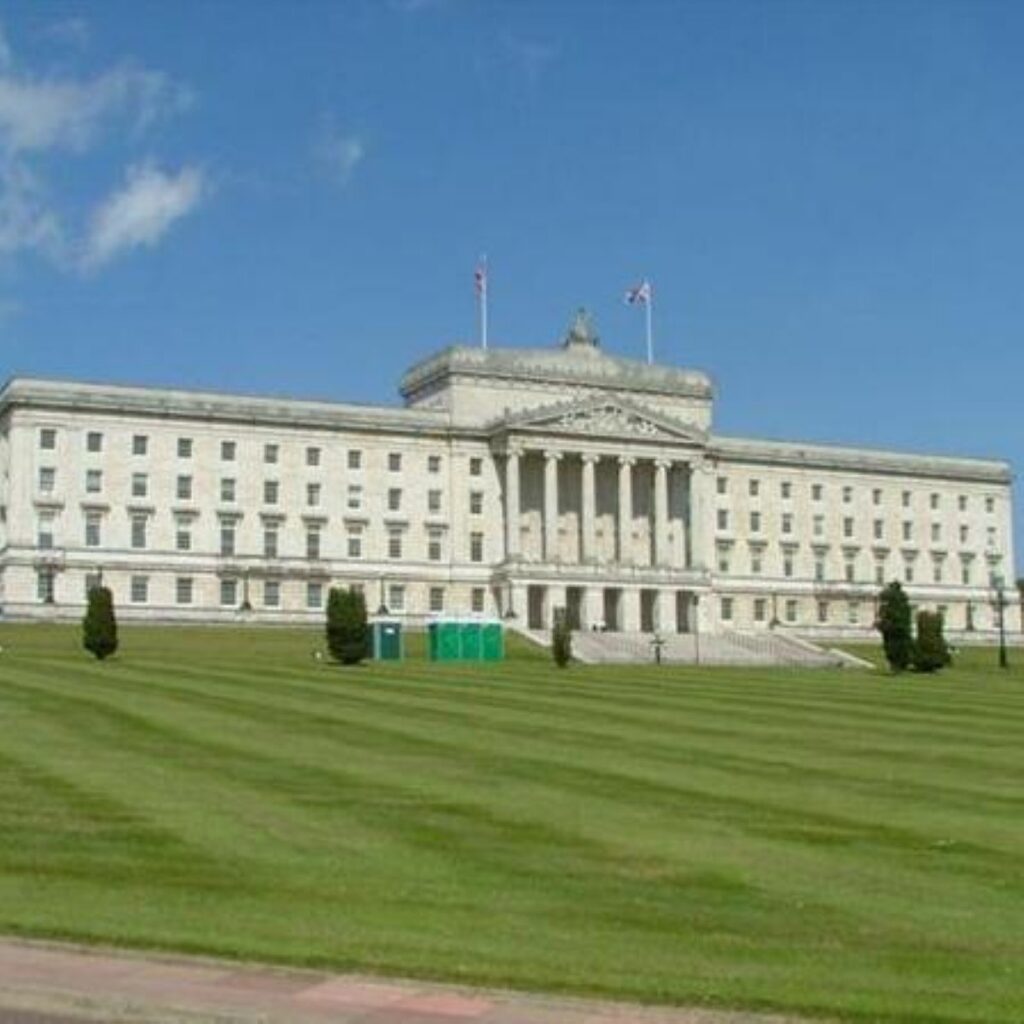
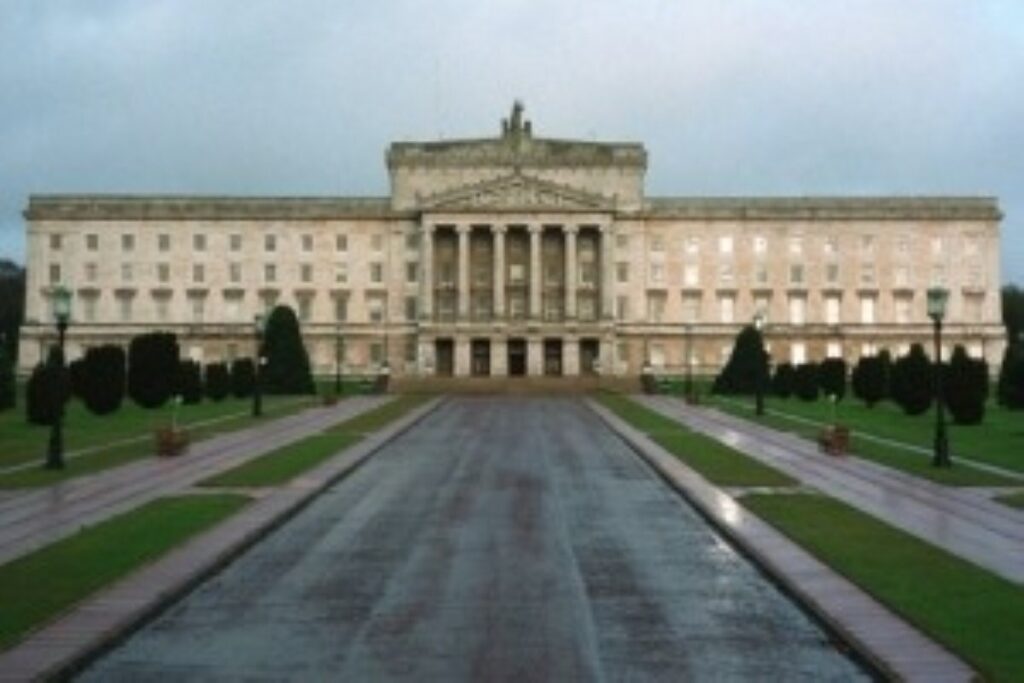
Stormont met for the final time on 28 March 1972. Faulkner marked the occasion with an address to a crowd of around 100,000 people from the first-floor balcony of parliament buildings.
He declared: “We feel that we, in our endeavour to provide just government in Ulster, have been betrayed from London.”
Rafton Pounder, the UUP MP for Belfast South, argued that direct rule represented the “internment of Stormont”.
In the end, the provisions set out in the Northern Ireland (Temporary Provisions) Act were anything but. The Northern Ireland Constitution Act, passed a year later, permanently abolished the parliament the 1972 act had indefinitely suspended.
Stormont, as it had been known – a majority-rule, unionist-dominated parliament – was no more.
The UUP responded by resigning the Conservative whip at Westminster. The party said Heath had acted “without taking its party colleagues in Northern Ireland into confidence and consultation”.
On 8 March 1973, Northern Ireland held its first referendum on its constitutional status – a “border poll” that resulted in an overwhelming, but in effect meaningless, vote to remain part of the United Kingdom. The poll, which represented the first time that a major referendum had been held in any region of the United Kingdom, was marked by a mass boycott from the nationalist community. It duly produced an almost unanimous majority vote in favour of maintaining the Union with Britain.
The border poll was followed by a white paper, Northern Ireland Constitutional Proposals, published on 20 March 1973. It proposed a devolved power-sharing executive, supported by an assembly, and a ‘Council of Ireland’ to consider cross-border matters with the Republic of Ireland.
Faulkner led the Sunningdale negotiations on behalf of the UUP, and was appointed as chief executive of Northern Ireland under the scheme in January 1974.
However, the agreement’s cross-border element was fiercely opposed by loyalists and hardline unionist politicians, led by Harry West, Paisley and Craig, who viewed it as a step towards a united Ireland. The so-called ‘Dublin-dimension’, it was feared, would see the unionist community “trundled into a United Ireland”.
In January 1974, Faulkner was deposed as leader of the UUP, and replaced by West.
At the February 1974 general election, eleven United Ulster Unionist Council (UUUC) MPs were returned. The UUUC, which comprised unionist opponents of the Sunningdale Agreement, secured the vast majority of Northern Ireland’s available seats (11 out of 12). The campaign slogan of the UUUC, “Dublin is just a Sunningdale away”, captured the concerns of the region’s unionist community.
Seven UUP, three Vanguard Unionist Progressive Party (VUPP), and one DUP MPs were elected. The UUUC won 58.3% of the vote, undermining the legitimacy of the Sunningdale Agreement and of Faulkner’s position.
On 14 May, a motion condemning the cross-border Council of Ireland was defeated in the Sunningdale assembly by 44 votes to 28. A coalition of loyalist paramilitaries and workers, known as the Ulster Workers’ Council (UWC), responded by calling a general strike to begin the following day.
The strike brought Northern Ireland to a standstill. UWC barricades blocked roads, and intimidation was used to stop people from going to work. Most critically, electricity supplies were also disrupted with rotating four-hourly power cuts. The British government, led by Harold Wilson, refused to negotiate with the UWC and declared a state of emergency.
On 28 May, with Northern Ireland crippled by the UWC strike, Faulkner and his unionist colleagues resigned from the Sunningdale executive. The power-sharing body, having failed to win cross-community support, collapsed.
In the October 1974 general election, Enoch Powell, the firebrand former Conservative MP, stood successfully as a UUP candidate in South Down. Powell left the Conservative Party in February 1974 over his opposition to Heath’s support for the European Economic Community (EEC).
The Sunningdale assembly was prorogued on 30 May, but not officially abolished until 29 March 1975. Responsibility for the government of Northern Ireland thus reverted to the British parliament under the arrangements for direct rule.
The unity of anti-Sunningdale action effectively killed the prospect of power-sharing for the best part of three decades. The Northern Ireland Constitutional Convention (1975) and a second Northern Ireland Assembly (1982-86) proved unsustainable solutions to the region’s political and security situation.
On 23 November 1985, a massive unionist demonstration took place at Belfast City Hall to protest against the Anglo-Irish Agreement, which had been signed eight days earlier by Margaret Thatcher, the British prime minister, and Garret FitzGerald, the Irish Taoiseach. The rally drew an estimated crowd of over 100,000 people, making it one of the largest political gatherings in the history of Northern Ireland.
The agreement affirmed that the two governments would support any future wish by the people of Northern Ireland to enter into a united Ireland. It recognised the “present wish of a majority of the people of Northern Ireland” to remain in the union, but declared that “if in the future a majority of the people of Northern Ireland clearly wish for and formally consent to the establishment of a united Ireland, they will introduce and support in the respective parliaments legislation to give effect to that wish.” Critically, the agreement granted the Republic of Ireland a formal consultative role in the governance of Northern Ireland through a new Anglo-Irish Intergovernmental Conference.
Following the signing of the agreement at Hillsborough Castle on 15 November 1985, unionist leaders withdrew from advisory boards and threatened to paralyse local government by refusing to set rates. On 16 November, the Northern Ireland Assembly – established in 1982 according to a scheme of ‘rolling devolution’ – voted by 44 votes to 10 for a motion calling for a referendum to be held on the agreement.
The ‘Ulster Says No’ rally formed part of a broader strategy of non-cooperation and civil disobedience orchestrated by the two main unionist parties: the UUP led by James Molyneaux, and Paisley’s DUP.
Molyneaux, considered the quiet man of Ulster politics, told the crowd: “Mr King has alleged that we no longer represent your views – he has alleged that in your hearts you really like the Anglo-Irish Agreement, well, do you?”
But the event is remembered for Paisley’s contribution, which was typical of his not-an-inch unionism and soaring rhetorical skill.
On 17 December 1985, less than a month after the rally, all 15 unionist MPs resigned their seats in the House of Commons simultaneously. This unprecedented move forced a series of by-elections, which the unionists framed as a de facto referendum on the agreement. It came after the UK government rejected unionist calls for a plebiscite on the agreement. A total of 14 out of 15 Unionist MPs secured re-election.
The Anglo-Irish Agreement is today seen as representing a pivotal moment in the Northern Ireland peace process. Crucially, it also signalled to unionists that the British government was willing to face down and repudiate their protests with regard to nationalist representation. It established the principle of consent, as to the governance of Northern Ireland, and ended the prospect of any return to simple majority rule.
1998-2003
On 10 April 1998, Good Friday, after marathon all-party talks in Belfast, a historic peace accord for Northern Ireland was finally reached. The Good Friday Agreement (GFA), also known as the Belfast Agreement, established a new political framework designed to end 30 years of violent conflict and create a lasting and inclusive settlement.
The deal, which had been brokered by the British and Irish governments and chaired by the US special envoy, senator George Mitchell, was the culmination of years of complex and often fraught negotiations. It followed a full 700 days of negotiations.
Its central pillar was the creation of a new, devolved Northern Ireland Assembly and a power-sharing executive, inviting unionists and nationalists to govern together. The accord also established a new ‘North-South’ ministerial council to “bring together those with executive responsibilities in Northern Ireland and the Irish Government” in order to “exchange information, discuss and consult with a view to co-operation on matters of mutual interest”.
In Northern Ireland, the agreement was spearheaded by the UUP leader, David Trimble, and the Social Democratic and Labour Party leader, John Hume. The two leaders jointly won the 1998 Nobel Peace Prize.
Of the GFA, Trimble commented: “I see a great opportunity for us to start a healing process… We know that the fundamental act of union is there, intact.”
The deal was subsequently endorsed in referendums in both Northern Ireland and the Republic of Ireland. It was endorsed by 71% of the vote in Northern Ireland and 94% in the Republic.
As in previous decades, the DUP remained the primary political vehicle for unionists opposed to power-sharing.
The assembly met for the first time on 1 July 1998; Trimble and SDLP deputy leader Seamus Mallon were elected as first minister and deputy first minister respectively.
The decision to sign the agreement caused a split within the party. In 2003, future DUP leader Sir Jeffrey Donaldson resigned from the party in protest and joined the DUP.
In a statement, Donaldson said: “I have been a member of this party for over 20 years, but it is not the party I joined. It’s a party that has abandoned its principles. It is a party which can no longer command the support of a clear majority of unionists.
“I do not see the Ulster Unionist Party ever again being the largest party in Northern Ireland.”
In the years following the Belfast Agreement, the DUP steadily eroded the UUP’s dominance, emerging as the largest unionist party in the 2003 Northern Ireland Assembly election. In 2003, Sinn Féin simultaneously supplanted the SDLP as the predominant representative of nationalism in Northern Ireland.
In March 2007 – in a moment that would have once been unthinkable – Ian Paisley and Sinn Féin’s Gerry Adams publicly announced an agreement to form a power-sharing government. The private negotiations that preceded the announcement were the first time the two parties had ever held direct talks.
This move cemented the DUP’s transition from a party of protest to a party of government. The Ulster Unionist Party has yet to recover its former dominance within unionism.