John Major launches ‘Back to Basics’ campaign
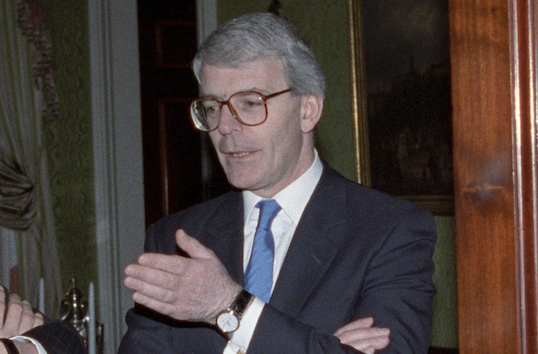
On 8 October 1993, the prime minister, John Major, used his keynote speech to the Conservative Party conference in Blackpool to launch a new campaign under the theme “Back to Basics”. The speech represented an seriously ill-fated attempt to reset Major’s embattled premiership.
The campaign was styled as a response to rising crime and what he described as a decline in traditional moral and social values. The Conservatives, he declared, were the only party capable of restoring order and rolling back the permissiveness of the 1960s.
***
Major adopted this classically conservative strategy in the hope it could unite his party, which was divided over Europe and still recovering from the trauma of ‘Black Wednesday’.
Addressing Conservative delegates, Major began by noting recent infighting over Europe and the Maastricht Treaty. “Disunity leads to opposition”, he declared.
“Not just opposition in Westminster, but in the European parliament and in town halls and county halls up and down this country.
“Of course we won’t agree on every single aspect of policy. No one expects that. We’re a democratic party with a whole range of lively ideas. But I think you’ll agree with me upon this – people look to us for common sense and for competence and we have a responsibility to you and to the people who put us in parliament to show those qualities day after day.”
He added: “And if agreement is impossible, and sometimes on great issues it is difficult, if not impossible, then I believe I have the right, as leader of this party, to hear of that disagreement in private and not on television, in interviews, outside the House of Commons.”
Major then broadened the focus of his address, professing to speak to the country beyond the conference hall. He said that “many people, particularly those of you who are older” now see “things around you in the streets and on your television screens which are profoundly disturbing”.
He referred to a “world that sometimes seems to be changing too fast for comfort”.
He cited examples including the replacement of terraces with “tower blocks” that had become “rat runs for muggers”, the removal of “traditional subjects – grammar, spelling, tables” in schools, and the idea that the family was “out of date”.
He also condemned the belief that “criminal behaviour was society’s fault, not the individual’s.”
Such “fashionable” beliefs, he said, were “wrong, wrong, wrong.”
Major declared that it was “time to get back to basics, to self-discipline and respect for the law, to consideration for others, to accepting a responsibility for yourself and your family and not shuffling off on other people and the state.”
The prime minister vowed that an “attack on crime” would be the “centrepiece of next year’s legislation.”
He concluded by stating the “clear and simple” of his speech: “We must go back to basics”.
He added: “We want our children to be taught the best, our public services to give the best, our British industry to be the best and the Conservative Party will lead the country back to those basic rights across the board.
“Sound money, free trade, traditional teaching, respect for the family and respect for the law. And above all, we will lead a new campaign to defeat the cancer that is crime.”
***
The 62-minute speech was initially well-received in the conference hall. However, its emphasis on “traditional values” soon emerged as a glaring weakness for the government which, contemporaries observed, struggled to live up to its own pronouncements on permissiveness.
The proposed campaign was broad in its emphasis, embracing a return to traditional standards in education and a tougher line on law and order. But whatever Major’s intention, it was widely interpreted by the media as a campaign about morality.
In January 1994, Major explicitly stated that the campaign was not “a crusade about personal morality”. However, the speech’s traditionalist tenor ultimately left the government vulnerable to accusations of hypocrisy.
In the years that followed, a series of Conservative MPs and ministers were implicated in sex scandals.
At the time of Major’s conference speech, Steven Norris, a junior transport minister, was already facing press revelations of simultaneous affairs with multiple women.
The “Back to Basics” speech also prompted the media to highlight previous Conservative scandals, such as the 1992 resignation of David Mellor as national heritage secretary two months after the revelation he had conducted an extramarital affair. Major had initially backed Mellor.
In January 1994, Tim Yeo was forced to resign as environment minister. Yeo, who had spoken of reducing single-parent families, was forced to step down after admitting he had fathered an illegitimate child.
He was the first of many ministerial casualties after Major’s “Back to Basics” speech.
Moreover, the scandals were not limited to personal morality. In October 1994, the Guardian alleged that Conservative MPs Neil Hamilton and Tim Smith had accepted payments from Mohamed Al-Fayed, the owner of Harrods, in exchange for tabling parliamentary questions – a controversy that became known as the “cash-for-questions” scandal.
Smith and Hamilton both resigned as government ministers over the scandal. The latter denied the allegations.
This controversy prompted Major to establish the committee on standards in public life, chaired by Lord Nolan, to review ethical standards and financial conduct among MPs and public officials. This inquiry led to the famous ‘Nolan principles’ in 1995.
Arguably the most high-profile resignation was that of Jonathan Aitken, the chief secretary to the Treasury. In July 1995, he left his cabinet post to sue the Guardian after the paper had published allegations of significant impropriety. He vowed in a press conference to wield “simple sword of truth and the trusty shield of British fair play”. His libel case collapsed, however, and Aitken was later convicted of perjury and jailed.
The sleaze scandals rolled on until the 1997 general election.
Each story of Tory impropriety – from financial sleaze to sexual indiscretion – was set against Major’s pronouncements in his October 1993 speech.
Launching his campaign in 1993, Major had spoken of “neighbourliness, decency [and] courtesy”. All else being equal, sleaze can prove politically costly. But such accusations now carried an added burden: charges of hypocrisy.
Major’s 1993 speech and subsequent revelations thus contributed to the perception of a Conservative government in terminal decline.
***
In June 1995, Major resigned as leader of the Conservative Party, triggering an immediate leadership contest. Speaking in the garden of 10 Downing Street, Major said his patience had been exhausted with the constant division and relentless leadership speculation. The first and final ballot, held after a short campaign on 4 July, saw Major win with 218 votes to Redwood’s 89.
However, the “put up or shut up” gambit – like his ‘Back to Basics’ strategy – failed to address either the Conservative Party’s deep ideological wounds or the series of sleaze scandals that would ultimately contribute to its landslide defeat in 1997.
On 1 May 1997, the Labour Party, led by Tony Blair, won a landslide general election victory, ending 18 years of Conservative rule. The result was the most decisive for any party since 1945, with Labour securing a House of Commons majority of 179 seats.
Blair’s party won 418 seats, its highest ever total, while the Conservatives were reduced to just 165 seats – their worst result since 1906. The landslide represented a swing of 10.3% from the Conservative to Labour.
It was revealed in 2002 that Major was revealed to have engaged in a four-year extramarital affair with a fellow Conservative MP, Edwina Currie, during the 1980s. The affair had ended before he became prime minister. Its disclosure, courtesy of Currie’s diaries, led the former minister to describe the “Back to Basics” campaign as “absolute humbug”.
Speaking in 2017, Major conceded his “Back to Basics” slogan had been counter-productive.
He said: “[Slogans] can mislead. I once used the phrase back to basics and it was taken up to pervert a thoroughly worthwhile social policy.”

Politics.co.uk Newsletters
DAILY
Politics@Lunch
WEEKLY
Week in Review