Britain forced out of ERM in ‘Black Wednesday’ crisis
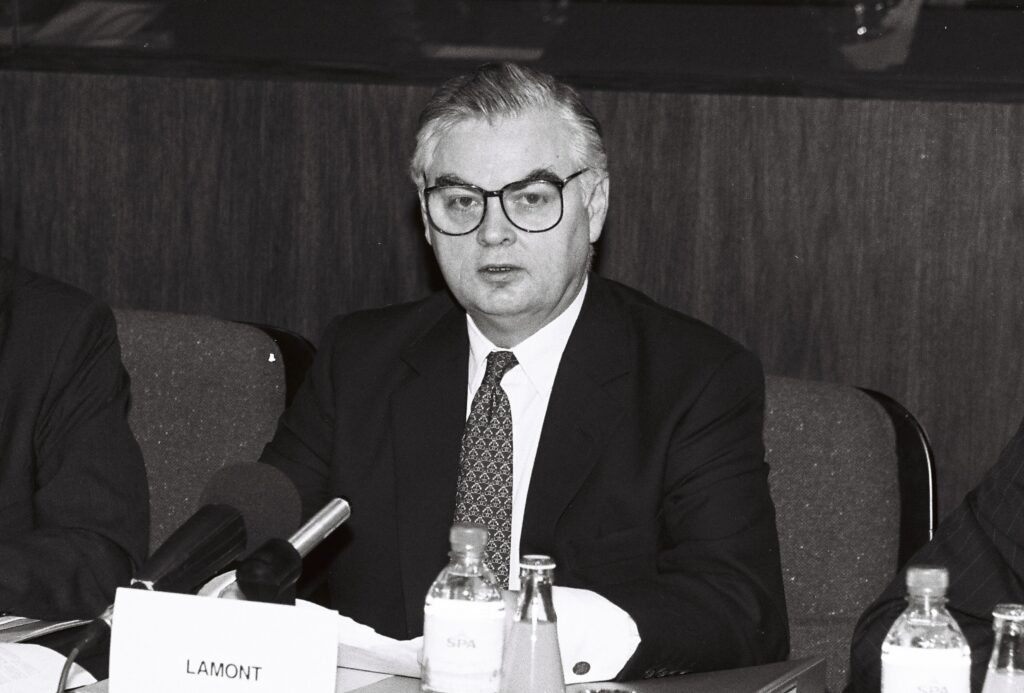
On 16 September 1992, the Conservative government of John Major was forced to withdraw the pound sterling from the European Exchange Rate Mechanism (ERM) after a day of financial turmoil.
The event, dubbed ‘Black Wednesday’, shattered the government’s reputation for economic competence and cost the UK taxpayer an estimated £3.3 billion. It came only five months after the 1992 general election returned a surprise Conservative majority.
***
The UK joined the ERM in October 1990 as the central plank of the Conservative government’s anti-inflation strategy, pegging the pound to the German Deutsche Mark at a rate of DM 2.95. However, the high interest rates required to maintain this peg, coupled with a deep domestic recession, put the pound under immense pressure.
In the weeks leading up to the crisis, international currency speculators – most famously the financier George Soros’ Quantum Fund – built up a significant short position in sterling. These speculators then prepared to sell off sterling, betting that the British government could not sustain the overvalued exchange rate.
The crisis came to a head on 16 September. In an attempt to defend the pound’s position as it tumbled through its ERM floor, the Bank of England spent billions of pounds of its foreign currency reserves buying sterling. The chancellor, Norman Lamont, announced an emergency rise in the interest rate from 10% to 12% at 11:00 am. A further rise to 15% was announced in the afternoon.
These decisions were taken by a small group of senior Conservative ministers: Major, Lamont, Michael Heseltine, Douglas Hurd and Kenneth Clarke.
Clarke later referred to the process as Major “dipping our hands in the blood”.
But the panic measures failed to stop the selling. That evening, Lamont was forced to concede defeat. In a famous statement outside the Treasury, he announced that Britain was suspending its membership of the ERM and that the 15% interest rate would not take effect.
“Today has been an extremely difficult and turbulent day”, Lamont began.
He added: “In the meantime, the government has concluded that Britain’s best interest is served by suspending our membership of the Exchange Rate Mechanism.”
Watching on as the chancellor delivered this statement was a young David Cameron, special adviser to Lamont from 1992 to 1993.
In the end, the pound’s devaluation and the freedom to cut interest rates may have helped the UK economy exit recession and begin a long period of growth. But for Major, the political price was the summary destruction of his authority.
***
Major’s ministry had been defeated by the markets. The Conservative Party’s prized claim to economic credibility was, over the course of a single news cycle, shattered.
Under immense pressure, on 24 September, Major led a commons debate on the subject of the government’s economic policy. Labour leader John Smith, in his contribution, memorably referred to Major as “the devalued prime minister of a devalued government”.
Seven months later in May 1993, Lamont was sacked. Major appointed Clarke as chancellor in his place.
Lamont emerged as an outspoken critic of the government and Major’s leadership. On 9 June, he delivered a searing indictment of the government’s position in a personal statement to the House of Commons.
Lamont accused the prime minister of “short-termism, too much reacting to events, and not enough shaping of events”.
He told the House: “When the prime minister told me two weeks ago that he wished to make changes in his government, I of course told him that I appreciated that he had a very difficult task.
“He generously offered me another position in his cabinet, but, in my opinion, it would not have been right either for him or for myself if I had accepted.”
The most quoted section of Lamont’s statement came when he referred to the Major government as giving “the impression of being in office but not in power”.
Lamont went on to support John Redwood, a leading Thatcherite figure on the party’s eurosceptic right, in the 1995 Conservative leadership contest.
The ERM debacle, in the long term, empowered Conservative euroscepticism.
Lamont emerged from the Treasury as a staunch eurosceptic and an early supporter of what later became known as “Brexit”.
***
Major never recovered from the Black Wednesday debacle. As chancellor, he had convinced the cabinet to sign Britain up to the ERM in October 1990.
In the years leading into the 1997 election, the Conservatives presided over a period of steady growth, low inflation and falling unemployment. But the damage had been done.
On 1 May 1997, the Labour Party, led by Tony Blair, won a landslide general election victory, ending 18 years of Conservative rule. The result was the most decisive for any party since 1945, with Labour securing a House of Commons majority of 179 seats.
Blair’s party won 418 seats, its highest ever total, while the Conservatives were reduced to just 165 seats – their worst result since 1906. The landslide represented a swing of 10.3% from the Conservative to Labour.
Major did not waste time in offering his resignation as Conservative leader. He said: “When the curtain falls it’s time to get off the stage and that is what I propose to do.”
He was replaced as Conservative leader by William Hague.

Politics.co.uk Newsletters
DAILY
Politics@Lunch
WEEKLY
Week in Review
