UK Independence Party founded by anti-Maastricht campaigners
On 3 September 1993, the UK Independence Party (Ukip) was founded by the academic Alan Sked.
Sked, professor of international history at the London School of Economics, had previously formed the Anti-Federalist League (AFL) in November 1991 to oppose the signing of the Maastricht Treaty, the foundation treaty of the European Union (EU).
Sked had stood as a Liberal Party candidate at the 1970 general election. He was also involved with the eurosceptic Bruges Group.
The AFL’s poor performance in the 1992 general election convinced Sked that a more focused, single-issue party was necessary. Reconstituted as Ukip in 1993, the party aimed to secure the United Kingdom’s withdrawal from the EU, rhetorically styled as “independence” – a platform then considered a fringe political position.
***
Ukip originally refused to acknowledge the authority of any institutions of the EU. The party’s platform maintained that the salaries of any Ukip candidates elected to the European parliament would be redirected to the NHS.
In the 1990s, Ukip operated mostly on the margins of British politics. It was initially overshadowed by the Referendum Party, led by James Goldsmith, which stood candidates in 547 constituencies at the 1997 general election, winning 811,849 votes (2.6%). Ukip stood 193 candidates and secured 105,722 votes (0.3%).
The Referendum Party’s decline after Goldsmith’s death in 1997 created space for Ukip’s political and electoral development.
In 1994, Sked attempted to court Enoch Powell, the former Conservative MP best known for his 1968 “Rivers of Blood” speech. Sked asked him to stand as a Ukip candidate. Powell declined.
On Ukip-headed paper, later seen by the Telegraph, Sked wrote: “A large number of people, many of them known to you, have suggested to me that I invite you to be our candidate for Central London in the Euro-Elections. As you know, we don’t intend to take up seats or salaries. We fight our course in the UK alone.”
Powell did, however, endorse three Ukip candidates in parliamentary elections between 1994 and 1997. He had previously spoken in support of Sked when he stood as a candidate at the 1993 Newbury by-election on an anti-Maastricht platform.
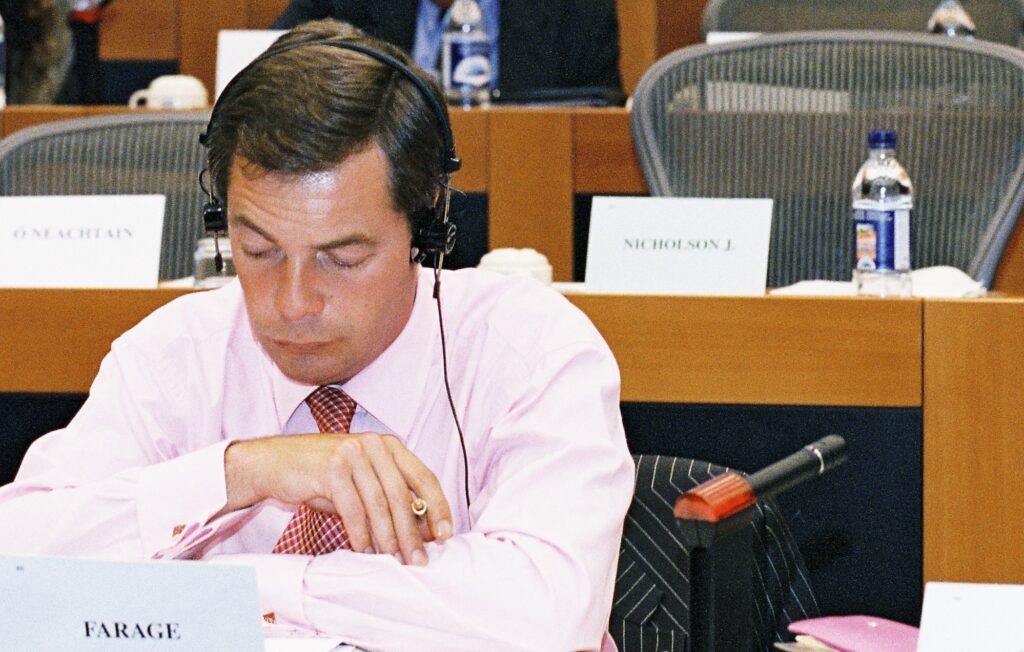
Ukip’s first breakthrough came in the 1999 European parliament elections. Aided by the parliament’s proportional electoral system, Ukip secured three seats – including one for a charismatic former commodities trader named Nigel Farage.
The success provided Ukip with a platform and a certain degree of political legitimacy.
***
Farage became Ukip chairman in 1998; he later served as leader from 2006 to 2009 and 2010 to 2016. He sought to sharpen the party’s image by appropriating populist and anti-establishment positions, including on immigration.
This strategic initiative put him at odds with Sked. The party founder believed that Ukip’s embrace of ultraconservative messaging would narrow its electoral appeal and dilute its euroscepticism.
Farage had driven Powell to Newbury in 1993 so he could participate in Sked’s by-election campaign. In March 1994, in his capacity as Ukip’s candidate in the Eastleigh by-election, Farage asked Powell for his endorsement.
According to the Telegraph, he wrote: “I have everything in place to fight a good, aggressive campaign but a voice from you could transform things and put the issue to the forefront. Please give us the help you can. As your performance at Newbury showed the electorate are beginning to wake from that long sleep. Come and give them another jog.”
Powell once again declined.
Sked resigned from Ukip in 1997. He argued the party was “doomed to remain on the political fringes” and should refuse seats in the “gravy train” of the European parliament. Sked later accused Farage of hijacking the party he founded by steering it towards the far right.
In 2013, Sked founded a new left-of-centre, anti-EU party to challenge Labour. He alleged that Ukip, under Farage’s leadership, had become “anti-immigrant, anti intellectual and racist”.
A Ukip spokesperson responded: “These are the tired and false repetitions of a disappointed man. Alan should be pleased with how well we are doing and the success of the party he created.”
In 2015, in an article for the Atlantic, Sked confessed to having created a “monster”.
***
At the 2004 European parliament elections, Ukip increased its representation to 12 MEPs.
In 2006, David Cameron, the recently elected leader of the Conservative Party, referred to Ukip as consisting of “fruitcakes”, “loonies” and “closet racists”.
Farage demanded an apology. “Let him tell us anything that we have said that could be construed as remotely racist, otherwise we demand an apology”, he said.
The Conservative leader, however, defended his remarks. “I don’t think I’m saying anything that hasn’t been said before”, he said.
“Ukip have some issues — not least that their own founding member Dr [Alan] Sked left the party because he thought they had been infiltrated by the far right… I was making a general point that they are the ‘stop the world I want to get off’ party.”
At the 2010 general election, Ukip won 919,546 votes (3.1%).
Ahead of polling day, Farage had stood down as leader to focus on his campaign for the Buckingham constituency – which was then represented by the speaker of the House of Commons, John Bercow. By convention, the major parties do not contest the speaker’s seat at election time.
Farage, who was badly injured in an aircraft crash on polling day, finished third with 8,410 votes (17.4%). He later admitted it was a “miscalculation” to try an unseat Bercow.
Ukip achieved its electoral peak at the 2014 European parliament elections.
These contests had long been a happy hunting ground for the party – on account of the proportional electoral system, the issues at hand and the apparent opportunity for voters to register a protest. But this time, Ukip won.
The party secured 27.5% of the vote, winning 24 of the UK’s 73 seats in the European parliament. This represented a 11-seat increase on its 2009 performance and marked the high point of its electoral success.
The Labour Party came second with 25.4% of the vote and 20 seats (up seven), while the governing Conservative Party was pushed into third place with 23.9% and 19 seats (down seven).
Farage hailed the outcome as a political “earthquake”.
He declared: “We may well see one party leader forced out of his position and another to reconsider his policy of opposition to a referendum on Europe, and David Cameron will have to take a much tougher negotiating stance.
“It is now not beyond the bounds of possibility that we hold the balance of power in another hung parliament.”
Mere months later, Ukip gained its first MP in the form of Conservative defector Douglas Carswell. Carswell triggered a by-election in his Clacton constituency – and won it. He was followed by Mark Reckless, the MP for Rochester and Strood.
At the 2015 general election, Farage’s party secured 12.6% of the vote, finishing third in terms of votes cast. However, due to the first past the post electoral system, this translated into only one seat (Carswell in Clacton).
Farage himself failed to win the South Thanet constituency. He initially stepped down as leader, but found his resignation rejected by Ukip’s national executive committee (NEC).
***
From 2010 to 2015, Ukip exerted considerable centrifugal pressure on the Conservative Party. This relationship was a critical factor in shaping Cameron’s 2013 pledge to hold an ‘in-out’ referendum on EU membership.
Farage was technically segregated from the official Vote Leave campaign during the 2016 referendum, which was headed by Dominic Cummings.
But Ukip nonetheless played a significant role in the referendum campaign, as a pro-‘leave’ outrider that could appeal to voters with messaging Cummings was reluctant to embrace.
Ukip’s “Breaking Point” poster, which depicted Syrian refugees near the Croatia-Slovenia border in 2015, drew condemnation from the official Britain Stronger in Europe and Vote Leave campaigns.
***
After 2016, with Farage seeking to step back as Ukip leader, the party descended into bitter internal disputes.
Under the leadership of Paul Nuttall, Ukip won only 1.8% of the vote at the 2017 general election.
In 2018, Gerard Batten was elected unopposed in Ukip’s fourth leadership contest in 18 months.
Batten shifted the party’s focus towards criticising Islam, and forged close ties with far-right activist Tommy Robinson. This move prompted a wave of resignations, including that of Farage.
Farage said Batten was “obsessed” with Islam and argued that “Ukip wasn’t founded to be a party based on fighting a religious crusade”.
Ukip’s support base steadily migrated to Faragist successor parties like the Brexit Party and Reform UK.
Politics.co.uk Newsletters
DAILY
Politics@Lunch
WEEKLY
Week in Review