Major resigns as Tory leader in ‘put up or shut up’ gambit
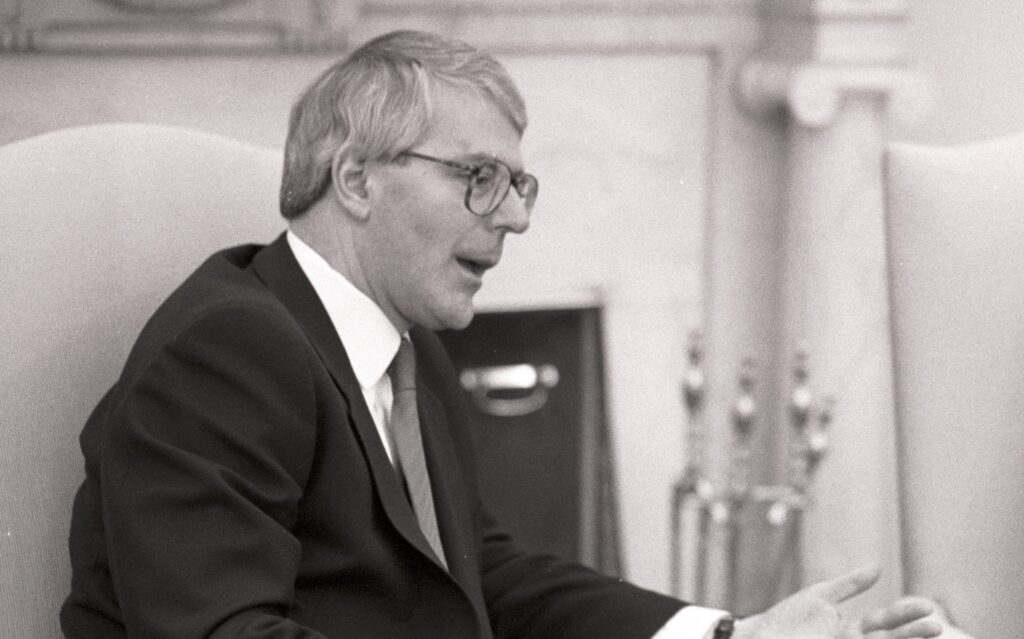
On 22 June 1995, the prime minister, John Major, resigned as leader of the Conservative Party, triggering an immediate leadership contest. The move was a direct attempt to definitively reassert his authority after years of Conservative infighting.
Speaking in the garden of 10 Downing Street, Major said his patience had been exhausted with the constant division and relentless leadership speculation. He issued a direct ultimatum to his detractors, who he accused of damaging the party and the government.
The prime minister declared: “I’ve now been prime minister for nearly five years. In that time we’ve achieved a great deal, but for the last three years I’ve been opposed by a small minority in our party. During those three years there have been repeated threats of a leadership election.
“In each year, they have turned out to be phoney threats. Now the same thing again is happening in 1995.”
He added: “The Conservative Party must makes its choice. Every leader is leader only with the support of his party. That is true of me as well.
“That is why I am no longer prepared to tolerate the present situation. In short, it is time to put up or shut up. I have nothing more to say this afternoon.”
***
The challenge was designed to call the bluff of his opponents and force them into an open contest. The only cabinet minister to take up the challenge was the secretary of state for Wales, John Redwood, a leading Thatcherite figure on the party’s eurosceptic right.
Redwood, one of the cabinet ministers Major labelled “bastards” in July 1993, resigned to stand against the prime minister.
Other potential challengers, including Michael Portillo and Michael Heseltine, chose not to stand. Both backed Major.
The Sun newspaper endorsed Redwood’s candidacy, running the front-page headline: “Redwood versus Deadwood”.
To win on the first ballot, Major needed to secure 50% of those eligible to vote, as well as a 15 point margin of victory. It was speculated that a second ballot would prompt Major’s resignation and the entrance of further candidates, such as Portillo, into the race. This was the pattern Thatcher’s defenestration followed in November 1990.
The first and final ballot, held after a short campaign on 4 July, saw Major win with 218 votes to Redwood’s 89.
Redwood had failed to broaden his appeal beyond those considered irredeemably hostile to the prime minister. Norman Lamont, the former chancellor, and Norman Tebbit, a Thatcherite enforcer, were among those who supported Redwood’s candidacy. Meanwhile, his unemotional manner earned him the nickname “Mr Spock” or “The Vulcan”.
Major’s comfortable victory stabilised his standing.
Speaking after the result was declared, Major stated: “I believe that has put to rest any question and speculation about the leadership of the Conservative Party up to and beyond the next general election.”
He added: “We have had this election. I think it has aired matters of important policy interests for all of us. But the election is now over. The message that I would give to every Conservative, whether he is a member of parliament, a party member or someone who simply shares our philosophy and supports us in the country, is that the time for division is over.
“We have made our choice, it is a clear-cut choice I believe beyond any doubt whatsoever.
“The responsibility we have, the current responsibility and the historic responsibility as well, is to carry our case to the electorate so they can judge the Conservative Party for what they are, and not what they are sometimes represented as being by people who are not themselves members of the Conservative Party.”
***
In a cabinet reshuffle on 5 July, Heseltine was appointed deputy prime minister to further shore up Major’s premiership. Redwood did not receive a new post – a clear signal that Major’s standing had been strengthened.
However, the “put up or shut up” gambit failed to address the deep ideological wounds over Europe that would ultimately contribute to the Conservative Party’s landslide defeat in 1997.
On 1 May 1997, the Labour Party, led by Tony Blair, won a landslide general election victory, ending 18 years of Conservative rule. The result was the most decisive for any party since 1945, with Labour securing a House of Commons majority of 179 seats.
Blair’s party won 418 seats, its highest ever total, while the Conservatives were reduced to just 165 seats – their worst result since 1906. The landslide represented a swing of 10.3% from the Conservative to Labour.
Portillo, having missed an opportunity to win the Conservative leadership in 1995, famously lost his seat two years later.
Redwood launched his second campaign for the Conservative leadership in 1997. He was defeated in the third round.

Politics.co.uk Newsletters
DAILY
Politics@Lunch
WEEKLY
Week in Review
