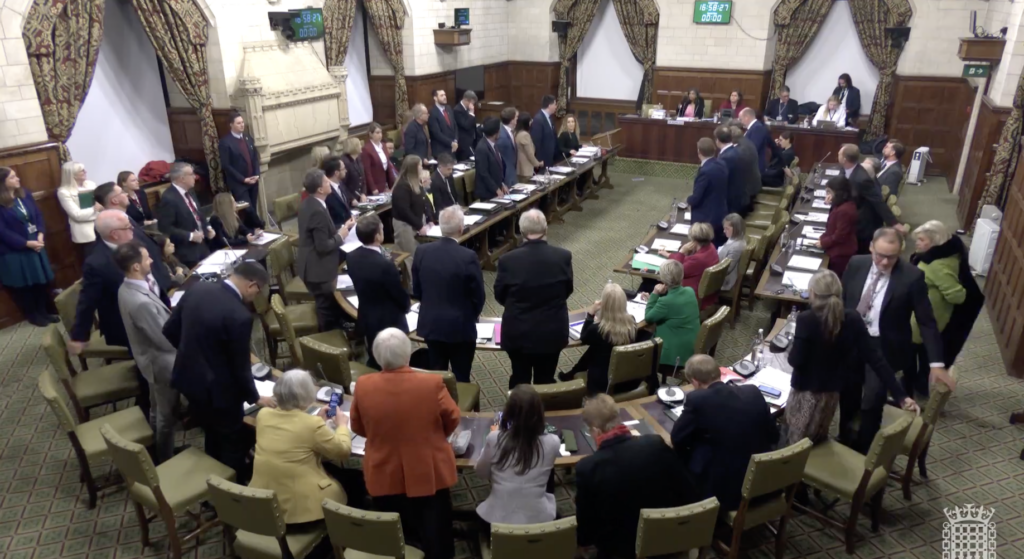
Cross-party MPs have voiced support for a televised national emergency briefing on climate and nature risks in a packed parliamentary debate.
The debate was held on e-petition 767687, started by broadcaster and leading naturalist Chris Packham, which has gained more than 138,000 signatures. The petition calls on the government to deliver a “clear national briefing” relating to the growing risks associated with “climate and nature breakdown”.
Liberal Democrat MP Andrew George said it was “perhaps the best-attended debate at Westminster Hall in which I have spoken”. He said he had counted “certainly 75” MPs.
George tabled an early day motion (EDM) in May of this year which expressed support for a national emergency briefing on climate. The motion, calling for the government to “screen a prime-time televised emergency briefing across all the main channels”, was supported by 116 MPs. Liberal Democrat leader Ed Davey and 30 Labour MPs backed the motion, with a total of seven parties represented among the signatories.
Speaking on Monday afternoon, climate transition minister Katie White said: “I have never seen a Westminster Hall debate as full as this.”
Liberal Democrat MP Roz Savage, a member of the petitions committee, opened the debate. She said the petition called for a national briefing “introduced by the prime minister and delivered by independent scientists, broadcast on live TV, radio and online platforms”.
The House of Commons petitions committee oversees the parliamentary e-petition system. The committee’s main role is to consider every petition that reaches the 100,000-signature threshold and determine whether to schedule it for a debate.
Savage voiced support for the petition, declaring: “Surely the British people deserve to know what the government already know.”
Savage said: “This moment calls for moral courage: the courage to tell people the truth, however uncomfortable, and trust them to rise to the challenge.”
The South Cotswolds MP said climate change was no longer a distant threat. “If a hostile power had caused the number of deaths attributed to this summer’s heatwaves, we would surely regard it as a national emergency”, she stated.
She said a briefing “must not simply frighten people into understanding the reality of climate change and ecosystem collapse; it must also equip them to respond”.
Several Labour backbenchers backed the call. Former frontbencher Richard Burgon said the government could help by “ensuring a Covid-style national broadcast on the climate and nature crisis”.
Jeff Smith, who chairs the all-party parliamentary group (APPG) for the BBC, said he generally agreed with the government’s reluctance to intervene in broadcasters’ editorial choices. But he said “the scale of the crisis needs a radical, one-off action”.
Josh Dean said he supported the call for the government to “screen a live, expert-led briefing to the nation”.
Labour MP Chris Hinchliff, who chairs the climate and nature crisis caucus in parliament, initially cited concerns about setting a precedent that “may be abused in future”. But he concluded that “the threat we face now is too great… for reservations and caution to win out.”
Others were more cautious. Labour’s Alex Mayer said she “would not want to compel any broadcaster to have to show a briefing.”
Mayer added: “We need to look to the future: imagine another government declaring a national emergency on something else that we did not agree with.”
Martin Rhodes said success “should not be measured by whether we hold a single, nationally broadcast briefing”. He said it should be measured by “whether we create a sustained national conversation”.
Former Liberal Democrat leader Tim Farron said he supported “a national briefing being televised and being a key moment of public service broadcasting that can bring people together”.
Former Green co-leader Adrian Ramsay said “a prime-time briefing would be incredibly powerful”.
Independent MP Shockat Adam said: “If the government can tell people to stockpile, they can certainly tell them why.”
Several MPs also raised the Rosebank oilfield, including the Green leader in the House of Commons, Ellie Chowns, who asked for it to be ruled out.
Tracker: the Labour MPs opposed to Rosebank oilfield as rebellion mounts
Conservative shadow minister Aphra Brandreth said her party welcomed “opportunities for people to discuss, challenge and learn about these issues”. But she said a single briefing “probably will not be sufficient”.
She added: “I worry that we are feeding climate anxiety rather than addressing it.”
The minister on duty, Katie White, did not commit to a televised briefing.
She said: “There is something wonderfully British about what has happened with the national emergency briefing. A film has become a movement.”
She said she and her counterparts at the Department for Environment, Food and Rural Affairs would meet the briefing’s organisers next week “to discuss the issues raised today and explore opportunities to work together”.
She added: “I will work with the climate and nature taskforce to explore further opportunities for public engagement.”