The reform of the House of Lords has been on the cards for centuries. It was actually abolished in 1649, but re-instated a few years later (along with the monarchy), and has remained the subject of intense debate ever since.
The idea of unelected peers having inherited access to parliament, alongside crony appointees and establishment time-servers, controlling the laws that we produce has long seemed absurd. Hereditary peers have only recently been removed, but little else has changed.
Now a group of MPs and peers are trying to change that, led by Baroness Smith of Llanfaes, a member of Plaid Cymru, and myself as chair of the all-party parliamentary group (APPG) for House of Lords reform. Baroness Smith has introduced a private members’ bill (PMB) that looks to radically change the make-up of the second chamber.
This long-overdue reform came in the wake of the Lords’ filibustering of a PMB, passed by the elected House of Commons, to introduce assisted dying under strict safeguards. The episode exposed how the Lords can obstruct parliamentary business, with few constraints on its ability to do so. Convention usually prevents such obstruction, but convention is all it is.
Peers are appointed almost entirely on the recommendation of the government and opposition parties, with no formal rules governing the process. There is no democratic element in this choice. It is the ultimate exercise in cronyism.
The purpose of the second chamber is to review and amend legislation that comes from the elected commons, looking for difficulties, changing the legislation and then sending it back with recommendations and legislative improvements. While there are many excellent peers who bring a high degree of knowledge and experience to this function, their contribution is undermined by the appointment of, for example, failed politicians rejected by voters, who simply don’t follow the conventions. The chamber is effectively lawless, meaning a handful of unelected peers can block legislation passed by the democratically elected commons by tabling hundreds of amendments, speaking for hours on end and talking bills out.
Baroness Smith’s bill sets out a basic framework for reform:
- The secretary of state must conduct a formal public consultation on proposals to replace the House of Lords within six months.
- That consultation must include a variety of stakeholders, including representatives of the UK’s devolved administrations, constitutional experts, and the Equality and Human Rights Commission (EHRC).
- The government must publish an official response within a further six months.
- All this with the long-term goal of establishing a more representative, elected second chamber for the nations and regions of the UK aligned with longer-term constitutional reforms.
We are pleased that a national commission on electoral reform has been announced. A review of the second chamber, potentially making its membership proportional, could be part of a more holistic review of how parliament works.
It should still be possible to draw on the sometimes excellent contributions of previous politicians, lawyers, doctors and business people who could be chosen to serve in the second chamber. But until that time, we are stuck with an institution that has remained substantially unchanged for hundreds of years.
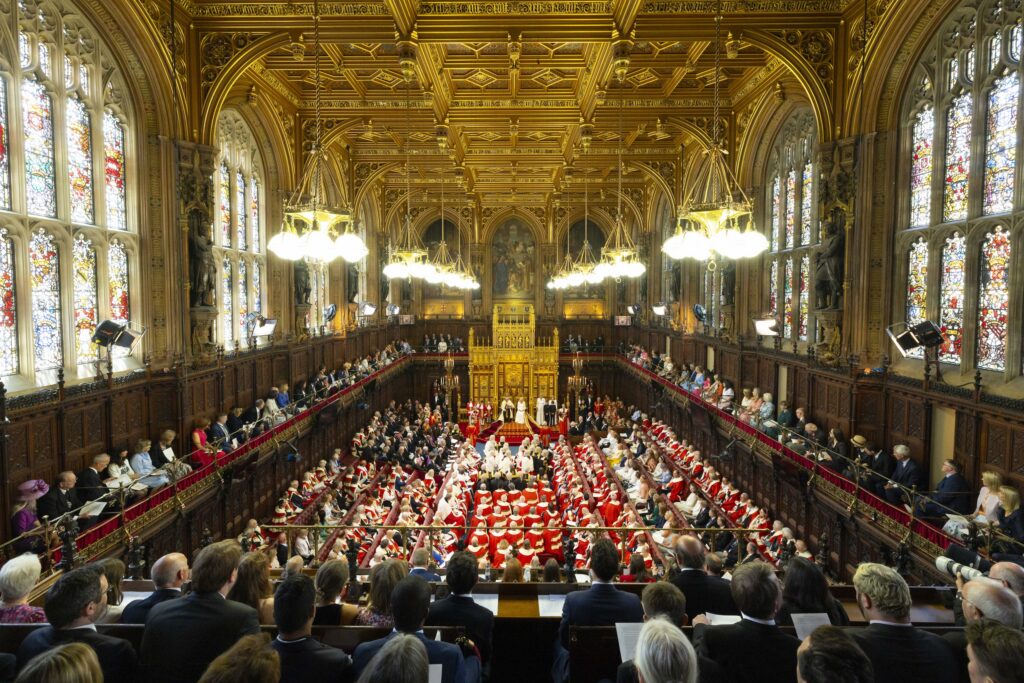
Last week, I showed a group of US doctors around parliament. This involved sitting in the viewing gallery of the House of Lords, looking at King Charles III’s throne, the Woolsack and a scattering of some very elderly peers. One doctor said, “How do these guys get here?”
When I answered that they were appointed by their mates, they all laughed – surely I was joking? Sadly I wasn’t joking at all.
That’s why we need Baroness Smith’s bill, and that’s why we must reform the House of Lords, starting with a national commission.
It’s going to take some doing, but we must now grasp that nettle.
Reform UK’s stance on House of Lords in doubt after MP rules out abolition