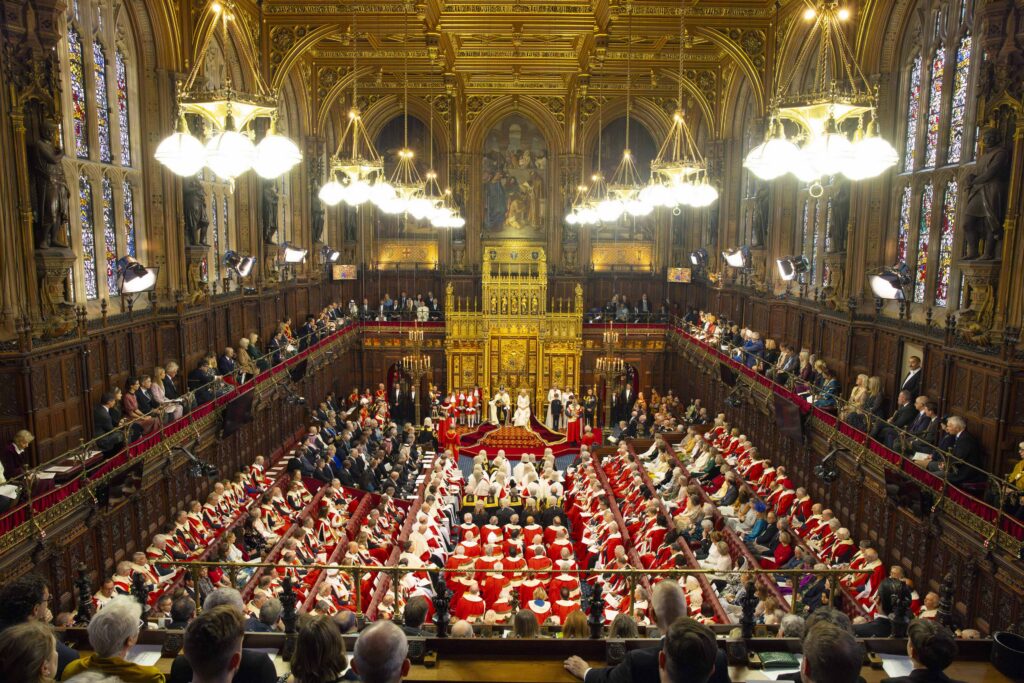
The House of Lords is the second chamber of the UK parliament, serving as a revising and scrutinising body for legislation and government action. As its members are not publicly elected, the House of Lords does not hold the same democratic primacy as the House of Commons and cannot block legislation outright.
Its principal constitutional function is to ask the government to reconsider decisions and to improve and amend draft laws.
The debate on the reform of the House of Lords, for the most part, centres on its composition rather than its powers. While supporters point to the independent expertise of its members as a vital check on the executive, critics argue that its unelected nature is an anachronism in a modern democracy.
House of Lords: factual breakdown
Composition and membership of the House of Lords
There are around 800 eligible members of the House of Lords. Historically, membership fell into three categories: life peers, the remaining hereditary peers (collectively the lords temporal), and Church of England archbishops and bishops (the lords spiritual).
The House of Lords Act 2026 removed the remaining 92 hereditary peers from the chamber.
Life peers form the vast majority of the membership and are appointed by the monarch on the advice of the prime minister or of the House of Lords Appointments Commission (Holac) for their lifetime. They cannot pass their title or seat in the House to their children.
There were previously 92 seats reserved for hereditary peers, a legacy of a compromise struck during the reforms of 1999. When a hereditary peer died, retired or was expelled, a by-election was held in which only other hereditary peers could vote. The 2026 legislation abolished the hereditary by-election system.
The lords spiritual consist of 26 archbishops and bishops of the Church of England. This makes the UK one of only two countries, alongside Iran, to provide an automatic place for religious clerics in its legislature.
Evaluation question
How far might extending representation to leaders of other major faiths serve to justify the continued presence of religious clerics in the legislature?
Powers and function of the House of Lords
The main role of the House of Lords is legislative scrutiny. It examines and amends bills that have been approved by the House of Commons. While it can delay most bills for up to a year, it cannot veto them.
The constitutional primacy of the elected commons over the unelected Lords was formally established by two key pieces of legislation in the 20th century. The Parliament Act 1911, which was the culmination of a constitutional crisis triggered by the Lords’ rejection of the 1909 “people’s budget”, removed the upper house’s power to veto any bill certified by the commons speaker as a “money bill”. For all other public legislation, it replaced their absolute veto with a power to delay a bill for a maximum of two years.
The primacy of the commons was strengthened by the Parliament Act 1949, which was introduced by Clement Attlee’s post-war Labour government to prevent the Conservative-dominated Lords from obstructing its iron and steel nationalisation plans. This second act further curtailed the Lords’ influence by reducing their delaying power from two years down to just one year.
The Lords also hold the government to account through questions and committee investigations.
Costs and allowances of the House of Lords
Members of the House of Lords are not salaried. They are eligible to claim a daily allowance to cover the costs of attending the House. For the financial year beginning in 2025, this allowance is set at £371 per qualifying day of attendance. Peers may choose to claim a reduced rate of £185 or claim no allowance at all.
The House of Lords (Hereditary Peers) Act 2026
On 10 March 2026, the House of Lords passed the Hereditary Peers Bill, marking the final abolition of the hereditary principle in the British parliament. The legislation fulfilled Labour’s manifesto commitment from the 2024 general election and effectively completed the reform process initiated by the House of Lords Act 1999.
The act removed the right of the remaining 92 excepted hereditary peers to sit and vote in the upper chamber. The act stipulated that the rights of hereditary peers would expire at the end of the 2025-2026 parliamentary session. It also permanently abolished the system of hereditary by-elections, which had been used to fill vacancies among the 92 since 1999.
With the passage of the act, the UK joined the majority of 21st-century democracies in removing hereditary elements from its legislature – leaving Lesotho’s Senate chamber as the only remaining body of its kind with a hereditary component.
The case for reform of the House of Lords
Lack of democratic legitimacy
The primary argument against the current House of Lords is that its members are appointed, not elected, giving them a democratic mandate of zero. Campaign groups such as the Electoral Reform Society contend that only a chamber elected by voters is appropriate to make laws in a modern democracy.
Size and cost
With around 800 members, the House of Lords is the second-largest legislative chamber in the world, surpassed only by China’s National People’s Congress. A 2017 report by a committee chaired by Lord Burns recommended a reduction to 600 members, but this target has been consistently exceeded due to new appointments.
Patronage and political appointments
Criticism is frequently directed at the appointments process, which is seen to enable prime ministers to reward political donors, former MPs, and allies with lifetime peerages. This practice is accused of filling the chamber with “cronies” rather than independent experts. One example of an appointment that attracted significant criticism was the elevation of Charlotte Owen, a 30-year-old former advisor to Boris Johnson, to the Lords in 2023.
Evaluation question
While often criticised as “cronyism”, to what extent can prime ministerial patronage in House of Lords appointments be justified as a necessary tool of statecraft to ensure the passage of a government’s legislative programme? Placement after “…rather than independent experts”.
Evaluation question
To what extent does the prime minister’s power to appoint political allies to the House of Lords compromise the chamber’s function as an independent scrutinising body?
Lack of representation
The House of Lords is criticised for not reflecting the diversity of the UK. While representation has improved, only around 30% of members are women.
A 2018 estimate suggested that approximately 6% of members identify as being from an ethnic minority background, compared with around 16% of the UK population. (This was an increase from an estimated 3% of members in 2000). By comparison, following the 2024 general election, nearly 14% of MPs are from ethnic minorities.
The case against major reform of the House of Lords
Primacy of the commons
A key argument for retaining an appointed chamber is that an elected second chamber would have its own democratic mandate. This could create legislative gridlock by empowering it to challenge the primacy of the House of Commons, which is directly accountable to the public.
Evaluation question
To what extent is legislative gridlock an inevitable consequence of an elected second chamber, or could a carefully designed constitution with clearly defined powers mitigate this risk?
A chamber of expertise
Supporters of the current system argue that an appointed chamber allows for the inclusion of eminent individuals with significant expertise in fields such as science, medicine, business, and the arts. These individuals can contribute to the quality of legislation without having to be career politicians.
Options for House of Lords reform
A fully elected chamber
The ongoing debate over reforming the House of Lords encompasses several distinct, often conflicting, constitutional principles. Campaigners for a fully elected second chamber, advance a case rooted in democratic legitimacy. They contend that in a modern democracy, only those chosen by the public should hold legislative power. They point to the current system of appointments as a dangerous source of prime ministerial patronage, which has led to repeated “cash for honours” scandals and risks filling the chamber with party donors and loyalists, undermining its function as an independent revising body.
A ‘hybrid’ chamber
Conversely, defenders of an appointed or hybrid chamber (part-elected, part appointed) raise concerns about the constitutional consequences of a fully elected house. Their central argument centres on the imperative to maintain the primacy of the commons and the need to avoid institutional conflict and legislative gridlock, particularly if controlled by an opposing party.
Critics have also suggested that a partially elected, “hybrid” house – as advocated by the 2000 A House for the Future report or Wakeham Report – lacks a clear constitutional rationale, creating two classes of members with different claims to legitimacy.
Scrap lords spiritual
A more specific, yet persistent, area of contention concerns the presence of the Lords Spiritual. The automatic right of the 26 most senior bishops of the Church of England to sit and vote in the chamber is seen by many as a constitutional anachronism. In an increasingly secular and multi-faith society, critics argue that granting legislative power on the basis of religious office is discriminatory and indefensible, a privilege without parallel in other western democracies.
A House of the nations and regions
One reform proposal includes a “House of the Nations and Regions” to give a voice to the devolved parts of the UK, or a body composed of experts from specific fields such as science, medicine, and the arts. The objective is to harness specialist knowledge and diverse experiences, creating a revising chamber whose authority derives from expertise, not a direct electoral mandate.
History of House of Lords reform
Historically, the power of the Lords – the representatives of the landed interests – was greater than that of the commons, but as democratic ideals took root in the UK, its power has gradually been eroded.
On 19 March 1649, the revolutionary Rump Parliament passed legislation to abolish the House of Lords. The move came seven weeks after the execution of King Charles I and was a key step in the establishment of the republican Commonwealth of England. By the end of the Civil War, the House of Commons viewed the upper chamber as an institution of royal and aristocratic privilege that was fundamentally incompatible with, and contemptuous of, a republic.
The preamble to the relevant act of parliament, An Act for Abolishing the House of Peers, made this position clear, famously declaring that “The Commons of England… find by too long experience that the House of Lords is useless and dangerous to the people of England”.
The Act for Abolishing the House of Peers created a unicameral (single-chamber) parliament in England for the first and only time in its history. It also removed political opponents of a new republican settlement and followed several previous moves to sideline the House, including the expulsion of the Lords Spiritual under the Clergy Act or Bishops Exclusion Act of 1640 (effective 1642).
The abolition of the Lords was an impermanent constitutional fixture. Following the collapse of the Protectorate, the House of Lords was restored on 8 May 1660 alongside the monarchy with Charles II as king.
House of Lords Reform – 1958 to 1999
The authority and composition of the House of Lords have been subject to a century-long process of incremental reform.
The Life Peerages Act, passed by Harold Macmillan’s Conservative government in 1958, allowed for the creation of non-hereditary members. It gave prime ministers the power to appoint individuals of apparent distinction from fields such as science, business, the arts, and public service for “life”. Significantly, the act allowed women to sit and vote in the House of Lords for the first time. While women had been able to vote in general elections and stand as a candidate since 1918, the upper chamber had remained an exclusively male preserve.
The first 14 life peers were announced on 24 July 1958. And in October 1958, Barbara Wootton, Stella Isaacs, Katharine Elliot and Irene Curzon – the first four women to be nominated to the upper chamber – were sworn in.
The Peerage Act 1963 enabled hereditary peers to disclaim their titles for their lifetime within twelve months of inheriting them (or within twelve months of the act for existing peers). The act also ended the election of the 16 ‘Scottish representative peers’, which followed each dissolution of parliament. The system had been established under the terms of the 1706 Treaty of Union. Scottish peers would now sit in the upper chamber on the same terms as their counterparts from the rest of the United Kingdom.
The legislation was the culmination of Labour MP Tony Benn’s campaign to disclaim the title (Viscount Stansgate) that he inherited upon the death of his father in November 1960.
After Macmillan resigned as prime minister in October 1963, two Conservative peers (the Earl of Home and Viscount Hailsham) announced they would renounce their titles with a view to contesting the coming leadership vacancy.
The practice of appointing hereditary peers virtually ceased in 1964 upon the start of Harold Wilson’s government. Macmillan, upon accepting an earldom 20 years later after his resignation as prime minister, became the last non-royal recipient of a hereditary peerage.
In its 1997 general election manifesto, the Labour Party under Tony Blair’s leadership committed to ending “the right of hereditary peers to sit and vote in the House of Lords will be ended by statute”. It vowed to do so by way of “an initial, self-contained reform, not dependent on further reform in the future”.
The party added: “This will be the first stage in a process of reform to make the House of Lords more democratic and representative.”
The 1998 Queen’s speech promised a bill “to remove the right of hereditary peers to sit and vote in the House of Lords” as “the first stage in a process of reform to make the House of Lords more democratic and representative.”
The 1998 legislative programme also announced the establishment of a royal commission “to review further changes and speedily to bring forward proposals for reform.”
The Labour government subsequently published its white paper, Modernising Parliament: Reforming the House of Lords, which served as the formal blueprint for fulfilling its manifesto commitment.
The paper proposed the abolition of the right of hereditary peers to sit and vote in the Lords, arguing that their position, based solely on birthright, had “no democratic legitimacy” and was an indefensible anachronism in a modern state. This move was explicitly framed as a self-contained “stage one” reform, designed to remove the large, inbuilt Conservative “3 to 1 built-in majority over the Labour Party” before proceeding to a more comprehensive overhaul.
To inform this future “stage two”, a royal commission was concurrently established, chaired by the former Conservative cabinet minister Lord Wakeham, with a mandate to examine the chamber’s role and functions and to propose viable options for its long-term composition.
The royal commission performed its traditional role as a political device – allowing Blair to both defer and outsource contentious, politically sensitive decision-making.
William Hague, the Conservative leader, characterised the government’s plans for removing the hereditary peers as “constitutional vandalism”.
Norman Fowler, Conservative MP and future lord speaker, argued the government intended to “introduce an assembly of appointees and placemen: a giant, ermine-clad quango.”
The passage of the legislation through parliament was marked by intense political machination. Although the government possessed an effectively all-powerful majority in the House of Commons, the bill was expected to elicit immense resistance in the Lords.
In the end, the initial proposal to remove all hereditary peers was modified by a crucial compromise, known as the “Weatherill amendment”, agreed between Blair and Viscount Cranborne, then the Conservative leader in the House of Lords. The amendment permitted 92 hereditary peers to retain their seats. This represented the key reform in the House of Lords Act 1999. The amendment was named after Lord Weatherill, then convenor of the crossbench or independent peers and previously speaker of the House of Commons.
A standing order adopted before royal assent specified the mechanism for filling the 92 seats, and elections were held in October and November 1999. Peers ranked the candidates in order of preference for the number of places available. The candidates with the highest number of votes were declared elected, and the ranked preferences were only examined in the event of a tie.
Before the 1999 reforms, the House of Lords had over 1,300 members. When the act came into force in November 1999, a total of 667 hereditary peers ceased to be members of the House of Lords.
House of Lords Reform – 1999 to 2010
Despite the initial intention to follow the House of Lords Act 1999 with comprehensive “stage two” reforms, the second step never materialised.
Evaluation question
To what extent does the failure to deliver comprehensive ‘stage two’ House of Lords reform reflect a lack of political will by successive governments – rather than the institutional resilience of the upper chamber?
The royal commission put forward a number of options for the future composition of the House, ranging from fully appointed to fully elected, with a series of compromises in between. Subsequently the government then set up a joint committee composed of MPs and peers to consider the report and produced a further white paper, which vowed to equip the “British people with a parliament and a constitution fit for the 21st century.”
On 11 December 2002, the joint committee published its first report, which set out “an inclusive range of seven options for the composition of a reformed House of Lords”. They were:
- Fully appointed
- Fully elected
- 80% appointed / 20% elected
- 80% elected / 20% appointed
- 60% appointed / 40% elected
- 60% elected / 40% appointed
- 50% appointed / 50% elected
In January 2003, Blair expressed his support for a fully appointed House, arguing against any “hybrid” creations. A chamber with an elected element, he suggested, would be tantamount to a “rival chamber” – not a “revising chamber”.
Blair told the House: “In my view, we should be cognisant not just of our views as Members of Parliament, but of the need to make sure that we do not have gridlock and that our constitution works effectively.”
The commons, however, was unable to reach a consensus on any of the options presented by the joint committee. In a series of indicative “free votes” held in the House of Commons in February 2003, MPs rejected every option presented to them. The results of the votes, also held in the House of Lords, were as follows:
Fully appointed second chamber
- House of Lords: 335 in favour, 110 against.
- House of Commons: 245 in favour, 323 against
Fully elected
- House of Lords: 106 in favour, 329 against
- House of Commons: 272 in favour, 289 against
80% appointed, 20% elected
- House of Lords: 39 in favour, 376 against
- House of Commons: Rejected without a vote
80% elected, 20% appointed
- House of Lords: 93 in favour, 339 against
- House of Commons: 281 in favour, 284 against
60% appointed, 40% elected
- House of Lords: 60 in favour, 359 against
- House of Commons: Rejected without a vote
40% appointed, 60% elected
- House of Lords: 91 in favour, 318 against
- House of Commons: 253 votes in favour, 316 against
50% appointed, 50% elected
- House of Lords: 84 in favour, 322 against
- House of Commons: rejected without a vote
Following this deadlock on comprehensive reform, the leader of the House of Commons, Robin Cook, observed dryly: “We should go home and sleep on this interesting position. That is the most sensible thing that anyone can say in the circumstances… the next stage in the process is for the joint committee to consider the votes in both Houses.
“Heaven help the members of the committee, because they will need it.”
In 2003, Blair announced the creation of a new department to oversee constitutional change, the Department for Constitutional Affairs, with Lord Falconer of Thoroton as its first secretary of state. The department reiterated the government’s support for a fully appointed House, but measures to achieve it did not materialise.
BBC News reported in March 2004 that the Blair government had put reform of the House of Lords “on hold”. Jack Cunningham, the then chairman of the joint committee on Lords reform, commented that it had been “clear for some time that things were going wrong”.
A 2006 cabinet reshuffle transferred the responsibilities previously held by Lord Falconer in the Department for Constitutional Affairs to Jack Straw as leader of the commons. The publication in 2007 of a white paper on House of Lords reform was preceded by a series of attempts by peers to block legislation approved by the commons, including the Anti-terrorism, Crime and Security Act 2001, the Hunting Act 2004, the Terrorism Act 2006, the Identity Cards Act 2006, and the Racial and Religious Hatred Act 2006.
The white paper described Lords reform as “unfinished business” and the 92 hereditary peers as a constitutional “anomaly”.
In the paper’s foreword, Straw stated: “Time and time again – in 1909, 1949, 1968 and 2003 – fundamental reform of the House of Lords has failed because, for some, the best became the enemy of the good.”
Straw argued that a “hybrid”, part-elected, part-appointed, House would be the model most likely to achieve a consensus in a further free vote of the House of Commons. The paper sought to illustrate how a “hybrid house” could work. Its central proposal was for a second chamber composed of 50% elected members and 50% appointed members.
The document detailed how such a system might work, suggesting that elections could be held using a regional list system – a type of proportional representation (PR) – at the same time as European Parliament elections, with members serving a long, single, non-renewable term of around 15 years to encourage independent judgment. The appointed half would be selected by an independent, statutory appointments commission, removing prime ministerial patronage, and would include a significant bloc of non-party-political crossbenchers to maintain the chamber’s character as a house of revision.
The white paper was followed by a series of indicative votes on 7 March 2007 in both Houses on the composition of the second chamber.
The House of Commons expressed a clear, and historically unprecedented, preference for a substantially or wholly elected second chamber. MPs first voted in favour of a model with an 80% elected and 20% appointed composition (by 305 to 267). Immediately following that, in a more decisive result, they supported a 100% elected House of Lords by a majority of 113 (337 to 224).
This vote represented the first time the commons had endorsed a democratic mandate for the upper house. Conversely, all proposals for a fully appointed chamber or for smaller elected minorities were rejected – including the government’s preferred compromise of a 50/50 hybrid model. Blair ultimately voted in favour of a 50/50 split.
The votes created a direct political challenge to the House of Lords itself, which was expected to, and subsequently did, vote in favour of a fully appointed chamber. The votes set the stage for further constitutional confrontation between the two Houses.
It was subsequently speculated that some MPs who supported a fully appointed House had in fact voted tactically for a fully elected upper chamber – an option they considered to be least acceptable to the House of Lords.
In July 2007, Straw stated that the details of reform – including the powers, size, and electoral system for a new chamber – would be referred to another cross-party working group for further discussion.
In May 2008, Gordon Brown as prime minister announced that the government would produce a new white paper on Lords reform. Straw, this time as justice secretary, spearheaded the proposals contained in An Elected Second Chamber. The paper’s central proposal was for a second chamber that was either 80% or 100% elected – per the consensus established in the March 2007 series of indicative votes. It suggested members be directly elected for a single, non-renewable term of 12-15 years, staggered over three general election cycles to ensure continuity.
To maintain a clear distinction from the commons, the paper explored various electoral systems, including first past the post, the alternative vote, and proportional systems like the single transferable vote or an open list system.
The proposals did not move forward to become legislation. Labour’s manifesto for the 2010 general election proposed a referendum on Lords reform.
However, the Constitutional Reform and Governance Bill, published in July 2009, provided for the abolition of the by-elections used to fill vacancies for the 92 hereditary peers. Thus, the number of “excepted hereditary peers” in the House of Lords would cease to remain at 92 and instead diminish one by one.
Addressing the commons on this proposal, Straw argued that by-elections had now reached “a risible position” since “we are now electing people to the House of Lords who were not hereditary peers at the time that the House of Lords Act was passed”. However, due to the calling of the 2010 general election, the provisions relating to hereditary peers (and provisions allowing members to be suspended or voluntarily resign from the House) were removed from the bill during “wash-up”.
At the time, the government stated that this followed discussions with the “main parties” to ensure other elements of the bill could pass and were the result of “difficult but inevitable choices”.
The Constitutional Reform and Governance Act 2010 was therefore passed without any changes to the membership of hereditary peers.
House of Lords reform since 2010
Following the election of the Conservative-Liberal Democrat coalition government in May 2010, it was announced that the two parties had agreed to establish a committee to bring forward proposals for a wholly or mainly elected upper chamber on the basis of proportional representation, with a draft bill expected by December 2010.
In the interim, the government stated, Lords appointments would be made “with the objective of creating a second chamber reflective of the share of the vote secured by the political parties in the last general election.”
The House of Lords Reform Bill announced in the Queen’s Speech on 9 May 2012 provided for an upper chamber of 450 members (halved from 826), 80% of whom would be elected – with the reforms to be completed by 2025. The remaining 20% of non-elected members (90) would be appointed by a statutory appointments commission on a non-party basis.
One-third of the elected members would have been chosen at the 2015 general election, another third at future elections set for 2020 and 2025 – 120 members in each election. Under the proposals, existing peers would be “phased” out as elected members were brought in.
However the bill was abandoned due to opposition from backbench Conservative MPs, with some 91 defying a three-line whip on the issue. In response, the then-deputy prime minister, Nick Clegg, claimed that the Conservatives had “broken the coalition contract” over the matter. David Cameron disputed this, saying that the agreement contained no specific promise to enact reform of the House of Lords.
The House of Lords Reform Act, which received royal assent in 2014, allowed members to resign from the House, in a way that had previously not been possible. It also allowed for the exclusion of any peer convicted of a criminal offence and sentenced to a term of imprisonment of one year or more. This was followed up by the 2015 House of Lords (Expulsion and Suspension) Act that authorised the House to expel or suspend members.
In 2017, an inquiry was set up by Lord Fowler (the Lord Speaker) under Lord Burns to examine the size of the House of Lords. The committee recommended the second chamber’s size be reduced to 600, that members be appointed to 15 year terms, that 15% would be cross benchers, and that no party would have an overall majority. It also suggested that the party appointments would be linked to a general election result.
Contrary to the Burns commission’s recommendations of a “two out, one in” approach to the departures of peers in order to move to the proposed target of 600 members, the number of peers in the House of Lords has continued to increase considerably in the last decade.
The most significant recent proposal for reform came in December 2022 from the Commission on the UK’s Future, led by former prime minister Gordon Brown. The commission recommended replacing the Lords with a new, smaller elected chamber called “the assembly of the nations and regions”, with its members serving as a democratic check on the government.
The Labour Party has adopted this as a long-term policy goal. In 2022, Labour leader Keir Starmer pledged to abolish the House of Lords to “restore trust in politics” and replace the second chamber with something more democratic and representative.
Labour have scaled back their ambitions since, instead opting for various reforms, including the introduction of a mandatory retirement age of 80, as well as new participation requirements – yet no legislation has yet been proposed to further these aims.
The Labour Party’s manifesto for the 2024 general election featured a commitment to remove the remaining 92 hereditary peers.
The House of Lords (Hereditary Peers) Act 2026
Following the 2024 general election, which resulted in a Labour landslide victory, all hereditary by-elections were formally suspended. Initially, the House of Lords amended the standing orders, changing the requirement to hold a by-election within three months of a vacancy to 18 months. The amendment had cross-party and crossbench support. (On 22 October 2025, the House extended the pause to 36 months through a further amendment to the standing orders.)
In September 2024, the government introduced legislation to implement its manifesto pledge to remove the hereditary peers from the upper chamber.
In July 2025, the House of Lords approved a major amendment, tabled by Conservative peer Lord Parkinson, which replaced clause one of the bill. Parkinson’s amendment instead proposed that the current excepted hereditary peers would remain in the House for life, but no new hereditary peers could join, permanently ending the system of by-elections. Parkinson argued this approach effectively fulfilled the government’s manifesto pledge while allowing peers to “say farewell to our colleagues in a more organic way”.
The amendment passed by 280 votes to 243.
In September 2025, the House of Commons formally rejected the Lords’ amendment, insisting on the immediate removal of all hereditary peers. The minister on duty, Nick Thomas-Symonds, argued that Parkinson’s amendment could allow the youngest hereditary peers, then aged 39, to remain for “decades to come”.
Thomas-Symonds noted that the Labour manifesto promised “immediate” reform, and that Parkinson’s amendment therefore breached the Salisbury-Addison convention, under which peers approve bills that fulfil manifesto pledges.
The Lords’ amendment was decisively rejected by 336 votes to 77.
On 10 March 2026, the House of Lords passed the Hereditary Peers Bill, marking the final abolition of the hereditary principle in the British parliament. The legislation fulfilled Labour’s manifesto commitment from the 2024 general election and effectively completed the reform process initiated by the House of Lords Act 1999.
The act removed the right of the remaining 92 excepted hereditary peers – comprising various ranks of Dukes, Earls, Viscounts and Barons – to sit and vote in the upper chamber.
Thomas-Symonds characterised the reform as the removal of an “archaic and undemocratic principle”.
He stated: “Hereditary peerages are an archaic and undemocratic principle. I am proud that we have fulfilled a key manifesto pledge of this government.
“Our parliament should always be a place where talents are recognised and merit counts. It should never be a gallery of old boys’ networks, nor a place where titles, many of which were handed out centuries ago, hold power over the will of the people.”
The act stipulated that the rights of hereditary peers would expire at the end of the 2025-2026 parliamentary session. The act also permanently abolished the system of hereditary by-elections, which had been used to fill vacancies among the 92 since 1999.
The government agreed to offer additional life peerages to the official opposition in the House and crossbenchers to compensate for the loss of hereditary representatives.
Quotes
“Electing the second chamber is not self-evidently the democratic option – by dividing accountability it can undermine the capacity of the people to hold government to account (since policies may emerge for which it is not directly responsible) and can sweep away the very benefits that the present system delivers.” – Lord Norton, March 2012
“The bloated House of Lords is rapidly becoming a home for defeated MPs rather than a serious scrutiny chamber. Today’s new appointees have literally just walked down the corridor from the Commons to take their cushy new jobs for life. It would be a gross hypocrisy for the government to say they care about improving democracy and then keep packing the second chamber with cronies and apparatchiks. These appointments must be the last. Voters are tired of the role of unelected power in politics and the public want and deserve an overhaul. The time for reform is now.” – Willie Sullivan, senior director, Electoral Reform Society, January 2020
“We should be rebuilding trust in politics, but this can’t just be an article of faith – we need to show how we will do things differently. Reforming our second chamber has to be a part of that.” – Keir Starmer, December 2022
Additional resources
- UK Parliament – The House of Lords: https://www.parliament.uk/business/lords/
- By-elections in the House of Lords: https://www.parliament.uk/mps-lords-and-offices/offices/lords/house-of-lords-external-communications/by-elections/
- Report of the Commission on the UK’s Future: https://labour.org.uk/wp-content/uploads/2022/12/Commission-on-the-UKs-Future.pdf