House of Commons abolishes the House of Lords
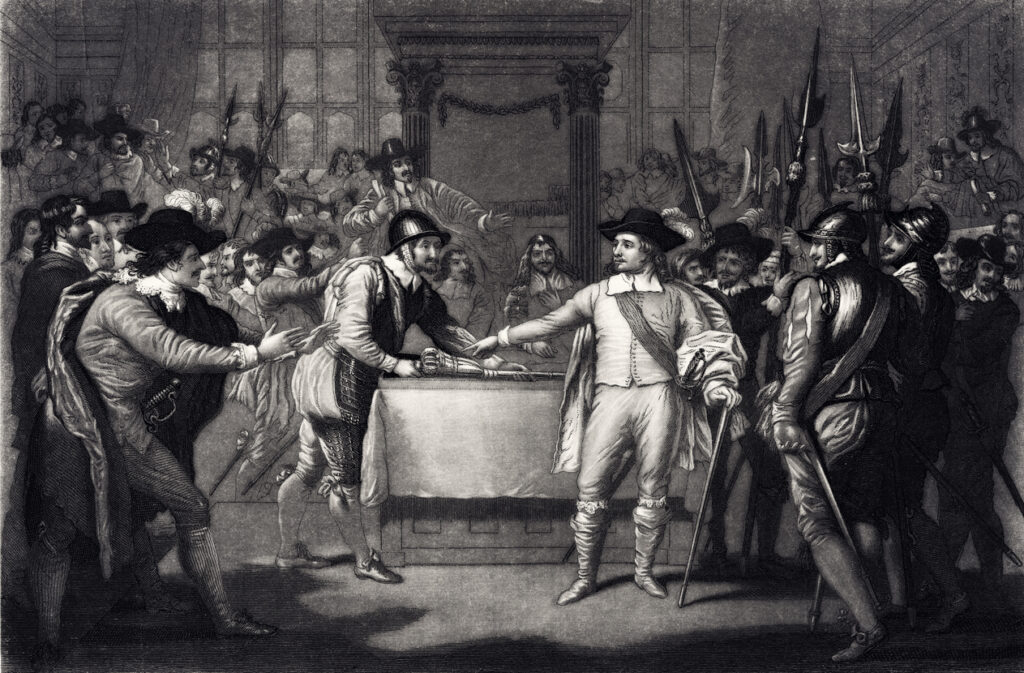
On 19 March 1649, the revolutionary Rump Parliament passed legislation to abolish the House of Lords. The move came seven weeks after the execution of King Charles I and was a key step in the establishment of the republican Commonwealth of England.
***
The Rump Parliament was created after a military intervention in December 1648 effectively expelled those seen to be sympathetic to the king. Pride’s Purge, conducted by New Model Army troops on the orders of Colonel Thomas Pride, removed members who were understood to be against trying Charles for high treason.
The purge, a comprehensive military coup, radically changed the composition of the original Long Parliament, which first sat in 1640.
The purged commons then forced through an act to establish a High Court of Justice to put King Charles I on trial for treason in January 1649. It did so by bypassing the House of Lords, declaring itself as the sole source of sovereignty in the land.
On 30 January, at the end of a four-day trial, Charles I was publicly executed.
The commons now viewed the House of Lords – a hereditary body – as the final bastion of royal and aristocratic privilege in the constitution. The Lords was seen as fundamentally incompatible with, and contemptuous of, the nascent republic. On 6 February, the commons adopted a resolution that described the House of Lords as “useless and dangerous to the people of England”.
The following day, 7 February, the commons passed a resolution that “the office of a king in this nation, and to have the power thereof in any single person, is unnecessary, burdensome, and dangerous to the liberty, safety and public interests of the people of this nation, and therefore ought to be abolished.”
Later in March, these radical resolutions were transformed into “acts”.
The Act for Abolishing the House of Peers, passed on 19 March, declared: “The Commons of England assembled in Parliament, finding by too long experience, that the House of Lords is useless and dangerous to the People of England to be continued… the House of Lords in Parliament, shall be and is hereby wholly abolished and taken away”.
The legislation further ruled that “the Lords shall not from henceforth meet or sit in the said House called The Lords House, or in any other House or Place whatsoever, as a House of Lords; nor shall Sit, Vote, Advise, Adjudge, or Determine of any matter or thing whatsoever, as a House of Lords in Parliament.”
The “legislation” formally created a unicameral (single-chamber) parliament in England for the first and only time in its history. The move further sidelined political opponents of a new republican settlement and followed several previous moves to reform the House, including the expulsion of the lords spiritual (bishops) under the Clergy Act or Bishops Exclusion Act of 1640.
***
The unilateral abolition of the House of Lords – not to mention the king – had reconfigured the traditional formula for passing legislation. But the commons, which now styled itself as the “Parliament of England”, assumed all legislative responsibility under the new settlement.
Conscious of accusations that their actions lacked legitimacy, on 22 March “parliament” agreed a declaration that publicly justified their “late proceedings” – namely the execution of the king and the abolition of the House of Lords.
The document began by asserting that parliament, elected to represent the people, had struggled “to remove Oppression, Arbitrary power, and all Opposition to the Peace and Freedom of the Nation.”
To this end, MPs had implemented alterations “which they judge most conducible to the honor of God, and the good of the Nation, the only end and duty of all their Labors.”
First and foremost, the declaration defended the unprecedented decision to put a king on trial, arguing that “the Crimes of the late King” were also unprecedented.
It stated: “The Representatives of the People now Assembled in Parliament, have judged it necessary to change the Government of this Nation from the former Monarchy, (unto which by many injurious incroachments it had arrived) into a Republique, and not to have any more a King to tyrannize over them.
Parliament then turned to the abolition of the House of Lords, arguing that the upper chamber “did not at all represent” the people in blocking legislation. The declaration argued that “neither the Government [or] Republique, nor the common safety could bear the Delays and Negatives of a House of Lords”.
Parliament vowed to continue to make alterations “for the taking away of corruptions, and abuses, delays, vexations, unnecessary travel and expences, and whatsoever shall be found really burthensome and grievous to the people.”
On 19 May, parliament passed An Act Declaring and Constituting the People of England to be a Commonwealth and Free-State.
This legislation stated that the country would be governed “by the Supreme Authority of this Nation” with power exercised by “the Representatives of the People in Parliament, and by such as they shall appoint and constitute as Officers and Ministers under them for the good of the People, and that without any King or House of Lords”.
***
Some years later, Oliver Cromwell replaced the Lords with a new governing body of between 40 and 70 members – all appointed by the lord protector himself.
This second chamber, constituted under the terms of The Humble Petition and Advice (1657), was simply referred to as the “Other House”. The Humble Petition and Advice, the second and last codified constitution of England (after the Instrument of Government), instructed Cromwell to “call Parliaments consisting of two Houses”.
It added: “That your Highness will consent, that none be called to sit and vote in the other House, but such as are not disabled, but qualified according to the qualifications mentioned in the former Article, being such as shall be nominated by your Highness, and approved by this House, and that they exceed not seventy in number, nor be under the number of forty (whereof the quorum to be one-and-twenty), who shall not give any vote by proxies.”
The Other House – a non-hereditary, appointed chamber with a more socially diverse fixed membership – was undoubtedly a constitutional novelty. However, one satirical derided its membership as nothing more than Cromwell’s “Sons and Kindred, Flattering Courtiers, corrupt Lawyers, degenerated Sword men, and… most of them self-interested Salary-men.”
The abolition of the Lords, in the end, was an impermanent constitutional fixture.
The interregnum period was marked by infighting – in the commons, between the two Houses, and between parliament and the lord protector. Cromwell famously disbanded the Rump Parliament in 1653. Following the collapse of the Protectorate after Cromwell’s death, the House of Lords was restored in May 1660 alongside the monarchy with Charles II as king.
The Convention Parliament declared that, “according to the antient and fundamental Laws of this Kingdom, the Government is, and ought to be, by King, Lords, and Commons.”
Moreover, as the 1649 act had been passed without the assent of either the Lords or a monarch, it was treated as legally void; the upper chamber simply resumed its functions as if the revolutionary period had never happened.
The bishops were readmitted under the Clergy Act 1661 – their exclusion having been secured before the king’s execution.

Politics.co.uk Newsletters
DAILY
Politics@Lunch
WEEKLY
Week in Review