Standards committee accuses Owen Paterson of ‘egregious’ lobbying breaches
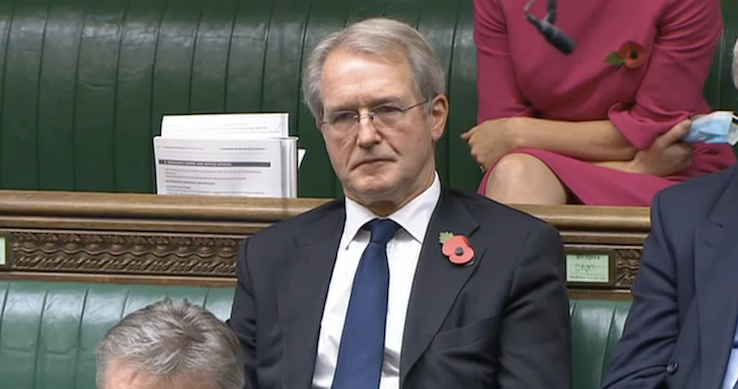
On 26 October 2021, the House of Commons standards committee published a highly critical report on the conduct of the Conservative MP Owen Paterson. It found Paterson had committed an “egregious” breach of the parliamentary rules against paid advocacy.
The report recommended that Paterson, a former cabinet minister under David Cameron, be suspended from the House of Commons for 30 sitting days. This recommendation was severe enough to trigger a recall petition in his constituency under the Recall of MPs Act 2015.
The saga that followed, dubbed ‘Patersongate’, played a significant role in weakening Boris Johnson’s premiership.
Committees on standards and privileges
***
Following a two-year investigation, the cross-party standards committee found that Paterson had used his position to benefit two companies for whom he was a paid consultant: Randox, a Northern Ireland healthcare diagnostics firm, and Lynn’s Country Foods, a Northern Ireland-based processor and distributor of sausages.
The parliamentary commissioner concluded that Paterson made three approaches to the Food Standards Agency and four to the Department for International Development on behalf of Randox, and a further seven approaches to the FSA regarding Lynn’s Country Foods. The report stated that “no previous case of paid advocacy has seen so many breaches or such a clear pattern of behaviour in failing to separate private and public interests.”
It added: “Mr Paterson’s remuneration from Randox and Lynn’s amounted to nearly three times his annual parliamentary salary.”
Paterson rejected the findings, claiming that the disciplinary process did not comply with “natural justice” and that he was innocent. He insisted that a “fair process would exonerate me”.
According to parliament’s standards procedure, MPs considered the report in a commons debate held on 3 November. A vote in favour of the report would have seen Paterson suspended from the commons for 30 days and a recall petition triggered in his North Shropshire constituency. This would likely have resulted in Paterson’s ‘recall’ and a by-election.
But the government, led by Boris Johnson, intervened. A three-line whip was imposed instructing Conservative MPs to support an amendment, tabled by Andrea Leadsom.
The amendment noted “concerns expressed about potential defects in the standards system” and provided for a delay to Paterson’s suspension. It called for a new committee to review the entire standards system, including the potential for MPs to have a right of appeal.
***
Jacob Rees-Mogg, the leader of the House of Commons, opened the debate on 3 November by moving a motion to approve the committee’s report and suspend Paterson. He immediately pivoted to support Leadsom’s amendment.
Rees-Mogg told the House: “Today I come not to defend [Paterson] but to consider the process by which he has been tried. It is not for me to judge him – others have done that – but was the process a fair one? Let justice be done though the heavens fall.”
Rees-Mogg argued that the current procedures did not provide for an “independent appeals process”. Under the current rules, he posited, the partisan commons was treated as a de facto court of appeal.
Moving the amendment, Leadsom said it questioned whether parliament’s “investigatory process should more closely reflect the laws of natural justice, where an accused MP can expect to have their own evidence taken into account, to put forward witnesses in their defence, to be interviewed early in the process and provide their own explanation and, vitally, to access an independent appeal process.”
This stance was met with furious objections from opposition MPs.
Thangam Debbonaire, the shadow commons leader, responded: “If, today, the amendment passes… it sends the message… that when we do not like the rules, we just break the rules; and when someone breaks the rules, we just change the rules.”
Chris Bryant, the Labour chair of the standards committee, stated: “It is the very definition of injustice that one should change the rules or the process at the very last moment, and to do so for a named individual…
“Retrospective legislation to favour or damage an individual because they are a friend or a foe is immoral.”
Leadsom’s amendment passed by 250 votes to 232. The main motion, as amended, was passed by 248 votes to 221.
In total, 13 Conservative MPs defied their party whip to vote against the amendment, including senior figures Mark Harper, Kevin Hollinrake and William Wragg. Dozens more abstained.
Angela Richardson was sacked from her role as parliamentary private secretary (PPS) to Michael Gove as punishment for her abstention.
The government therefore used its parliamentary majority to effectively override the findings of a standards investigation into one of its MPs.
This sparked an immediate and furious backlash from opposition MPs. The government was accused of using its majority to undermine parliamentary oversight and override the findings of a standards investigation.
Labour said the government’s actions marked “a return to the worst of the 1990s Tory sleaze culture”.
The government was ultimately forced into a damaging U-turn just the following day, on 4 November. Plans for a new committee were abandoned. Announcing the climbdown, Rees-Mogg acknowledged the vote had “created a certain amount of controversy”. He said that a link “needs to be broken” between Paterson’s case and a wider overhaul of parliament’s disciplinary processes.
Mark Harper, one of 13 MPs who vote against Leadsom’s amendment, responded: “This is one of the most unedifying episodes I have seen in my 16 years as an MP. My colleagues should not have been instructed, from the very top, to vote for this. This must not happen again.”
Richardson was reinstated to her PPS role.
On 5 November, Paterson announced his resignation as an MP.
In a statement, he said: “I will remain a public servant but outside the cruel world of politics”.
MPs approved the standards committee report into Paterson on 16 November.
Explaining the government’s position, Rees-Mogg told the House: “The backbench amendment that we supported was intended to facilitate the exploration, on a cross-party basis, of the standards system, with a time-limited, ad hoc committee.
“However, I regret that the amendment conflated an individual case with more general concerns. That was a mistake. Crucially, the amendment did not carry cross-party support, which is why we have changed our approach.”
Rees-Mogg faced condemnation from senior Conservatives.
Theresa May said the government’s U-turn would “not undo the damage that has been done by the vote of 3 November.”
She added: “The attempt by [MPs] aided and abetted by the government under cover of reform of the process, effectively to clear [Paterson’s] name was misplaced, ill-judged and just plain wrong.”
On 17 November, speaking to the commons liaison committee of senior MPs, Johnson admitted that trying to defend Paterson was a “total mistake”.
He said: “I think it was a total mistake not to see that the former member for North Shropshire’s breach of the rules made any discussion about anything else impossible. And I totally accept that.”
***
Paterson’s resignation as an MP precipitated the North Shropshire by-election on 16 December 2021.
The Liberal Democrat candidate, Helen Morgan, won the seat, securing 17,957 votes (47.2%) – a majority of 5,925 over the Conservative candidate. The result came on a 34.2 point swing to the Liberal Democrats from the Conservative Party. This amounted to the seventh-largest swing in UK by-election history – and the second-largest from the Conservatives to the Liberal Democrats (including predecessor parties) since 1945.
Morgan was the first non-Conservative to win the seat since 1904. Paterson had won a 22,949-vote majority at the 2019 general election.
In her victory speech, Morgan stated: “The people of North Shropshire have spoken on behalf of the British people. They have said loudly and clearly, ‘Boris Johnson, the party is over.’
“Your government, run on lies and bluster, will be held accountable. It will be scrutinised, it will be challenged and it can and will be defeated.”
Morgan’s victory took the number of Liberal Democrat MPs up to 13.
Boris Johnson said he accepted “personal responsibility” for the seismic by-election defeat.
He added: “Clearly the vote in North Shropshire is a very disappointing result and I totally understand people’s frustrations, I hear what the voters are saying in North Shropshire and in all humility I have got to accept that verdict.”
Patersongate has been characterised as the first of “three Ps” (also Partygate and the Pincher affair) that ultimately led to Johnson’s resignation.
Owen Paterson continued to insist the disciplinary process was unfair, pursuing a legal challenge against the British government at the European Court of Human Rights (ECHR). The ECHR rejected his claim in September 2024.

Politics.co.uk Newsletters
DAILY
Politics@Lunch
WEEKLY
Week in Review
