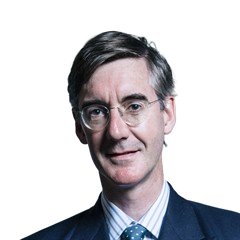
Sir Jacob Rees-Mogg is a broadcaster, businessman and former Conservative MP for North East Somerset (2010-2024).
Rees-Mogg held several Cabinet positions between 2019 and 2022 under prime ministers Boris Johnson and Liz Truss.
Known for his traditionalist persona, socially conservative views and staunch euroscepticism, Rees-Mogg was a prominent figure on the right wing of the Conservative Party and chaired the European Research Group (ERG) of MPs from 2018 to 2019.
Rees-Mogg lost his parliamentary seat at the 2024 general election. Contesting the newly formed North East Somerset and Hanham constituency, he was defeated by the Labour candidate, Dan Norris, who won with a majority of 5,319.
Rees-Mogg received a knighthood in Boris Johnson’s resignation honours list (2023).
Jacob Rees-Mogg: frontbench career
Rees-Mogg served as leader of the House of Commons and lord president of the council from July 2019 to February 2022.
Rees-Mogg was sometimes at the centre of controversies during his tenure as leader of the House of Commons.
On 28 August 2019, Rees-Mogg convened a meeting of privy councillors which advised Queen Elizabeth II to prorogue parliament. The approach was denounced by critics as an anti-democratic, unconstitutional ploy to bypass MPs – at a time when the parliamentary arithmetic over Brexit was finely balanced. Prorogation in order to secure a “no-deal” Brexit – the default legal position under EU law’s Article 50 process – had been a point of debate in the 2019 Tory leadership contest.
The supreme court ultimately ruled that the prorogation was unlawful. Rees-Mogg described the judgment as a “constitutional coup”.
In September 2019, as MPs considered a bill that would block a no-deal Brexit, Rees-Mogg was pictured lounging on the commons frontbench. Labour MP Anna Turley said Rees-Mogg’s pose was the “physical embodiment of arrogance, entitlement, disrespect and contempt for our parliament.”
In November 2021, as commons leader, Rees-Mogg was at the centre of attempts to delay the suspension of Conservative MP Owen Paterson, after the commons standards committee found he had committed an “egregious” breach of the parliamentary rules against paid advocacy. Addressing MPs, Rees-Mogg argued that the current procedures did not provide for an “independent appeals process”.
The government was ultimately forced into a damaging U-turn. Announcing the climbdown, Rees-Mogg acknowledged the vote had “created a certain amount of controversy”. He said that a link “needs to be broken” between Paterson’s case and a wider overhaul of parliament’s disciplinary processes.
Rees-Mogg was appointed to the newly created post of minister for Brexit opportunities and government efficiency in February 2022. Although the position was at the minister of state level, it was confirmed that Rees-Mogg would attend cabinet meetings. In this role, he was responsible for driving “forward the changes we are able to make now that we have left the EU, delivering on our post-Brexit agenda across Whitehall”, a Downing Street spokesperson said.
In June 2022, Rees-Mogg publicly declared their loyalty to Johnson ahead of a Conservative “no-confidence” in his leadership. The vote was triggered by discontent within the parliamentary party following the “partygate” scandal and the publication of the Sue Gray report. While the prime minister ultimately won the vote, the scale of the rebellion against him, with 148 of his own MPs voting to remove him, severely weakened his authority and presaged his resignation the following month.
At the time, Rees-Mogg stated: “The time for navel-gazing has ended. The British people gave Boris a mandate, Tory MPs would be wise to accept it.”
Under Liz Truss, Rees-Mogg served as secretary of state for business, energy and industrial strategy (September to October 2022).
Rees-Mogg resigned upon Rishi Sunak’s appointment as prime minister in October 2022.
Rees-Mogg remained loyal to Boris Johnson on the backbenches and was named by the privileges committee as among the MPs who “co-ordinated campaign of interference” in its work. The formal reprimand concerned the committee’s inquiry into whether Johnson misled parliament over Partygate.
Jacob Rees-Mogg: backbench career
Rees-Mogg first stood for parliament at the 1997 general election, standing as the Conservative Party candidate for Central Fife in Scotland. Despite his, and his nanny’s best efforts, the 27-year-old failed to win the traditional Labour seat for the Conservatives.
Rees-Mogg was first elected to parliament in 2010 and he quickly acquired a reputation for his distinctive speaking style, socially conservative stances and frequent rebellions against the coalition government whip.
Rees-Mogg became known for using parliamentary procedure, including filibustering, to oppose measures he disagreed with. His traditionalist views and dress sense inspired the nickname “the honourable member for the 18th century”.
A staunch eurosceptic, Rees-Mogg was appointed as chair of the influential European Research Group (ERG) of Conservative backbenchers in 2018. In this capacity, he played a leading role in opposing Theresa May’s proposed Brexit withdrawal agreement.
Following the publication of May’s deal in November 2018, Rees-Mogg submitted a letter of no-confidence in the prime minister. He said the deal failed to “meet the promises given to the nation”.
On 12 December, Sir Graham Brady, the chairman of the 1922 committee of Conservative backbenchers, announced that he had received at least 48 letters of no confidence – exceeding the threshold of 15%.
At the time, Rees-Mogg was prominent in seeking to organise opposition to May.
However, the confidence vote somewhat stabilised May’s position. She won by 200 votes to 117 – a majority of 83. Rees-Mogg went on to vote against the Brexit deal on two out of the three occasions it was brought before parliament.
What is Rees-Mogg doing now?
Since losing his parliamentary seat in July 2024, Rees-Mogg has continued his career as a broadcaster and political commentator.
He hosts Jacob Rees-Mogg’s State Of The Nation on GB News, a role he began in early 2023 while still an MP. He also writes columns for newspapers.
Political Views
Rees-Mogg is generally identified with the Thatcherite and socially conservative wings of the Conservative Party.
In his school report from Eton College, Rees-Mogg was described as a “particularly dogmatic” Thatcherite. Rees-Mogg would likely not dispute this description.
In a February 2025 article for GB News, Rees-Mogg described Thatcher as a “leader who embodied strength, determination, and vision.”
He added: “She knew what the people she represented wanted and how to give it to them. She defined them as her people, and she stood for those who worked hard and sought to better themselves as she had done.
“She was ideological because her ideology worked and she clearly saw the failure of airy-fairy socialism.”
Rees-Mogg is open about his Catholic faith and its influence on his political views. He is opposed to same-sex marriage and abortion on these grounds.
Leadership elections
Tory leadership 2022 (II): Rees-Mogg supported Boris Johnson’s explored candidacy in the Conservative Party’s October 2022 leadership election. The contest was triggered by the resignation of Liz Truss after just 45 days in office, following the financial and political tailspin triggered by her “mini-budget”.
Johnson, who had resigned as prime minister only months earlier, initially sought a return to office and claimed to have secured the 100 nominations required to proceed. However, he announced his withdrawal on 23 October, stating that “you can’t govern effectively unless you have a united party in parliament.” Sir Graham Brady, chair of the 1922 committee of Tory backbenchers, later confirmed that Johnson had indeed secured the 100 MPs necessary to force a ballot of the Conservative membership – which he could well have won.
Tory leadership 2022 (I): Rees-Mogg supported Liz Truss’ candidacy in the Conservative Party’s July-September 2022 leadership election. The contest was triggered by the resignation of Boris Johnson, following the mass exodus of more than 60 frontbenchers.
Truss, the then-foreign secretary, campaigned on a platform of sweeping tax cuts. After finishing second in the final parliamentary ballot with 113 votes, she won the subsequent vote of the party membership with 81,326 votes (57.4%) and was appointed prime minister on 6 September.
Tory leadership 2019: Rees-Mogg supported Johnson for the party’s leadership in 2019. The election was triggered by the resignation of Theresa May following her inability to secure a Brexit deal acceptable to the Conservative Party.
Johnson, the former foreign secretary and mayor of London, campaigned on the central pledge to “deliver Brexit” by 31 October 2019, “deal or no deal”. He thereby positioned himself as the candidate best-placed to break the parliamentary deadlock. Johnson secured 114 votes in the first parliamentary ballot, and reached 160 votes in the final MP round. In the subsequent ballot of the party membership, Johnson won a decisive victory with 92,153 votes (66.4%).
Tory leadership 2016: Rees-Mogg supported Johnson’s potential candidacy for the party’s leadership in June 2016. The contest was triggered by the resignation of David Cameron following the UK’s vote to leave the European Union.
Johnson, the former mayor of London and a leading figure in the Vote Leave campaign, was widely regarded as the frontrunner to succeed Cameron. However, his campaign was upended when Gove unexpectedly withdrew his support and announced his own leadership bid. Johnson announced on 30 June that he would not enter the race, leaving his supporters to shift their allegiances.
Rees-Mogg went on to endorse Gove’s candidacy. Gove secured 48 votes in the first ballot, placing third, but his support fell to 46 votes in the second ballot on 7 July. As the candidate with the fewest votes in that round, Gove was eliminated from the contest.
Finally, Rees-Mogg endorsed Andrea Leadsom’s candidacy. Leadsom, the minister of state for energy and climate change, emerged as a leading Leave candidate, securing 66 votes in the first ballot and 84 in the second. She withdrew from the contest on 11 July before the membership vote could take place.
Factional identity and party tradition
Net Zero Scrutiny Group: In the 2019-2024 parliament, Rees-Mogg was associated with the Net Zero Scrutiny Group (NZSG), a faction within the Conservative Party that questioned the cost and feasibility of the UK’s climate targets. The group, which came to prominence in 2022, sought to link the then-Conservative government’s commitment to net zero with the cost-of-living crisis. In a 2022 open letter published in the Daily Telegraph, the group urged the government to scrap green levies and drill for more fossil fuels in the North Sea to lower energy bills. The COP26 climate conference in 2021 was said to have been a catalyst for the group’s formation.
Tax pledge Tories: In November 2023, Rees-Mogg signed the “tax pledge” – which committed supportive MPs to not vote for any further increases in the overall tax burden. The initiative was associated with the Conservative Growth Group (CSG), a faction within the party that advocated for lower taxes and supply-side reforms to stimulate economic growth. The group was formed by allies of the former prime minister Liz Truss. The “tax pledge” was spearheaded by Jake Berry, who served as Conservative chair in Truss’ short-lived government.
Cornerstone Group: Rees-Mogg was a member of the Cornerstone Group, a highly traditionalist and socially conservative faction of Conservative MPs. Its political philosophy was summarised by its motto: “Faith, Flag, and Family”. In July 2005, the group published a pamphlet that accused the-leader Michael Howard of running a general election campaign that was too “timid” about tax cuts, public service reform and family values.
Rwanda rebellion (amendments): In January 2024, Rees-Mogg was one of around 60 Conservative MPs who supported amendments to the government’s Safety of Rwanda (Asylum and Immigration) Bill. The amendments, proposed by Conservative MPs Sir Bill Cash and Robert Jenrick, sought to strengthen the proposed legislation by limiting the ability of individual asylum seekers to prevent their deportation to Rwanda, under the terms of the government’s flagship removals scheme. The rebellion was composed of Tory MPs on the right of the party.
Brexit and Europe
Brexit referendum: Rees-Mogg supported Leave in the 2016 Brexit referendum, and therefore agreed with a majority of his constituents, 51.6% of whom voted to Leave.
Leave Means Leave: Rees-Mogg was a supporter of Leave Means Leave, a cross-party eurosceptic pressure group established in the aftermath of the 2016 EU referendum. The group, which described itself as “the campaign for a clean Brexit”, set out its opposition to any withdrawal agreement that it believed would keep the UK tied to EU rules and institutions – a position often referred to as a “hard Brexit”.
Article 50: In February 2017, Rees-Mogg voted in favour of the European Union (Notification of Withdrawal) Bill. The legislation empowered the prime minister to notify the Council of the European Union of the UK’s intention to withdraw, formally triggering the process set out in Article 50 of the Treaty on European Union. MPs supported the bill by 498 votes to 114 at second reading.
Social values and conscience issues
Same-sex marriage (2013): In February 2013, Rees-Mogg was one of the 139 Conservative MPs to vote against the Marriage (Same Sex Couples) Bill at its second reading. The landmark piece of legislation, which received its second reading by 400 votes to 175, legalised marriage for same-sex couples in England and Wales.
Foreign policy and security
Trident renewal (2016): Rees-Mogg voted in favour of a government motion calling for the renewal of the Trident nuclear deterrent system in July 2016. The motion, which was passed by 472 votes to 117, committed the UK to constructing a new fleet of submarines to carry the nation’s nuclear weapons.
Syria airstrikes (2015): Rees-Mogg voted in favour of a government motion to extend UK airstrikes against Isis from Iraq into Syria in December 2015. The motion, which was passed by 397 votes to 223 after a 10-hour debate in the House of Commons, authorised the RAF to conduct strikes against Isis targets in Syria.
Syria airstrikes (2013): Rees-Mogg voted in favour of the government’s motion on the principle of military intervention in Syria in August 2013. The government motion was defeated by 285 votes to 272, a move which effectively ruled out UK participation in any US-led military strikes.
Sanctioned (Russia): In April 2022, Rees-Mogg was among the group of MPs placed on a sanctions list by the Russian government. The measure barred them from entering Russia and was presented by Moscow as a retaliatory response to the UK’s stance on the invasion of Ukraine.
Before Politics
Jacob William Rees-Mogg was born in Hammersmith, London, on 24 May 1969. His father was the late William Rees-Mogg, former editor of the Times newspaper and a life peer.
His sister, Annunziata Rees-Mogg, served as a Brexit Party member of the European Parliament (MEP) from 2019 to 2020.
Rees-Mogg is an alum of Eton and Trinity College Oxford. In his first-year at Oxford University, Rees-Mogg was nominated for the title of “Pushy Fresher” by the student newspaper. His nomination was simply a photo with the caption: “What more need we say?”.
After graduating, Rees-Mogg pursued a career in finance, initially working for J Rothschild Investment Management and later Lloyd George Management in Hong Kong.
In 2007, Rees-Mogg co-founded Somerset Capital Management (SCM) LLP.
Personal Life
Rees-Mogg married Helena de Chair, daughter of the late poet and Conservative MP Somerset de Chair, in 2007. They have six children: Peter, Mary, Thomas, Anselm, Alfred and Sixtus.
In 2017, Rees-Mogg was asked if he had ever changed a nappy.
He responded: “I don’t think Nanny would approve, because I’m sure she’d think I wouldn’t do it properly”.
The family resides at Gournay Court, a Grade II*-listed manor house in West Harptree, Somerset. They also own a townhouse in Westminster. Their long-serving nanny, Veronica Crook, previously cared for Rees-Mogg as a child.
Rees-Mogg’s net worth, combined with his wife’s anticipated inheritance, has been estimated to be over £100 million.
Trivia
Rees-Mogg developed an interest in stocks and shares from a young age, attending company AGMs after inheriting £50 aged 10.
Rees-Mogg has a keen interest in classic cars. He bought a Bentley T1, after his father spotted it at auction in 1992.
On the campaign trail in Central Fife back in 1997, Rees-Mogg was mocked for driving around in a Bentley. Rees-Mogg reportedly replied: “It’s just a Mercedes”.
Rees-Mogg is very fond of cider.
Speaking at the opening of the Palladium Electric Wetherspoons pub in Midsomer Norton, Rees Mogg said: “I actually make my own cider. We’ve got a few apple trees and we have a go and it’s great fun… Last year we made about 25 gallons. I like it, whether it’s any good I don’t know but it’s fun to do.”
Jacob Rees-Mogg has not written for Politics.co.uk.