Cameron and Clegg unveil coalition in Downing Street ‘rose garden’ ceremony
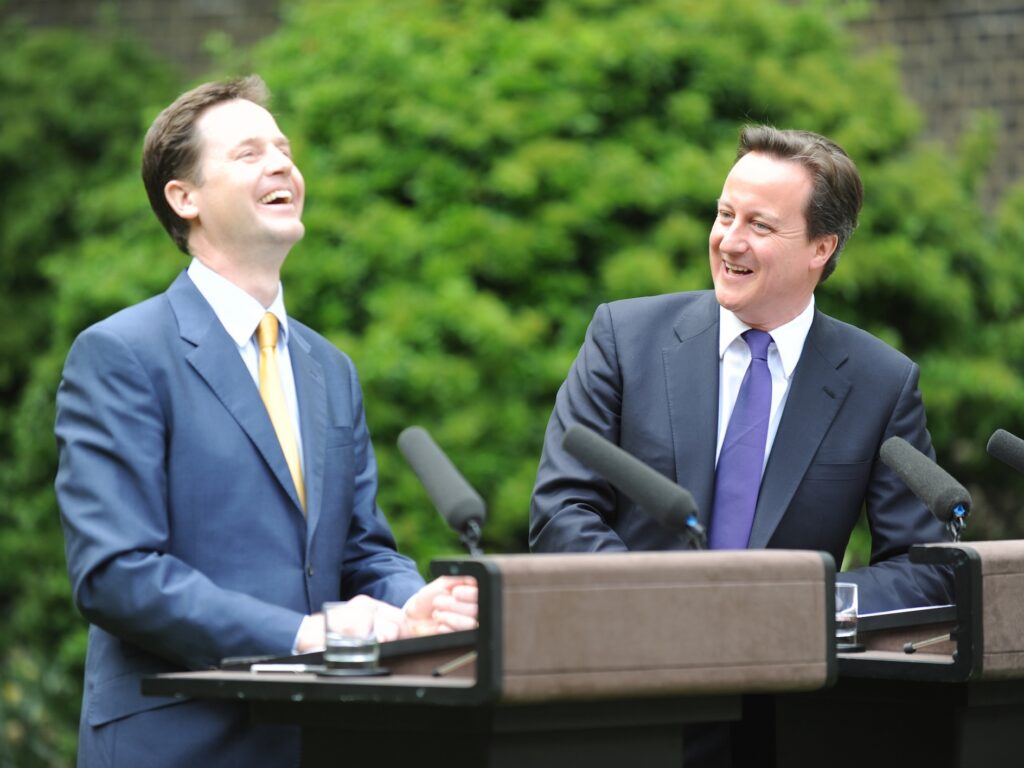
David Cameron and Nick Clegg formally presented their new coalition government to the nation on 12 May 2010, at a joint press conference in the Downing Street rose garden.
Standing side-by-side in the sunshine, the new Conservative prime minister and his Liberal Democrat deputy hailed the formation of the UK’s first peacetime coalition government since the Second World War as a “historic and seismic shift”.
***
The general election held on 6 May 2010 resulted in the country’s first hung parliament since February 1974, ending 13 years of Labour government.
Held in the aftermath of the 2008 financial crisis, the Conservative Party won the most seats and votes but fell 20 seats short of the 326 required for an overall majority. The Conservatives won 306 seats with 36.1% of the vote, a net gain of 96 MPs compared to the notional 2005 result. The Labour party, led by Gordon Brown, lost 91 seats, returning 258 MPs on a 29.0% vote share.
The Liberal Democrats, having secured 57 seats, held the balance of power in the House of Commons.
The inconclusive result triggered five days of intense negotiations between the parties known as the “five days in May”. A Labour-Lib Dem coalition was considered as a possibility – likely with the support of smaller nationalist parties, and negotiations were held to this effect. But the most viable path to a stable government was provided by a formal arrangement between the Conservatives and the Liberal Democrats.
On the evening of 11 May, Brown resigned as prime minister, and Cameron entered 10 Downing Street.
The Cameron-Clegg press conference the following day, 12 May, was notable for its relaxed and optimistic tone. Commentators quickly dubbed it the rose garden “love-in”, likening the setting to a wedding reception.
Addressing the assembled press, Cameron referred to a new “Liberal Democrat-Conservative government” – an ordering that felt entirely deliberate.
He declared that the new administration would be “united behind three key principles: freedom, fairness and responsibility”.
He added: “It will be an administration united behind one key purpose. That is to give our country the strong, stable and determined leadership that we need for the long term.”
Cameron stated that the press conference amounted to the announcement of a “new politics – a new politics where the national interest is more important than the party interest, where cooperation wins out over confrontation, where compromise, where give and take, where reasonable, civilised, grown-up behaviour is not a sign of weakness, but a sign of strength.”
Speaking for the first time as deputy prime minister, Clegg remarked: “We have just been through an election campaign and now we have a coalition. Until today, we were rivals; now, we are colleagues.
“That says a lot about the scale of the new politics that is now beginning to unfold. This is a new government and it is a new kind of government, a radical reforming government where it needs to be and a source of reassurance and stability at a time of great uncertainty in our country too.”
***
This serene picture of coalition unity was tested when the leaders engaged with the media in a Q&A. Andy Bell of 5 News asked Cameron whether he regretted responding “Nick Clegg” to the question: “What is your favourite joke?”
Clegg, apparently unaware of the remark, asked Cameron: “Did you say that?”
The prime minister responded: “I’m afraid I did, once”.
At which point, the deputy prime minister playfully gestured to the garden exit, telling journalists: “That’s it, I’m off!”
“Come back!”, Cameron pleaded in response.
The prime minister continued: “We’re all going to have things that we said thrown back at us. And there’s a serious point in this; which is, if you want to spend the next five years finding Lib Dem politicians who slightly disagree with Conservative politicians about this, or a slightly nuanced policy, you can find lots.
“But we’re looking at the bigger picture, we’re looking at what a bold move like this with a strong stable government can achieve. And if it means swallowing some humble pie, and if it means eating some of your words, I cannot think of a more excellent diet in which to provide the country with good government.”
A Conservative MP reportedly quipped afterwards: “If I was Samantha [Cameron], I would worry David is going to run off with the man next door.”
This inaugural coalition press conference coincided with the publication of a seven-page document outlining the initial “Conservative–Liberal Democrat coalition agreement”.
In the foreword, the deal stated: “These are the issues that needed to be resolved between us in order for us to work together as a strong and stable government”.
The document, which would serve as the terms of reference governing the coalition, detailed the key compromises made by both parties. The central agreement was a commitment to tackle the UK’s budget deficit, with an emergency budget promised within 50 days.
Key concessions to the Liberal Democrats included a referendum on changing the electoral system to the alternative vote (AV) and a commitment to legislate for five-year fixed term parliaments. For their part, the Conservatives secured agreement on policies such as placing a cap on non-EU immigration and allowing new providers to enter the state schooling system.
In part, the fixed term parliament agreement represented a binding commitment by Cameron not to unilaterally collapse the coalition and call an election at a politically advantageous moment for the Conservatives.
The document also specified areas where the parties could, in effect, ‘agree to disagree’ such as on the renewal of the Trident nuclear deterrent and on education funding.
Of the 57 Liberal Democrat MPs, only former party leader Charles Kennedy and Manchester Withington MP John Leech refused to support it.
In an article for the Observer, published 16 May, Kennedy warned of the risks of “a subsequent assimilation within the Conservative fold.”
He added: “Like many others I was keen to explore the possibilities of a so-called ‘progressive coalition’, despite all the obvious difficulties and drawbacks. It remains a matter of profound disappointment that there was insufficient reciprocal will within the Labour party – and they should not be allowed to pose in opposition purity as a result.”
A final longer agreement, entitled The Coalition: our programme for government, was published on 20 May.
***
The coalition cabinet featured five Liberal Democrat MPs, including Clegg as deputy prime minister, Vince Cable as business secretary, David Laws as chief secretary to the Treasury, Chris Huhne as energy and climate change secretary and Danny Alexander as secretary of state for Scotland.
To manage the relationship and make key strategic decisions, a core group known as the “quad” was established. This consisted of the prime minister, the deputy prime minister, the chancellor (George Osborne), and the chief secretary to the Treasury. Alexander succeeded Laws as chief secretary to the Treasury shortly after the coalition began its life.
The quad was set up to resolve policy disagreements, so compromises could be taken to the wider cabinet.
Despite some difficulties, notably over the AV referendum and House of Lords reform, the coalition served a full five-year term – a feat many commentators initially believed was unlikely back in May 2010.
But the electoral consequences for the Liberal Democrats as the coalition’s junior partner were severe. In the 2015 general election, the Conservative Party won a narrow outright majority; the Liberal Democrats saw their parliamentary representation collapse from 57 MPs to just eight.

Politics.co.uk Newsletters
DAILY
Politics@Lunch
WEEKLY
Week in Review
