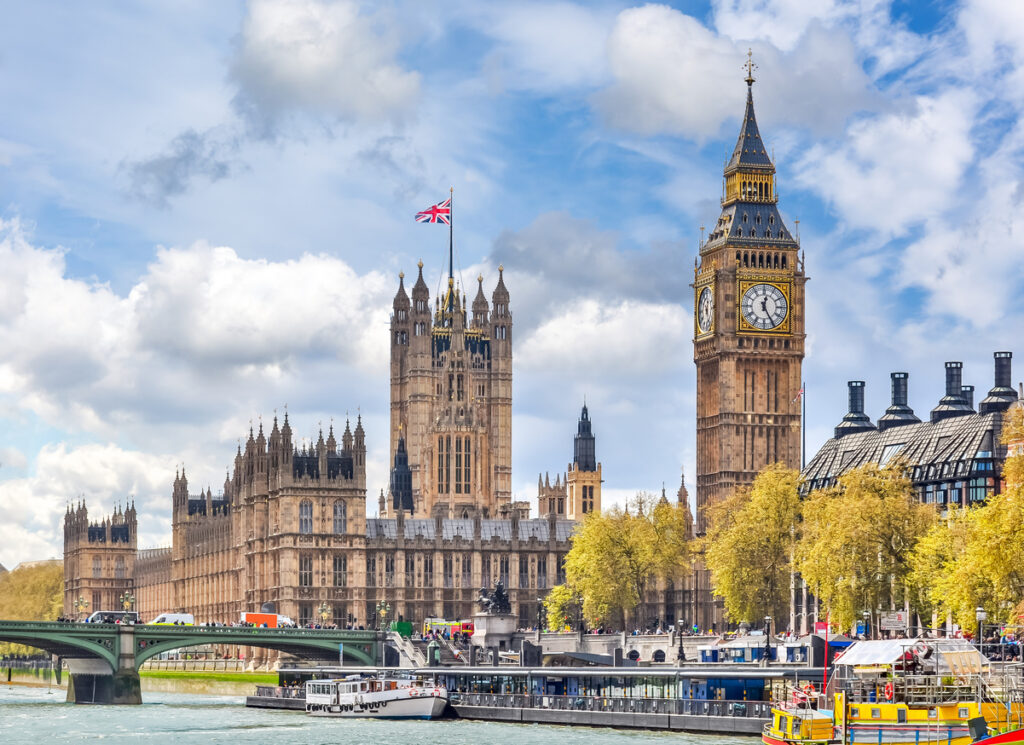
A hung parliament refers to a situation where no single political party has an absolute majority of seats in the House of Commons.
Hung parliaments most commonly arise as a result of an inconclusive general election. This leads to a period of negotiation between the political parties to determine who can form a stable government. The UK’s political system is built on the principle that the government must be able to command the confidence of the House of Commons.
Recent hung parliaments occurred following the 2010 and 2017 general elections. These outcomes led to arrangements (a formal coalition and a “confidence and supply” agreement respectively) whereby a government could be formed on a somewhat stable footing.
The February 1974 general election also produced a hung parliament. In lieu of any formal or informal arrangements, a second general election was held in October 1974, resulting in a slim Labour majority of three seats.
The January 1910 and December 1910 general elections also produced hung parliaments. In both instances, Liberal prime minister H.H. Asquith continued to govern with the support of the Irish nationalist bloc.
A hung parliament can also come about when a government’s slim majority is eroded through by-election defeats, MPs defecting to opposition parties and suspensions of the whip. This occurred in December 1996 during John Major’s tenure as prime minister, and in March 1977 during Jim Callaghan’s tenure as prime minister. In these instances, a government can continue in office until it chooses to call an election or falls following the passage of a “no-confidence” measure.
Major was compelled to call an election for May 1997 (five years after the 1992 election). Callaghan’s government fell after the Conservative opposition, led by Margaret Thatcher, passed a no-confidence motion, resulting in the 1979 election.
What happens in a hung parliament?
Following a general election, no matter the result, the incumbent prime minister does not automatically resign. In the event of a hung parliament, wherein no single party can form a reliable government, the prime minister is under no obligation to resign.
Constitutional convention dictates that the sitting prime minister remains in office in a caretaker capacity.
A hung parliament triggers a period of negotiations between the parties in a bid to form a stable government.
The party with the largest number of MPs, it is generally accepted, is given the first opportunity to form a government by engaging in talks with other parties. This was the case following the 2010 general election, when the Liberal Democrats under Nick Clegg held the balance of power. Clegg indicated that the Conservatives, having won the most seats, would be given the first opportunity to reach out for negotiations.
The monarch remains strictly neutral and above this political process, awaiting its outcome.
Evaluation question
Do hung parliaments risk drawing the crown into political controversy if inter-party negotiations break down entirely?
Options for forming a government in a hung parliament
There are three main ways a government can be formed following a hung parliament:
Coalition
A coalition government is a form of administration in which two or more political parties join together to govern, sharing ministerial posts, cabinet positions and responsibility for policy.
Coalitions are most common when a general election produces a “hung parliament”, where no single party has won an overall majority of seats in the House of Commons.
To form a stable administration that can command the confidence of the legislature, parties can negotiate a formal arrangement. This is usually underpinned by a detailed “coalition agreement” that sets out a joint policy programme for the government’s term in office.
Historically, peacetime coalitions have proved rare in British politics. The establishment of the devolved administrations in the late 1990s, however, now means coalition politics is a staple of British governance.
- Example: The 2010-2015 Conservative Liberal Democrat coalition
Confidence and supply agreement
A confidence and supply agreement is a formal deal in which a smaller party or independent members agree to support the government in key parliamentary votes.
These agreements are a means by which a minority administration facing a hung parliament can pass legislation, doing so with the support of a smaller party. They are less formal than a full coalition government.
In a coalition, the smaller party joins the government and its senior members take up ministerial posts in the cabinet. By contrast, in a supply and confidence deal, the supporting party remains outside of government and does not assume ministerial office.
Evaluation question
To what extent does a confidence and supply agreement provide a minor party with the political leverage of a coalition while mitigating the electoral risks of assuming formal executive responsibility?
In a coalition, all ministers are bound by the principle of collective responsibility, and thereby are required to support the government on all issues. Both majority and minority parties in a coalition take the same whip (provided there is no “agreement to differ” on a specific issue).
In a supply and confidence deal, the supporting party is only bound on the specific issues of supply and confidence. On all other legislation, it is free to vote against the government.
- Example: The Conservative-DUP confidence and supply agreement, negotiated following the 2017 general election.
Minority government (without agreement)
A party can also attempt to govern as a minority without any formal deals. This is the most precarious option, as the government must seek to build a majority for every single vote on a case-by-case basis. Such governments are often seen as unstable, and would be unlikely to pass consequential legislation. They may be formed in order to govern the county before such a time as another general election can be called.
Evaluation question
Should the largest party in a hung parliament always seek some form of agreement, such as a coalition or confidence and supply deal, in order to avoid the instability that comes with leading a minority government? Placement after “…pass consequential legislation.”
- Example: Harold Wilson’s minority Labour government following the February 1974 general election. Ramsay MacDonald’s minority Labour administrations (1924 and 1929-1931).
Tests for a government in a hung parliament
The first crucial test for any new government formed after a hung parliament is the vote on the king’s speech. If the government wins this vote, it has effectively demonstrated that it commands the confidence of the House of Commons and can begin its tenure in office.
In 2017, the Democratic Unionist Party (DUP) supported the queen’s speech proposed by Theresa May’s Conservative government before an agreement had been reached. This was seen as a signal of good will, looking ahead to a likely agreement.
Throughout a hung parliament, governments will face constant tests in the form of passing budgets, surviving no-confidence motions and winning support for subsequent king’s speeches. Furthermore, while the backing of a junior coalition partner or a confidence-and-supply agreement may allow the government to secure majorities on these core votes, the prime minister’s broader legislative agenda is inevitably constrained by the fragile parliamentary arithmetic.
Governments may be forced to abandon flagship policies or reach compromises in order to remain in office.
Evaluation question
Do the compromises required to survive a hung parliament ultimately betray the mandate on which the governing party was elected?
Theresa May was notably unable to secure parliamentary approval for her Brexit withdrawal agreement on three occasions, a failure that ultimately led to her resignation as prime minister. Boris Johnson subsequently felt compelled to call another snap general election (2019) in an effort to win a majority capable of delivering Brexit on his terms.
Even where coalitions are able to secure victories on major votes, they may still break down on specific policy issues. This was evident in 2012/2013, when a Conservative backbench rebellion forced the government to abandon proposals to reform the House of Lords. In response, the Liberal Democrats withdrew their support for proposed boundary changes.
The ‘five days of May’: how the Con-Lib coalition was formed
The 2010 general election resulted in the country’s first hung parliament (coming about as a consequence of an election) since February 1974. David Cameron’s Conservative party won the most seats and votes; however, it fell 20 seats short of the 326 required for an overall majority.
The incumbent Labour party, led by prime minister Gordon Brown, lost 91 seats, returning 258 MPs on a 29.0% vote share. The Liberal Democrats, having secured 57 seats, held the balance of power in the House of Commons.
The inconclusive result triggered five days of negotiations between the parties known as the “five days in May”.
Brown remained in office in a caretaker capacity while the parties attempted to determine who could form a stable government. Nick Clegg was the first to move. He indicated that the Conservative Party, as the party which had won the most seats, should have the first opportunity to begin negotiations.
Clegg said that he believed the Tories had gained the “first right” to attempt to form a government.
Speaking outside No 10 Downing Street, Brown said he would be “willing to see any of the party leaders”. However, he added that “should the discussions between Mr Cameron and Mr Clegg come to nothing… I would be prepared to discuss with Mr Clegg the areas where there may be some measure of agreement between our two parties”.
He declared: “I understand and completely respect the position of Mr Clegg in stating that he wishes first to make contact with the leader of the Conservative Party.”
Cameron, meanwhile, immediately made a “big, open, and comprehensive offer” to the Liberal Democrats.
In a speech on the day after polling day, Cameron stated: “I want to make a big, open and comprehensive offer to the Liberal Democrats. I want us to work together in tackling our country’s big and urgent problems – the debt crisis, our deep social problems and our broken political system.”
A Labour-Lib Dem coalition was considered as a possibility, likely with the support of smaller nationalist parties, and negotiations were held to this effect. For a period, the Liberal Democrats were in simultaneous negotiations with both the governing Labour Party and the opposition Conservative Party. But the most viable path to a stable government was provided by a formal arrangement between the Conservatives and the Liberal Democrats.
On the evening of 11 May, Brown resigned as prime minister, and David Cameron entered 10 Downing Street.
Cameron and Clegg then formally presented their new coalition government to the nation on 12 May 2010, at a joint press conference in the Downing Street rose garden. This inaugural coalition press conference coincided with the publication of a seven-page document outlining the initial “Conservative–Liberal Democrat coalition agreement”.
Under this arrangement, Clegg was appointed as deputy prime minister.
In the foreword, the deal stated: “These are the issues that needed to be resolved between us in order for us to work together as a strong and stable government”.
The document, which would serve as the terms of reference governing the coalition, detailed the key compromises made by both parties. The central agreement was a commitment to tackle the UK’s budget deficit, with an emergency budget promised within 50 days.
Key concessions to the Liberal Democrats included a referendum on changing the electoral system to the alternative vote (AV) and a commitment to legislate for five-year fixed term parliaments. For their part, the Conservatives secured agreement on policies such as placing a cap on non-EU immigration and allowing new providers to enter the state schooling system.
The document also specified areas where the parties could, in effect, ‘agree to disagree’ such as on the renewal of the Trident nuclear deterrent and on education funding.
The cabinet featured five Liberal Democrat MPs, namely Clegg as deputy prime minister, Vince Cable as business secretary, David Laws as chief secretary to the Treasury, Chris Huhne as energy and climate change secretary and Danny Alexander as secretary of state for Scotland.
To manage the relationship and make key strategic decisions, a core group known as the “quad” was established. This consisted of the prime minister, the deputy prime minister, the chancellor (George Osborne), and the chief secretary to the Treasury. Alexander succeeded Laws as chief secretary to the Treasury shortly after the coalition was consolidated.
The quad was set up to resolve policy disagreements, so compromises could be taken to the wider cabinet.
Despite some difficulties, notably over the AV referendum and House of Lords reform, the coalition served a full five-year term – a feat many contemporary commentators, back in May 2010, initially believed was unlikely.
However, the electoral consequences for the Liberal Democrats as the coalition’s junior partner were severe. In the 2015 general election, the Conservative Party won a narrow outright majority. The Liberal Democrats saw their parliamentary party collapse from 57 MPs to just eight.
Evaluation question
How far does the Liberal Democrat experience from 2010 to 2015 demonstrate that entering a formal coalition carries disproportionate electoral risks for a minor British political party?
Other examples of hung parliaments
January 1910 general election
Liberal prime minister H.H Asquith fought the January 1910 general election on a peers vs the people platform. It came after the House of Lords had blocked the People’s Budget, a radical fiscal package designed to fund naval expansion and sweeping new social welfare programmes.
The result was a hung parliament. The Liberals won 274 seats – just two more than their Conservative/Unionist opponents. Asquith was able to remain in power with the support of Labour and Irish nationalist MPs.
The speech from the throne in February 1910 set out a limited legislative programme. The government would seek to pass the People’s Budget, having secured the endorsement of the electorate, and reform the upper chamber.
John Redmond, the leader of the Irish Parliamentary Party (IPP), used his party’s influence to secure commitments from Asquith. Redmond refused to support the People’s Budget until he had been assured that power of the Lords would be broken. This outcome, Redmond figured, would remove the final obstacle to Irish home rule – his party’s ultimate objective.
Redmond called on the prime minister to give the IPP “reasonable assurances that he would be able to carry his veto bill into law this year”. Then, he said, “we will not abstain from voting on the budget. We will vote for it.” Redmond’s “assurances” were a reference to the suggestion that King Edward VII should pack the Lords (appoint hundreds of Liberal peers under the royal prerogative) to force through reform of the upper chamber.
Asquith proceeded to indicate to parliament that he was willing to deliver such advice to the sovereign.
1929 general election
Labour emerged as the largest party for the first time at the 1929 general election with 287 seats on 33.3% of the vote. The Conservatives under Stanley Baldwin secured 260 seats on 38.1%. The Liberal Party, led by David Lloyd George, won 59 seats on 23.6% of the vote. (It would mark the last time when a third party polled more than one-fifth of the popular vote until 1983.)
In the hung parliament, Lloyd George’s Liberal Party held the balance of power and tentatively agreed to prop up a minority Labour administration, led by Ramsay MacDonald. Since leaving Downing Street in 1922, Lloyd George, leading a truncated party, had come to regard electoral reform and a more equitable distribution of seats as necessary to any broader Liberal recovery.
On 13 June 1929, Lloyd George told a meeting of Liberal MPs that the “mandate of the government would end as soon as it failed to pursue a Liberal policy.” He clarified that his party’s attitude to the government would “be influenced by the line which it took up on the question of electoral reform.”
MacDonald, who briefly led a minority administration in 1924, appealed to the commons to act as a “council of state”.
In his opening speech of the parliament on 2 July, the prime minister declared: “I wonder how far it is possible, without in any way abandoning any of our party positions, without in any way surrendering any item of our party principles, to consider ourselves more as a council of state and less as arrived regiments facing each other in battle.”
He called on MPs to put “our ideas into a common pool”, from which parliament could draw “legislation and administration that will be of substantial benefit to the nation as a whole.”
Notably, the king’s speech included a declaration that the MacDonald government would “institute an examination of the experiences of the election so that the working of the law relating to parliamentary elections may be brought into conformity with the new conditions.”
The second MacDonald ministry survived from 1929 to 1931 with ad hoc support from Lloyd George’s Liberal bloc. In return, the government introduced the Representation of the People (No. 2) Bill, which proposed the introduction of the alternative vote (AV) for elections to the House of Commons. Liberal support for the package was lukewarm, with the party having expressed its preference for a more proportional system.
The bill ultimately secured its third reading in the House of Commons on 2 June 1931, by 278 votes to 228.
The Conservative-dominated House of Lords remained deeply hostile to AV, however, viewing it as a cynical partisan measure. Peers passed wrecking amendments, including one that would have applied AV only to London and boroughs with populations over 200,000.
However, before the deadlock between the Lords and the commons could be resolved, the Labour cabinet split over a package of austerity measures proposed in response to the 1931 financial crisis.
MacDonald initially sought to resign as prime minister, but was invited by King George V to lead a National Government including both Conservative and Liberal ministers.
The new administration, formed as a temporary solution to the deteriorating financial situation, abandoned the AV bill. On 6 October 1931, parliament was dissolved for an election; the National Government subsequently secured the greatest landslide of modern times.
February 1974 general election
The February 1974 general election, called by the Conservative prime minister, Edward Heath, produced a hung parliament – the first since 1929. While the Conservatives won a slightly larger share of the popular vote (37.9%) than Labour (37.2%), Harold Wilson’s party secured 14 more seats, winning 301 to the Conservatives’ 297.
But arguably the most dramatic story was the performance of Jeremy Thorpe’s Liberal Party, which gained over six million votes – 19.3% of the total – but won only 14 seats. That was Britain’s inconclusive answer to Heath’s defiant challenge: “Who governs Britain?”
Heath exercised his constitutional right to attempt to remain in post as prime minister. He offered the Liberals a coalition with a cabinet seat for their leader and a “speaker’s conference to consider the desirability and possibility of a change in our electoral arrangements.”
The proposition added: “We should then be ready to co-operate in seeing that the conclusions and recommendations of the conference were put to parliament in the customary way.”
Thorpe, under pressure from Liberal activists, could not accept these terms.
Wilson, meanwhile, insisted that he would not be attempting to agree any deals with rival parties.
Heath resigned on 4 March, allowing the Labour leader to return to Downing Street at the head of a minority government.
The unstable parliamentary arithmetic, with Labour 17 seats short of a majority, made another election effectively inevitable. It followed in October of the same year; 1974 therefore became the first year to feature two general elections since 1910.
Wilson was returned as prime minister in October, with a slim majority of just three seats.
1977-1979 hung parliament
Shortly after entering Downing Street, Labour prime minister James Callaghan saw his parliamentary majority eroded due to a series of by-election defeats. He initially sought to remain in office through an agreement known as the “Lib-Lab Pact”.
A joint statement announcing the Lib-Lab pact was issued 23 March 1977. It confirmed the creation of a joint consultative committee, established under the leader of the House, Michael Foot, to examine policy before it reached the floor of the House.
Under the terms of the pact, Callaghan pledged to progress legislation for Scottish and Welsh devolution – a key Liberal demand.
The statement added: “We agree that this arrangement between us should last until the end of the present parliamentary session, when both parties would consider whether the experiment has been of sufficient benefit to the country to be continued.”
The government also committed to subject forthcoming legislation concerning elections to the European parliament to a free vote. The European Assembly Elections Bill included a procedural device that allowed the proposed first past the post system and proposed PR system to be set out in the same bill. This would leave the choice of determining the electoral system to a free vote of MPs during the bill’s committee stage. An anti-PR amendment was ultimately approved by 319 votes to 222.
The pact ended in the summer of 1978, after 15 months, depriving the government of 13 crucial parliamentary votes. It came as Callaghan ruled out the possibility of an autumn election. Labour was left to rely on ad-hoc support and an often innovative whipping operation.
On 28 March 1979, the Labour government was defeated by a single vote in a motion of no confidence. The successful no-confidence motion – passed by 311 votes to 310 – led directly to the 1979 general election. Liberal MPs, led by David Steel, voted against the government.
In the Devolved Nations
Hung parliaments are a routine outcome in the devolved legislatures. Unlike the first past the post system used for Westminster, the more proportional electoral systems make it difficult for a single party to win an outright majority.
Scotland
Donald Dewar, the inaugural first minister of Scotland, announced his first cabinet in May 1999, which included two Liberal Democrat MSPs. Jim Wallace became deputy first minister and minister for justice; fellow Liberal Democrat Ross Finnie served as minister for rural affairs.
This Lib-Lab partnership proved remarkably stable, lasting through two elections and three different Labour first ministers (Dewar, Henry McLeish, and Jack McConnell) until 2007.
The Scottish National Party (SNP) emerged as the largest party following the 2007 Scottish Parliament election, winning 47 seats. The party formed a minority government under Salmond as first minister. The SNP then achieved a surprise majority at the 2011 Holyrood election, securing 69 of the 129 seats at Holyrood – a majority of four.
It was an outcome the Scottish Parliament’s electoral system was designed to prevent. Under Holyrood’s additional member system (AMS), voters in Scotland are given two ballots: one to elect 73 constituency members under the first past the post (FPTP) system; and a second to elect 56 ‘additional’ MSPs, seven for each of eight regions.
From 2021 to 2024, the SNP governed with the support of the Scottish Green Party through a power-sharing deal known as the Bute House Agreement. Two Green MSPs, Patrick Harvie and Lorna Slater, were appointed as ministers.
Under the deal, Green ministers attended cabinet meetings at least twice a year. The agreement followed the May 2021 Scottish parliament election, in which the SNP won 64 of the 129 seats, one short of an overall majority.
Wales
In Wales, the Senedd Cymru (formerly the National Assembly for Wales) has consistently operated without a single-party majority, necessitating various formal and informal political arrangements.
Following the inaugural 1999 election, Alun Michael led a minority Labour administration. His successor, Rhodri Morgan, formed a “Coalition Partnership” with the Welsh Liberal Democrats in October 2000. This agreement saw Liberal Democrat leader Michael German appointed as deputy first minister and minister for economic development, while fellow Liberal Democrat Jenny Randerson served as minister for culture. The partnership lasted until the 2003 election.
The 2007 election resulted in a significant shift. The “One Wales” coalition between the Labour Party and Plaid Cymru provided a majority in the Senedd from 2007 to 2011. Under the agreement, Plaid Leader Ieuan Wyn Jones was made deputy first minister, serving under Labour’s Rhodri Morgan as first minister (and later Carwyn Jones).
In total, three Plaid Cymru members sat in the cabinet as full ministers, including Jones, Elin Jones (rural affairs), and Rhodri Glyn Thomas (heritage).
The One Wales coalition represented the first time a nationalist party had entered government anywhere in the UK.
From December 2021 until May 2024, the Welsh Labour government operated with support from Plaid Cymru through a formal “co-operation agreement”. Unlike a formal coalition, Plaid Cymru remained in opposition and did not take up ministerial seats in the cabinet. Instead, the parties worked together on 46 specific policy areas, including free school meals and Senedd reform. Plaid appointed special advisers to serve in the offices of the Welsh government.
Adam Price, the leader of Plaid, said his party was “transforming itself from a traditional opposition party in the Westminster sense to something new and refreshingly different, a co-opposition party, co-operating where possible, while continuing to oppose, and to scrutinise and criticise where necessary”.
The agreement was terminated early in May 2024 after Plaid Cymru withdrew. The party’s latest leader, Rhun ap Iorwerth said the decision was related to controversies surrounding the new first minister, Vaughan Gething, and what he called “a significant lack of judgement.”
Northern Ireland
The Northern Ireland assembly, under the terms of the Good Friday Agreement, requires a power-sharing agreement to operate. Some of the problems that arise as a result of hung parliaments, therefore, are intrinsic to the system. That said, ministerial positions in the executive are allocated to the main parties proportionally using the D’Hondt system, ensuring that both unionist and nationalist communities are represented in government.
Additional resources
- House of Commons Library – Hung Parliaments: https://commonslibrary.parliament.uk/research-briefings/sn04951/
- House of Commons Library – The 2010 Coalition Government at Westminster: https://commonslibrary.parliament.uk/research-briefings/sn06404/
- The Coalition agreement for stability and reform (2010): https://www.gov.uk/government/publications/the-coalition-agreement-for-stability-and-reform

