James Callaghan becomes prime minister after winning Labour leadership
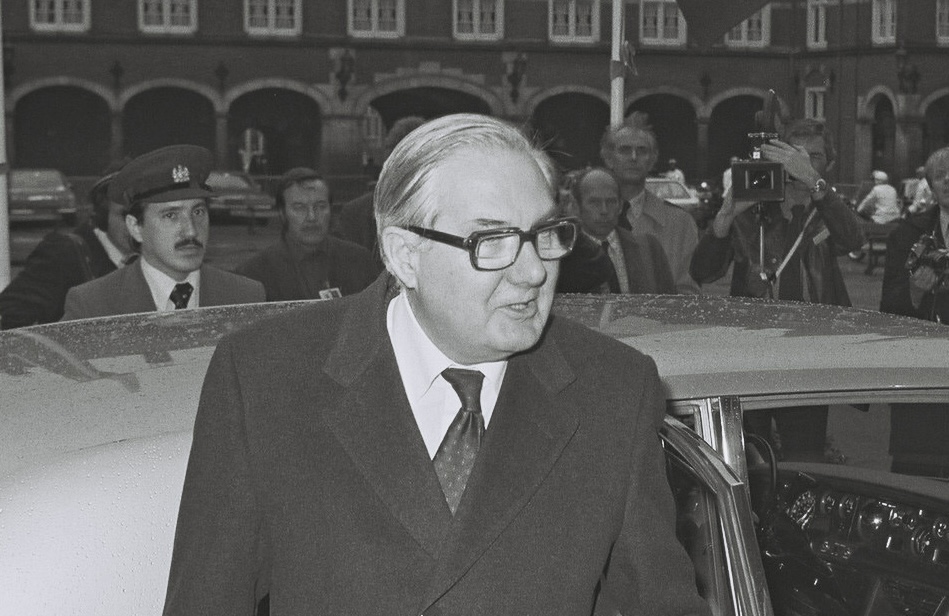
On 5 April 1976, James Callaghan became the United Kingdom’s new prime minister after winning the second and final ballot of the Labour Party leadership contest. The 64-year-old foreign secretary defeated the candidate of the party’s left, employment secretary Michael Foot, by 176 votes to 137 following a swift two-week contest.
Callaghan was sometimes referred to as “Sailor Jim”, on account of his service in the Second World War, and “Sunny Jim” for his upbeat temperament. In assuming the role of prime minister, Callaghan became the first and so far only politician in history to hold all four of the ‘great offices of state’: chancellor of the exchequer (1964 to 1967), home secretary (1967 to 1970), foreign secretary (1974 to 1976) and prime minister.
Upon his appointment, Callaghan reportedly exclaimed: “Prime minister, and I never went to university!”.
***
The 1976 Labour leadership election was triggered by Harold Wilson’s shock resignation three weeks earlier. Callaghan, however, is said to have been tipped off as to Wilson’s intentions some days in advance.
The contest is remembered today for its display of considerable political talent. The roster of candidates, Callaghan, Foot, Tony Benn, Roy Jenkins, Denis Healey and Anthony Crossland, were all heavyweight figures in their own right.
Callaghan, considered a non-divisive and experienced candidate, entered the contest as the favourite.
Jenkins and Benn withdrew from the contest after its first round on 25 March. They secured the support of 56 and 37 Labour MPs respectively. Crosland (17) was eliminated.
Foot, meanwhile, won the support of 90 colleagues in the first round. Callaghan secured 84 and Healey 30.
Jenkins, a fellow Gaitskellite figure, had damaged his prospects upon resigning from the shadow cabinet in April 1972 over his party’s demand for a referendum on Europe. He viewed the leadership’s shift to backing a referendum, which came during the debate over the European Communities Act, as a concession to his party’s eurosceptic wing. Benn, the former home secretary’s eurosceptic rival, was a prominent supporter of the referendum strategy. The two cabinet ministers clashed during the 1975 EEC vote as the spiritual leaders of the remain and withdrawal camps.
Healey, having avoided elimination in the first round of the 1976 contest, initially sought to fight on and put his name forward for the second ballot on 30 March. Benn advised his supporters to endorse Foot.
In the second ballot, Healey’s support rose to 38 – still some distance behind Callaghan (141) and Foor (133).
Healey’s social democratic support base largely flocked to Callaghan’s camp. The foreign secretary won the support of 176 colleagues in the final ballot on 5 April, outperforming Foot (137).
In his acceptance speech, Callaghan paid tribute to Wilson, but asked for the party to “wipe the slate clean”. He took on Labour’s factions, declaring: “If we work together as a team, we shall be unbeatable. I want no cliques. There will be no insiders and no outsiders.”
The new prime minister told members of the Tribune and Manifesto groups, factions positioned on opposite wings of the party, that “none of you holds the Ark of the Covenant.”
Callaghan insisted that he would “not be willing to accept a situation in which minority groups in the Parliamentary Labour Party manoeuvre in order to foist their views on the party as a whole.”
Callaghan also confirmed that Healey, the chancellor, would remain in post and promised Foot would be offered a cabinet role. Foot later accepted the posts of leader of the House of Commons, a government role, and deputy Labour leader, a party role.
In his first televised address to the nation, Callaghan acknowledged the difficulties ahead. “There is no soft option. I don’t promise you any real easement for some time to come”, he said.
“There can be no lasting improvement in your living standards until we can achieve it without going deeper and deeper into debt as a nation.”
Callaghan vowed to govern with “determination, energy and optimism” in his first appearance at the despatch box as prime minister on 6 April.
He added: “Speaking personally, I am looking forward to a honeymoon of about 10 days at the most, and then I rather fancy that there will be the well-known cries of ‘Bring back Harold’ from the opposition benches.”
Jeremy Thorpe, the leader of the Liberal Party, told Callaghan that if he stuck to the “objectives that he indicated last night on television, he will be entitled to support going beyond his own party, or sometimes instead of his own party.”
The prime minister responded: “I am very grateful for support from wherever it comes, but I intend to rely upon the support of my own party in this House. As long as I command that support, I shall be ready to do what is necessary in the national interest.”
***
Callaghan inherited a precarious political and economic situation. The country was in the grip of an economic crisis with high inflation. In the end, Callaghan’s premiership was defined by the struggle against these economic headwinds, leading to the 1976 sterling crisis and culminating in the “Winter of Discontent”. Callaghan’s decision to ask the International Monetary Fund (IMF) for an emergency loan in 1976 created significant tensions within the Labour Party and cabinet.
Labour, meanwhile, stood on the cusp of losing its majority in parliament.
In 1976, the Labour government’s slim parliamentary majority was gradually eroded by a run of by-election losses. Callaghan initially sought to remain in office through an agreement known as the “Lib-Lab Pact”.
A joint statement announcing the Lib-Lab pact was issued on 23 March 1977. It confirmed the creation of a joint consultative committee, established under the leader of the House, Michael Foot, to examine policy before it reached the floor of the House.
Under the terms of the pact, Callaghan pledged to progress legislation for Scottish and Welsh devolution – a key Liberal demand.
The statement added: “We agree that this arrangement between us should last until the end of the present parliamentary session, when both parties would consider whether the experiment has been of sufficient benefit to the country to be continued.”
The government also committed to subject forthcoming legislation concerning elections to the European parliament to a free vote. The European Assembly Elections Bill included a procedural device that allowed the proposed first past the post (FPTP) system and proposed proportional representation system to be set out in the same bill. This would leave the choice of determining the electoral system to a free vote of MPs during the bill’s committee stage. An anti-PR amendment was ultimately approved by 319 votes to 222.
The pact ended in the summer of 1978, after 15 months, depriving the government of 13 crucial parliamentary votes. It came as Callaghan ruled out the possibility of an autumn election. Labour was left to rely on ad-hoc support and an often innovative whipping operation.
***
On 28 March 1979, the Callaghan government was defeated by a single vote in a motion of no confidence. The successful no-confidence motion – passed by 311 votes to 310 – led directly to the 1979 general election. Liberal MPs, led by David Steel, voted against the government.
Callaghan resigned as Labour leader 18 months after Labour’s 1979 general election defeat.
In November 1980, Foot was elected leader of the Labour Party, securing a narrow victory over his main rival, Healey, in the final ballot of Labour MPs.
Roy Jenkins and Anthony Crosland, who had stood in the 1976 contest, were no longer in contention for the role. Jenkins left parliament to serve as president of the European Commission in January 1977. Crosland died on 19 February 1977, aged 58.

Politics.co.uk Newsletters
DAILY
Politics@Lunch
WEEKLY
Week in Review