Nicola Sturgeon announces resignation as first minister of Scotland
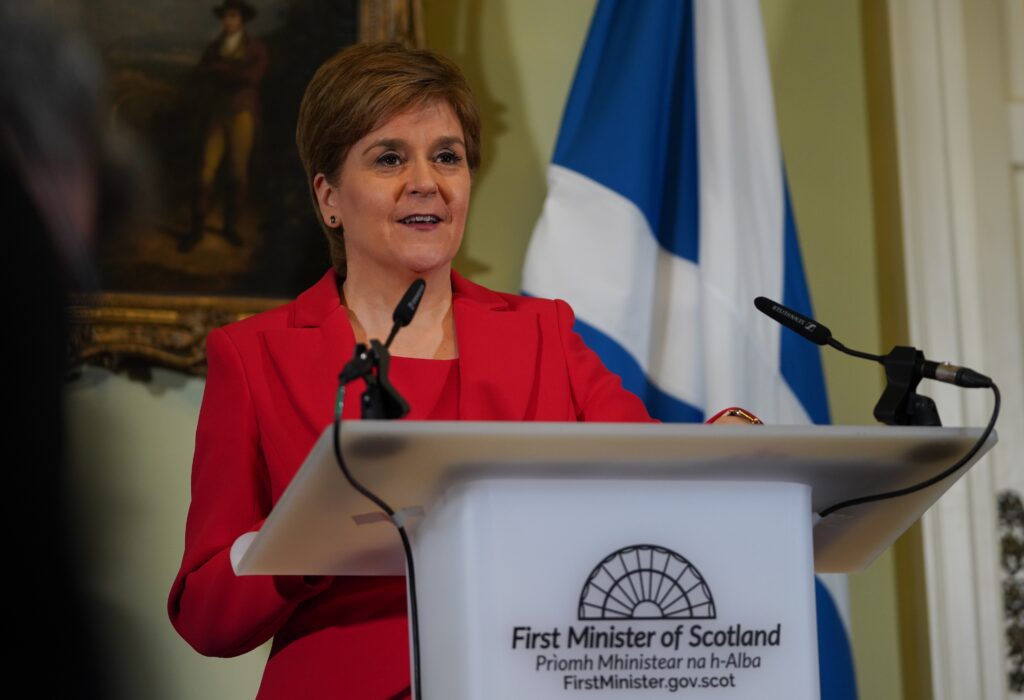
On 15 February 2023, Nicola Sturgeon made a surprise announcement that she would resign as first minister of Scotland and leader of the Scottish National Party (SNP). After more than eight years in office, she resigned as the longest-serving first minister of Scotland.
Sturgeon entered office as first minister in the wake of the 2014 Scottish independence referendum and the resignation of her mentor, Alex Salmond. She was the first woman to hold the office of first minister since the dawn of devolution in 1999.
Under Sturgeon’s leadership, the SNP won 56 out of 59 available seats at the 2015 general election. Labour was the principal victim of this latest expression of nationalist sentiment, collapsing from 40 seats in Scotland to just one. Sturgeon remained in office as first minister following the 2016 Scottish Parliament elections, in which the SNP fell two seats short of securing a second consecutive overall majority. Sturgeon and the SNP, which remained by far the largest single party in the Scottish Parliament, led a minority government.
***
The SNP went into the 2021 Scottish Parliament elections actively campaigning for a second referendum on Scottish Independence. The SNP won 64 of the 129 seats, one short of an overall majority.
The party subsequently governed with the support of the pro-independence Scottish Green Party through a power-sharing deal known as the Bute House Agreement. Two Green MSPs, Patrick Harvie and Lorna Slater, were appointed as ministers. Under the deal, Green ministers attended cabinet meetings at least twice a year.
This coalition government, citing its electoral mandate, formally initiated its campaign for a second independence referendum. In June 2022, Sturgeon unveiled a series of papers titled Building a New Scotland, which were designed to build a fresh case for independence. She announced her intention to hold a consultative referendum on 19 October 2023.
However, the crucial question of the legality of the Scottish Parliament legislating for such a referendum without the consent of the UK parliament remained a significant obstacle. The Scotland Act 1998, which established the Scottish Parliament, reserves matters relating to the Union of the Kingdoms of Scotland and England to the UK Parliament in Westminster. To proceed with a legally binding referendum, a Section 30 order from the UK government would be required, a power the Conservative government at Westminster, under successive prime ministers Boris Johnson, Liz Truss, and Rishi Sunak, consistently refused to grant.
In an attempt to circumvent this, the Scottish government sought a ruling from the UK’s supreme court on whether the Scottish parliament had the authority to legislate for a consultative referendum on its own. In November 2022, the Supreme Court delivered a unanimous verdict, ruling that the Scottish Parliament does not have the power to legislate for a referendum on Scottish independence without the consent of the UK parliament. The court determined that any referendum, even a consultative one, would relate to the reserved matter of the Union and was therefore outside the legislative competence of Holyrood.
This ruling was a significant blow to the SNP’s strategy. In response, Nicola Sturgeon declared that the 2024 UK general election would be treated as a “de facto referendum” on Scottish independence. This new approach was met with some internal debate within the SNP.
In December 2022, Ian Blackford announced his intention to stand down as SNP leader in the House of Commons after weeks of speculation about his position. Reports suggested forces within the SNP group at Westminster, supportive of Stephen Flynn’s prospective candidacy, had applied pressure on Blackford to quit his post. At the time, Flynn dismissed suggestions he was “on manoeuvres” – supported by a band of “men in grey kilts” – with a view to ousting Blackford.
Flynn, who entered parliament at the 2019 election, was elevated as leader of the SNP group just five days later, defeating Aberdeen South MP Alison Thewliss by 26 votes to 17 in a ballot of the party’s MPs. Thewliss, seen as close to Sturgeon and Blackford, had not been expected to stand, but was reported to have entered the contest after claims that Flynn intended to overhaul much of the SNP’s frontbench team at Westminster.
Flynn’s accession was characterised as a symbolic changing of the guard in Scottish nationalism.
Sturgeon’s resignation also followed the controversy over the Gender Recognition Reform Bill, which sought to amend the Gender Recognition Act 2004, making it simpler for people to change their gender without having to obtain a medical diagnosis. The UK government at Westminster, led by Rishi Sunak, intervened to block the bill from receiving royal assent, making use – for the first time – of a section 35 order under the Scotland Act 1998. This move marked the first post-legislative veto of a bill since Queen Anne refused assent to the Scottish Militia Bill in 1708.
Responding to the section 35 order on 17 January 2023, Sturgeon accused the secretary of state for Scotland, Alister Jack, of making a “direct attack on the institution of the Scottish Parliament”.
On top of this, the ongoing developments of Operation Branchform – a Police Scotland investigation into the SNP’s finances and the handling of funds raised for a future independence referendum campaign – were an increasingly destabilising backdrop. The probe, launched in 2021, intensified in early 2023. In the days before Sturgeon’s resignation, former SNP treasurer Douglas Chapman was among those reported to be contacted by the police.
***
In February, Sturgeon announced her resignation as first minister, citing the personal toll of leadership and the need for a fresh voice.
Speaking at a press conference at the first minister’s official residence, Bute House in Edinburgh, Sturgeon said she knew in her “head and my heart” that the time was right to stand down. She cited the personal pressure of the job and argued that she could no longer commit the energy the role required. “It is only possible to give absolutely everything to a job of this nature for so long”, she said.
Sturgeon added: “Given the nature and scale of the challenges the country faces, I feel that duty, first and foremost, to our country – to ensure that it does have the energy of leadership it needs, not just today, but through the years that remain of this parliamentary term.”
Sturgeon’s departure triggered an internal SNP leadership contest.
In March 2023, the SNP chief executive and Sturgeon’s husband, Peter Murrell, resigned in the face of a no confidence vote. In his resignation statement, Murrell took responsibility after the party’s head of communications, Murray Foote, rubbished accurate reports about a fall in SNP membership.
In April and June 2023 respectively, Murrell and Sturgeon were arrested by Police Scotland in connection with Operation Branchform. They were both released without charge.
***
Humza Yousaf defeated rivals Kate Forbes and Ash Regan in the 2023 SNP leadership election, succeeding Sturgeon as first minister.
Yousaf secured 26,032 votes (52.1%) in the second round. He narrowly defeated Forbes, who secured 23,890 votes (47.9%). Regan was defeated in the first round, having only secured 5,599 votes (11.1%). Regan had resigned from the Scottish government in October 2022 over the Gender Recognition Reform Bill. In her resignation statement, Regan said her “conscience” could not allow her to vote for the gender reform proposals.
In April 2024, Yousaf’s disastrous decision to end the power-sharing agreement with the Scottish Greens led to a vote of no confidence. The Scottish Greens, the SNP’s former pro-independence partners in government, were lined up to vote against Yousaf, alongside the Scottish Conservatives, Scottish Labour and the Scottish Liberal Democrats.
The Alba Party, which had one MSP in Ash Regan (who had defected from the SNP), appeared to hold the casting vote. Alba was formed by Alex Salmond in 2021. Its formation was fuelled by a breakdown in the relationship between Salmond and Nicola Sturgeon, then the first minister of Scotland. In 2019, Salmond was arrested and charged with sexual assault and attempted rape for allegations that were said to have occurred during his tenure as first minister. In March 2020, Salmond was acquitted of all charges at trial.
In the ‘no-confidence’ vote in Yousaf’s government, if Regan sided with the SNP, the result would have been a 64-64 tie. According to precedent, the parliament’s presiding officer would then have cast their deciding vote against the motion of no-confidence. At the time, Salmond referred to Regan as the “most powerful MSP in the Scottish Parliament”.
On 28 April, Salmond said his party was “prepared to assist” Yousaf “as long as independence is restored as the key priority of the Scottish government.” The intervention came after Yousaf reportedly ruled out a pro-independence SNP-Alba pact.
On 29 April, Yousaf resigned as first minister of Scotland, saying he was not willing “to trade my values and principles – or do deals with whomever – simply for retaining power.”
The no-confidence vote in the Scottish government was subsequently rejected by 70 votes to 58. In the wake of Yousaf’s resignation, the Scottish Greens voted against the motion.
Following Yousaf’s brief tenure, John Swinney, a veteran of the SNP and a former deputy first minister under both Salmond and Sturgeon, was elected as the new leader of the SNP unopposed and became Scotland’s first minister in May 2024 – just weeks before a UK general election was called for 4 July. Swinney appointed Forbes as deputy first minister.
On 10 May, Swinney admitted that the SNP government’s proposed gender recognition reforms “cannot be implemented.”
***
The results of the 2024 general election marked a seismic shift in the Scottish political landscape and a severe setback for the independence movement. The SNP’s long-held electoral dominance crumbled as the party’s representation at Westminster was decimated, falling from 48 to just 9 seats. In a dramatic reversal of fortunes, the Labour Party surged back to prominence in its former heartland, winning 37 seats and becoming the largest Scottish party at Westminster for the first time since 2010. The SNP’s share of the vote fell by 15 points to 30%, while Labour’s rose by over 16 points to 35.3%.
In April 2024, Murrell was re-arrested and charged with embezzlement. He appeared in court on 20 March 2025. At this time, Police Scotland also confirmed that its inquiries into Sturgeon had concluded.
In January 2025, Sturgeon announced that she and Murrell had “decided to end” their marriage.

Politics.co.uk Newsletters
DAILY
Politics@Lunch
WEEKLY
Week in Review
