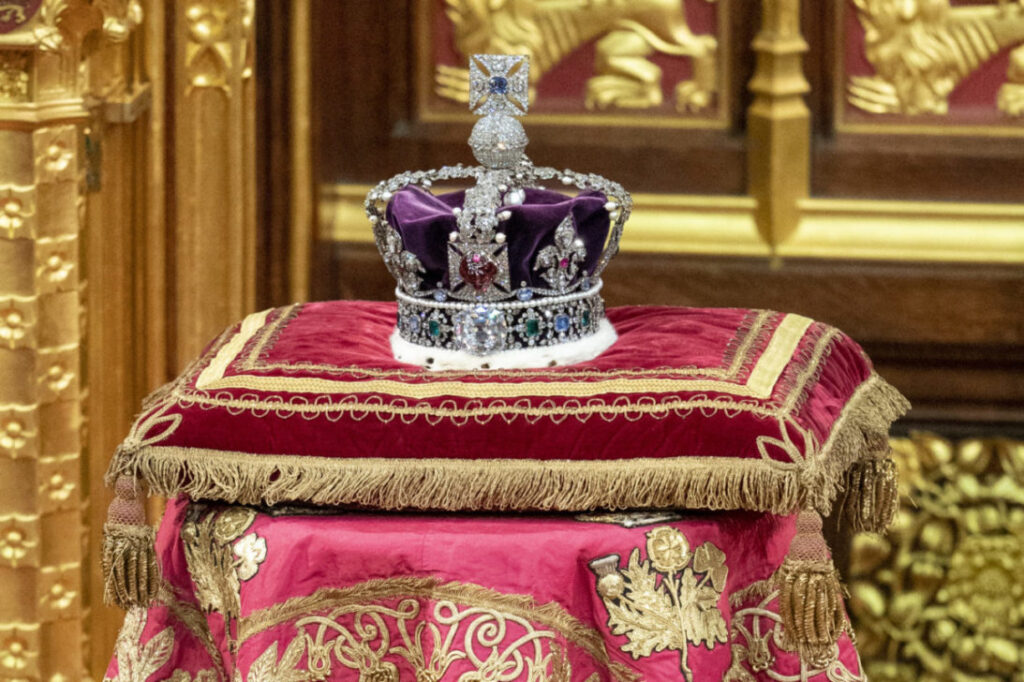
The British monarch, King Charles III, is the sovereign and head of state of the United Kingdom and its overseas territories.
The British political system is described as a constitutional monarchy, where the monarch’s role is largely ceremonial, with actual power exercised by elected officials in accordance with agreed rules.
The British monarch acts as an impartial head of state, undertaking constitutional duties, while remaining above party politics.
Do the public support the monarchy?
The debate over whether the UK should abolish the monarchy and become a republic remains a feature of political discourse, though the institution generally retains the support of a majority of the public. According to a YouGov poll from May 2025, 57% of the public have a positive view of the institution of the monarchy in general, compared to 35% with a negative view.
This support varies significantly by age. While older Britons are strongly supportive, those aged 18-24 are more divided. In the same May 2025 poll, this younger group held a net favourability rating for the institution of -2 – suggesting more young people viewed it negatively than positively.
The British monarchy: constitutional role and function
The monarch has a series of key constitutional duties. These include the state opening of parliament, the formal appointment of the prime minister, giving royal assent to parliamentary legislation, and approving official appointments and secondary legislation through the privy council.
The monarch also acts as head of state by paying and receiving state visits, formally receiving the credentials of foreign ambassadors, and holding regular confidential audiences with the prime minister.
In addition, the monarch is the head of the armed forces. Since the reign of Henry VIII, the British monarch has also been the supreme governor of the Church of England. All state honours are awarded in the monarch’s name, though most are conferred on the advice of the government.
The British monarch is the head of the Commonwealth, a symbolic role at the head of the political association of 56 member states. King Charles III is also the head of state of 14 independent countries in addition to the United Kingdom. These Commonwealth realms are Antigua and Barbuda, Australia, The Bahamas, Belize, Canada, Grenada, Jamaica, New Zealand, Papua New Guinea, Saint Kitts and Nevis, Saint Lucia, Saint Vincent and the Grenadines, Solomon Islands, and Tuvalu. In 2021, Barbados became the latest state to remove the monarchy as the head of state, but remains part of the Commonwealth.
The case for a constitutional monarchy
An impartial head of state
A constitutional monarch is positioned above party politics and factional interests, serving as a focus for national unity. Supporters argue that the separation of the head of government (the prime minister) from the head of state is a key benefit, allowing the monarch to provide impartial support to a wide range of charitable and voluntary organisations.
This unifying non-political role of the royal family is something that spreads through the monarch’s annual Christmas broadcast, attendance at ceremonial events like Trooping the Colour, and the dispatch of congratulatory telegrams to centenarians and couples marking their diamond wedding anniversaries.
A link with history and tradition
The monarchy provides a direct, living connection to the United Kingdom’s history. This continuity is also expressed through the monarch’s role as Head of State in 14 other countries and as Head of the Commonwealth, reinforcing historic international ties.
An asset to Britain’s ‘soft power’
Soft power is the ability to influence others without resorting to coercive pressure or “hard power”. This is generated from the extent of a nation’s cultural appeal, the strength of its diplomatic network, the global reputation of its higher education system and the quality of the country’s political institutions.
Proponents argue that the global profile, historic ties and cultural influence of the royal family are assets to the UK’s soft power.
According to the 2025 Brand Finance Global Soft Power Index, the UK ranks third globally, behind the USA and China. The report attributes this in part to the cultural influence projected by the monarchy.
Tourism magnet
Royal residences and events are a considerable draw for tourism. In 2024/25, the Royal Collection Trust recorded 2.9 million visitors to official residences, generating £22 million in income. VisitBritain notes that in the same year, over 11 million inbound visits included trips to castles or historic houses.
The case against a constitutional monarchy
Democratic argument
Critics, such as the campaign group Republic, argue that a hereditary head of state is fundamentally undemocratic. They contend that citizens should have the right to elect and hold to account the person in this office. This argument also critiques the perceived political influence of the monarch, which is exercised without public scrutiny.
The established church
The monarch’s role as supreme governor of the Church of England is criticised by secularists and those who argue for the disestablishment of the church. They claim it is anachronistic in a multicultural and largely secular society for one denomination to be given constitutional primacy.
Cost and transparency
The cost of the monarchy is a consistent point of criticism. Campaigners argue that the total cost, including security, is significantly higher than the official sovereign grant figure and that the system lacks full transparency. They often contrast the UK’s expenditure with the lower costs of other European monarchies.
A forward-looking Britain
It is argued that replacing the monarchy with an elected head of state would project a more modern and meritocratic image of Britain to the world. Critics suggest that hereditary power perpetuates a social structure defined by class and deference, which is reinforced by the associated honours system.
How much does the royal family cost?
Official expenditure is funded by the sovereign grant. This is a single grant from the Treasury, calculated as a percentage of the profits of the Crown Estate from two years prior. In July 2023, the Royal Trustees reduced this from 25% to 12% to account for a major increase in Crown Estate income from offshore wind projects.
In 2024/25 the sovereign grant was £86.3 million. The sovereign grant for the financial year 2025-26 was £132.1 million – an increase of £45.8 million or 53% in cash terms on the previous year. Of that total, £72 million was allocated for “core” activities and £60 million for the reservicing of Buckingham Palace.
The grant for 2026-27 is expected to rise to £137.9 million.
The security of the royal family is funded separately by the Metropolitan Police, while the costs of royal visits are borne by local councils.
Senior royals also have private incomes. For the financial year ending March 2025, the Duchy of Lancaster, the private estate of the sovereign, generated a net surplus of £28.7 million. In the same period, the Duchy of Cornwall, the private estate of the heir to the throne, generated a revenue surplus of £22.9 million for Prince William.
The evolution of the monarchy (1215-1701)
Parliament began as a body of leading nobles and clergy that the monarch consulted in the exercise of power, which gradually assumed more and more power at the expense of the sovereign.
A notable development occurred in 1215. Then, in a meadow at Runnymede on the bank of the River Thames, King John was compelled by his rebellious barons to seal Magna Carta, a peace settlement that placed limits on royal power.
Magna Carta, the product of five days of intensive negotiations at Runnymede, was designed to protect the feudal rights of free men. Its 63 clauses placed restrictions on the king’s ability to levy taxes without baronial consent, protected the church from royal interference, and sought to prevent abuses of justice by the king’s officials.
Magna Carta was a short-lived social contract. But its significance as a symbol of lawful rule is measured in centuries. This nominal peace treaty, in establishing that the sovereign was subject to the rule of law, codified principles that Britons suffering under despotism would cite for centuries to come.
Evaluation question
Evaluate the extent to which an uncodified constitution can effectively protect historic limitations on executive power?
The crowns of England and Scotland were united in 1603 when James VI of Scotland became James I of England.
The only interruption to the institution of the monarchy was its abolition between 1649 and 1660, following the English civil war. The conflict was sparked by the misrule of Charles I. His ‘Personal Rule’ without parliament (1629-1640); religious policies, which were perceived as crypto-Catholic (Arminianism); and attempts to raise revenue through ‘ship money’, contrary to all precedent, had alienated significant sections of the political establishment.
The monarchy was restored on 8 May 1660 after eleven years of republican rule under the Commonwealth and Protectorate. The convention parliament proclaimed that King Charles II had been the lawful monarch since the execution of Charles I.
The civil war formed part of a broader constitutional arc whereby political power, once exercised by virtue of the ‘divine right of kings’, passed from the monarch to parliament.
It was the Glorious Revolution of 1688 that helped establish the supremacy of parliament over the monarch.
After the flight of the Catholic James VII of Scotland and II of England to France in December 1688, the specially convened convention parliament produced the Declaration of Right – a constitutional document that looked to limit the power of the monarchy, asserted the rights of parliament, and enabled the formal offering of the throne to William of Orange and his wife, Mary.
The declaration was the decisive act of the Glorious Revolution. The convention parliament declared that James VII/II had abdicated and the throne was vacant. The document went on to affirm a series of fundamental rights and liberties. It asserted that elections of MPs ought to be free, the need for freedom of speech in parliament, the need for regular parliaments, and that cruel and unusual punishments should not be inflicted. The declaration was later given statutory force, with some amendments, as the Bill of Rights 1689.
Over the following centuries, a series of conventions developed that transferred all political power to elected ministers responsible to parliament. The monarch’s legislative functions, while constitutionally necessary, thereby became ceremonial duties performed on the advice of the government.
Development of the British monarchy (1701-1999)
The 1701 Act of Settlement granted parliament the power to determine the succession to the throne.
Scotland and England were formally joined as Great Britain by the 1707 Act of Union. For England, the primary motivation for a full political union was to secure the Protestant supremacy created by the Glorious Revolution and prevent a Catholic Stuart monarch from using Scotland as a base to reclaim the crown.
Article 2 of the Treaty of Union stated Scotland’s acceptance of the Hanoverian Succession (initially under George I), which followed the death of Queen Anne. The article thus ensured Great Britain’s commitment to Protestant monarchy.
During this era, the exercise of the royal veto also came to an end. The last time royal assent was withheld was in 1708 by Queen Anne over the Scottish Militia Bill. Even in this case, the decision was driven by the deteriorating security situation facing the recently formed Kingdom of Great Britain – as opposed to a disagreement between the sovereign and parliament. Before Anne’s reign, King William III had vetoed five public bills passed by parliament between 1692 and 1696. And while Anne’s veto was the last exercised by a monarch for a bill passed by the parliament at Westminster, British colonies and former colonies were still subjected to legislative vetoes by governors acting on royal instructions.
The US Declaration of Independence (1776) prominently featured the complaint that King George III had “refused his assent to laws, the most wholesome and necessary for the public Good.”
The Hanoverian succession did not go unchallenged. In August 1745, Charles Edward Stuart, known as ‘Bonnie Prince Charlie’, raised his father’s royal standard at Glenfinnan in the Scottish Highlands, formally igniting the final Jacobite rising. The Jacobites planned to overthrow the Hanoverian regime under King George II, restoring James VII/II and the House of Stuart to the British throne.
At the Battle of Culloden on 16 April 1746, the Jacobite army of 5,000 Highlanders was defeated by a government force of 7,000, commanded by George II’s youngest son, William, Duke of Cumberland.
Decades later, the monarchy faced a different kind of crisis under George IV. In August 1820, the House of Lords commenced proceedings on the Pains and Penalties Bill, which effectively put Queen Caroline, the estranged wife of King George IV, on public trial. George IV had ascended the throne earlier that year and was determined to prevent Caroline, whom he had long since grown to detest, from being crowned Queen. Remarkably, this trial pitting two ostensible royals against each other tapped into wider radical sentiment and public discontent.
As parliament considered the future of the monarchy, the people intervened. George IV was roundly ridiculed by radical publications. Fearing public disorder, the prime minister, Lord Liverpool, said he “could not be ignorant of the state of public feeling with regard to this measure” and announced that the government would withdraw the bill.
Caroline retained her title, but was forcibly barred from George IV’s coronation. She died 19 days later, on 7 August 1821.
The monarchy’s role evolved alongside the expansion of the British Empire. The Royal Titles Act 1876 conferred the title of Empress of India upon Queen Victoria, reflecting prime minister Benjamin Disraeli’s close personal and political relationship with the monarch.
By the 20th century, the sovereign’s power to select the prime minister had long since lapsed. King George V, who reigned from 1910 to 1936, however, played a prominent role in the formation of the National Government in 1931. When Ramsay MacDonald travelled to Buckingham Palace to tender his resignation, George V persuaded the Labour prime minister to stay on in the role. MacDonald was urged to construct and lead a cross-party government in the national interest, tasked with steering the country through the financial emergency precipitated by the Wall Street crash two years previously.
The king then summoned the leaders of the Conservative and Liberal parties to Buckingham Palace. The meeting’s conclusion came with the following notice: “His Majesty the King invited the Prime Minister, Mr. Stanley Baldwin, and Sir Herbert Samuel to Buckingham Palace this morning, and the formation of a National Government is under consideration.
“A public announcement will be made later.”
Queen Elizabeth II was crowned at a ceremony in Westminster Abbey on 2 June 1953. Elizabeth succeeded her father, King George VI, as monarch following his death on 6 February 1952.
The decision to televise the coronation, against the initial advice of prime minister Winston Churchill, proved to be a landmark moment in the history of both the monarchy and broadcasting. An estimated 27 million people in the United Kingdom watched the service on television, outnumbering the 11 million who listened on the radio. The population of Britain at the time was just over 36 million. Many families bought or rented television sets specifically for the occasion, and thousands more watched in cinemas, pubs, and community halls.
Despite heavy rain, an estimated three million people lined the streets of London to watch the grand procession of soldiers and statesmen from around the commonwealth that accompanied the Queen’s golden state coach to and from the abbey. Street parties, meanwhile, were held throughout the UK.
In a radio broadcast on the evening of her Coronation, the Queen said: “Throughout all my life and with all my heart I shall strive to be worthy of your trust”.
The late 20th century brought a full-blown crisis for the monarchy following the death of Princess Diana in 1997. Diana’s death in the early hours of 31 August 1997 stunned the nation. Buckingham Palace’s initial statement said Queen Elizabeth II and the Prince of Wales (Charles) were “deeply shocked and distressed by the terrible news”.
This restrained response, however, sparked a wave of public anger. The public perceived the reserved statement as insufficient, and even ignorant of the national outpouring of grief. The backlash, which accumulated over days, grew into a full-blown crisis for the monarchy.
The refusal of Buckingham Palace to fly the Royal Standard at half-mast, in particular, provoked public anger and disparaging headlines. Under royal protocol, the queen’s flag cannot fly at Buckingham Palace unless she is there. “Show us you care”, declared the front page of the Express. The Sun asked: “Where is our Queen? Where is her flag?”
On 5 September 1997, the Queen made a live television broadcast in which she paid tribute to Diana as an “exceptional and gifted human being”.
Tony Blair famously described Diana as the “people’s princess”.
The House of Lords Act 1999 removed the right to sit and vote for royal peers, including the Prince of Wales (later King Charles III), the Duke of Edinburgh (Prince Philip), the Duke of York (Prince Andrew), the Duke of Gloucester, the Duke of Kent and the Earl of Wessex.
Due to the 1999 reforms, Charles III, during his long tenure as Prince of Wales, was the last heir to the throne to address the upper chamber.
The Prince of Wales delivered his maiden speech in the House of Lords on 13 June 1974. The 25-year-old prince chose to speak in a debate on sport and leisure, highlighting the need for better recreational facilities and opportunities for young people. Specifically, the debate concerned the recent publications of the House of Lords select committee on sport and leisure.
In his contribution, the Prince of Wales called for better co-ordination of leisure facilities to meet the challenge of “removing the dead hand of boredom and frustration from mankind”.
Before this, the last Prince of Wales to have spoken in the Lords was the future King Edward VII on 22 February 1884. In his contribution, Prince Albert gave his full support to the establishment of a Royal Commission to conduct a “searching inquiry” into the housing of the poor and working classes.
Recent developments
The most significant modern reform to succession has been the Succession to the Crown Act 2013. This act ended the system of male-preference primogeniture, meaning the eldest child, regardless of gender, now precedes their siblings in the line of succession. It also removed the disqualification of a person who marries a Roman Catholic. The current line of succession begins with Prince William, followed by his son, Prince George.
The early 2020s saw the British royal family endure their most difficult period in the media spotlight since the divorce of then Prince Charles and Princess Diana in the early 1990s. In early 2021, Prince Harry and his wife, Meghan Markle gave a TV interview with Oprah Winfrey in America. In the interview, Markle claimed that Harry had been asked by an unnamed family member “how dark” their son Archie’s skin might be. The comments came at a bad time for the royal family, with Prince Andrew facing regular questions around his relationship with the disgraced financier Jeffrey Epstein.
In 2021, Elizabeth II’s husband Prince Philip, the Duke of Edinburgh, died aged 99. He had acted as royal consort between 1952 and 2021, making him the longest ever serving royal consort.
Elizabeth II’s reign, the longest in British history, ended with her death on 8 September 2022.
Elizabeth II was history’s longest reigning female monarch, having been Queen of the United Kingdom, Canada, Australia and New Zealand for 70 years between 6 February 1952 and 8 September 2022. Between 1952 and 2022, Queen Elizabeth II gave royal assent to more than 3,650 acts of parliament. Over her reign, Queen Elizabeth II appointed 15 prime ministers and 7 Archbishops of Canterbury.
Only five other kings and queens in British history have reigned for 50 years or more. They are: Queen Victoria (63 years), George III (59 years), Henry III (56 years), Edward III (50 years), James VI of Scotland (James I of England) (58 years).
There were also seven Archbishops of Canterbury during Queen Elizabeth II’s reign: archbishops Geoffrey Fisher, Michael Ramsey, Donald Coggan, Robert Runcie, George Carey, Rowan Williams, and Justin Welby.
Elizabeth was succeeded by her son, King Charles III. The coronation of King Charles III and Queen Camilla took place on 6 May 2023. It was reported that the coronation was watched by more than 18 million people in the UK.
Quotes
“I declare before you all that my whole life whether it be long or short shall be devoted to your service and the service of our great imperial family to which we all belong.” – The Queen’s 21st birthday speech, April 1947
“The events that I have attended to mark my Diamond Jubilee have been a humbling experience. It has touched me deeply to see so many thousands of families, neighbours and friends celebrating together in such a happy atmosphere”…”I hope that memories of all this year’s happy events will brighten our lives for many years to come. I will continue to treasure and draw inspiration from the countless kindnesses shown to me in this country and throughout the Commonwealth. Thank you all.” – The Queen‘s Diamond Jubilee Message, June 2012
“I come not to be served, but to serve.” – King Charles III during his coronation, May 2023
“The time has come to fully leave our colonial past behind, Barbadians want a Barbadian head of state. This is the ultimate statement of confidence of who we are, and what we are capable of achieving.” – Mia Mottley, the prime minister of Barbados, September 2020
“The royal visit is a reminder of the bond between Canada and the Crown – one forged over generations, shaped by shared histories, and grounded in common values. A bond that, over time, has evolved, just as Canada has, to reflect the strength, diversity, and confidence of our people. […] This historic honour matches the weight of our times. It speaks to our enduring tradition and friendship, to the vitality of our constitutional monarchy and our distinct identity, and to the historic ties that crises only fortify.” – Mark Carney, the prime minister of Canada, May 2025
Additional resources
- The royal family: https://www.royal.uk/
- The sovereign grant and royal finances: https://www.royal.uk/royal-finances-0
- The Crown Estate: https://www.thecrownestate.co.uk/

