A coalition government is a form of administration in which two or more political parties join together to govern, sharing ministerial posts, cabinet positions and responsibility for policy.
Coalitions are most common when a general election produces a “hung parliament”, where no single party has won an overall majority of seats in the House of Commons.
To form a stable administration that can command the confidence of the legislature, parties can negotiate a formal arrangement. This is usually underpinned by a detailed “coalition agreement” that sets out a joint policy programme for the government’s term in office.
There is no constitutional difference between a coalition government and a standard single-party government. But they operate differently in practice, owing to their diverse ideological composition.
Historically, peacetime coalitions have proved rare in British politics. The establishment of the devolved administrations in the late 1990s, however, now means coalition politics is a staple of British governance.
Defining features of a coalition
The defining characteristic of a coalition is that members of participating parties are appointed as ministers. The number and seniority of these posts are a key part of the negotiations and are typically distributed in rough proportion to the number of seats each party has.
A coalition agreement can be used to set the terms of a formal arrangement, creating a framework to specify areas of commons ground, compromise and, moreover, where unity may be impossible. A formal agreement can be based on the policies set out in the manifestos of the coalition partners.
The constitutional convention of collective responsibility is extended to all ministers from all parties within the coalition. There can be exceptions to this set out in a formal “agreement to differ”. Otherwise, all ministers are expected to publicly support and defend a given position, regardless of their party affiliation or private views.
How a coalition differs from a confidence and supply agreement
A confidence and supply agreement is a formal deal in which a smaller party or independent members agree to support the government in key parliamentary votes.
These agreements are a means by which a minority administration facing a hung parliament can pass legislation, doing so with the support of a smaller party. They are less formal than a full coalition government.
In a coalition, the smaller party joins the government and its senior members take up ministerial posts in the cabinet. By contrast, in a supply and confidence deal, the supporting party remains outside of government and does not assume ministerial office.
In a coalition, all ministers are bound by the principle of collective responsibility, and thereby are required to support the government on all issues. Both majority and minority parties in a coalition take the same whip (provided there is no “agreement to differ” on a specific issue).
In a supply and confidence deal, the supporting party is only bound on the specific issues of supply and confidence. On all other legislation, it is free to vote against the government.
Theresa May negotiated a confidence and supply agreement with the Democratic Unionist Party (DUP) following the 2017 general election, which resulted in a hung parliament.
The Conservative-Liberal Democrat coalition (2010-2015)
The 2010 general election resulted in the country’s first hung parliament (following an election) since February 1974, ending 13 years of Labour government and leading to the formation of a Conservative-Liberal Democrat coalition.
The Conservatives won 306 seats with 36.1% of the vote, a net gain of 96 MPs compared to the notional 2005 result. The incumbent Labour Party, led by prime minister Gordon Brown, lost 91 seats, returning 258 MPs on a 29.0% vote share.
The Liberal Democrats, having secured 57 seats, held the balance of power in the House of Commons.
The inconclusive result triggered five days of intense negotiations between the parties. A Labour-Lib Dem coalition was considered as a possibility, likely with the support of smaller nationalist parties. But the most viable path to a stable government was provided by a formal arrangement between the Conservatives and the Liberal Democrats.
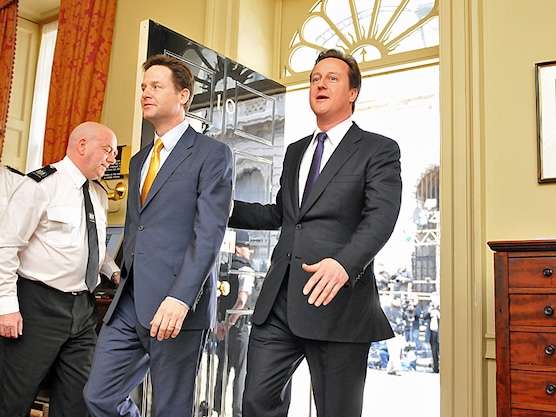
Under this arrangement, Nick Clegg was appointed as deputy prime minister.
Cameron and Clegg formally presented their new coalition government to the nation on 12 May 2010, at a joint press conference in the Downing Street rose garden. This inaugural coalition press conference coincided with the publication of a seven-page document outlining the initial “Conservative–Liberal Democrat coalition agreement”.
In the foreword, the deal stated: “These are the issues that needed to be resolved between us in order for us to work together as a strong and stable government”.
The document, which would serve as the terms of reference governing the coalition, detailed the key compromises made by both parties. The central agreement was a commitment to tackle the UK’s budget deficit, with an emergency budget promised within 50 days.
Evaluation question
If a junior coalition partner, such as the Liberal Democrats in 2010, must inevitably compromise on core manifesto pledges to secure a governing agreement, does entering a coalition betray the voters who supported them?
Key concessions to the Liberal Democrats included a referendum on changing the electoral system to the alternative vote (AV) and a commitment to legislate for five-year fixed term parliaments. For their part, the Conservatives secured agreement on policies such as placing a cap on non-EU immigration and allowing new providers to enter the state schooling system.
The document also specified areas where the parties could, in effect, ‘agree to disagree’ such as on the renewal of the Trident nuclear deterrent and on education funding.
A final longer agreement, entitled The Coalition: our programme for government, was published on 20 May.
The cabinet featured five Liberal Democrat MPs, including Clegg as deputy prime minister, Vince Cable as business secretary, David Laws as chief secretary to the Treasury, Chris Huhne as energy and climate change secretary and Danny Alexander as secretary of state for Scotland.
To manage the relationship and make key strategic decisions, a core group known as the “quad” was established. This consisted of the prime minister, the deputy prime minister, the chancellor (George Osborne), and the chief secretary to the Treasury. Alexander succeeded Laws as chief secretary to the Treasury shortly after the coalition began its life.
The quad was set up to resolve policy disagreements, so compromises could be taken to the wider cabinet.
The most obvious moment of tension during the coalition came with the 2011 referendum on the alternative vote. This referendum led to the incongruous political situation of the two governing parties openly campaigning against each other. The ‘No’ campaign, led by senior Conservative figures, argued that AV was a complicated, expensive, and unfair system. The ‘Yes’ campaign was championed by the Liberal Democrats.
The sometimes acrimonious nature of the campaign and the “Yes” campaign’s overwhelming defeat (by 68% to 32%) created some bitterness within the coalition.
This was further exacerbated in 2012 when the government abandoned plans for House of Lords reform, after a large Conservative backbench rebellion. This led to the Liberal Democrats withdrawing support for proposed boundary changes.
Nonetheless, the coalition served a full five-year term – a feat many commentators initially believed was unlikely back in May 2010.
But the electoral consequences for the Liberal Democrats as the coalition’s junior partner were severe. In the 2015 general election, the Conservative Party won a narrow outright majority. The Liberal Democrats saw their parliamentary party collapse from 57 MPs to just eight.
Evaluation question
Is Benjamin Disraeli’s 1852 assertion that “England does not love coalitions” an accurate reflection of the electorate’s mindset?
Coalitions in the devolved nations
Coalition governments have been a regular feature of the UK’s devolved legislatures since their inception in 1999. Unlike the first past the post system used for Westminster, the more proportional electoral systems make it difficult for a single party to win an outright majority, creating the conditions for cross-party cooperation.
Scotland
Donald Dewar, the inaugural first minister of Scotland, announced his first cabinet in May 1999, which included two Liberal Democrat MSPs. Jim Wallace became deputy first minister and minister for justice; fellow Liberal Democrat Ross Finnie served as minister for rural affairs.
This Lib-Lab partnership proved remarkably stable, lasting through two elections and three different Labour first ministers (Dewar, Henry McLeish, and Jack McConnell) until the SNP’s rise to power in 2007.
From 2021 to 2024, the Scottish National Party (SNP) governed with the support of the Scottish Green Party through a power-sharing deal known as the Bute House Agreement. Two Green MSPs, Patrick Harvie and Lorna Slater, were appointed as ministers. Under the deal, Green ministers attended cabinet meetings at least twice a year.
The agreement followed the May 2021 Scottish parliament election, in which the SNP won 64 of the 129 seats, one short of an overall majority.
The deal was not presented as a formal coalition. The SNP and Greens (both pro-independence parties) agreed several prominent exceptions to the principle of collective responsibility. The pact was referred to as a “cooperation agreement”.
Referring to the Greens in government, the agreement stated: “These ministers will, as a consequence of the agreed processes for cooperation and collaboration as set out in co-operation and collaboration, observe the principle of collective responsibility, except in respect of excluded matters.”
The SNP ended the agreement in April 2024, choosing to govern as a minority administration. This led to the downfall of Humza Yousaf as first minister.
Wales
In Wales, the Senedd Cymru (formerly the National Assembly for Wales) has consistently operated without a single-party majority, necessitating various formal and informal political arrangements.
Following the inaugural 1999 election, first secretary Alun Michael led a minority Labour administration. His successor, Rhodri Morgan, formed a “Coalition Partnership” with the Welsh Liberal Democrats in October 2000. This agreement saw Liberal Democrat leader Michael German appointed as deputy first minister and minister for economic development, while fellow Liberal Democrat Jenny Randerson served as minister for culture. The partnership lasted until the 2003 election.
The 2007 election resulted in a significant shift. The “One Wales” coalition between the Labour Party and Plaid Cymru provided a majority in the Senedd from 2007 to 2011. Under the agreement, Plaid Leader Ieuan Wyn Jones was made deputy first minister, serving under Labour’s Rhodri Morgan as first minister (and later Carwyn Jones). In total, three Plaid Cymru members sat in the cabinet as full ministers, including Jones, Elin Jones (rural affairs), and Rhodri Glyn Thomas (heritage).
The “One Wales” coalition represented the first time a nationalist party had entered government anywhere in the UK.
Northern Ireland
The Northern Ireland assembly, under the terms of the Good Friday Agreement, requires a power-sharing agreement to operate. Ministerial positions in the executive are allocated to the main parties proportionally using the D’Hondt system, ensuring that both unionist and nationalist communities are represented in government.
Earlier examples of coalition governments
The wartime coalition (1940-1945)
The formation of the wartime coalition under Winston Churchill as prime minister followed the famous “Norway Debate” from 7-8 May 1940. The position of Neville Chamberlain as prime minister had come under further strain following the failure of the Allied campaign in Norway, when attempts to repel the Germans culminated in the loss of about 4,000 British troops.
In the early hours of 10 May, German forces invaded Belgium, the Netherlands, and Luxembourg, beginning the Battle of France. Chamberlain, having faced an onslaught of criticism in the Norway debate, felt compelled to resign. Labour refused to serve alongside him in a wartime coalition.
On 10 May 1940, Churchill was appointed prime minister, leading a coalition that included the Conservative, Labour and Liberal parties
The wartime coalition was held together by the singular objective of winning the war. To streamline decision-making, Churchill established a small war cabinet.
Initially, this consisted of just five members, including Churchill, Chamberlain as Lord President of the Council, Lord Halifax (Conservative) as foreign secretary, Clement Attlee (Labour) as Lord Privy Seal, and Arthur Greenwood (Labour) as a minister without portfolio. The war cabinet later expanded to eight members. Some key additions were Ernest Bevin (Labour), Herbert Morrison (Labour), Anthony Eden (Conservative) and Archibald Sinclair (Liberal).
Attlee formally became the first deputy prime minister in 1942.
The most significant moment of tension came over the publication of the Beveridge Report in December 1942. The report, which outlined the blueprint for a post-war welfare state, was met with immense public enthusiasm. Labour and the Liberals embraced it as a path to a better post-war Britain, but many Conservatives, including Churchill himself, were wary of the costs and the distraction from the war effort.
The House of Commons debated the Beveridge report across three days from the 16 February to 18 February 1943 – in what proved to be a showdown between the wartime coalition and Labour MPs. In total, 97 Labour MPs backed an amendment which expressed dissatisfaction with the government’s policy and urged “early implementation of the plan”.
The debate, however, did not lead to the collapse of the coalition or clear cracks between different parties on the government frontbench.
The eventual break-up of the coalition came shortly after VE Day in May 1945. Churchill initially wanted to maintain the cross-party wartime coalition until victory in the Pacific was secured; Attlee expressed his wish for the swift dissolution of parliament.
The 1945 general election resulted in a large landslide majority for the Labour Party. Labour won 393 seats, a net gain of 239, securing a landslide parliamentary majority of 145. The Conservatives were reduced to 197 seats, losing 190.
The National Government (1931-1940)
The formation of the National Government followed the collapse of Ramsay MacDonald’s minority Labour government, which had been in office since 1929, tasked with leading Britain through the Great Depression. The report of the May Committee on National Expenditure, published July 1931, recommended drastic cuts to public spending, including a significant cut to unemployment benefit, to balance the budget.
The Labour cabinet split over the proposals. With the government paralysed, MacDonald travelled to Buckingham Palace on 24 August to tender his resignation to King George V. The usual procedure would have seen the King accept MacDonald’s resignation and send for the leader of the opposition, Stanley Baldwin. But in a crucial, constitutionally innovative intervention, George V persuaded MacDonald to stay on as prime minister. He was urged to construct and lead a cross-party government in the national interest, tasked with steering the country through the financial emergency.
The king then summoned the leaders of the Conservative and Liberal parties to Buckingham Palace.
The new, smaller emergency cabinet announced on 25 August was composed of 10 members. It comprised MacDonald and three other senior Labourites – alongside four Conservatives, including Stanley Baldwin and Neville Chamberlain, and two Liberals.
The government constituted on 25 August 1931 was intended to be a temporary measure. But it lasted years beyond the general election in October 1931, which MacDonald was convinced to call by his new Conservative allies. Campaigning for a so-called ‘Doctor’s mandate’ to rescue Britain through the Great Depression, the October 1931 election produced a crushing landslide victory for the National Government.
The coalition captured two-thirds of the votes cast and won 554 (90.1%) of the 615 available commons seats.
In early 1932, splits in the National government over trade policy burst into the open, leading to the adoption of the first formal “agreement to differ”. The coalition was divided on tariff policy, with minister divided between protectionist and pro-free trade elements. Liberal ministers in the National Government were allowed to differ from the government’s policy.
In January 1932, the home secretary, Liberal MP Herbert Samuel, began a speech in parliament by referencing the doctrine of collective responsibility. He said: “The House will have an opportunity… of discussing fully the departure from the doctrine of collective responsibility which is marked by my appearance at this box this afternoon”.
Samuel argued that tariffs would tax the “food of the people”.
The official terms of the ‘agreement to differ’ were published in the Times on 23 January 1932.
It stated: “The cabinet has had before it the report of the committee on the balance of trade, and after prolonged discussion it has been found impossible to reach unanimous conclusion on the committee’s recommendations.
“The cabinet, however, is deeply impressed with the paramount importance of maintaining national unity in presence of the grave problems that now confront this country and the whole world. It has accordingly determined that some modification of usual ministerial practice is required and has decided that ministers who find themselves unable to support the conclusions arrived at by the majority of their colleagues on the subject of import duties and cognate matters are to be at liberty to express their views by speech and vote.
“The cabinet, being essentially united on all other matters of policy, believes that by this special provision it is best interpreting the will of the nation and the needs of the time.”
The agreement to differ, the first official declaration of its kind, was immensely controversial. Stanley Baldwin, a senior Conservative minister, argued that the British constitution was a “living organism”. He insisted that this was wholly beneficial to the stability of the country.
In the wake of the controversy, a no confidence motion was rejected by 438 votes to 39.
MacDonald served as prime minister until June 1935, when he was succeeded by Baldwin. The National Government continued in one form or another, led for the latter part of its life by the dominant Conservative Party, until the collapse of Chamberlain’s government in 1940.
Conservative-Liberal coalition (1915-1922)
In May 1915, Liberal prime minister H. H. Asquith formed a wartime coalition government, bringing an end to the last all-Liberal Party administration in British history.
Two crises influenced the coalition’s formation: the shell crisis, exposed by the Times newspaper, which reported that the British Expeditionary Force was being hampered by a critical shortage of artillery shells on the western front; and the abrupt resignation of the first sea lord, admiral Lord Fisher. Fisher resigned in protest at the Dardanelles campaign, an amphibious assault on Gallipoli championed by the first lord of the admiralty, his ministerial superior, Winston Churchill.
Faced with accusations of mishandling the war effort, Asquith was confronted by the Conservative leader, Andrew Bonar Law, and the chancellor of the exchequer, fellow Liberal David Lloyd George.
Asquith was persuaded to form a new Liberal-Conservative coalition government, with Lloyd George serving as minister for munitions.
Lloyd George soon aligned himself with the Conservatives in supporting conscription. The issue divided the Liberals. Asquith ultimately used his considerable political stature to steer the measure through his party and parliament in May 1916, but it left him weakened. Military setbacks at the Siege of Kut (April 1916) and the Somme (July 1916) further imperilled Asquith’s position.
After a power struggle with Lloyd George over the prospect of a streamlined ‘war cabinet’, Asquith resigned on 5 December 1916. His critics were duly challenged to construct a stable administration
Lloyd George answered this call with a five-member war cabinet, which drew support from the Conservatives, Labour and some supporters of his own party. As a result, the Liberals bisected: the Lloyd George-supporting faction was now allied with the Conservatives; Asquith’s Liberals entered opposition.
Lloyd George resigned as prime minister on 19 October 1922, having been turfed out of office by his critics in the Conservative Party.
The Aberdeen coalition (1852-1855)
In December 1852, a Whig-Peelite coalition was created under the Earl of Aberdeen as prime minister. Sir James Graham, the first lord of the Admiralty and senior Peelite, described the cabinet’s composition as a “tessellated pavement”. Contemporaries spoke of the “Coalition of All the Talents”.
The Peelites had split from the Conservative Party over former prime minister Robert Peel’s decision to repeal the Corn Laws, a longstanding protectionist measure. After Peel’s death, Aberdeen was recognised as the leading Peelite figure in parliament.
The Aberdeen coalition was formed after the collapse of the Earl of Derby’s minority Conservative government. On the eve of the government’s formation, Conservative chancellor Benjamin Disraeli defended his budget in the House of Commons, facing an increasingly united-looking opposition.
With his budget in deep peril, Disraeli addressed the emerging Whig-Peelite alliance. “Yes! I know what I have to face”, the chancellor said.
“I have to face a coalition. The combination may be successful. A coalition has before this been successful. But coalitions, although successful, have always found this, that their triumph has been brief.
“This too I know, that England does not love coalitions.”
Disraeli’s budget was defeated by 305 votes to 286 – a majority of 19. Derby’s government duly resigned.
The Aberdeen coalition combined several leading parliamentarians, including William Ewart Gladstone (Peelite), Lord John Russell (Whig) and Viscount Palmerston (Whig).
Queen Victoria expressed great pleasure at the coalition’s formation. Writing to the king of Belgium on 28 December, she hailed the “formation of so brilliant and strong a cabinet”.
However, the relationship between Russell, a former prime minister, and Palmerston was particularly fraught. Palmerston, who had previously resigned as foreign secretary after repeatedly clashing with Russell, later exacted his revenge by helping bring about the collapse of Russell’s government.
The coalition was ultimately destroyed by its mismanagement of the Crimean War (1853-1856). Russell resigned as he could not vote against an effective no-confidence motion in the government.
Aberdeen resigned, leading to Palmerston’s appointment as prime minister.
The Aberdeen coalition, while short-lived, is cited by historians as providing a bridge between the old Whig aristocracy and the Liberal Party. The formation of the Liberals as a cohesive political unit can be traced to a meeting at Willis’ Rooms, St James’s Street, in 1859. It was there that the Peelites committed to a parliamentary alliance to defeat the Earl of Derby’s latest government, paving the way for a second Palmerston administration.
The Fox-North coalition (1783)
This short-lived alliance, formed between the radical Whig Charles James Fox and the former Tory prime minister Lord North, was detested by King George III. He regarded it as “the most daring and unprincipled act that the annals of this kingdom ever produced”.
The alliance, led nominally by the Duke of Portland as prime minister, negotiated the Treaty of Paris. The treaty was signed on 3 September 1783, officially ending the War of American Independence.
The immediate trigger for the coalition’s dismissal was the East India Bill, introduced by Fox to place the East India Company under government control. The proposed legislation would have vested the East India Company’s affairs in seven commissioners. Of these commissioners, four were supporters of Fox and two were supporters of North. The seventh was North’s son.
William Pitt the Younger opposed the bill in the commons, delivering a famous speech addressing the bill itself and the curious nature of the Fox-North coalition. He spoke of his “astonishment” at the “extraordinary coincidence of sentiment and conduct of men, who were known to have acted and professed principles so diametrically opposite”.
He suggested that if one judged Fox by his past principles, one would have expected him “to reprobate, not to propose, the system he had just divulged.”
The bill passed the commons, where the Fox-North coalition possessed a majority. But its passage was sabotaged in the House of Lords by George III, who subsequently appointed Pitt as prime minister.
Quote
“I have to face a coalition. The combination may be successful. A coalition has before this been successful. But coalitions, although successful, have always found this, that their triumph has been brief. This too I know, that England does not love coalitions.” – Benjamin Disraeli, addressing the House of Commons in December 1852.
“Some people have said that our coming together will feature in the history books. But I don’t want this to be an historic government because we are a coalition, I want us to be an historic government because of what this coalition achieves. And if we keep to the clarity of this vision, if we stick to this determined plan then I truly believe we can transform our economy.” – David Cameron, on forming coalition government, May 2010
“I would like to say something directly to the nearly seven million people who supported the Liberal Democrats in the general election last week. I am acutely aware that I carry your hopes, your aspirations with me into this coalition. I can imagine this evening that you will be having many questions, many, many doubts about this new government. But I want to assure you that I would not have entered into this agreement if I had not been genuinely convinced that it offers a unique opportunity to deliver the kind of change which you and I would like to see: fairer taxes; a fair start in life for every child in this country; a new start for our discredited banking system and the prospect of new, sustainable growth in our economy; and a new hopeful politics that you can trust once again.” – Nick Clegg, on forming coalition government, May 2010
“The consequences of being in power and of not getting our messages across to the public at large have been particularly distressing. Clearly we have not succeeded in communicating our message, which has led to a loss of identity and… support. It may have been naive of us not to realise the threat we faced as the smaller party in a coalition government that does not have a single media outlet fighting our corner.” – Tim Farron, then the Liberal Democrats’ party president, September 2011
Additional resources
- House of Commons Library – The 2010 Coalition Government at Westminster: https://commonslibrary.parliament.uk/research-briefings/sn06404/
- The Coalition agreement for stability and reform (2010): https://www.gov.uk/government/publications/the-coalition-agreement-for-stability-and-reform
- House of Commons Library – Coalition statistics: https://commonslibrary.parliament.uk/research-briefings/sn05547/