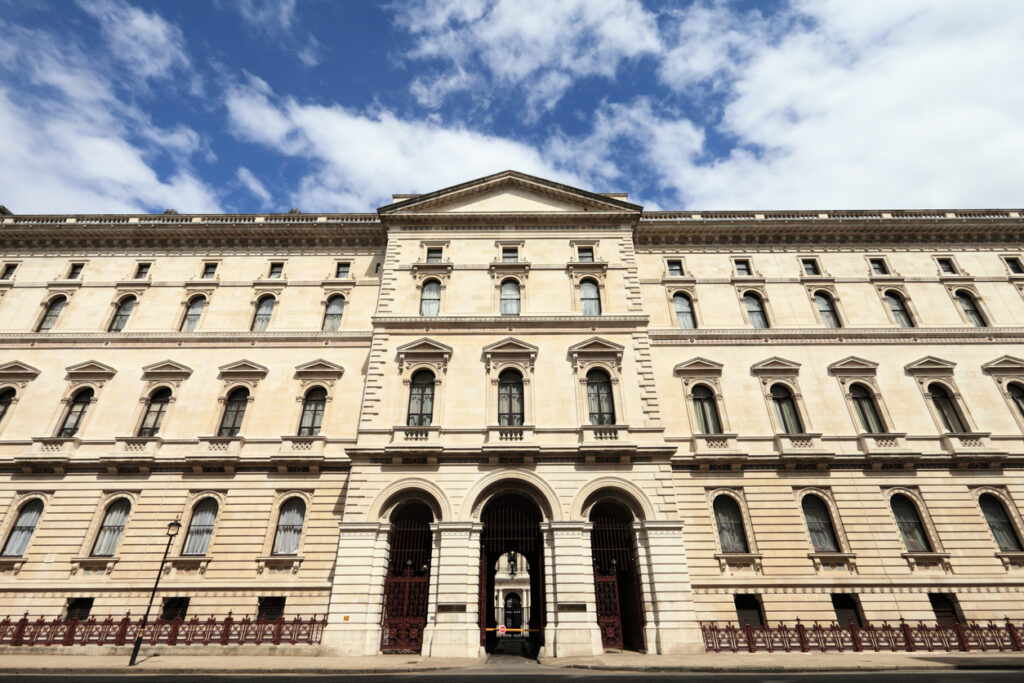
The great offices of state are the four most senior and prestigious ministerial posts in the United Kingdom government. They are the only positions that have been continuously occupied in cabinet for centuries, and even predate the modern cabinet system.
The four great offices of state are: prime minister, chancellor of the exchequer, foreign secretary, and home secretary.
Prime minister
Current holder: Andy Burnham
The prime minister is the head of His Majesty’s government. The holder of the office is the person best able to command the confidence of the House of Commons, and they are appointed by the monarch. This tends to be the leader of the party with the largest number of MPs.
The prime minister has overall responsibility for the policy and decisions of the government.
Key functions include appointing and dismissing all other ministers, overseeing the work of the civil service and all government departments and acting as the principal government figure in parliament. The prime minister also advises the monarch on the exercise of key royal prerogative powers.
The official residence and office of the prime minister is 10 Downing Street. The role emerged in the 18th century, with Sir Robert Walpole considered to be the first to hold the position.
Andy Burnham was appointed as prime minister in July 2026.
Chancellor of the exchequer
Current Holder: John Healey
The chancellor of the exchequer is the government’s chief finance minister and is responsible for all economic and financial matters, serving as the head of His Majesty’s Treasury.
The chancellor’s principal role is to prepare the government’s annual budget, which includes proposals for taxation and public spending. They are responsible for overall fiscal policy, managing the national debt and controlling public expenditure across all government departments.
The official residence of the chancellor is 11 Downing Street (since 1828). The office is one of the oldest in government, with its origins tracing back at least to the 13th century.
By long-standing tradition, the chancellor is the only individual allowed to consume alcohol at the dispatch box. The last chancellor to do so was Kenneth Clarke (1993-1997) during the budget statement.
Rachel Reeves, appointed as chancellor in July 2024, was the first woman to hold the office of chancellor. Reeves left office in July 2026.
Foreign secretary
Current holder: Ed Miliband
The secretary of state for foreign, commonwealth and development affairs, commonly known as the foreign secretary, is responsible for the UK’s foreign policy and its relationships with other countries and international organisations.
The foreign secretary heads the Foreign, Commonwealth & Development Office (FCDO) and is responsible for the UK’s diplomatic service. They also have oversight of the Secret Intelligence Service (MI6) and the Government Communications Headquarters (GCHQ).
The official London residence of the foreign secretary is 1 Carlton Gardens. The office was established in its modern form in 1782.
Home secretary
Current holder: Shabana Mahmood
The secretary of state for the Home Department, commonly known as the home secretary, is responsible for the internal affairs of the United Kingdom, including national security.
The home secretary’s wide-ranging remit includes policing in England and Wales, counter-terrorism, immigration and borders and the functions of the passport office. The home secretary has oversight of the Security Service (MI5).
The Home Office was also formally created in 1782. Unlike the other great office holders, the Home Secretary does not have a designated official residence.
Individuals who have held several great offices of state
Only one individual in British political history has held all four great offices of state. Jim Callaghan served as prime minister from 1976 to 1979, foreign secretary from 1974 to 1976, home secretary from 1967 to 1970, and chancellor of the exchequer from 1964 to 1967.
Several leading politicians have held at least two great offices of state. Some recent examples include Yvette Cooper (home secretary and foreign secretary), Liz Truss (foreign secretary and prime minister), Boris Johnson (foreign secretary and prime minister), Jeremy Hunt (foreign secretary and chancellor), James Cleverly (foreign secretary and home secretary), Sajid Javid (home secretary and chancellor), and Philip Hammond (foreign secretary and chancellor).
Politicians who have held three great offices of state include John Major (prime minister, chancellor and foreign secretary), Harold Macmillan (prime minister, chancellor and foreign secretary), Winston Churchill (prime minister, chancellor and home secretary), Rab Butler (chancellor, foreign secretary and home secretary), and John Simon (chancellor, foreign secretary and home secretary).
Former prime ministers have sometimes returned to hold another great office of state – although this trajectory is rare. Arthur Balfour, prime minister from 1902 to 1905, returned to serve as foreign secretary. Alec Douglas-Home, who served as prime minister from 1963 to 1964, returned as foreign secretary from 1970 to 1974.
The most recent example is David Cameron, prime minister from 2010 to 2016 and foreign secretary from 2023 to 2024.
Additional resources
- 10 Downing Street, Prime Minister’s Office: https://www.gov.uk/government/organisations/prime-ministers-office-10-downing-street
- HM Treasury: https://www.gov.uk/government/organisations/hm-treasury
- Foreign, Commonwealth & Development Office: https://www.gov.uk/government/organisations/foreign-commonwealth-development-office
- The Home Office: https://www.gov.uk/government/organisations/home-office

