Gordon Brown becomes prime minister after decade in waiting
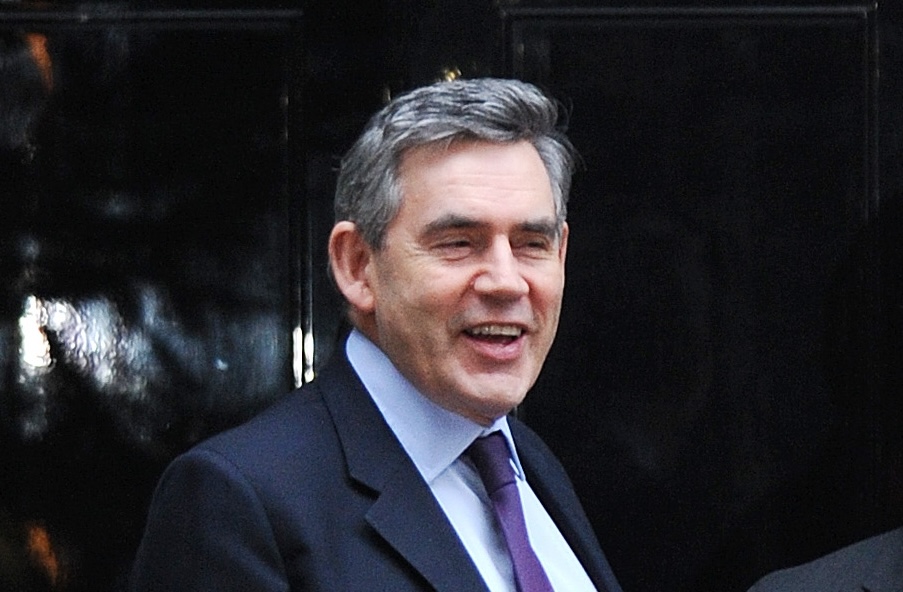
On 27 June 2007, Gordon Brown succeeded Tony Blair as prime minister.
Brown’s coronation was the culmination of years of escalating tension at the top of the Labour party.
Blair declared as early as September 2004 that he would not seek a fourth term as prime minister, at which point it was well known that Brown, the chancellor, coveted the top job.
The terms of Brown’s succession were reportedly settled over a decade earlier following the death of John Smith, who served as Labour leader from 1992 to 1994. According to party lore, Brown reluctantly agreed not to stand against Blair for the leadership, allowing him a clear run. This purported arrangement, finalised at the Granita restaurant in London, promised Brown unprecedented powers over economic policy as chancellor and the premiership, in time, upon Blair’s resignation as prime minister.
This dynamic – the “Granita Pact” – effectively defined the strained Blair-Brown relationship from 1997 to 2007. Over time, the latter’s patience wore increasingly thin.
***
The 2005 election produced a historic third consecutive Labour majority. But the party’s standing in the House of Commons was significantly reduced. Blair, damaged by the fallout of the Iraq War, possessed a majority of 66 seats.
Tension between Blair and Brown was a constant theme of the 2005 campaign. This longstanding strain was only momentarily defused when the prime minister was pictured handing his chancellor an ice cream.
Blair initially pledged to serve a full third term. “I’ve said I will serve a full term, that’s what people will be electing”, he insisted in April 2005, mere weeks before polling day.
But the prime minister came under considerable political pressure in the year following the election campaign.
In November 2005, Blair suffered his first major commons defeat as prime minister, when MPs rejected a government amendment to the Terrorism Bill. The 90-day amendment, introduced at report stage, was defeated by 322 votes to 291 – a majority of 31. A total of 49 Labour MPs defied the government’s three-line whip and sided with the opposition.
Blair’s authority was undermined by the so-called “cash-for-honours” scandal, when, in early 2006, the police were called upon to investigate allegations that fundraisers for both the Labour and Conservative parties had offered supporters a life peerage in return for their financial support. Blair and various other figures from all the main parties were interviewed by the police over the affair. Lord Levy, Labour’s fundraiser, was arrested and released on bail.
In addition, the prime minister came in for criticism over his response to the Israeli invasion of Lebanon in the summer of 2006. He refused to back international calls for an immediate ceasefire.
The catalyst for the rebellion that ultimately ousted Blair was a comment he made during an interview with the Times newspaper. It came as the prime minister hoped to downplay calls for him to set a fixed departure date – as demanded by allies of Brown.
On 1 September 2006, Blair told MPs to stop “obsessing” about the likely duration of his tenure and to “get on with the business of government”. He rebuffed calls to set a departure date.
He said: “I have said I am not fighting the next election and I will leave ample time for my successor… I have said everything I intend to say on this, and people can just draw whatever conclusions they want.”
On 5 September, 17 Labour MPs describing themselves as “Labour loyalists and implacable modernisers” issued a letter – coordinated by Chris Bryant and Siôn Simon – calling on Blair to stand down.
In the confidential letter, which was soon leaked, the MPs maintained that they had always “believed passionately in the same kind of modern, progressive, electable Labour Party” as Blair.
They added: “Sadly, it is clear to us – as it is to almost the entire party and the entire country – that without an urgent change in the leadership of the party it becomes less likely that we will win that election.”
Tom Watson, a junior government minister, was among the signatories. Watson was told to withdraw his name or resign by the government chief whip, Jacqui Smith; he resigned alongside six parliamentary private secretaries (Khalid Mahmood, Wayne David, Ian Lucas, Mark Tami, Chris Mole and David Wright.)
In his resignation letter, Watson said that he no longer believed that Blair remaining in office “is in the interest of either the party or the country.”
Four of the PPS group issued a joint statement saying Blair had “not ended the uncertainty over when you intend to leave office, which is damaging the government and the party”.
Blair responded by saying he had been “intending to dismiss” Watson as a junior minister.
The prime minister added: “Had he come to me privately and expressed his view about the leadership, that would have been one thing. But to sign a round robin letter which was then leaked to the press was disloyal, discourteous and wrong.
“It would therefore have been impossible for him to remain in government.”
Labour MP John McDonnell, who had declared his intention to run for the leadership as early as July 2006, described the developments as “like an episode of the Sopranos”.
Brown denied having any part in the plot.
David Cameron, the Conservative leader of the opposition, derided the government as in “meltdown” and “unable to show leadership on the challenges of the future.”
On 6 September, shortly before Watson’s resignation, Blair and Brown reportedly met for 90 minutes without coming to a formal agreement on what should happen next. The chancellor was yet to make a public comment on the resignations. It came as the Sun reported that the prime minister had set 31 May 2007 as his departure date.
Meanwhile, the Daily Mirror published a leaked memo purporting to show Blair’s departure plans. The memo, which described Blair’s legacy as the “triumph of Blairism”, contained plans for a farewell tour including appearances on Blue Peter and Songs of Praise.
It added: “As TB enters his final phase he needs to be focusing way beyond the finishing line, not looking at it.
“He needs to go with the crowds wanting more. He should be the star who won’t even play that last encore. In moving towards the end he must focus on the future.”
***
In the end, Blair was forced to announce that the party’s upcoming conference would be his last.
On 7 September, during a pre-arranged visit to a school in London, the prime minister conceded that recent developments had not been Labour’s “finest hour.”
Blair told reporters in a statement: “Now, as for my timing and date of departure, I would have preferred to do this in my own way, but as has been pretty obvious from what many of my cabinet colleagues have said earlier in the week, the next party conference in a couple of weeks will be my last party conference as party leader, the TUC next week will be my last TUC, probably to the relief of both of us.”
On 25 September, at the scene of Blair’s final conference, Brown declared his candidacy for the leadership. The chancellor said he would “relish the opportunity to take on David Cameron and the Conservative Party.”
Brown declared: “I know where I come from, what I believe and what I can contribute. And I am confident that my experience and my values give me the strength to take the tough decisions.”
Downing Street was forced to issue a statement refuting a Bloomberg report that Cherie Blair had said “that’s a lie” in response to Brown’s claim it had been a privilege to serve under her husband.
Blair delivered his final conference speech as prime minister the following day, 26 September.
He told delegates: “They say I hate the party, and its traditions. I don’t. I love this party. There’s only one tradition I hated: losing. I hated the 1980s not just for our irrelevance but for our revelling in irrelevance.
“And I don’t want to win for winning’s sake but for the sake of the millions here that depend on us to win, and throughout the world…
“You’ve given me all I have ever achieved, and all that we’ve achieved, together, for the country. Next year I won’t be making this speech.
But, in the years to come, wherever I am, whatever I do. I’m with you. Wishing you well. Wanting you to win. You’re the future now. Make the most of it.”
Clip.
Brown was the only candidate to secure the necessary nominations from MPs. McDonnell, a veteran leftwinger, failed to gather sufficient support. Brown won 313 (88.2%) nominations to McDonnell’s 29 (8.2%).
At a special conference on 24 June 2007, the long-serving chancellor was announced as the new Labour leader.
***
On the day of the handover, Blair tendered his resignation to the queen at Buckingham Palace. Brown then made his own visit to be invited to form a government as prime minister.
In his first speech on the steps of 10 Downing Street, Brown promised a new direction.
He stated: “This will be a new government with new priorities… I will try my upmost. This is my promise to all of the people of Britain. And now let the work of change begin.”
The new prime minister initially enjoyed a successful honeymoon period. He won praise for his handling of a series of crises, including terrorist attacks in London and Glasgow, an outbreak of foot-and-mouth disease and severe national flooding.
Brown’s poll ratings soared, fuelling intense speculation in the autumn of 2007 that he would call a snap general election to secure his own mandate. But the prime minister, faced with polling that showed he could lose seats, backed down. The saga was seized upon by Labour’s opponents and markedly damaged his political authority.
Brown’s premiership was subsequently dogged by accusations of indecision. His response to the 2008 global financial crash, however, won international plaudits and is regarded as his finest hour.
Brown led the Labour Party into the 2010 general election, which resulted in the country’s first hung parliament since February 1974, ending 13 years of majority Labour government. Cameron’s Conservative Party won the most seats and votes but fell 20 seats short of the 326 required for an overall majority. Labour lost 91 seats, returning 258 MPs on a 29.0% vote share.
A Labour-Lib Dem coalition was considered as a possibility – likely with the support of smaller nationalist parties, and negotiations were held to this effect. For a period, the Liberal Democrats were in simultaneous negotiations with both the governing Labour Party and the opposition Conservative Party. But the most viable path to a stable government was provided by a formal arrangement between the Conservatives and the Liberal Democrats.
On the evening of 11 May, Brown resigned as prime minister.
After days of wrangling, Brown handed over to Cameron, who entered office at the head of a Conservative-Liberal Democrat coalition.
***
Since leaving office, Brown has claimed that Blair agreed he would vacate the top job during his second term in office.
In his memoir My Life, Our Times, published November 2017, Brown said the importance of the Granita dinner had been over-stated – suggesting the agreement between the Labour rising stars had been agreed a fortnight earlier.
The dinner, he revealed, “merely confirmed what he had already offered and I had already agreed.”
Brown wrote: “Tony had reiterated that he had wanted me to stay on as shadow chancellor and would give me control over economic and social policy.
“This time, he added another promise – that if elected as prime minister, he would stand down in his second term…
“He said this was a family choice that he had already made. He wanted to be free from day-to-day politics to be with his children in their teens – the time of life when parents are most needed. It was a promise he repeated on several occasions.”
He added: “When I offered to chair Tony’s leadership campaign, he demurred. And while I helped write his leadership speeches, I was frozen out of the campaign. Long into the future, the focus of the 1994 leadership race would wrongly remain on what was said at Granita.
“The restaurant did not survive and ultimately neither did our agreement.”
Allies of Blair have also criticised Brown’s conduct in seeking to oust the prime minister.
In his memoirs, published September 2010, Blair said that Brown could be “maddening” and accused his successor of lacking “emotional intelligence”.
In a July 2010 interview with the Times, Lord Mandelson said that Brown had been “very badly served” by his allies when he was chancellor.
Mandelson commented: “The unbridled contempt that some people around Gordon had for Tony and those who worked for him was very destructive.”
Confidential papers, which found their way into the press in June 2011, appeared to detail a plot by allies of Brown to oust Blair as prime minister. The 2006 plot, codenamed “Project Volvo”, pointed to a campaign of co-ordinated activity by key Brownite figures to exert pressure on the prime minister.
Included in the cache of documents were apparent handwritten notes by Brown, detailing his negative feelings towards Blair.
In one document, Brown wrote that “if we are to renew Labour, we will have to be as rigorous and as brutal as we were in the creation of New Labour”.
In another memo, Brown criticised Blair’s 2005 Labour conference speech, saying “all his talk” of Labour dominating the centre ground “is not about re-establishing Labour, but a self-promotion about his exceptionalism”.
In February 2006, Blair reportedly responded to the incessant handover requests from Brown with a note. “The division at the top is killing us”, he stated.
The then-prime minister added: “You (understandably) want to end the uncertainty by me going now.
“You need to be the candidate of continuity and change. The second will be relatively easy to do. A different person is, by its nature, change.
“The first, however, rests on a smooth transition. Critical to that is not merely the absence of disunity in the handover; it is also the visible, clear demonstration that the person who most embodies NL [New Labour], ie me, is working hand in hand with the successor.”
He added: “Whilst I remain PM, the final decision has to be mine; and that cannot provoke a breakdown. I will try, at all costs, to avoid disagreement, but there can’t be stalemate if it happens.”
On a copy of this letter, Brown noted the words “shallow”, “inconsistent” and “muddled”.

Politics.co.uk Newsletters
DAILY
Politics@Lunch
WEEKLY
Week in Review
