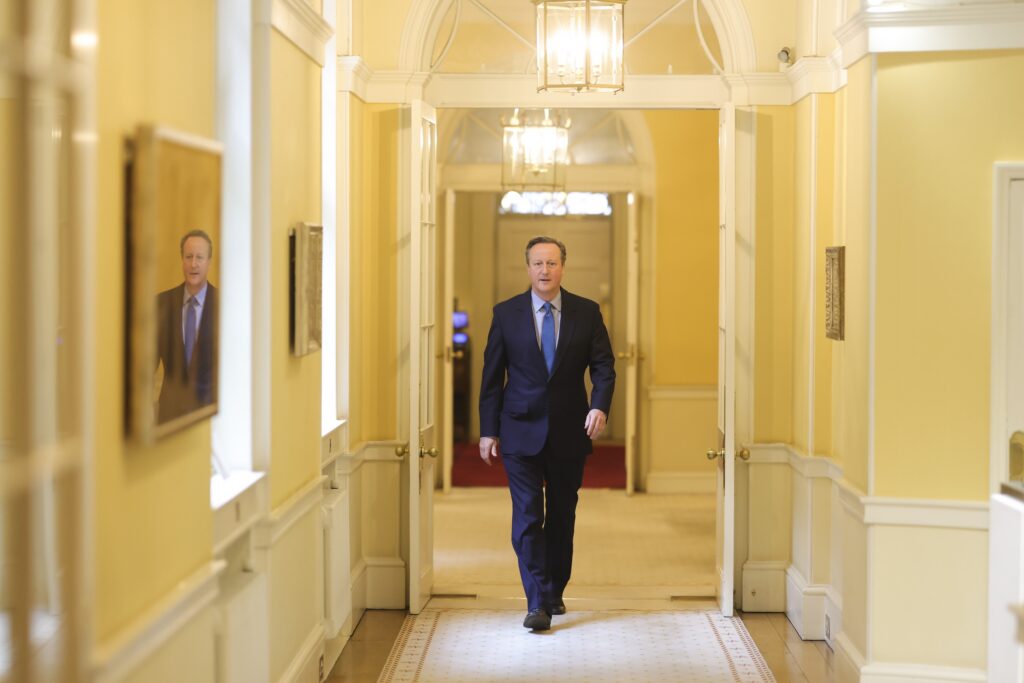
Rishi Sunak appoints David Cameron as foreign secretary
On 13 November 2023, Rishi Sunak executed his second and final cabinet reshuffle as prime minister.
The catalyst for the reshuffle was the conduct and dismissal of Suella Braverman, whom Sunak had appointed as home secretary in October 2022. Tensions between Braverman and Downing Street had been rising for some months when, in an article for the Times, she stated there was a “perception that senior police officers play favourites when it comes to protesters” and were tougher on right-wing protesters than pro-Palestinian demonstrations.
Braverman wrote: “Unfortunately, there is a perception that senior police officers play favourites when it comes to protesters.
“During Covid, why was it that lockdown objectors were given no quarter by public order police yet Black Lives Matters demonstrators were enabled, allowed to break rules and even greeted with officers taking the knee?
“Rightwing and nationalist protesters who engage in aggression are rightly met with a stern response yet pro-Palestinian mobs displaying almost identical behaviour are largely ignored, even when clearly breaking the law? I have spoken to serving and former police officers who have noted this double standard.”
According to reports, Downing Street requested edits to the article that were not implemented.
***
The most surprising and historically significant element of the reshuffle was the return to frontline politics of David Cameron, prime minister from 2010 to 2016. Cameron had resigned from parliament in the wake of the referendum on Britain’s membership of the European Union (EU).
He was therefore granted a life peerage and elevated to the House of Lords as Baron Cameron of Chipping Norton. Cameron was the first former prime minister to return to the cabinet since Alec Douglas-Home, who served as prime minister from 1963 to 1964 and foreign secretary from 1970 to 1974.
In total, Cameron was the fifth ex-PM to be reappointed to the cabinet since 1900.
Arthur Balfour, prime minister from 1902 to 1905, served in several senior roles from 1915 to 1929 – including as foreign secretary. Ramsay MacDonald, prime minister in 1924 and again from 1929 to 1935, served as lord president of the council from 1935 to 1937. Neville Chamberlain, prime minister from 1937 to 1940, served briefly as lord president of the council upon leaving Downing Street.
Cameron also became the first foreign secretary to serve from the House of Lords since Lord Carrington, who held the post from 1979 to 1982.
Historically, it is considerably more common for peers to serve in less prominent cabinet-attending roles. Baroness Morgan served as culture secretary from 2019 to 2020; during Gordon Brown’s tenure as prime minister, Lord Mandelson and Lord Adonis held cabinet roles as business secretary (2008-2010) and transport secretary (2009-2010) respectively.
Sunak shuffled James Cleverly, the incumbent foreign secretary, into the Home Office as Braverman’s replacement. Meanwhile, Thérèse Coffey – the deputy prime minister during the brief and tumultuous Liz Truss premiership – left her role as environment secretary.
Sunak was also seen to promote a series of allies, including Victoria Atkins as health secretary, Laura Trott as chief secretary to the Treasury, and Richard Holden as Conservative chairman.
Esther McVey, a figure associated with the Conservative right, was promoted as minister without portfolio in the Cabinet Office. Downing Street subsequently briefed that McVey had taken up the post as the government’s de facto “minister for common sense”.
***
It was Cameron’s appointment, however, that attracted the largest share of attention.
Critics suggested the move undermined Sunak’s declaration at the recent Conservative conference that he was the “change candidate”. The Labour Party’s campaign chief, Pat McFadden, responded: “This puts to bed the prime minister’s laughable claim to offer change from 13 years of Tory failure.”
Cameron’s involvement with the collapsed speciality finance group, Greensill Capital, was also raised by critics and commentators. Cameron was accused of lobbying ministers to secure preferential treatment for Greensill during the Covid-19 pandemic.
Lord Cameron’s appointment also sparked questions over accountability and parliamentary scrutiny. As a peer, he would not appear in the House of Commons to face questioning from MPs, as his predecessor, James Cleverly, had done.
The speaker of the commons, Lindsay Hoyle, expressed some concern in this regard, highlighting the “gravity of the current international situation”.
He told MPs that while Cameron’s appointment was “not the first time in recent years that a cabinet minister has been appointed in the House of Lords but, given the gravity of the current international situation, it is especially important that this House is able to scrutinise the work of the Foreign, Commonwealth and Development Office effectively.”
He added: “I have therefore commissioned advice from the clerks about possible options for enhancing scrutiny of the work of the foreign secretary when that post is filled by a member of the other House.”
It has been suggested that Lord Carrington’s departure as foreign secretary at the outbreak of the Falklands War reflected a recognition of fact that, at a time of crisis, the senior position should be occupied by a member of the House of Commons and therefore answerable to MPs.
Sunak subsequently styled Andrew Mitchell, the development minister, as deputy foreign secretary. Mitchell therefore served as the Foreign Office’s most senior presence in the commons.
Cameron’s return was also noted for creating points of policy tension, given his public opposition to some of Sunak’s decisions – including previous cuts to the foreign aid budget (as chancellor) and the cancellation of the Northern leg of the HS2 rail line.
Cameron vowed to adhere to the principle of collective responsibility.
In a statement, Cameron said that while he had “disagreed with some individual decisions, it is clear to me that Rishi Sunak is a strong and capable prime minister, who is showing exemplary leadership at a difficult time.”
***
Suella Braverman, meanwhile, did not go quietly.
On 14 November, she sent a scathing letter to Sunak, her former boss, suggesting he had reneged on the terms of a deal the two had agreed during the October 2022 Conservative leadership contest.
Braverman wrote: “As you know, I accepted your offer to serve as home secretary in October 2022 on certain conditions.
“Despite you having been rejected by a majority of party members during the summer leadership contest and thus having no personal mandate to be prime minister, I agreed to support you because of the firm assurances you gave me on key policy priorities.”
Braverman’s sacking was reported to have riled the Conservative right, and even elicited a ‘letter of no confidence’ – courtesy of longstanding Boris Johnson ally Andrea Jenkyns.
The missive, addressed to Graham Brady as chair of the 1922 committee of Conservative backbenchers, was riddled with rudimentary grammatical and spelling mistakes.
Jenkyns wrote: “Enough is enough. If it wasn’t bad enough that we have a party leader that the party members rejected, the polls demonstrate that the public reject him, and I am in full agreement. It is time for Rishi Sunak to go.”

Politics.co.uk Newsletters
DAILY
Politics@Lunch
WEEKLY
Week in Review