Callaghan government falls by a single vote in dramatic no-confidence motion
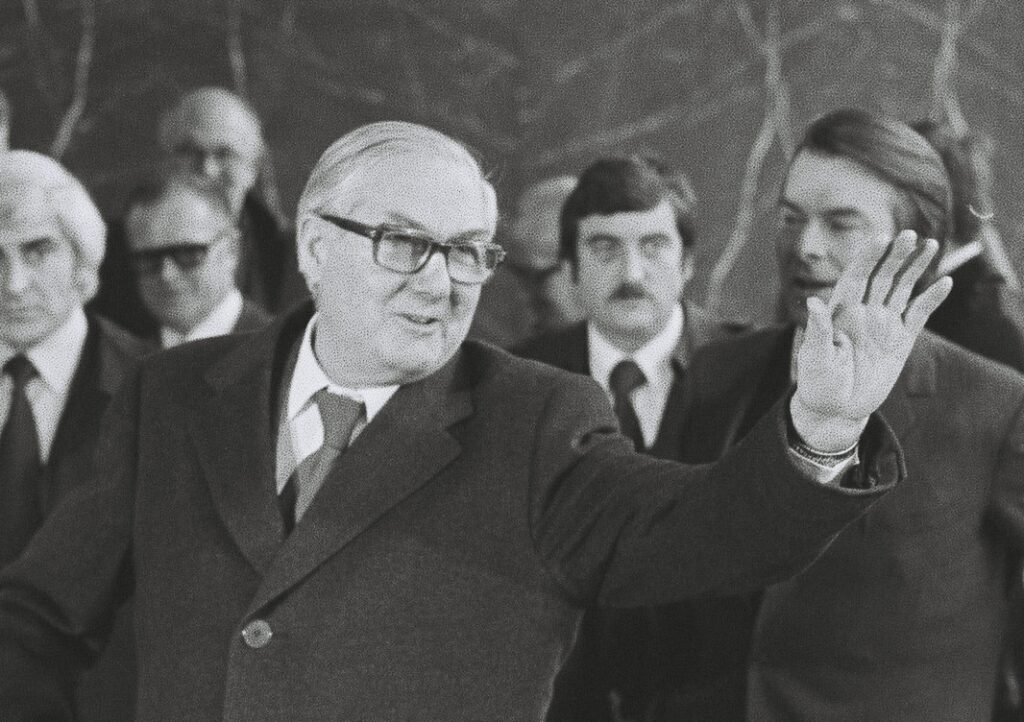
On 28 March 1979, one of the most dramatic nights in British political history, the Labour government under James Callaghan was defeated by a single vote in a motion of no confidence.
The vote – 311 to 310 – was announced to raucous cheers from Conservative MPs just after 10:00 pm, marking the first time a government had been brought down on a confidence vote since 1924. The result triggered a general election and paved the way for the Thatcher era.
The motion, “that this House has no confidence in Her Majesty’s Government”, was tabled by Margaret Thatcher as leader of the opposition. It followed the government’s failure to win the Scottish and Welsh devolution referendums earlier that month. These defeats prompted the Scottish National Party (SNP) to withdraw its support for the minority Labour government.
Callaghan’s administration had been clinging to power since losing its majority in 1977, relying on a pact with the Liberal Party, the support of smaller parties and an often innovative whipping operation.
The government’s standing was severely damaged by the Winter of Discontent, a period of widespread industrial unrest and public sector strikes. Opinion polls at the time placed Thatcher’s Conservative Party 13 points ahead of Labour.
The government’s fate was effectively sealed when the 77-year-old Labour MP Sir Alfred Broughton, bedridden after a heart attack, was warned he might not survive the journey to Westminster.
Initially, the government deputy chief whip, Walter Harrison, approached his opposite number, Conservative whip Bernard Weatherill, to secure a “pairing” agreement for Broughton. Weatherill rejected the suggestion that a Tory MP would agree to absent themselves as part of a pairing arrangement on such an important vote. But he acquiesced, honourably agreeing to abstain himself. Harrison said he would not hold Weatherill to this deal – a sacrifice that would have surely ended his political career. The demise of Callaghan’s government was gentlemanly, then, and Weatherill went on to serve as speaker of the House of Commons from 1983 to 1992.
***
Thatcher opened the debate as leader of the opposition. She moved the motion that “this House has no confidence in Her Majesty’s Government”.
The Conservative leader’s speech served as a clear exposition of Thatcherite principles.
Thatcher argued that Labour’s platform amounted to taxing the citizen more and providing “him with his basic standard of living, according to what the government decide he needs.” She argued that while such policies were put forward in the name of social responsibility, “we shall never have social responsibility unless, first, we have responsible individuals.”
She argued that the Winter of Discontent had seen the demise of an “orderly society”.
The Tory leader told the House: “[Citizens] expect the rubbish to be cleared, the schools to be open and the hospitals to be functioning. They are not. They expect each man and woman to rise to his obligations in an orderly and decent way.
“They expect bargains to be kept between trade unions and employers. Finally, they expect ministers to support them in those views.”
In her peroration, Thatcher condemned the government for having “doubled prices, doubled dole queues, doubled debt, diminished our defences and undermined public respect and confidence in the law”.
She added: “There has been a failure not only of policies but of the whole philosophy on which they are based – the philosophy which elevates the state, dwarfs the individual and enlarges the bureaucracy.”
David Steel, the leader of the Liberal Party, remarked that parliament found itself “stuck on devolution, stuck on tax reform and stuck on pay policy, and on industrial relations policy it is not only stuck but is sub-contracting its responsibilities to groups outside parliament”.
He said this made the “case for a fresh parliament.”
Callaghan, in what would be one of his final contributions as prime minister, mocked Thatcher’s approach to the debate – which was only called after the Conservatives received the support of the Liberals and SNP.
He declared: “We can truly say that once the leader of the opposition discovered what the Liberals and the SNP would do, she found the courage of their convictions.
“So, tonight, the Conservative Party, which wants the [Scotland Act] repealed and opposes even devolution, will march through the lobby with the SNP, which wants independence for Scotland, and with the Liberals, who want to keep the act.
“What a massive display of unsullied principle!”
Callaghan said the minority parties were walking “into a trap”.
The prime minister added: “If they win, there will be a general election. I am told that the current joke going around the House is that it is the first time in recorded history that turkeys have been known to vote for an early Christmas.”
Callaghan concluded: “Let need, not greed, be our motto. Our purpose as a government and as a party is to present a bold, socialist challenge to all these problems as we face these tasks. I ask for the confidence of the House and of the country so that we may continue with our work.”
Michael Foot, the leader of the House of Commons, wound up the debate for the government. His contribution featured the famous description of David Steel, as a politician who had “passed from rising hope to elder statesman without any intervening period whatsoever”.
The 311 MPs who voted ‘no confidence’ in Callaghan’s government comprised 279 Conservatives, 13 Liberals, 11 SNP representatives, eight Ulster unionists (five Ulster Unionist Party, one United Ulster Unionist Party, one Democratic Unionist Party) and one independent.
Two Ulster Unionist Party MPs, three Plaid Cymru MPs and two MPs of the breakaway Scottish Labour Party (SLP) voted against the motion tabled by the official opposition.
Gerry Fitt, the leader of the Social Democratic Labour Party (SDLP), and Frank Maguire, an independent republican MP, both abstained. Fitt was opposed to promises Callaghan had made to unionist MPs in an attempt to secure their support. During the debate, the SDLP leader referred to Callaghan’s “deal with the devil”.
Fitt stated: “Rumours are circulating in the House and throughout Northern Ireland about the levels to which this government will stoop to maintain themselves in office for a few weeks more.
“I rarely agree with [Thatcher], but today she said that this Government should maintain their dignity. I believe that too. It is heartbreaking to see a Labour Government without dignity.”
Maguire, a rare sight in Westminster who had yet to deliver his maiden speech, was in parliament for the vote. But he told a bemused journalist: “I have come over here to abstain in person.”
***
Speaking after the vote, Callaghan said that the government would “take our case to the country”.
He proclaimed: “Tomorrow I shall propose to Her Majesty that parliament be dissolved as soon as essential business can be cleared up, and I shall then announce as soon as may be – and that will be as soon as possible – the date of dissolution, the date of the election and the date of meeting of the new parliament.”
Thatcher responded that since the government no longer had the “authority to carry on business without the agreement of the opposition”, she looked forward to parliament’s dissolution.
At the 1979 general election, the Conservative Party achieved a decisive victory. The result saw Thatcher become the first female prime minister in British and European history. The Conservatives won 339 seats (up 62), securing a comfortable working majority of 43, while Labour slumped to 269 seats (down 50). The swing of 5.2 points from Labour to the Conservatives was the largest since 1945.
The Liberals secured 11 seats (down two). The SNP was reduced from 11 seats to just two.
Callaghan, the only individual to have held all ‘great offices of state’ (prime minister, chancellor of the exchequer, home secretary and foreign secretary), stepped down as Labour leader in 1980.

Politics.co.uk Newsletters
DAILY
Politics@Lunch
WEEKLY
Week in Review
