Wilson defends devaluation in ‘pound in your pocket’ broadcast
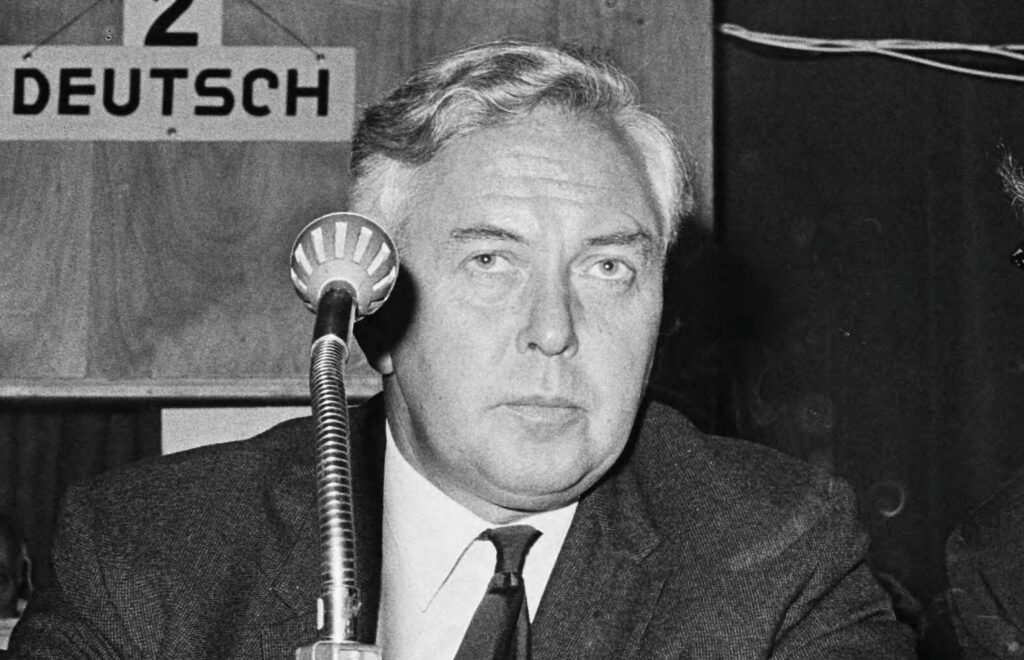
On 19 November 1967, the prime minister, Harold Wilson, addressed the nation to defend his government’s decision to devalue the pound sterling. The broadcast is best remembered for Wilson’s insistence that the devaluation did not mean the pound “in your pocket” had lost its value.
The government’s official devaluation announcement was made the previous evening, Saturday 18 November, by James Callaghan as chancellor of the exchequer. After weeks of feverish speculation, Callaghan said that the exchange rate was being lowered from $2.80 to $2.40 to the pound, a cut of 14.3%. A succession of external shocks – including the Six-Day War in the Middle East, the closure of the Suez Canal, and a domestic dock strike – had made the previous exchange rate untenable.
***
The government had fought for three years to maintain the pound’s position, having inherited a trade deficit of £800 million from the Conservatives in 1964. The balance of payments deficit was blamed on the last government’s expansionary fiscal policy, which they hoped would precipitate a pre-election economic boom. But increased demand had caused imports to rise precipitously, weakening the UK’s trade position.
With sterling under assault from speculators, the Bank of England deployed hundreds of millions of pounds of its gold and foreign exchange reserves in an attempt to shore up the currency.
Wilson initially resisted altering Britain’s exchange rate. Indeed, sterling’s defence was described as a central pillar of the government’s economic policy. Both Wilson and Callaghan understood the damaging political implications of devaluation. It would necessitate stringent austerity measures to control demand in the economy, stabilising the balance of payments.
In July 1967, Callaghan said that the “logical purpose of devaluation is a reduction in the standard of life at home.”
He told MPs: “Devaluation is not the way out of Britain’s difficulties… I do not regard sterling as being any great symbol. I just do not want either to devalue our own word or to bring down the standard of life of our own people.”
Wilson was involved in the last decision to devalue the pound in 1949 (from $4.03 to $2.80 to the pound). Douglas Jay, the economic secretary to the Treasury at the time, later wrote that Wilson – then the president of the Board of Trade – “changed sides three times within eight days and finished up facing both ways” over the decision to devalue.
Some 18 years later, the task of overseeing Britain’s second post-war devaluation fell, once more, to Labour.
The events leading up to the devaluation amounted to a debacle. Wilson accepted Callaghan’s decision to devalue on 15 November, and it was agreed that Callaghan would announce the government’s position three days later on 18 November.
The chancellor, however, was called before MPs on 16 November to make a statement on rumours the government was seeking to shore up sterling with a “$1,000 million loan being negotiated with foreign banks.”
Callaghan responded that it would be wrong for him “either to confirm or to deny a press rumour of this kind.”
In a follow-up question, Labour MP Stan Orme suggested that devaluation would be preferable to deflationary measures, demanded by an overseas creditor, such as “a reduction in public expenditure at home [and] a wage freeze.”
Callaghan responded that he had “nothing to add to or to subtract from anything I have said on previous occasions on the subject of devaluation”.
Callaghan was bound by commons rules not to mislead the House, but could not risk the economic and political consequences of a premature announcement. His refusal to repeat previous denials, however, led to further selling of sterling on world markets. In the 24 hours that followed, the Bank of England spent hundreds of millions of pounds in a futile attempt to prop up the currency.
The government’s official devaluation announcement followed as planned on 18 November.
A Treasury press notice outlined the government’s decision that “in order to achieve a substantial surplus on the balance of payments consistent with economic growth and full employment, the exchange rate of the £ should be lowered”.
The release spoke of the “opportunities” for exporters, but warned of the need to constrain “the growth of demand by consumers at home in”.
A series of measures were outlined in order to achieve “an improvement in our balance of payments of at least £500 million a year”.
The bank rate was immediately raised to 8%, banks were asked to limit advances to all but “priority borrowers, especially exporters”, and defence spending was cut by £100 million. Additionally, hire purchase regulations on car sales were tightened, requiring a minimum deposit of 33.3% and a maximum repayment period of 27 months.
***
Wilson addressed the nation on 19 November.
In his broadcast, the prime minister argued that devaluation would see Britain “break out from the straitjacket which has constricted us under successive governments”.
“We must take with both hands the opportunity now presented to us”, he said. “Any who fail through laziness or self-seeking, any who frustrate the work of others by unofficial strikes, will imperil the right of all our people to work, the right to work not only for ourselves but for the nation.”
The prime minister added: “This is a proud nation. We’re on our own now. It means putting Britain first.”
Wilson said he would not “attribute blame” for the devaluation crisis “to the policies of the last government or this government, to unofficial strikers [or] to the manoeuvring of speculators at home and abroad.”
But he said it would have been “irresponsible to go on dealing with these successive waves of speculation by borrowing for three months, six months at a time”. While Wilson vowed not to assign blame, therefore, currency speculators were repeatedly singled out in his broadcast statement.
Moreover, he argued that the government’s response addressed the “root cause of the speculation”.
“Failure to attack the root cause”, he said, “would have meant trying to borrow – this time, in conditions in which our creditors abroad might well insist on guarantees about this or that aspect of our national policies.”
He defended the government’s policy up to this point, maintaining that no one could doubt “our determination to win through”.
He added: “Exports, even our increasing exports, could not earn enough to meet the successive waves of speculation against sterling”.
The broadcast, however, is best remembered for Wilson’s suggestion that Britons would not immediately feel worse off as a consequence of devaluation.
He declared: “From now the pound abroad is worth 14% or so less in terms of other currencies. It does not mean, of course, that the pound here in Britain, in your pocket or purse or in your bank, has been devalued.
“What it does mean is that we shall now be able to sell more goods abroad on a competitive basis.”
The prime minister’s “pound in your pocket” line was seized upon by critics and satirists, who saw it as disingenuous. The devaluation ultimately led to higher prices for imports, including food and raw materials – which in turn drove up the cost of living for British consumers.
Edward Heath, the Conservative leader, responded by way of a rebuttal broadcast. He said the government had “denied 20 times in 37 months that they would ever devalue the pound”.
He added: “In three years, the socialist government has reduced Britain from a prosperous nation to an international pauper. Mr Wilson himself bears the responsibility, for he has taken personal charge of the conduct of the economy.”
The Daily Mirror, a Labour-supporting paper, commented: “It is not only the pound that has been devalued, it is also the integrity of the government, and there is so little goodwill left to squander.”
***
Callaghan returned to the commons on 20 November to make a statement on his devaluation decision and the accompanying austerity measures. He explained that devaluation would make imports more expensive, leading to a “small but noticeable rise in prices”.
The chancellor expressed his “great personal regret” at having to recommend devaluation.
Michael Foot, the Labour backbencher, responded: “Many of us rejoice that we have now got this albatross off our necks”.
A debate on the “economic situation” followed across two days from 21 to 22 November.
The shadow chancellor, Iain Macleod, recounted the government’s “mismanagement”, characterising its policy as a “horrifying story of bungling incompetence at a brutal cost to our reserves”.
Macleod calculated that from the moment of the cabinet decision to the announcement, “about £300 million was spent in supporting sterling”.
He said there could be no excuse for such “ignorant negligence”, which he connected to Callaghan’s statement to the House on 16 November.
Macleod commented: “The chancellor gave an answer which was petulant and abrupt. As a result, sterling went virtually through the floor that afternoon. It would have been easy for him to have given a reassuring answer which would have held the position.”
Edward Heath, the Conservative leader, addressed MPs on 22 November. He said the government’s devaluation announcement had sparked a “deep, burning resentment” in the country.
Heath said this anger had increased in the wake of Wilson’s broadcast, referring directly to the “pound in your pocket” remark.
He declared: “That broadcast will long be remembered for that sentence. It will be remembered as the most dishonest statement ever made, ever made even by the prime minister.”
Richard Crawshaw, a Labour backbencher, announced he would resign the party whip in protest at the government’s position. “I indict the government for a lack of guts”, Crawshaw declared, “for a lack of determination, and for a lack of honesty in telling the people what is required of them.”
The government’s large majority, secured at the 1966 general election, meant Wilson was not in danger when the House divided later on 22 November.
335 MPs voted in favour of a motion welcoming Callaghan’s statement “on the measures in relation to the economic situation”. 258 voted to reject it.
The motion passed by a majority of 77; Labour went into the debate with a nominal majority of 86.
***
But Callaghan, who had consistently opposed devaluation, nonetheless felt compelled to resign.
In his memoirs, Callaghan recorded that, when the devaluation policy was being decided, he “had already intimated to the prime minister that it was my firm decision to resign once the devaluation operation was complete and I had accounted for myself to the House of Commons.”
He added: “The prime minister urged me very strongly to remain at the Treasury for the time being, but I felt unable to do so in view of the undertakings I had given in good faith as lately as the previous September that sterling would not be devalued.”
In a cabinet reshuffle, Roy Jenkins was appointed as the new chancellor; Callaghan moved to the Home Office.
The devaluation eventually succeeded in bringing the balance of payments into surplus by 1969.
The Conservative Party under Edward Heath’s leadership won the general election that followed in 1970. The result, which gave the Conservatives a majority of 30, was one of the biggest electoral shocks of the post-war era. In the final phase of the campaign, the national mood appeared to turn following the publication of poor trade figures showing a £31 million trade deficit for May.
The revelations resonated with the focus of the Conservative campaign. (England’s quarter-final defeat by West Germany in the World Cup on 14 June has also been linked, somewhat tenuously, to the reversal of Wilson’s political fortunes).
Heath’s campaign focused on a message of economic competence and a promise to curb the power of the trade unions. The Conservative leader referred to a “shopping basket election”, hoping to capitalise on concerns over the cost of living. Controversially, he warned that Labour’s re-election could result in sterling facing a second devaluation.
***
In August 1971, US president Richard Nixon suspended the convertibility of the dollar into gold. It signalled the effective collapse of the Bretton Woods fixed exchange rate system.
Upon making this decision, Nixon declared that “your dollar will be worth just as much tomorrow”. This line drew comparisons to that delivered by Wilson in 1967.
Nixon said: “If you want to buy a foreign car or take a trip abroad, market conditions may cause your dollar to buy slightly less. But if you are among the overwhelming majority of Americans who buy American-made products in America, your dollar will be worth just as much tomorrow as it is today.
“The effect of this action, in other words, will be to stabilise the dollar.”
Nixon’s criticism of “speculators” also echoed the position taken by Wilson in 1967.
One cartoonist reportedly depicted Nixon telephoning Wilson to apologise for plagiarising his lines.

Politics.co.uk Newsletters
DAILY
Politics@Lunch
WEEKLY
Week in Review