Geoffrey Howe resigns from Thatcher cabinet over Europe
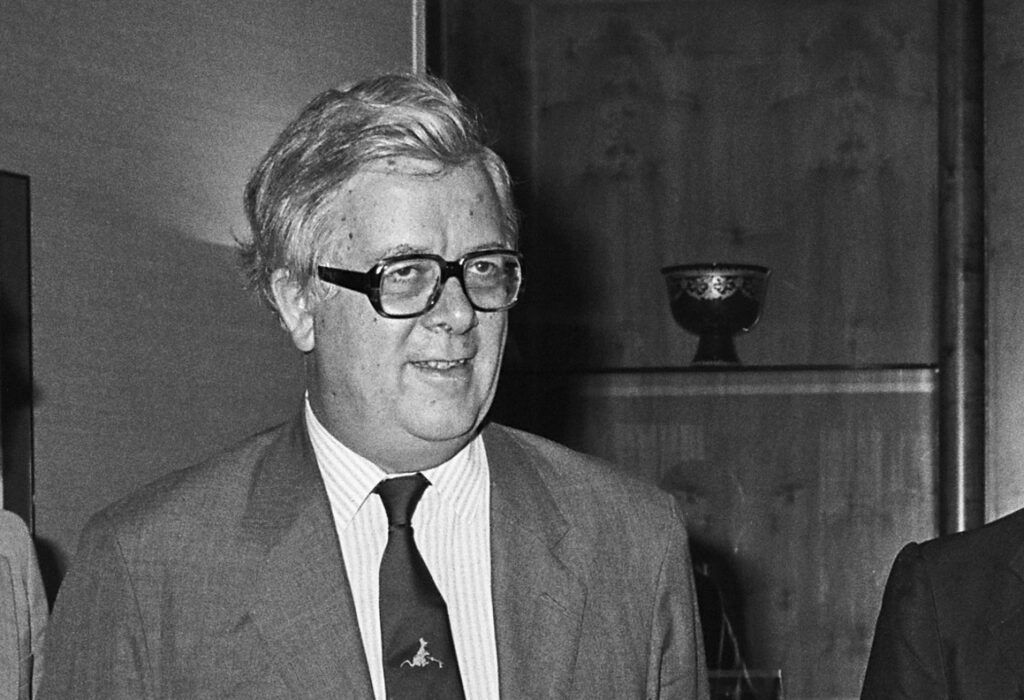
On 1 November 1990, Geoffrey Howe resigned from his posts as deputy prime minister and leader of the House of Commons, citing fundamental disagreements with Margaret Thatcher‘s stance on European integration.
Howe had served under Thatcher in a series of prominent ministerial roles, including as chancellor (1979 to 1983) and foreign secretary (1983 to 1989). His resignation directly precipitated the 1990 Conservative leadership contest that ended Thatcher’s premiership.
***
Howe and Thatcher were at odds over their commitment – or lack thereof – to the European project.
In September 1988, the prime minister delivered a famous speech at the College of Europe in Bruges in which she set out her stark opposition to European supranationalism and integration.
Thatcher delivers landmark Bruges speech warning against ‘European superstate’
In the speech’s most consequential passage, Thatcher warned: “We have not embarked on the business of throwing back the frontiers of state at home, only to see them re-imposed at a European level with a European superstate exercising a new dominance from Brussels.”
In his memoirs, Howe – then the foreign secretary – wrote that hearing Thatcher’s Bruges speech was “like being married to a clergyman who had suddenly proclaimed his disbelief in God.”
He added: “I can now see that this was probably the moment in which there began to crystallise the conflict of loyalty with which I was to struggle for perhaps too long.”
Over the following years, divisions within the Conservative Party over Europe deepened, particularly regarding monetary policy and Britain’s role in European economic integration. The European Exchange Rate Mechanism (ERM), an economic stability measure, emerged as a flashpoint in 1989. Howe and the chancellor, Nigel Lawson, threatened to resign from cabinet if Thatcher failed to oversee Britain’s entry into the ERM.
In July 1989, Thatcher responded with a reshuffle, replacing Howe as foreign secretary with John Major. Howe was made leader of the commons, a post embellished with the title of deputy prime minister.
Some months later on 26 October, Lawson resigned as chancellor, citing the influence of Alan Walters, Thatcher’s personal economic adviser, who opposed Britain’s entry into the ERM.
Major, the new chancellor of the exchequer, proposed a compromise on the thorny issue of monetary union. In June 1990, he announced his support for the creation of a new common European currency, the ‘hard ECU’, as a practical alternative to the vision of a single currency. The ‘hard ECU’ (European Currency Unit) would provide a common or dual currency, managed by a European Monetary Fund, that would circulate in parallel with existing national currencies like the pound, the franc, and the Deutschmark. If it proved popular, it could eventually evolve into a single currency.
Chancellor John Major proposes ‘hard ECU’ as euro alternative
Over time, Major also became convinced that the UK’s membership of the ERM was necessary to combat inflation and restore macroeconomic stability. Alongside Douglas Hurd, his replacement as foreign secretary, he too set about convincing Thatcher.
The Major-Hurd axis was ultimately more effective than its Howe-Lawson predecessor in influencing Thatcher’s thinking. On 4 October, she reluctantly agreed to Britain’s entry into the ERM at a rate of DM 2.95 to £1.00.
***
Thatcher’s eurosceptic, anti-integrationist worldview – famously expounded at Bruges – found finer expression in her defiant “No. No. No.” declaration on 30 October 1990.
In a statement to MPs, Thatcher updated the House on the developments of the recent European summit in Rome. She clarified that Major’s “hard ECU would be a parallel currency, not a single currency… a single currency is not the policy of this government.” Questioned on this point specifically, she further insisted that the ‘hard ECU’ currency would not “become widely used throughout the community”.
Thatcher told the House: “It would possibly most widely used for commercial transactions. Many people would continue to prefer their own currency.”
In response to Labour leader of the opposition Neil Kinnock’s line of questioning, she issued her most strident denunciation of European integration to date.
Thatcher said: “The president of the [European] commission, Mr [Jacques] Delors, said at a press conference the other day that he wanted the European parliament to be the democratic body of the community, he wanted the commission to be the executive and he wanted the council of ministers to be the senate.
“No. No. No.”
For Howe, the last remaining member of Thatcher’s original 1979 cabinet, this proved to be the last straw. He resigned in protest at the prime minister’s stance on Europe and opposition to a single European currency, believing her rhetoric undermined the government’s negotiating position.
In his resignation letter, addressed to the prime minister, Howe cited “the growing difference which has emerged between us on the increasingly important issue of Britain’s role in Europe.”
He wrote: “My vision of Europe has always been practical and hard-headed. I am not a Euro-idealist or federalist… Our conduct of policy on the crucial monetary issue in Europe – first on ERM and now on EMU (European Monetary Union) – has given me increasing grounds for concern.”
He added: “We need to be able to persuade friends as well as challenge opponents, and to win arguments before positions become entrenched… The risks of being left behind on EMU are severe.”
In her reply, Thatcher argued that the differences Howe cited between the two on Europe were not “nearly as great as you suggest.”
She added: “I believe the party is united behind these aims… we have always been the party of Europe, and will continue to be so…
“Finally, may I say how saddened I am personally at your decision to move to the back benches. Your steadiness has been a source of great strength to the government for more than eleven years.”
Kinnock responded: “Mrs Thatcher has been bitten by the man she treated as a doormat and she deserves it. All the other members of the divided government who agree with Geoffrey Howe should now, if they are serious about their beliefs, stand up to be counted.
“She is not fit to lead a government and should go now.”
Paddy Ashdown, the Liberal Democrat leader, said: “This could be a mortal blow to Mrs Thatcher”.
On 12 November, Thatcher delivered the traditional foreign policy speech at the lord mayor’s banquet. She opened with a reference to Howe’s resignation, called attention to the apparent precariousness of her position – and vowed to fight on as prime minister.
Thatcher began: “May I thank you also for your splendid speech and congratulate you on being elected lord mayor?
“Since I first went into bat eleven years ago, the score at your end has ticked over nicely. You are now the 663rd lord mayor.
“At the prime minister’s end, we are stuck on 49. I am still at the crease, though the bowling has been pretty hostile of late. And in case anyone doubted it, can I assure you there will be no ducking the bouncers, no stonewalling, no playing for time.
“The bowling’s going to get hit all round the ground. That is my style.”
***
On 13 November, Howe delivered his highly anticipated personal statement in the House of Commons to a packed chamber.
Denis Healey, the former deputy Labour leader, had once compared being attacked by Howe to “being savaged by a dead sheep”. The ex-chancellor was sometimes mocked as “Mogadon man”, after the sleeping medication.
But for Thatcher, who was perched on the frontbench having finished prime minister’s questions, Howe’s statement was coruscating, brutal and ultimately fatal.
The former chancellor began by addressing the claim that his resignation was merely about “style” and personality clashes rather than “substance”.
Referring to the defence of Thatcher mounted by her cabinet allies, Howe stated: “Indeed, if some of my former colleagues are to be believed, I must be the first minister in history who has resigned because he was in full agreement with government policy…
“The truth is that, in many aspects of politics, style and substance complement each other. Very often, they are two sides of the same coin.”
Howe further suggested that the “success against inflation” that characterised the early 1980s had been hindered because of the delay in joining the ERM. He quoted Nigel Lawson, who was sitting to his right, that “The real tragedy is that we did not join the exchange rate mechanism… at least five years ago.”
Howe confirmed that Lawson and himself had “made it clear that we could not continue in office unless a specific commitment to join the ERM was made.”
He added: “As the House will no doubt have observed, neither member of that particular partnership now remains in office… It is now, alas, impossible to resist the conclusion that today’s higher rates of inflation could well have been avoided had the question of ERM membership been properly considered and resolved at a much earlier stage.”
Broadening his critique, he condemned the government for seeing the European Community as a “static entity to be resisted and contained”, rather than an “active process which we can shape.”
Howe referred to Thatcher’s Bruges speech, delivered two years previously.
He suggested the speech presented “an over-simplified choice, a false antithesis, a bogus dilemma, between one alternative, starkly labelled ‘co-operation between independent sovereign states’ and a second, equally crudely labelled alternative, ‘centralised, federal super-state’, as if there were no middle way in between.”
Moreover, Howe argued that the prime minister had made the chancellor’s ‘hard ECU’ proposal “untenable” by appearing to rule out “any compromise at any stage on any of the basic components” of monetary union.
He said: “Reporting to this House, [Thatcher] almost casually remarked that she did not think that many people would want to use the hard ECU anyway – even as a common currency, let alone as a single one.”
He added: “How on earth are the chancellor and the governor of the Bank of England, commending the hard ECU as they strive to, to be taken as serious participants in the debate against that kind of background noise?”
In the speech’s most famous passage, he said Thatcher’s position was “rather like sending your opening batsmen to the crease only for them to find, the moment the first balls are bowled, that their bats have been broken before the game by the team captain.”
Howe ended his speech with an appeal to his former cabinet colleagues: “The time has come for others to consider their own response to the tragic conflict of loyalties, with which I have myself wrestled for perhaps too long.”
***
Discontent had been rising for some time over Thatcher’s political style and the botched implementation of the unpopular poll tax. In December 1989, she had survived a leadership challenge forced by a “stalking horse” candidate, Conservative MP Anthony Meyer. Thatcher won decisively, but 60 MPs did not vote for her.
At the time of Howe’s resignation, the Conservatives were as much as 16 points behind Labour in the opinion polls. The party had only recently lost the Eastbourne by-election to the Liberal Democrats; at the 1987 election, the Tories had won the seat with a majority of 16,923.
Howe’s speech galvanised existing opposition to Thatcher’s premiership. Most significantly, it spurred Michael Heseltine, the former defence secretary, to launch a leadership challenge. Heseltine had resigned from cabinet in January 1986 over the ‘Westland affair’ and remained a bitter critic of the prime minister.
Heseltine’s challenge triggered the 1990 Conservative leadership election.
Thatcher ultimately won the first ballot of Conservative MPs, but the margin was insufficient to prevent a second round. As such, the prime minister withdrew from the contest on 22 November, effectively calling time on her 11-year premiership.
Margaret Thatcher announces resignation as prime minister
Howe stood down from the House of Commons at the 1992 general election, and was elevated to the House of Lords as Baron Howe of Aberavon shortly thereafter.
The former foreign secretary died on 9 October 2015, aged 88.

Politics.co.uk Newsletters
DAILY
Politics@Lunch
WEEKLY
Week in Review
