Chancellor John Major proposes ‘hard ECU’ as euro alternative
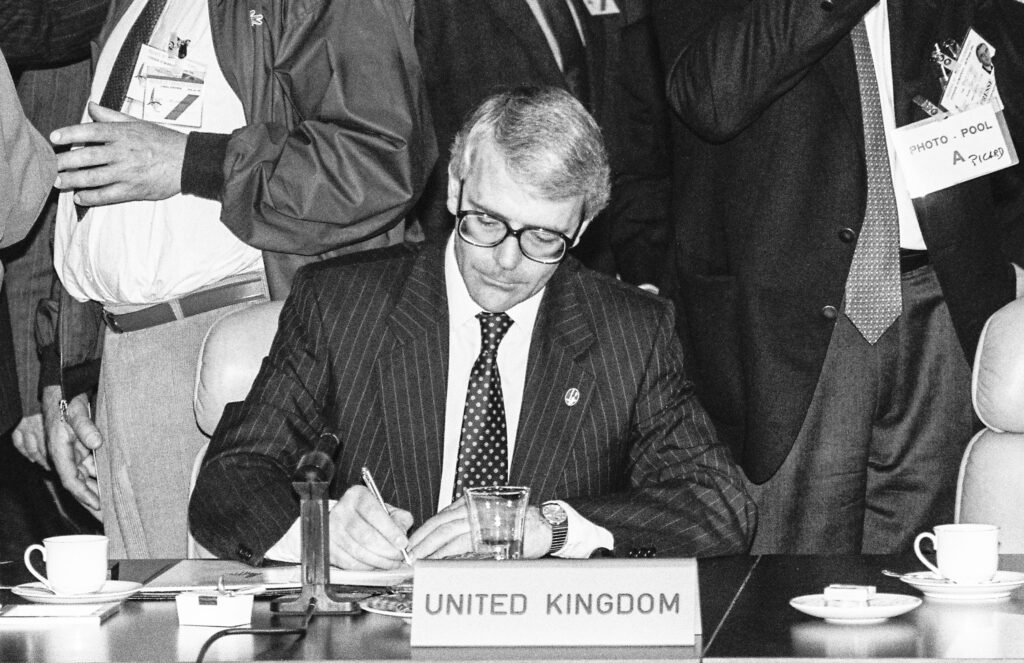
On 20 June 1990, the chancellor of the exchequer, John Major, formally proposed the creation of a new common European currency, the “hard ECU”, as a practical alternative to the vision of a single currency.
The proposal was launched as European leaders, spearheaded by the European commission president Jacques Delors, were pushing for a rapid move towards full economic and monetary union, complete with a single currency and central bank. This initiative was stridently opposed by the prime minister, Margaret Thatcher, and Conservative eurosceptics. Major’s plan was designed to offer a ‘gradualist’ alternative that maintained the pound, and therefore the principle of subsidiarity, while ensuring Britain continued to be engaged in the debate.
***
Under the British proposal, a hard ECU (European Currency Unit) would provide a common or dual currency, managed by a European Monetary Fund, that would circulate in parallel with existing national currencies like the pound, the franc, and the Deutschmark. It would be designed never to devalue against other member currencies, ensuring its value.
The idea was that citizens and businesses could choose to use it in their transactions, and its success or failure would be determined by the market, rather than political mandates. If it proved popular, it could eventually evolve into a single currency.
In a speech to the German Industry Forum, Major said: “What we’re seeking to do is to provide a currency that those who wish to use it could use, either for business transactions or personal transactions, without going down the route of a single currency across the whole of Europe, which we think has enormous difficulties and enormous dangers too.”
He added: “[These proposals] are practical, they are progressive, they offer choice, not prescription. They evolve naturally from stage I and have the potential to evolve further. In time the ECU would be more widely used. It would become a common currency for Europe.
“In the very long term, if peoples and governments so choose it could develop into a single currency, but that is a decision we should not take now for we cannot yet foresee what the size and circumstances of the new Europe would be.”
The plan was an attempt to forge a compromise in the increasingly contentious debate over European monetary union. It had obvious political benefits, in that it appeared to appease different elements of the Conservative Party – allowing distinct tendencies to identify with the plan’s simultaneous embrace of and resistance to monetary integration.
Thatcher, for instance, was of the position that the proposals could not “develop into a single currency without altering” without further alterations.
***
However, the plan failed to attract universal support either domestically or among Britain’s European partners. Indeed, the crucial downside of the plan, politically, was that neither europhile nor eurosceptic could enthusiastically embrace its inherent compromises.
Edward Heath, the europhile former prime minister, argued that “the cumbersome process of having a common currency alongside the national currency” was “neither necessary or desirable”.
In a commons statement on 30 October 1990, better known for Thatcher’s “No, no, no” retort to European federalism, the prime minister said that the “hard ECU would be a parallel currency, not a single currency… a single currency is not the policy of this government.”
Questioned further on the proposal, Thatcher insisted that the hard ECU currency would not “become widely used throughout the community”.
She added: “It would possibly most widely [be] used for commercial transactions. Many people would continue to prefer their own currency.”
Major was privately outraged.
In his memoirs, the chancellor noted: “With this single sentence she wrecked months of work and preparation. Europe had been suspicious that the hard ECU was simply a tactic to head off a single currency, and now the prime minister, in a matter of a few words, convinced them it was.”
For Geoffrey Howe, the last remaining member of Thatcher’s original 1979 cabinet, this proved to be the last straw.
The former chancellor referenced Thatcher’s remarks in his famous resignation speech. “After the comments of… the prime minister two weeks ago”, Howe said, “there is grave danger that the hard ECU proposal is becoming untenable.”
Thatcher’s apparently dismissive approach to the hard ECU plan also informed the speech’s most famous passage.
Howe declared: “How on earth are the chancellor [Major] and the governor of the Bank of England, commending the hard ECU as they strive to, to be taken as serious participants in the debate against that kind of background noise?
“I believe that both the chancellor and the governor are cricketing enthusiasts, so I hope that there is no monopoly of cricketing metaphors. It is rather like sending your opening batsmen to the crease only for them to find, the moment the first balls are bowled, that their bats have been broken before the game by the team captain.”
Major succeeded Thatcher as prime minister in November 1990 after a short leadership contest.
***
In January 1991, Major maintained that the plan was “attracting more support”. But later that year, the prime minister was forced to “rebut” reports that the proposals were being reviewed by the government.
Major stated: “I am happy to rebut suggestions that we are abandoning the hard ECU. On the contrary, the ideas which led us to put forward our proposals are making some headway with our partners…
“We are often condemned for maintaining our position in the face of widespread disagreement, but we are certainly not so perverse as to throw away a good idea just because our partners agree with us!”
In November 1991, during an early debate on the Maastricht process, Labour’s John Smith felt compelled to ask: “Did [the hard ECU plan] die? When did it die? Who killed it? Where is it buried?
“I hope that the chancellor can give us a full report on the sad demise of the hard ECU.”
He added: “The ineluctable conclusion to which one is driven is that the hard ECU was never more than a device to paper over the cracks in the Conservative Party.”
***
The hard ECU plan was met with scepticism and, ultimately, rejection from Britain’s European partners. Having emerged from a government in Thatcher’s that resisted any moves towards monetary union, it was viewed with instinctive suspicion. Spain was the only country reported to have shown the proposal any sympathy; others saw the plan as a diversionary tactic.
Britain’s European partners proceeded with the path that led to the Maastricht Treaty and the creation of the euro.
As Major’s tenure as prime minister progressed, his battle to control the eurosceptic forces in the Conservative Party only became more acrimonious.

Politics.co.uk Newsletters
DAILY
Politics@Lunch
WEEKLY
Week in Review
