Margaret Thatcher announces resignation as prime minister
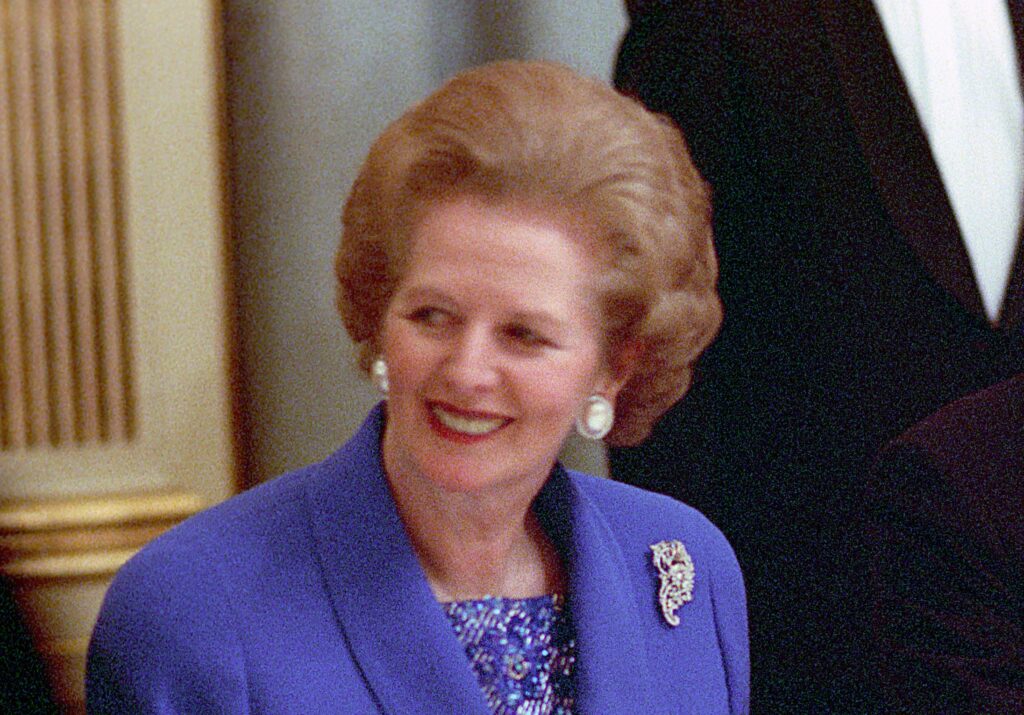
On 22 November 1990, Margaret Thatcher announced her intention to resign as prime minister and leader of the Conservative Party, bringing to an end her 11 years in Downing Street. The decision came during the 1990 Conservative leadership contest, in which Thatcher failed to secure the overwhelming support of Tory MPs.
Conservative discontent with Thatcher’s leadership had been simmering since at least the 1986 Westland affair, which saw the resignation of Michael Heseltine as defence secretary. By 1990, the government was suffering from the intense unpopularity of the Community Charge, known universally as the “poll tax”, and internal spits over its policy on European integration.
Thatcher’s resistance to the European Exchange Rate Mechanism (ERM) as well as monetary and political union alienated senior colleagues. Nigel Lawson resigned as chancellor on 26 October 1989, citing the influence of Alan Walters, Thatcher’s personal economic adviser. Walters opposed Britain’s entry into the ERM.
In December 1989, Thatcher survived a leadership challenge forced by ‘stalking horse’ candidate Anthony Meyer. The prime minister won decisively, but 60 MPs did not vote for her.
***
On 1 November 1990, Geoffrey Howe – the last remaining member of Thatcher’s 1979 cabinet – stood down as deputy prime minister. He cited fundamental disagreements with Thatcher’s stance on European integration.
It came after Thatcher issued her most strident denunciation of European integration to date with her famous “No. No. No.” declaration on 30 October 1990.
At the time of Howe’s resignation, the Conservatives were as much as 16 points behind Labour in the opinion polls. The party had only recently lost the Eastbourne by-election to the Liberal Democrats; at the 1987 election, the Tories had won the seat with a majority of 16,923.
On 12 November, Thatcher delivered the traditional foreign policy speech at the Lord Mayor’s Banquet. She opened with a reference to Howe’s resignation, called attention to the precariousness of her position – and vowed to fight on as prime minister.
Thatcher began: “May I thank you also for your splendid speech and congratulate you on being elected lord mayor?
“Since I first went into bat eleven years ago, the score at your end has ticked over nicely, You are now the 663rd lord mayor.
“At the prime minister’s end, we are stuck on 49. I am still at the crease, though the bowling has been pretty hostile of late. And in case anyone doubted it, can I assure you there will be no ducking the bouncers, no stonewalling, no playing for time.
“The bowling’s going to get hit all round the ground. That is my style.”
On 13 November, Howe delivered a devastating resignation statement in the House of Commons.
Denis Healey, the former deputy Labour leader, had once compared being attacked by Howe to “being savaged by a dead sheep”. But for Thatcher, perched on the frontbench having finished prime minister’s questions, Howe’s statement was coruscatingly brutal.
In the speech’s most famous passage, he argued that Thatcher’s position on Europe was “rather like sending your opening batsmen to the crease only for them to find, the moment the first balls are bowled, that their bats have been broken before the game by the team captain.”
Howe’s speech spurred Heseltine to launch a formal leadership challenge the following day, 14 November.
The former defence secretary declared: “I have a better chance now than Mrs Thatcher of leading the Conservative Party into a fourth electoral victory and avoiding the ultimate calamity of a Labour government.”
***
The first ballot of Conservative MPs took place on 20 November. Thatcher, who was attending a summit in Paris, secured 204 votes (54.8%) to Heseltine’s 152 (40.9%). There were 16 abstentions.
Under the complex rules of the Conservative Party, established in 1975, a candidate required a majority of 15% of the total electorate to win outright. Thatcher’s majority was 52 votes; she needed 56.
The prime minister had fallen short by just four votes.
Immediately following the result, Thatcher appeared in front of reporters outside the British Embassy in Paris.
She said: “I am actually very pleased that I got more than half the Parliamentary party, but disappointed that it is not quite enough to win on the first ballot.”
Thatcher vowed to “fight on” and “fight to win”.
Heseltine responded: “I’m overwhelmed with gratitude to my parliamentary colleagues who in such large measure have given me their support. The results that we have are within one or two of the firm pledges that we had received by this morning. I will therefore allow my name to go forward.”
Cecil Parkinson, a Thatcher loyalist, said that the result was “as bad as it could be for the party as a whole and gives our opponents another wonderful week of watching us divide ourselves.”
Upon her return to London, Thatcher’s rigid stance shifted. On 21 November, she held a series of one-on-one meetings with her cabinet ministers. Many pledged their personal loyalty. But the majority warned her that she would lose a second ballot against Heseltine and that her continued candidacy could fracture the party. Confronted with the loss of cabinet support, she decided to withdraw to allow other candidates to enter the race and thwart Heseltine.
At 9:30 am on 22 November, Thatcher informed the cabinet of her decision.
A statement issued from 10 Downing Street read: “The prime minister, the right honourable Margaret Thatcher FRS MP has informed Elizabeth II… that she does not intend to contest the second ballot of the election for leadership of the Conservative Party and intends to resign as prime minister as soon as a new leader of the Conservative Party has been elected. The prime minister will seek an Audience of Elizabeth II later this morning to convey her decision formally.”
A personal statement attributed to Thatcher added: “Having consulted widely among colleagues, I have concluded that the unity of the party and the prospects of victory in a general election would be better served if I stood down to enable cabinet colleagues to enter the ballot for the leadership. I should like to thank all those in cabinet and outside who have given me such dedicated support.”
Conservative Party chairman Kenneth Baker responded: “Once again Margaret Thatcher has put her country’s and party’s interests before personal considerations.”
Lord Callaghan, Thatcher’s predecessor as prime minister, said: “Those who live by the sword shall perish by the sword”.
Neil Kinnock, the leader of the Labour Party, said Thatcher’s conduct in resigning “showed that she amounts to more than those who have turned on her in recent days.”
Liberal Democrat leader Paddy Ashdown told MPs: “We believe that she made the right decision and made it with great dignity.”
John Major, the chancellor of the exchequer, and Douglas Hurd, the home secretary, announced their candidacies for the Tory leadership mere hours after Thatcher’s announcement.
In a joint statement, they said: “We have decided to let both our names go forward in friendly contest so that our party colleagues who take the decision can choose which of us is better placed to unite the party.”
***
Later that afternoon, the House of Commons debated a motion of no confidence tabled by the Labour Party.
Thatcher, in the course of defending her record, famously joked that she would “consider the proposal” of becoming the governor of a European central bank.
“I am enjoying this”, she declared, to cheers from the treacherous benches behind her.
Labour’s no-confidence motion was rejected by 367 votes to 247.
In the second Conservative leadership ballot held on 27 November, Major secured 185 votes. Heseltine won 131, while Hurd was supported by 56 Conservative colleagues.
Major was two votes short of the required majority and his rivals conceded.
Margaret Thatcher formally tendered her resignation to Queen Elizabeth II on 28 November 1990.
In her final remarks outside Downing Street, a visibly emotional Thatcher said: “We’re leaving Downing Street for the last time after eleven-and-a-half wonderful years, and we’re very happy that we leave the United Kingdom in a very, very much better state than when we came here eleven -and-a-half years ago.
“It’s been a tremendous privilege to serve this country as prime minister – wonderfully happy years – and I’m immensely grateful to the staff who supported me so well, and may I also say a word of thanks to all the people who sent so many letters, still arriving, and for all the flowers.
“Now it’s time for a new chapter to open and I wish John Major all the luck in the world. He’ll be splendidly served and he has the makings of a great prime minister, which I’m sure he’ll be in very short time.
“Thank you very much. Goodbye.”
Politics.co.uk Newsletters
DAILY
Politics@Lunch
WEEKLY
Week in Review