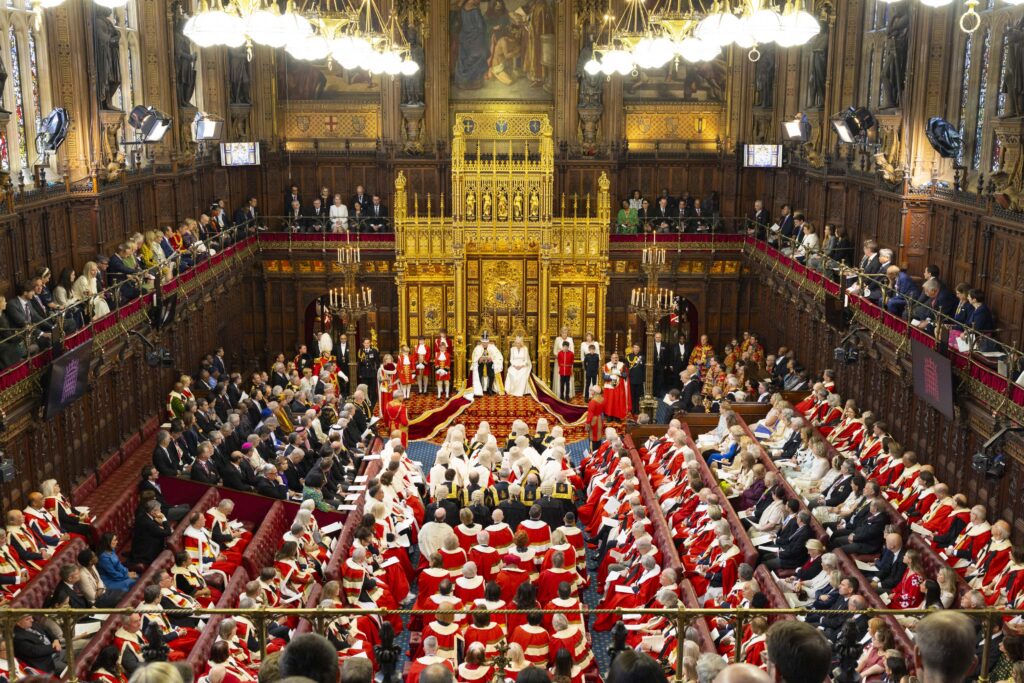
The state opening of parliament marks the formal start of the parliamentary year.
It is the grand ceremonial event that brings together the three parts of parliament: the monarch, the House of Lords and the House of Commons.
The ceremony is the occasion for the speech from the throne (king’s speech/queen’s speech), which announces the government’s legislative agenda for the new parliamentary session.
The state opening that took place on 17 July 2024 following the 2024 general election marked the first state opening under the new Labour government.
The most recent state opening of parliament took place on 13 May 2026.
What is the king’s speech?
The king’s speech is a speech delivered by the monarch from the throne in the chamber of the House of Lords. It outlines the government’s proposed policies and the specific bills it plans to introduce to parliament during the new session.
The speech is written entirely by the government, not by the monarch. The king delivers the speech in a neutral and formal tone, as he is constitutionally obliged to read the text prepared for him by his ministers. It is a statement of the government’s agenda, not the monarch’s personal views.
After the ceremony, both the House of Commons and the House of Lords begin a multi-day debate on the content of the king’s speech. At the end of this debate, the commons holds a vote on a message, crafted by the government, responding to the speech – confirming that it is willing to implement its policy agenda.
The motion reads: “We, Your Majesty’s most dutiful and loyal subjects, the Commons of the United Kingdom of Great Britain and Northern Ireland, in Parliament assembled, beg leave to offer our humble thanks to Your Majesty for the Gracious Speech which Your Majesty has addressed to both Houses of Parliament.”
A successful vote on a response to the king’s speech is taken to mean the government has the confidence of the House.
The state opening ceremony: step-by-step
The state opening is rich with historical ceremony and tradition.
- The monarch travels from Buckingham Palace to the Palace of Westminster, entering through the Sovereign’s Entrance under the Victoria Tower.
- Once the monarch is seated on the throne in the House of Lords, the senior official known as ‘Black Rod’ is sent to summon the House of Commons. As they approach, the door is ceremonially slammed in their face.
- Black Rod then strikes the door three times with their staff of office (the Black Rod).
- The door is opened, and Black Rod enters the commons chamber and requests the members’ attendance in the House of Lords to hear the speech from the throne.
- The speaker of the House of Commons then leads the MPs in a procession from their chamber to the House of Lords. By tradition, the prime minister and the leader of the opposition walk side-by-side.
- The MPs gather at the bar of the House of Lords, at the opposite end of the chamber from the throne. The monarch then delivers the speech.
- The “debate on the address” then begins in the House of Commons. This debate is held on a motion thanking the monarch for their address to parliament. The motion is moved and seconded by a government backbencher. The two backbenchers are selected by the government and usually comprise one long-serving Member and one relative newcomer.
- During the debate on the address, there is the opportunity for MPs to amend and reject the motion, signalling their disagreement with the government’s programme.
State opening of parliament: key traditions
Many of the ceremony’s quirks are symbolic, representing key moments in the history of the relationship between the crown and parliament.
Ceremonial search of parliament
A ceremonial search of the Palace of Westminster’s cellars is carried out by the Yeomen of the Guard, the royal bodyguards, ahead of the state opening of parliament. This commemorates the Guy Fawkes Gunpowder Plot of 1605.
The “hostage” MP
Before the monarch leaves Buckingham Palace, the vice-chamberlain of the household (a government whip) is ceremonially taken to the palace and held “hostage” until the monarch’s safe return.
This tradition dates from a time of conflict between parliament and the crown and acts as a symbolic guarantee of the sovereign’s safety.
Slamming the door
Black rod having the door of the commons slammed in their face symbolises the independence of the House of Commons and its right to debate and conduct its business without interference from the monarch’s representative.
This tradition is said to commemorate the last time the monarch entered the chamber of the House of Commons – when, on 4 January 1642, King Charles I entered with an armed guard to arrest five of his leading parliamentary critics.
The Outlawries Bill
At the beginning of the new session of parliament, before MPs consider the motion responding to the speech from the throne, the House of Commons formally gives a first reading to a token bill. This practice takes only a few seconds.
The Outlawries Bill has never been printed. But it demonstrates the House’s right to discuss matters of its own choosing before it considers the monarch’s message. The practice is said to date as far back as 1558.
When does the state opening of parliament take place?
The word “parliament” can be used to refer to the time between two general elections. The current parliament is the 59th parliament of the United Kingdom, which first met in July 2024 following the general election.
A parliament is sub-divided into several year-long “sessions”, which begin with the state opening of parliament, and end with parliament’s prorogation.
Prorogation brings all parliamentary business to an end. Legislation is not carried over unless specific provision is made.
A parliament – the period between one general election and the next – is typically composed of four or five sessions, so a state opening usually occurs annually. A state opening is also always held to begin the new parliament immediately after a general election has taken place.
The Gunpowder Plot (1605)
The Gunpowder Plot of 1605 was an attempted regicide masterminded by a group of English Catholics who sought to assassinate the Protestant King James I and destroy the entire English establishment by blowing up the Houses of Parliament. The plot was scheduled for Tuesday 5 November 1605, the date of the state opening of parliament.
The conspiracy, led by Robert Catesby, formed in an atmosphere of hostility and resentment among Catholics following the accession of James I in 1603. The conspirators conceived a radical, multi-stage plan. They planned to detonate explosives in the cellars beneath the House of Lords when the king, his heir, peers and MPs would all be assembled for the state opening.
Among the conspirators was Guy Fawkes – a soldier who had served 10 years fighting for the Spanish in the Netherlands and was entrusted with the execution of the explosion.
The plot was discovered just hours before it was due to be executed. On 26 October 1605, an anonymous letter was sent to William Parker, 4th Baron Monteagle, a Catholic peer, warning him not to attend parliament on the elected day. Monteagle immediately took the letter to the authorities.
The letter warned that “they shall receive a terrible blow this Parliament; and yet they shall not see who hurts them”.
Francis Tresham, the suspected author of the letter, was Monteagle’s brother-in-law.
On the evening of 4 November, a search of the cellars beneath the House of Lords was undertaken by officials. The searchers, led by Sir Thomas Knyvett, discovered the hidden barrels of gunpowder and their guard, Guy Fawkes.
Fawkes, who gave his name as John Johnson, was arrested and taken to the Tower of London.
King James I recounted the plot in his speech at the state opening of parliament on 9 November, delivered four days later than previously planned.
The sovereign spoke of “a far greater Thanksgiving… which is to GOD, for the great and miraculous Delivery he hath at this time granted to me, and to you all, and consequently to the whole Body of this Estate”.
He referred to the “cruelty of the Plot it self, wherein cannot be enough admired the horrible and fearful cruelty of their Device, which was not only for the destruction of my Person, nor of my Wife and Posterity only, but of the whole Body of the State in general”.
The Earl of Rosebery’s king’s speech debacle (1894)
In his first speech in office as prime minister, the Earl of Rosebery summarily announced that home rule for Ireland would be delayed until England, the “predominant member of the partnership of the three kingdoms”, could be convinced of its merits.
Rosebery’s comments were delivered in response to criticism of his first queen’s speech as prime minister from the leading Conservative/Unionist, the Marquess of Salisbury.
The remarks sparked fury among Gladstonian Liberals and the Irish nationalist bloc. Both groups were committed to Irish home rule. Rosebery’s predecessor as prime minister, William Ewart Gladstone, had tried on two occasions to legislate for Irish home rule (a devolved Irish parliament).
Rosebery’s statement was seen to represent a shift in position. Gladstone’s approach required simple majorities in the ‘imperial parliament’, which included Irish MPs and peers. Rosebery, rather, referred to the consent of England as the dominant component of the union state. Moreover, under Gladstone, the Liberal Party had adopted the position that the ‘Irish question’ needed to be settled before any separate reforms could be achieved. Rosebery now planned to push ahead in lieu of home rule.
Rosebery, a Liberal prime minister, himself seemed to be taken aback by the significance of his “considerable admission”.
He told peers: “I did not mean to dilate so much on the question of home rule. The noble Marquess has, at any rate, the satisfaction of eliciting that declaration.”
Addressing the commons the following day, on 13 March 1894, the leading Irish nationalist John Redmond expressed “dissatisfaction, the distrust, and… alarm” at Rosebery’s “ambiguous and halting phrases”. He furiously repudiated the “predominant partnership” doctrine as “preposterous”, “insulting”, “extraordinary” and “humiliating”. An effective English veto, he remarked, “changes the whole aspect of the home rule question”.
John Morley, the chief secretary for Ireland and committed home ruler, argued Rosebery’s remarks were not tantamount to a new constitutional doctrine, but a recognition of the practical reality that “it could be of no avail to submit home rule bill after home rule bill to the House of Lords… until we had made further progress in the conversion of the minds of the people” of England.
Then, on 13 March 1894, Liberal MP Henry Labouchère moved an amendment calling for an end to the “Lords’ veto”. He urged the government to appoint 500 new peers to overcome the upper chamber’s hostile majority – and “cook them in their own juice.”
The queen’s speech contained no measures to take on the Lords. In his address, Labouchère said he “was sick of seeing popular measures destroyed in the House of Lords – sick of pouring good radical liquor into a Tory vat.” He rejected the House of Lords as composed of “hereditary Peers, Bishops”, “brewers”, “bankers”, “rich nonentities” and “failures from the House of Commons.”
Speaking for the government, Harcourt opposed the amendment, mocking its “impracticable” method. Referring to Labouchère’s proposal to pack the Lords with Liberal supporters, he asked: “I suppose my honourable friend has his list ready?”
Labouchère responded: “I have a list of stalwarts, who will sacrifice themselves for a short time, in order to destroy themselves as peers and their brother peers.”
Labouchère’s amendment ultimately passed by 147 votes to 145.
Arthur Balfour, the Conservative leader in the commons, responded that the vote marked “the first time… in the memory of most of us that an amendment to the address has been carried in the face of a government which is supposed to have a majority in the House, and I think we ought to have, before the evening closes, and even before the debate is continued, some declaration from the government.”
Balfour asked for some clarification. Would the government reverse the amendment, he asked, “or resign?”. He did not receive an immediate response; the debate continued for some time with further amendments considered.
Joseph Chamberlain, a leading Conservative/Unionist, forced the government’s hand by moving a motion to adjourn; he pointed to the time, past midnight, and regretted that the House was considering further amendments without an understanding of whether the government would proceed. “It is perfectly clear that some step must be taken… in order to extricate the government from the position in which they are placed”, he told MPs.
Harcourt acquiesced. He returned to the commons chamber the next day to deliver a statement disowning the queen’s speech as amended. The government, he said, “cannot present to the Sovereign… a document of which they are not prepared to accept the entire and immediate responsibility.”
“The course which we intend to pursue is this”, Harcourt said, “when the address in its present form is put from the chair we shall vote against that address. It will then be possible for the government to move a new address to the crown.”
Balfour responded by ridiculing the government’s “prophetic obscurity” on its actual policy for the Lords. Labouchère described the treatment of his amendment as a “sham”.
The debacle presaged the collapse of Rosebery’s unsuccessful administration one year later.
Attlee’s succession of king’s speeches (1947/48)
Labour prime minister Clement Attlee’s strategy to nationalise the British steel industry was anchored by a series of king’s speeches between 1947 and 1948.
During Attlee’s first term as prime minister, Labour divisions and political anxieties over steel nationalisation led to a delay in enacting the manifesto commitment. This delay meant the measure – demanded by Labour’s Bevanite elements – risked running afoul of the effective veto peers held over legislation in the final two years of a parliament under the Parliament Act 1911.
The Parliament Act 1911 stated that, to override the Lords veto, a bill needed to be passed by MPs in three “successive sessions” over a period of not less than two years. Ministers expected that the Conservative majority in the upper chamber would use their two-year suspensory veto to block the nationalisation of steel until after the general election due in 1950.
To circumvent this, the government introduced the Parliament Bill (later the Parliament Act 1949) to reduce the Lords’ delaying power from two years to one. This allowed steel nationalisation to be introduced into the 1948-1949 parliamentary session.
The proposal to amend the Parliament Act was first included in the October 1947 king’s speech. As expected, it was defeated in the House of Lords. And so, in September 1948, a short parliamentary session began – solely organised to satisfy the Parliament Act 1911’s “three successive sessions” rule.
In the round, the Attlee government planned to use the Parliament Act 1911 to pass a new Parliament Bill. This new legislation, further reducing the power of the Lords, would then be used to pass steel nationalisation.
The historically succinct speech from the throne in September 1948 said MPs had been summoned “in order that you may give further consideration to the bill to amend the Parliament Act 1911.”
It added: “It is not proposed to bring any other business before you in the present session.”
Responding to this king’s speech, the former Labour MP Alfred Edwards expressed his understanding that the whole of parliament had been “dragged here to listen to a 74-word speech” because “the minister of health [Nye Bevan] threatened to resign his position unless the government agreed to nationalise the steel industry.”
Following the short September session, the October 1948 King’s Speech – the second speech from the throne in as many months – contained the much-expected measure on the nationalisation of the steel industry. The speech from the throne also implored parliamentarians to “consider further the bill to amend the Parliament Act 1911 on which during the last two sessions your Houses have disagreed.”
A third passage through the House of Commons would fulfil the terms of the 1911 act. On 31 October 1949, the commons considered the Parliament Bill at second reading for the third time in two years. It ultimately secured its third reading on 14 November 1949, passing by 340 votes to 187.
Under significant political pressure, however, the Attlee government ultimately agreed to delay steel nationalisation until after the general election.
Other notable state openings: from Peel to Starmer
Robert Peel defeats Melbourne
On 30 August 1841, Robert Peel, leader of the Conservative Party, was appointed prime minister, forming his second ministry. This followed the resignation of the Whig government led by Lord Melbourne, which had been decisively defeated in the recent general election.
But Peel’s succession marked a constitutional milestone. His return to power began on 4 June 1841, when his motion of no confidence in the Melbourne ministry passed by a single vote (312 to 311). Melbourne’s government had already decided to call an election, however, which followed in June and July.
The election resulted in a majority of over 70 for the Conservatives.
For the first time in British electoral history, the majority of the governing party (the Whigs) had been converted into a majority for the opposition party (Peel’s Conservatives).
The new parliament assembled on 19 August 1841. Melbourne, as was convention at the time, remained in office. (The prime minister was selected by the sovereign, not dictated by the whims of the electorate.) But the government was again defeated on a “no-confidence” amendment to the queen’s speech, tabled by Conservative MP James Stuart-Wortley.
Peel was subsequently invited to return to office as prime minister.
Ramsay MacDonald defeats Baldwin
On 22 January 1924, James Ramsay MacDonald was appointed prime minister by King George V, becoming the first Labour politician to lead His Majesty’s government.
The appointment came after the Liberal Party, led by former prime minister H. H. Asquith, supported a Labour amendment to the first king’s speech of the new parliament (elected in December 1923). The election resulted in a hung parliament and the Conservative government led by Stanley Baldwin initially remained in office.
Baldwin’s defeat on the king’s speech precipitated his resignation and MacDonald’s appointment as prime minister.
Churchill’s ‘locust years’ speech
On 12 November 1936, Winston Churchill delivered a famous indictment of the government’s indecision and failure to rearm in the face of Nazi Germany’s mobilisation. At this stage in his career – the height of his “wilderness years” as a backbencher – Churchill had primarily devoted himself to warning of the threat posed by Germany.
Speaking during the debate on the address in the House of Commons, Churchill condemned the Conservative-led National Government for its “complacency” over national defence. Churchill referred to the period since 1932 and 1933 as “the years which the locust hath eaten” – quoting a previous speech by Thomas Inskip, the minister for coordination of defence.
Churchill proposed to develop Inskip’s Biblical allusion and “see which are these ‘years which the locust hath eaten’, even if we do not pry too closely in search of the locusts who have eaten these precious years.”
He chronicled Hitler’s rise to power, Germany’s rearmament – a development he insisted was “general public knowledge in this country” – and warned that Britain could not afford further delay.
The DUP back May
Following the 2017 general election, which saw the ruling Conservative Party lose its commons majority, prime minister Theresa May entered negotiations with the Democratic Unionist Party (DUP) to secure the survival of her minority government.
The 2017 election left the Conservatives with 317 seats (down 13), eight short of a majority. Labour had increased its parliamentary representation to 262 (up 30).
On 21 June 2017, DUP MPs supported May’s first queen’s speech since the election. This result suggested May enjoyed the confidence of the House of Commons.
Then, on 26 June, a formal “confidence and supply” agreement was signed in Downing Street by the Conservative chief whip, Gavin Williamson, and the DUP’s chief whip, Sir Jeffrey Donaldson, in the presence of the two party leaders, Theresa May and Arlene Foster.
Under the terms of the deal, the DUP agreed to support the government when it came to all future queen’s speech debates. The party also committed to supporting May on all motions of confidence and on all supply bills, including the budget and other financial legislation.
Labour rebellions
In November 2023, 56 Labour MPs voted in favour of a Scottish National Party (SNP) amendment to the king’s speech in the House of Commons calling for an “immediate ceasefire” in Gaza – defying the instruction set out by the party’s frontbench. Labour had tabled its own motion, making a more moderate appeal for a “humanitarian pause” in the conflict and ordered its representatives to support that stance.
On 23 July 2024, seven Labour MPs had the whip withdrawn after voting for an SNP amendment to the king’s speech, the first delivered under a Labour government in 15 years, calling on the new Labour government to scrap the two-child benefit cap. Those suspended were Zarah Sultana, Imran Hussain, John McDonnell, Apsana Begum, Richard Burgon, Ian Byrne and Rebecca Long-Bailey.
In February 2025, the whip was restored to four of those suspended MPs – Hussein, as well as Burgon, Byrne and Long-Bailey. However, Begum, Sultana and McDonnell remained as independent MPs because they had continued to be critical of the government, reports and briefings indicated.
In September 2025, the whip was restored to Begum and McDonnell.
Additional resources
- House of Commons Library – Debate on the Address: movers and seconders since 1900: https://commonslibrary.parliament.uk/research-briefings/sn04064/