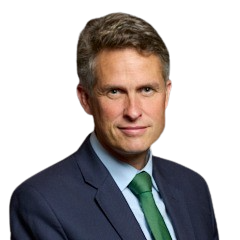
Sir Gavin Williamson is the Conservative MP for Stone, Great Wyrley and Penkridge, having first been elected to parliament at the 2010 general election for the predecessor constituency of South Staffordshire.
A senior MP, Williamson has served in several cabinet posts, including as secretary of state for education (2019-2021) and secretary of state for defence (2017-2019).
In the 2024 general election for the new Stone, Great Wyrley and Penkridge constituency, Williamson received 19,880 votes, representing 46.5% of the vote share. The Labour candidate, Jacqueline Brown, came second with 14,414 votes (33.7%), while the Liberal Democrat candidate, Sam Harper-Wallis, secured 2,952 votes (6.9%). Williamson was duly elected with a majority of 5,466.
Williamson was knighted in March 2022 for political service.
Williamson: career since 2024 general election
Williamson is a member of the House of Commons procedure committee (since June 2025) – the committee responsible for considering the practice and procedure of the House in the conduct of its public business. It can make recommendations to the House about the operation of the House’s Standing Orders for public business.
In late 2024, during the committee stage of the House of Lords (Hereditary Peers) Bill, Williamson tabled an amendment that sought to abolish the lords spiritual and the right of religious representatives to assume an automatic place in the upper chamber. Speaking during the bill’s committee stage, Williamson characterised the presence of bishops in the upper chamber as “fundamentally unfair”. He argued that it was wrong that a “bloc of clerics… have a right and a say over our legislation – over the way that my constituents live.”
Williamson acknowledged the right of bishops to contribute to public debate, but he said this should occur “from the pulpit, not in parliament”
Cabinet Office minister Ellie Reeves spoke in opposition to Williamson’s amendment, arguing it would alter a “focused bill that delivers on a manifesto commitment to bring about immediate reform.” Williamson’s amendment was ultimately defeated by 378 votes to 41.
Williamson: career and controversies
Williamson has served in a series of high-profile ministerial and government roles during his political career.
Most recently, Williamson was briefly as minister without portfolio in the Cabinet Office from October to November 2022. His tenure under Rishi Sunak as prime minister lasted for mere weeks before he was forced to resign over the publication of WhatsApp messages sent to the former chief whip, Wendy Morton. Williamson had told Morton there was a “price for everything” after learning he was not invited to the state funeral of Queen Elizabeth II.
Williamson denied allegations relating to past bullying behaviour.
In his resignation letter, he wrote: “As you know, there is an ongoing complaints process concerning text messages I sent to a colleague. I am complying with this process and have apologised to the recipient for those messages.
“Since then, there have been other allegations made about my past conduct. I refute the characterisation of these claims, but I recognise these are becoming a distraction for the good work this government is doing for the British people.
“I have therefore decided to step back from government so that I can comply fully with the complaints process that is underway and clear my name of any wrongdoing.”
Williamson previously served in cabinet as secretary of state for education from July 2019 to September 2021 and secretary of state for defence from November 2017 to May 2019.
Williamson’s tenure as education secretary was dominated by the Covid-19 pandemic. In August He was at the centre of a damaging U-turn on the grading of A-level and GCSE results in England after the government was forced to announce that students would receive grades based on teacher assessments rather than marks generated by a controversial algorithm. The decision followed student protests over results that were perceived as unfair and discriminatory.
When A-level results were released on 13 August, nearly 36% of grades awarded by the algorithm were one grade lower than teachers’ predictions. 3% were down two grades. (In 2019, 79% of university entrants did not achieve their predicted grades). The downgrading disproportionately affected high-achieving students in schools with historically lower results. It sparked accusations that the algorithm entrenched educational inequality.
Facing widespread criticism, on 15 August, Williamson said that the grading system would remain in place, and there would be “no U-turn, no change”. The education secretary also criticised Scottish ministers for U-turning the week prior. He insisted that awarding unmoderated grades would be “unwise” and cause “rampant grade inflation”. But faced with mounting pressure and the release of GCSE results imminent, the government U-turned.
Williamson apologised for the “distress” caused but defended the initial aim of maintaining standards. Jonathan Slater, the most senior civil servant in the Department for Education (DfE), ultimately left his post over the debacle.
Williamson was ultimately dismissed as education secretary in the 2021 cabinet reshuffle and replaced by Nadhim Zahawi.
In October 2025, the UK Covid-19 Inquiry heard that the prime minister, Boris Johnson, considered sacking Williamson over the results fiasco. Giving evidence to the inquiry, Johnson acknowledged that the system had “failed” and the government had “got the wrong initial model”.
Asked whether he should have sacked Williamson, Johnson told the Covid Inquiry: “I think if I look back at my handling of my beloved colleagues over the three-and-a-bit years I was in government, I can think of all sorts of changes I might have made.
“But I don’t think there’s any point in speculating about it now, except I think that on the whole, given the difficulties that we faced, I think that the department under Gavin did a pretty heroic job in trying to cope with Covid, and that was my judgment.”
During his tenure as defence secretary, Williamson urged Russia to “go away” and “shut up”. The comments came after a speech announcing a £48 million investment in a new defence facility and followed the Salisbury poisoning – the failed assassination attempt to poison Sergei Skripal, a former Russian military officer and double agent.
In May 2019, Williamson was dismissed as defence secretary following an inquiry into a leak from the National Security Council regarding Huawei’s potential involvement in the UK’s 5G network. Williamson strenuously denied responsibility for the leak. Downing Street said the prime minister, Theresa May, had “lost confidence in [Williamson’s] ability to serve”.
In a letter confirming his dismissal, May wrote: “No other, credible version of events to explain this leak has been identified.”
Williamson responded: “I appreciate you offering me the option to resign, but to resign would have been to accept that I, my civil servants, my military advisers or my staff were responsible: this was not the case.”
Williamson: chief whip and rise to prominence
Williamson rose to prominence as a Conservative fixer and formidable party-manager under May and David Cameron. He served as parliamentary private secretary (PPS) to Cameron from 2013 to 2016. A PPS acts as an unpaid parliamentary assistant, providing a link between the senior frontbencher and backbench MPs. The role is widely regarded as the first step on the ministerial ladder. Williamson previously served as PPS to Patrick McLoughlin as transport secretary (2012-2013) and Hugo Swire as minister of state for Northern Ireland (2011-2012).
Following Cameron’s resignation in the wake of the 2016 Brexit referendum, Williamson managed Theresa May’s successful campaign in the subsequent Conservative leadership election. He was appointed as parliamentary secretary to the Treasury and chief whip under May, serving in this role from July 2016 to November 2017.
As government chief whip, Williamson was a key figure in the negotiations between the Conservative Party and the Democratic Unionist Party (DUP) that followed the 2017 general election. These talks led to a “confidence and supply agreement” between the parties. Williamson said the formal pact alongside the DUP’s chief whip, Sir Jeffrey Donaldson.
Williamson was an imposing figure as government chief whip. His deputy at the time, Anne Milton, later (November 2022) described her boss’ conduct as “threatening”.
In November 2022, the former deputy chief whip told Channel 4 News: “I do remember him asking me to give the MP in question the cheque, and he waved it under my nose and said, ‘make sure when you give him this cheque he knows that I now own him.’”
As a backbencher, Williamson sat on the House of Commons Northern Ireland affairs select committee from July 2010 to November 2011.
Williamson delivered his maiden speech on 8 June 2010.
In it, he said: “We will have a truly vibrant economy only when we recreate the Victorian spirit of ingenuity and inventiveness that made Britain such a vibrant country, as I am sure it will be again.”
He added: “I truly welcome the prime minister’s comments about the importance of manufacturing and I hope that the Treasury team listen well to his comments and do not spend all their time listening to bankers.
“They should also listen to manufacturers, because we often have a lot more common sense than bankers.”
Before entering parliament, Williamson was a Conservative councillor on North Yorkshire County Council from 2001 to 2005. He unsuccessfully contested the constituency of Blackpool North and Fleetwood at the 2005 general election.
Political Views
Leadership elections and loyalty
Tory leadership 2022 (I): Williamson supported Rishi Sunak’s candidacy in the Conservative Party’s July-September 2022 leadership election. The contest was triggered by the resignation of Boris Johnson, following the mass exodus of more than 60 frontbenchers.
Sunak, the former chancellor, warned against “comforting fairytales” regarding unfunded tax cuts. Although he won every round of the parliamentary ballots, securing 137 votes in the final stage, Sunak was defeated by Liz Truss in the membership vote, finishing with 60,399 votes (42.6%).
Tory leadership 2022 (II): Williamson again supported Sunak’s candidacy in the Conservative Party’s October 2022 leadership election. The contest was triggered by the resignation of Truss after just 45 days in office, following the financial and political tailspin triggered by her “mini-budget”.
Unlike the summer contest, this election featured an expedited process requiring each candidate to secure at least 100 nominations from MPs to proceed. Sunak, having emerged as the clear frontrunner, was declared leader of the Conservative Party unopposed on 24 October.
Tory leadership 2019: Williamson supported Boris Johnson for the party’s leadership in 2019. The election was triggered by the resignation of Theresa May following her inability to secure a Brexit deal acceptable to the Conservative Party.
Johnson, the former foreign secretary and mayor of London, campaigned on the central pledge to “deliver Brexit” by 31 October 2019, “deal or no deal”. He thereby positioned himself as the candidate best-placed to break the parliamentary deadlock. Johnson secured 114 votes in the first parliamentary ballot, and reached 160 votes in the final MP round. In the subsequent ballot of the party membership, Johnson won a decisive victory with 92,153 votes (66.4%).
Tory leadership 2016: Williamson supported Theresa May for the party’s leadership in July 2016. The contest was triggered by the resignation of David Cameron following the UK’s vote to leave the European Union.
May, the then-home secretary, secured a commanding lead in the parliamentary stages, receiving 165 votes in the first ballot and 199 in the second. Following the withdrawal of her final rival, Andrea Leadsom, on 11 July, May was declared leader unopposed and was appointed prime minister two days later.
Factional identity and party tradition
Mass deportation: In May 2025, Williamson signed an early day motion (EDM) concerning the mass deportation of illegal migrants. The motion, tabled by the independent MP Rupert Lowe, expressed “grave concern at the continued presence of over one million illegal migrants in the United Kingdom”.
The EDM urged the government to “implement a comprehensive national strategy to identify, detain, and deport all individuals found to be residing in the United Kingdom illegally, and to ensure that such policies are backed by the necessary legislative, diplomatic, logistical and financial resources to restore confidence in the rule of law and the security of our borders.”
Lucy Connolly EDM: In May 2025, Williamson joined a small, cross-party group of MPs in signing a parliamentary motion expressing concern over the imprisonment of Lucy Connolly, who was jailed for inciting racial hatred in a social media post following the knife attacks in Southport. Connolly posted online calling for “mass deportation now”, adding “set fire to all the… hotels [housing asylum seekers]… for all I care”.
The early day motion, tabled by Lowe, stated that Connolly was a young mother convicted of a non-violent offence during a period of “unprecedented overcrowding” in the prison system.
Williamson and Lowe appeared to have established something a rapport, having worked together across several campaigns.
On 30 June 2025, Lowe launched a new political organisation and pressure group named Restore Britain. The group’s advisory board included Williamson.
In a social media post on 31 July 2025, Lowe stated: “So pleased to have Gavin on the Restore Britain team — he has been enormously supportive of our efforts in Parliament, signing a number of motions on mass deportations, rape gangs, Lucy Connolly, and more.
“We are getting things done, not just moaning about it.”
On 13 February 2026, Lowe announced that Restore Britain would transition from a pressure group into a national political party.
Williamson subsequently suggested he would end his involvement with Restore Britain as a result of it becoming a political party.
Conservative Environment Network: Williamson is listed as a member of the Conservative Environment Network (CEN) parliamentary caucus. CEN is an independent forum for conservatives that supports conservation and decarbonisation. It calls for the environment to be given a higher profile at the heart of policy making, describing “biodiversity loss, climate change, and wasteful resource use are threats to our national security”, and promotes “market-based policies” to environmental challenges. Members of its parliamentary caucus, such as Williamson, are thought to generally align with the group’s “green” message and environmentalism.
Brexit and Europe
Brexit referendum: Williamson supported Remain in the 2016 Brexit referendum, and therefore disagreed with a majority of his constituents, 65.2% of whom voted to Leave.
Article 50: In February 2017, Williamson supported the European Union (Notification of Withdrawal) Bill. The legislation empowered the prime minister to notify the Council of the European Union of the UK’s intention to withdraw, formally triggering the process set out in Article 50 of the Treaty on European Union. MPs supported the bill by 498 votes to 114 at second reading.
Assisted dying
Williamson voted against the Terminally Ill Adults (End of Life) Bill, better known as the assisted dying bill, at both second reading (November 2024) and third reading (June 2025).
Social values and conscience issues
Abortion decriminalisation (2025): Williamson voted against a backbench amendment to the Crime and Policing Bill that sought to decriminalise abortion in England and Wales in June 2025. The amendment, which was passed by a majority of 242 votes, removed women from the threat of prosecution for ending a pregnancy at any stage. As an issue of conscience, MPs were allowed to vote according to their personal beliefs.
Same-sex marriage (2013): In February 2013, Williamson was one of the 139 Conservative MPs to vote against the Marriage (Same Sex Couples) Bill at its second reading. The landmark piece of legislation, which received its second reading by 400 votes to 175, legalised marriage for same-sex couples in England and Wales.
Foreign policy and security
Trident renewal (2016): Williamson voted in favour of a government motion calling for the renewal of the Trident nuclear deterrent system in July 2016. The motion, which was passed by 472 votes to 117, committed the UK to constructing a new fleet of submarines to carry the nation’s nuclear weapons.
Syria airstrikes (2015): Williamson voted in favour of a government motion to extend UK airstrikes against Isis from Iraq into Syria in December 2015. The motion, which was passed by 397 votes to 223 after a 10-hour debate in the House of Commons, authorised the RAF to conduct strikes against Isis targets in Syria.
Syria airstrikes (2013): Williamson voted in favour of the government’s motion on the principle of military intervention in Syria in August 2013. The government motion was defeated by 285 votes to 272, a move which effectively ruled out UK participation in any US-led military strikes.
Before Politics
Born in Scarborough, North Yorkshire, on 25 June 1976, Williamson attended Raincliffe School, a local comprehensive, and Scarborough Sixth Form College. He graduated from the University of Bradford with a degree in social sciences.
Williamson served as national chair of Conservative Students from 1997 to 1998.
Williamson subsequently pursued a career in manufacturing and business management. He was managing director of Aynsley China, a Staffordshire-based pottery firm, having previously worked at fireplace manufacturer Elgin & Hall. He later became managing director of an architectural design firm.
Personal Life
Williamson is married to Joanne Eland, a former primary school teacher. They married in 2001 and have two daughters.
Williamson holds Somaliland honorary citizenship and campaigns for the recognition of Somaliland.
In an article for Politics.co.uk, published in April 2025, Williamson argued that the “worldwide recognition of Somaliland cannot be ignored for even a second longer.”
He added: “Expansionist rhetoric and propaganda can only be combatted by recognising Somaliland – a stable, functional, and successful nation with a strong record of holding democratic elections.
“In stark contrast, Somalia is wracked with in-fighting and provides a haven for piracy with a president willing to use his own people as collateral in a never-ending campaign of self-promotion and regional dominance.”
Trivia
Williamson famously kept a tarantula in his commons desk. The tarantula, named Cronus, was seen as a symbol of the “dark arts” sometimes deployed by chief whips to keep their parties in line.
In May 2026, Williamson announced that Cronus had died.
In September 2021, Williamson faced criticism after he appeared to confuse England footballer Marcus Rashford with rugby player Maro Itoje in an interview discussing campaigning work.
Itoje responded: “Due to recent speculation I thought it was necessary to confirm that I am not Marcus Rashford … And whilst we are here my name is not Mario either!! Just a simple Maro Itoje will do … Much love, Marcu … I mean Maro Itoje.”

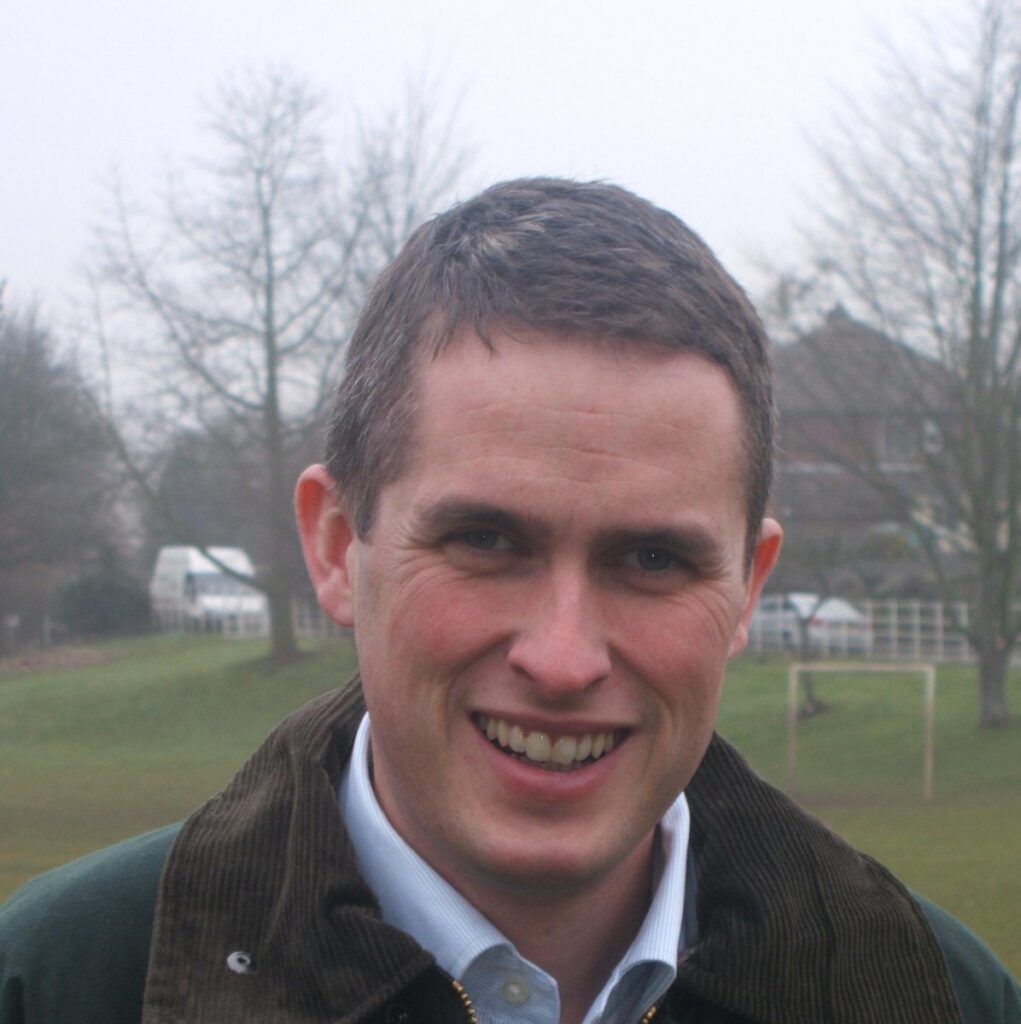
Gavin Williamson: ‘Appointing Mandelson was a grave error – Starmer must be held accountable’
12 September 2025