Robert Peel forms majority Conservative government after election win
On 30 August 1841, Robert Peel, leader of the Conservative Party, was appointed prime minister, forming his second ministry. This followed the resignation of the Whig government led by Lord Melbourne, which had been decisively defeated in the recent general election.
Peel’s succession marked a constitutional milestone. His return to power began on 4 June 1841, when his motion of no confidence in the Melbourne ministry passed by a single vote (312 to 311). Melbourne’s government had already decided to call an election, however, which followed in June and July.
The election resulted in a majority of over 70 for the Conservatives.
For the first time in British electoral history, the majority of the governing party (the Whigs) had been converted into a majority for the opposition party (Peel’s Conservatives). This pattern would not be repeated until after the second Reform Act of 1867.
***
The new parliament assembled on 19 August 1841.
Melbourne, as was convention at the time, remained in office; the prime minister was selected by the sovereign, not dictated by the whims of the electorate. But the government was again defeated on a “no-confidence” amendment to the queen’s speech, tabled by Conservative MP James Stuart-Wortley.
Stuart-Wortley insisted that the primary question of the debate was “whether her majesty’s present advisers were persons with whom the country would consent to intrust the government.”
Lord Bruce, seconding the amendment, said that “a thrill of astonishment and dismay passed through the nation when they found, that notwithstanding the position in which ministers found themselves, the stream of dignities and emoluments continued welling forth, and flowed as copiously, if not more profusely, than at any preceding period.”
The Conservative MP said ministers “had braved the indignation not only of two Houses… but of the nation at large”.
Peel, in his contribution, said the electorate had “vindicated” the position previously adopted by the commons: that the government should resign.
In the end, Melbourne had no choice but to tender his resignation to an exasperated Queen Victoria.
Victoria was known to have a personally difficult relationship with Peel, stemming, in significant part, from the 1839 Bedchamber crisis – when the queen resisted the Tory leader’s request for her to replace some of her Whig-aligned entourage. This disagreement meant Peel was not appointed prime minister of a minority government – despite Melbourne declaring his intention to resign.
Victoria described Peel as “such a cold odd man”.
The young sovereign’s relationship with Melbourne, meanwhile, was exceptionally warm. Victoria even regarded Melbourne as a mentor, and financially supported the Whig’s 1841 re-election effort.
But in order to ensure competent government, Victoria was now obliged to send for Peel – ushering in a majority Tory government for the first time since the 1832 Great Reform Act.
Peel’s assumption of power on 30 August, therefore, was the first time in British history that a prime minister had been installed primarily by a general election victory against a serving government, rather than by monarchical discretion.
The Conservative victory effectively limited Victoria’s foremost prerogative power. There could be no room for personal preference on this occasion.
John Wilson Croker, a former MP and statesman, wrote in a letter to Peel: “It’s the first time that I remember in our history that the people have chosen the first minister for the sovereign. Mr Pitt’s case in ’84 is the nearest analogy; but then the people only confirmed the Sovereign’s choice; here every Conservative candidate professed himself in plain words to be Sir Robert Peel’s man, and on that ground was elected.”
The last government to be brought into existence by the independent initiative of the Crown, it has been said, was the Earl of Aberdeen’s Peelite-Liberal coalition in 1852. But royal patronage ultimately failed to sustain it.
***
Peel’s second ministry included several figures who had either served as prime ministers or would one day serve as prime minister, including Peel, the Duke of Wellington, the Earl of Ripon, Lord Stanley, Aberdeen, and William Gladstone.
Moreover, the ministry went on to become one of the great reforming governments of the nineteenth century, notably reintroducing the income tax in 1842.
Peel told the House on 11 March 1842: “I propose, for a time at least, (and I never had occasion to make a proposition with a more thorough conviction of its being one which the public interest of the country required) – I propose, that for a time to be limited, the income of this country should be called on to contribute a certain sum for the purpose of remedying this mighty and growing evil [a structural budget deficit].”
The Mines Act of 1842 banned the employment of women and children underground; the Factory Act 1844, meanwhile, limited working hours for children and women in factories.
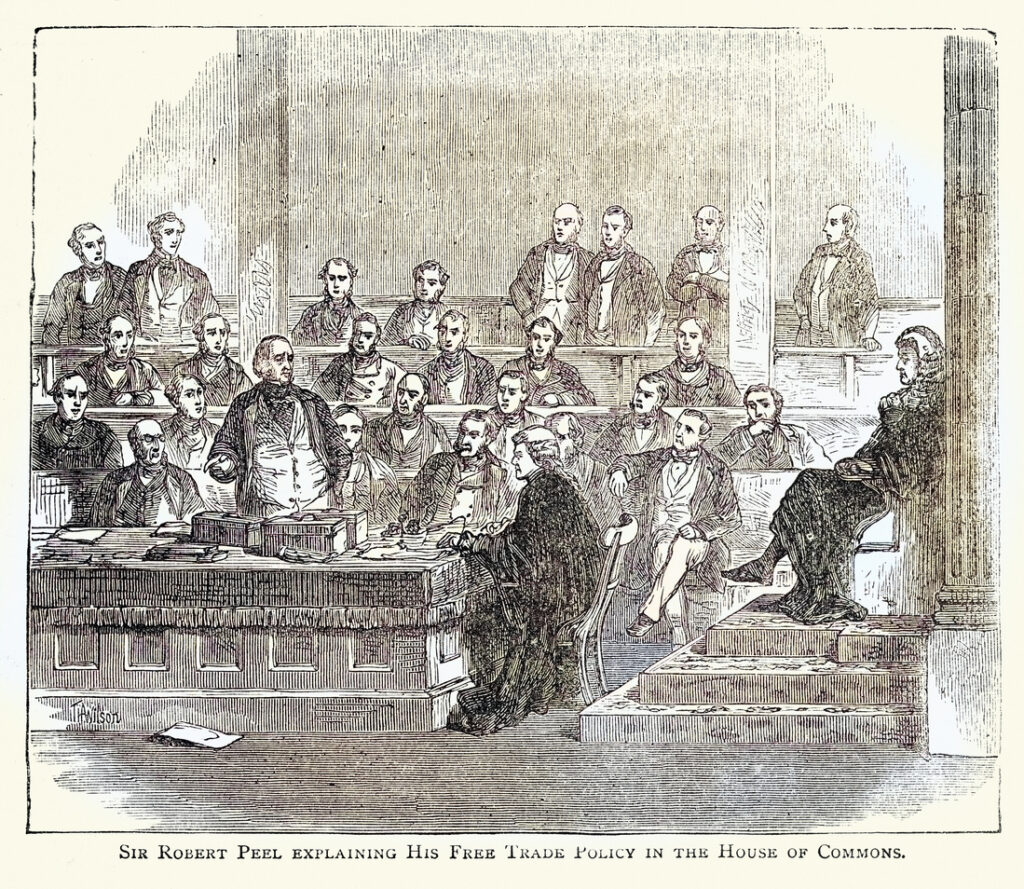
The second Peel ministry’s defining decision, however, was the 1846 repeal of the Corn Laws.
This policy, spurred by the failure of the Irish potato crop in 1845 and the famine that followed, split Peel’s party. The prime minister had also come under significant political pressure from the Anti-Corn Law League (ACLL), led by Richard Cobden and John Bright.
Peel’s pivot against protectionism reflected a profound pragmatism.
In a speech on 27 August 1841, addressing the House as the incoming prime minister, Peel stated that were he to exercise power “it shall be upon my conception – perhaps imperfect, perhaps mistaken, but my sincere conception – of public duty.”
On 17 September 1841, Peel insisted would not govern “by a servile tenure, which would compel me to be the instrument of carrying other men’s opinions into effect.”
Peel’s pragmatism previously manifested in his conversion to Catholic emancipation, when faced with Daniel O’Connell’s Clare campaign in 1828/29.
On both occasions, however – his conversion to free trade and Catholic emancipation – Peel failed to carry his party with him.
In 1846, Peel’s act of career suicide passed with a majority of 98 – a full two-thirds of his own MPs voted against the government. On the same day, Peel’s Irish Coercion Bill was defeated in the House of Commons by 292 votes to 219. Tory protectionists allied themselves with the opposition Whigs and Radical MPs in defeating the measure.
Peel resigned as prime minister on 29 June 1846.
Victoria now dreaded Peel’s removal from office. In 1845, the queen paid tribute to her prime minister as a “man of unbounded loyalty, courage, patriotism and high-mindedness”.
***
In his resignation speech, Peel argued that his actions were motivated by a principled desire to “avert dangers which we thought were imminent, and to terminate a conflict which, according to our belief, would soon place in hostile collision great and powerful classes in this country.”
He added: “The maintenance of power was not a motive for the proposal of these measures; for, as I said before, I had not a doubt, that whether these measures were accompanied by failure or success, the certain issue must be the termination of the existence of this government.”
Peel accepted that he would be “severely censured” by his party and “execrated by every monopolist.”
The outgoing prime minister concluded: “But it may be that I shall leave a name sometimes remembered with expressions of good will in the abodes of those whose lot it is to labour, and to earn their daily bread by the sweat of their brow, when they shall recruit their exhausted strength with abundant and untaxed food, the sweeter because it is no longer leavened by a sense of injustice.”
Those Conservatives who remained loyal to Peel, known as the pro-free trade Peelites, included Aberdeen and William Ewart Gladstone. In 1859, the Peelites merged with the Whigs and the Radicals to form the Liberal Party.
Peel’s government between 1841 and 1846 was the only majority Conservative government until Benjamin Disraeli formed his second ministry between 1874 and 1880.
On 2 July 1850, Peel died from the fatal injuries he suffered while horseback riding in a park near his London home.

Politics.co.uk Newsletters
DAILY
Politics@Lunch
WEEKLY
Week in Review