Parliament issues Declaration of Right, offering crown to William and Mary
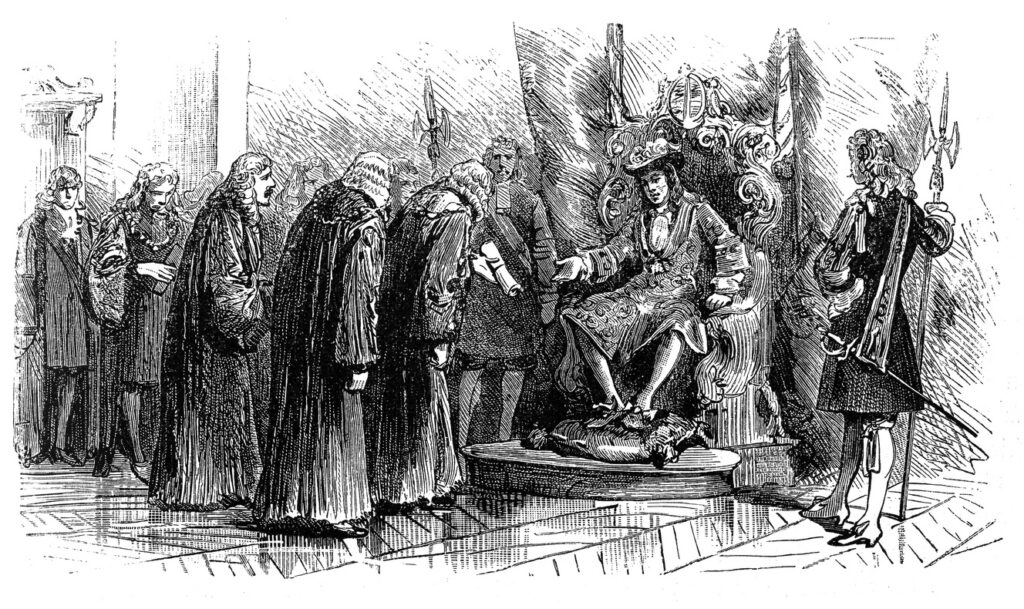
On 12 February 1689, the convention parliament produced a Declaration of Right, a constitutional document that sought to limit the power of the monarchy, asserted the rights of parliament, and enabled the formally offering of the throne to William of Orange and Mary, Princess of Orange.
The declaration, the results of months of negotiations in Westminster, was in many ways the decisive act of the Glorious Revolution. After the flight of the Catholic King James VII of Scotland and II of England to France in December 1688, the specially convened parliament declared that he had “abdicated” and the throne was “vacant”.
It effectively entrenched parliament’s status as a permanent feature of political life and confirmed the transfer of power from the sovereign to the legislature.
Specifically, the declaration set out to ensure that the abuses of power attributed to James could not be repeated. It compiled a comprehensive list of his misdeeds, including the suspension of the Test Acts, the prosecution of the Seven Bishops for petitioning the crown, the establishment of a standing army and the imposition of “cruel punishments”.
The declaration accused James of endeavouring to “subvert and extirpate the Protestant religion and the laws and liberties of the kingdom.”
The document went on to affirm a series of fundamental rights and liberties.
It prohibited “excessive bail”, cruel and unusual punishments, and the sovereign from suspending or dispensing with laws passed by parliament.
It asserted that elections of MPs “ought to be free”, that for freedom of speech in parliament (parliamentary privilege) “ought not to be impeached or questioned”, the right of the subjects to petition the monarch, and the need for regular parliaments.
The declaration proclaimed that for “redress of all grievances, and for the amending, strengthening and preserving of the laws, parliaments ought to be held frequently.” (This was reinforced by the Meeting of Parliament Act 1694, or Triennial Act, which required parliament to meet annually and to hold general elections once every three years.)
The declaration further resolved that “William and Mary, Prince and Princess of Orange, be and be declared, King and Queen of England, France, and Ireland.”
In sum, through both its pronouncements and its effective role in determining the sovereign, the declaration represented a definitive assertion of parliamentary supremacy over absolute monarchy.
***
On 13 February, when parliament formally offered the crown to William of Orange and Mary, it also read aloud the Declaration of Right – albeit not as a condition which they had to accept to be made King and Queen.
The declaration was later given statutory force, with some amendments, as the Bill of Rights 1689, which received royal assent on 16 December 1689.
The Bill of Rights barred Roman Catholics from the throne of England as “it hath been found by experience that it is inconsistent with the safety and welfare of this Protestant kingdom to be governed by a papist prince”.
The revolutionary settlement was consolidated successively by the 1701 Act of Settlement, which limited the line of succession to Protestants, and the 1707 Acts of Union, which created the Kingdom of Great Britain. From 1714, with George I’s accession, the Kingdom of Great Britain was ruled by the Hanoverian dynasty.
Jacobitism, which championed the claim to the throne of James VII/II, remained a problem for the Hanoverian regime. Jacobite leaders mounted two serious challenges to the Hanoverian succession: in 1715, led by James Edward Stuart (the “Old Pretender”), and 1745, led by Charles Edward Stuart, known as ‘Bonnie Prince Charlie’.
The Bill of Rights remains in force today. Its influence can be seen in other legislation relating to the rights and freedoms of individuals, in particular the US Bill of Rights 1789, and also the UN Declaration of Human Rights adopted by the General Assembly in 1948, and the European Convention on Human Rights (ECHR) in force 1953.

Politics.co.uk Newsletters
DAILY
Politics@Lunch
WEEKLY
Week in Review
