Palace of Westminster destroyed by devastating fire
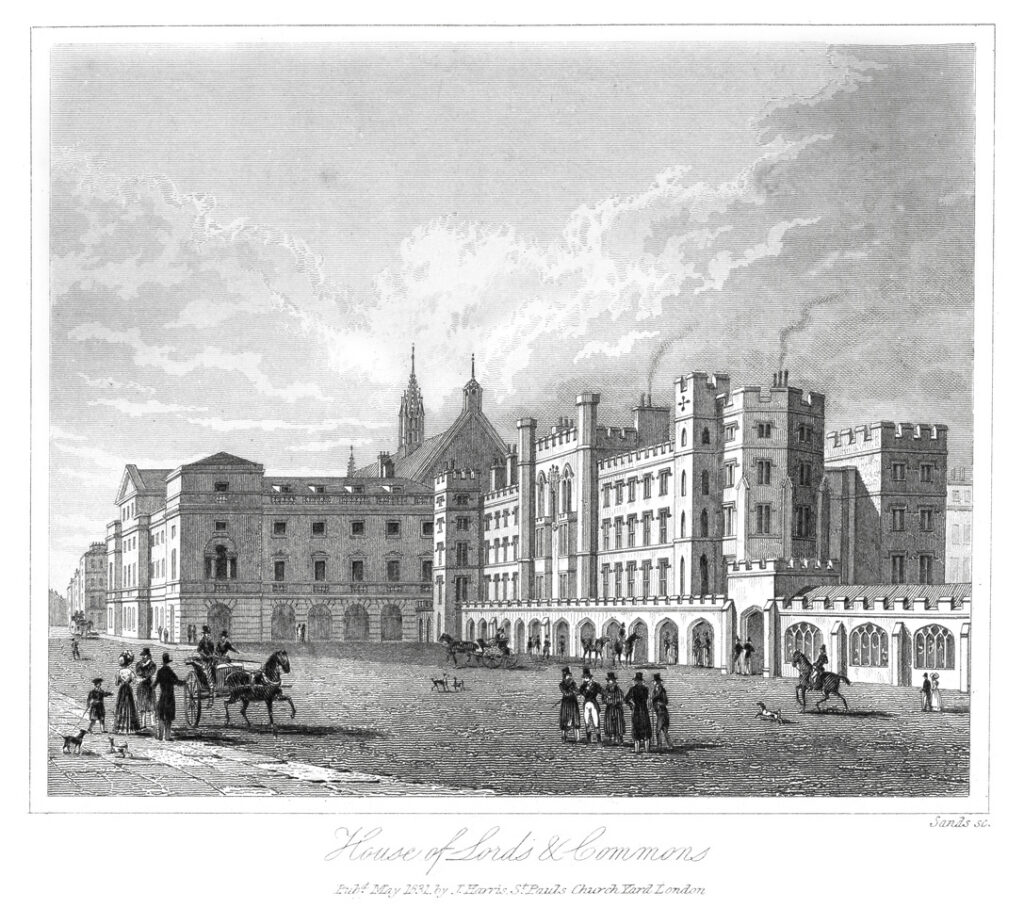
On 16 October 1834, a fire destroyed the majority of the medieval Palace of Westminster, the seat of the Houses of Parliament. The blaze was started by the burning of tally sticks (a form of medieval tax receipt) in two under-floor furnaces beneath the House of Lords.
The tally sticks, relics of a long-redundant method of accounting that had not been used since 1826, were ordered to be disposed of by officials. On the morning of 16 October, two workmen were instructed to burn the two cartloads of wood in the furnaces, used for heating the upper chamber.
Over several hours, the men fed the sticks into the furnaces, causing them to dangerously overheat. By 5:00 pm, the furnaces were extinguished; the tally sticks had been successfully incinerated.
At 6:00 pm, witnesses found that the House of Lords was now on fire. The flames spread rapidly through the combustible complex of medieval buildings that made up the old palace.
The inferno – the biggest blaze since the Great Fire of London in 1666 – was visible across London. Crowds gathered, and hundreds of volunteers and early fire engines struggled to control the blaze. The private London Fire Engine Establishment, alongside parish and insurance company fire engines, saved Westminster Hall and its 14th-century oak roof timbers.
“Damn the House of Commons, let it blaze away!”, the chancellor of the exchequer is said to have cried. “But save, O save the Hall!”
There were no recorded fatalities, despite the immense scale of the disaster and the estimated £2 million in damage to the mostly uninsured palace. A public inquiry found several officials guilty of negligence and foolishness in the handling of the tally sticks, but no one was criminally prosecuted.
The 1834 fire accelerated the establishment of the first public, professional London Fire Brigade. It also sparked the creation of a National Archives for the United Kingdom, which would now manage public records.
The subsequent architectural competition to replace the Palace was won by Charles Barry, who, with the assistance of A. W. N. Pugin, designed the iconic Gothic Revival parliament building that stands today.
***
Parliament reassembled in February 1835 after a general election.
King William IV initially attempted to foist the recently renovated Buckingham Palace on the homeless MPs; he did not care for the construction.
MPs, however, considered the palace to be too far removed from central London. They moved into the building previously occupied by the House of Lords, the Lesser Hall, which was serviceable after some renovation work.
The fire, interestingly, had an immediate political impact.
When parliament was reconvened, Tory MP Lord Francis Egerton said the blaze necessitated the re-election of the incumbent speaker, Sir Charles Manners-Sutton, who was undergoing a challenge from Whig MPs.
Egerton referenced the destruction of documents containing records of parliamentary precedent. He maintained that the House had lost its written memory, and therefore needed Sutton’s personal memory to function in its temporary accommodation.
The fire, however, was also implicated in the controversy that cost Manners-Sutton the speakership. His defeat was shaped by the Whig belief that he had conspired with the King and the Duke of Wellington, the former prime minister, to overthrow the previous Whig government led by Viscount Melbourne.
Charles Manners-Sutton unseated as speaker by Whig opposition
William IV had appointed a new prime minister in the final months of the 1832-1834 parliament: first Wellington (as a caretaker) and then Sir Robert Peel. He objected to the appointment of Lord John Russell as a senior minister in Melbourne’s government, believing Russell to be a radical. These moves came despite the Whigs holding a majority in the House of Commons.
Following the 1835 general election, Peel’s Conservatives remained in a clear minority at Westminster, returning 273 MPs. The Whigs, allied with Daniel O’Connell’s Irish Repeal Association, held 385 seats.
Manners-Sutton was a Tory parliamentarian before assuming the speaker’s chair, and Whig MPs saw him as an opponent of the Reform Act 1832.
Manners-Sutton’s defence was that his frequent meetings with the king and attendance at the privy council – which the Whigs viewed as plotting – were actually about the fire.
Seeking an eighth term as speaker, Manners-Sutton detailed how he rushed from Brighton to London as the fire raged and wrote an immediate letter to the king reporting the devastation. He argued that his subsequent attendance at the privy council was not to plot a new government, but to serve on a committee of inquiry into the “cause of the fire”.
He also said he had been asked to “survey Buckingham house and gardens” to judge whether the estate could serve as a temporary parliament, placing him at the scene of the alleged crime. Shortly thereafter, Melbourne’s government was booted from office.
He insisted that “at no one of the privy councils that he had attended had any business been done but of the most formal description.”
The inferno, however, had indirectly inspired a sense of political intrigue.
William Joseph Denison rose to propose James Abercromby as the Whig candidate for the speakership. Denison argued that the dismissal of the previous government “unheard and without a trial” required a speaker who could firmly represent the rights of the commons against the crown.
Leading the attack for the opposition, Lord John Russell acquitted Sutton of “any share in any political intrigues” regarding the dismissal of the government. However, he argued that Sutton’s attendance at the privy council during the crisis – even if it was regarding the fire – was “conduct unbecoming the speaker of the House of Commons”.
Russell argued that Sutton should have made excuses to avoid meetings dominated by Wellington’s caretaker government. By failing to do so, Russell argued, Sutton’s “political bias… had got the better of him” and “induced him to concur in acts, which, as speaker of the House of Commons, he had much better have avoided.”
Peel characterised the attempt to remove Manners-Sutton as an act of “singular ingratitude.” He reminded the House that the reformers were happy to support Manners-Sutton in the 1833 speakership election, but now sought to “unfairly take the very first opportunity to subject him to disgrace.”
The House proceeded to a division – an immediate test of the strength of the parties in the new parliament. The result was a narrow victory for the Whig opposition. Abercromby was elected speaker by 316 votes to 306 – a majority of 10.
Abercromby was led to the chair amidst loud cheers, drowning out his first address as speaker-elect.
It marked the first time a speaker had been removed by a vote of the House since 1780.
Robert Peel issues Tamworth Manifesto

Politics.co.uk Newsletters
DAILY
Politics@Lunch
WEEKLY
Week in Review
