Robert Peel issues Tamworth Manifesto
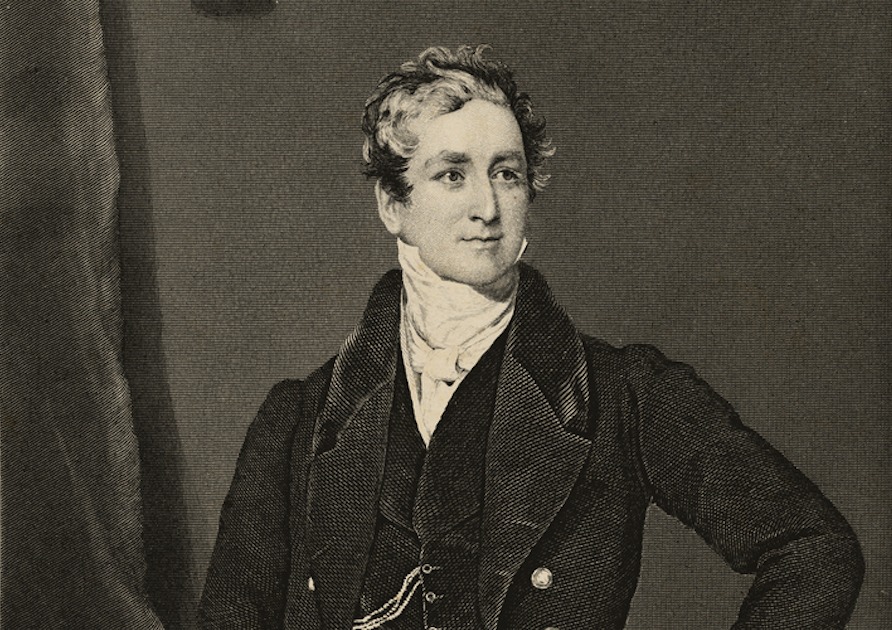
On 18 December 1834, Robert Peel issued a formal address to the electors of his constituency in Tamworth. Published widely in the national press, the “Tamworth Manifesto” is regarded as the foundational document of the modern Conservative Party.
The manifesto was conceived as a response to the Great Reform Act of 1832. It is said to have heralded the transition from the reactionary “Toryism” of the Duke of Wellington, which was inherently sceptical of popular politics, to a new “conservatism” which was willing to embrace moderate reform to preserve established institutions.
In 1828-29, the Tory party had split over the Roman Catholic Relief Act, which Wellington and Peel as home secretary had adopted after concluding it was necessary to prevent revolution in Ireland. The ‘Ultra-Tories’, who remained vehemently opposed to Catholic emancipation, styled themselves as protectors of the ‘Protestant constitution’.
The remaining, more moderate Tories had taken to calling themselves “conservatives”.
***
Wider political reform was resisted by Duke of Wellington during his tenure as prime minister (1828 to 1830) and all the way up to the Great Reform Act’s passage in June 1832. The crisis that surrounded the 1832 act’s passage is remembered by some historians as the closest Britain came to revolution.
Peel was among those resisting political reform. King William IV offered him the post of prime minister during this period “on the condition of introducing an extensive measure of reform”. But Peel declined, saying he could not enter office without “a light heart, a firm step, and an erect aspect”.
He said of Great Reform Act: “I considered it a revolutionary measure, calculated to introduce such changes in the practical working of the constitution, as, if not revolutionary in themselves, would lead to revolution; and, therefore, to the principles and details of that bill I have offered to the last, my most decided opposition.”
In November 1834, King William IV dismissed the Whig ministry of Lord Melbourne, William objected to the appointment of Lord John Russell as chancellor in Melbourne’s government, believing Russell to be a radical. It marked the last time a British monarch would sack a prime minister who commanded a parliamentary majority.
The sovereign initially sent for Wellington, who was reluctant. He said the next prime minister should sit in the commons, and recommended Peel to form the first Tory administration since the Great Reform Act.
The prime minister-select, however, was holidaying in Italy. James Hudson, a young official in the Queen’s Household, was dispatched to the continent to locate the missing member for Tamworth.
Peel was eventually tracked down on 25 November in Rome, at a ball of the Duchess of Torlonia. He then made a hasty return to London where, on 9 December, he formed a minority government. Wellington, who had been serving as prime minister in the interim, duly stepped aside.
***
The Conservatives had been badly beaten at the 1832 general election – the first since the Great Reform Act. Peel, facing a hostile House of Commons, requested a dissolution of parliament.
During the campaign, he issued his Tamworth Manifesto – an appeal to the property-owning middle classes enfranchised by the Great Reform Act. It marked a declaration of Peel’s attitude to current political issues and outlined the principles that would define his government.
Peel recognised that the party could no longer rely on the ‘rotten boroughs’ and aristocratic corruption that had sustained the old Tory party. He therefore sought to reassure voters that the issue of reform had been settled.
Peel declared his conviction “that [public] confidence cannot be secured by any other course than that of a frank and explicit declaration of principle.”
He accepted the Reform Act 1832 as a “final and irrevocable settlement of a great constitutional question.”
It was a settlement, the prime minister proclaimed, that “no friend to the peace and welfare of this country would attempt to disturb, either by direct or by insidious means.”
He defined his policy as: “The firm maintenance of established rights, the correction of proved abuses and the redress of real grievances.”
But Peel warned against constant radical change. He stated he would not accept office if it meant living in a “perpetual vortex of agitation.”
He wrote: “If by adopting the spirit of the Reform Bill it be meant that we are to live in a perpetual vortex of agitation; that public men can only support themselves in public estimation by adopting every popular impression of the day – by promising the instant redress of anything which anybody may call an abuse – by abandoning altogether that great aid of government – more powerful than either law or reason – the respect for ancient rights, and the deference to prescriptive authority; if this be the spirit of the Reform Bill, I will not undertake to adopt it.”
He added: “But if the spirit of the Reform Bill implies merely a careful review of institutions, civil and ecclesiastical, undertaken in a friendly temper combining, with the firm maintenance of established rights, the correction of proved abuses and the redress of real grievances – in that case, I can for myself and colleagues undertake to act in such a spirit and with such intentions.”
Peel acknowledged, however, that such “declarations of general principle are… necessarily vague.”
He therefore pledged to address the grievances and “conscientious scruples of dissenters”, regarding church rates and marriage laws. He promised a settlement on the contentious issue of tithes.
Peel promised to protect the “true interests of the Established religion”.
He vowed that future pensions would be confined to those with “just claims to the royal beneficence”.
The prime minister assured voters he would not obstruct the ongoing inquiry into municipal corporations, offering his past conduct as the “best proof that I was not unfriendly to the principle of inquiry.”
Peel argued that church reform should “strengthen and confirm its just claims upon the respect and affection of the people.”
The general election held in January and February 1835 saw a significant recovery for Peel’s party. The Conservatives gained approximately 100 seats – proving the party could survive and compete in the reformed political system.
***
However, Peel’s Conservatives remained in a clear minority at Westminster, returning 273 MPs. The Whigs, allied with Daniel O’Connell’s Irish Repeal Association, held 385 seats.
Peel’s first ministry was defined by a futile struggle against parliamentary arithmetic.
The Whigs immediately asserted themselves by unseating the incumbent speaker, Sir Charles Manners-Sutton, who was a Tory parliamentarian before assuming the chair. Whig MPs saw him as an opponent of the Reform Act 1832.
During his short first tenure as prime minister, Peel established the Ecclesiastical Commission to review the governance of the Church of England and recommend potential reforms. The policy exemplified the “Peelite” approach of reforming institutions to ensure their survival.
In April 1835, the Whigs brought forward a report critical of the administration of the Church of Ireland. It was an attempt to unite the Whigs and Irish Repeal Association MPs on an issue Peel could not accept. The government was defeated by 285 votes to 258.
Peel resigned on 8 April 1835, and Lord Melbourne returned to power.
But the Tamworth Manifesto and Peel’s short-lived ministry had reinvented his party.
The diarist Charles Greville noted the transformation in Peel’s reputation: “I believe it to be impossible that anything can prevent Peel’s speedy return to office; he has raised his reputation to such a height during this session, he has established such a conviction of his great capacity and of his liberal, enlarged, and at the same time safe views and opinions, that even the Radicals, such as Hume, join in the general chorus of admiration which is raised to his merits; he stands so proudly eminent, and there is such a general lack of talent, that he must be recalled by the voice of the nation and by the universal admission that he is indispensable to the country.”
Peel’s Conservative Party returned to power after the 1841 general election.
The second Peel ministry was one of the great reforming governments of the nineteenth century, notably reintroducing the income tax in 1842. It included several figures who had either served as prime ministers or would one day serve as prime minister, including Peel, the Duke of Wellington, the Earl of Ripon, Lord Stanley (the Earl of Derby), the Earl of Aberdeen, and William Gladstone.

Politics.co.uk Newsletters
DAILY
Politics@Lunch
WEEKLY
Week in Review