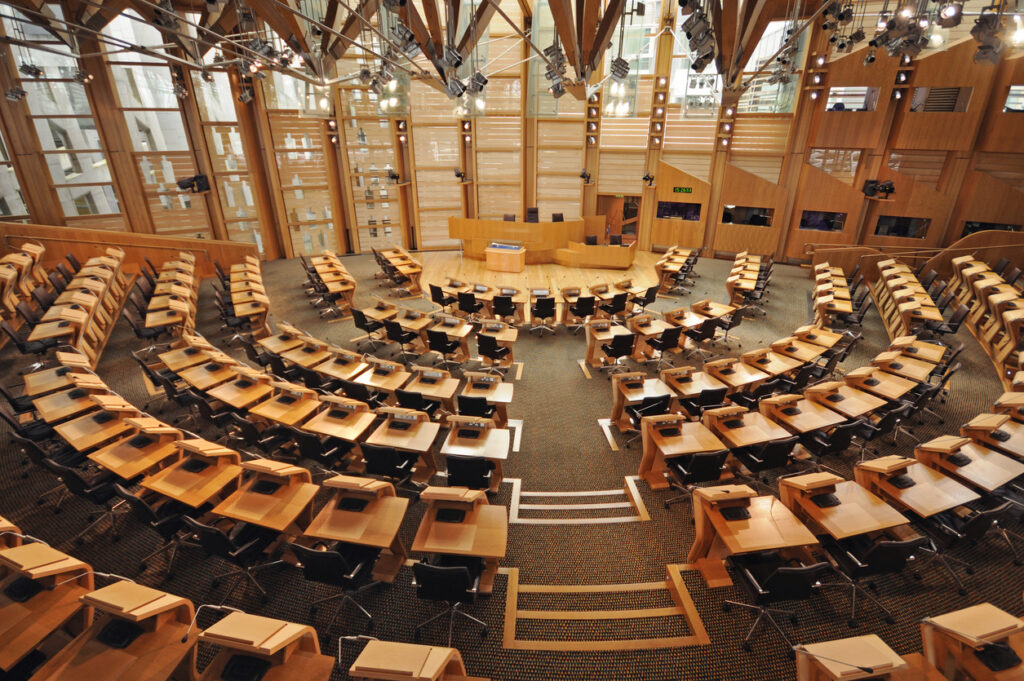
The Scottish Parliament, often referred to by its location as “Holyrood”, is the devolved, unicameral legislature of Scotland. Established in 1999, its core functions are to make laws on a wide range of domestic matters, to scrutinise the work of the Scottish Government, and to represent the people of Scotland.
The parliament is composed of 129 members of the Scottish Parliament (MSPs), who are elected every five years. It has significant powers, including the ability to set the rates and bands of income tax in Scotland.
What are the powers and responsibilities of the Scottish Parliament?
The Scottish Parliament operates on a “devolved matters” model, meaning it can legislate on any issue that is not specifically “reserved” to the parliament at Westminster.
The powers of the Scottish Parliament are defined by a package of laws, primarily the Scotland Acts of 1998, 2012 and 2016.
The parliament has the power to make laws on a wide range of domestic policy areas, including:
- agriculture, forestry and fisheries
- benefits (some aspects)
- consumer advocacy and advice
- economic development
- education and training
- elections to the Scottish Parliament and local government
- energy (some aspects)
- environment
- equality legislation (some aspects)
- fire services
- freedom of information
- health and social services
- housing
- justice and policing
- local government
- planning
- sport and the arts
- taxation (some aspects)
- tourism
- transport (some aspects)
One of the most significant powers of the Scottish Parliament is its ability to set rates of income tax for Scottish taxpayers.
The Scotland Act 2012 first devolved limited income tax powers, introducing the Scottish rate of income tax (SRIT). This meant that from April 2016, the Scottish Parliament was able to set a different rate of income tax in Scotland.
The Scotland Act 2016 substantially extended these powers. It enabled the Scottish Parliament to set both the rates and the tax band thresholds (excluding the personal allowance). These powers apply to all non-savings, non-dividend income of Scottish taxpayers.
Proposed income tax rates and bands are not part of the annual Budget Bill. They are set out by the Scottish government in a “Scottish rate resolution” (SRR). Before the final stage of the Budget Bill, MSPs consider the SRR by voting on a motion in the chamber.
Reserved powers remain the responsibility of the parliament in Westminster. They include:
- benefits (some aspects)
- betting and gambling
- broadcasting
- constitution (some aspects)
- consumer protection policy
- currency
- data protection
- defence and national security
- equality legislation (most aspects)
- energy (most aspects)
- elections to the UK Parliament
- employment law and industrial relations
- financial services
- foreign affairs
- immigration, asylum and visas
- nationality and citizenship
- postal services
- taxation (some aspects)
- telecommunications
- trade and industry
- transport (some aspects)
Elections to the Scottish Parliament
Electoral system
Elections to the Scottish Parliament are held under the alternative member system (AMS).
AMS is a hybrid system that combines first past the post (FPTP) with a proportional top-up. Voters cast two votes: one for a candidate in a local constituency (elected by FPTP), and a second for a political party in a larger region. A number of “additional members” are then elected from regional party lists to make the overall distribution of seats more proportional to the share of the regional party vote.
In Scotland, voters are issued two separate ballot papers: one to elect 73 constituency MSPs via FPTP, and a second “regional” ballot to elect 56 additional MSPs. Before the election, each political party publishes a list of candidates for each region.
These additional seats are distributed across eight regions, with seven MSPs per region. They are allocated using the D’Hondt formula, named after Belgian lawyer and mathematician, Victor d’Hondt, which takes into account the number of constituency seats a party has already won. The system is designed to “top up” parties that are under-represented in the constituency results.
Under the D’Hondt formula, the process for each of the eight regions works as follows:
- The number of regional list votes for each party is taken.
- This number is then divided by the number of constituency seats the party has already won in that region, plus one.
- The party with the highest resulting figure wins the first regional list seat.
- The calculation is then repeated. According to the formula, the divisor for the party that just won a seat is increased by one.
- This process continues until all seven regional seats for that region have been allocated.
This system aims to create a more proportional outcome. For instance, in the 2021 Scottish Parliament election, the Scottish Greens did not receive enough votes to return any constituency MSPs. However, they received eight “additional” MSPs.
Election timing
Section 2 of the Scotland Act 1998 originally provided for four-year fixed term parliaments. The Scottish Elections (Reform) Act 2020 extended this to five years. This was done in order to reduce the chance of devolved elections clashing with general elections to the parliament at Westminster, following the passage of the Fixed-term Parliaments Act 2011.
Under section 3 of the Scotland Act 1998, which established the Scottish Parliament, a snap election can be triggered if at least two-thirds of the members vote in favour of an early dissolution. A snap election also follows if the legislature fails to nominate a first minister within 28 days of a vacancy.
The presiding officers of the Scottish and Welsh legislatures also have the power to vary their election date by up to one month from the standard date, which is the first Thursday in May.
How are vacancies filled?
The method for filling a vacant seat depends on the type of MSP. If a constituency MSP resigns or dies, a by-election is held in that constituency to elect a replacement.
If a regional list MSP resigns or dies, no by-election is held. The vacant seat is automatically offered to the next available and willing person on the regional list submitted by that party at the last election.
What happens after an election?
Following an election, the monarch formally opens the new session of the Scottish Parliament.
The MSPs must take an oath or “affirm” their allegiance to the king as part of a swearing-in ceremony.
The oath says: “I do swear that I will be faithful and bear true allegiance to His Majesty King Charles, his heirs and successors, according to law. So help me God”.
The affirmation, which omits any religious reference, reads: “I do solemnly, sincerely and truly declare and affirm that I will be faithful and bear true allegiance to His Majesty King Charles, his heirs and successors, according to law.”
The first item of business for the newly elected MSPs is to elect a presiding officer to chair their proceedings.
The parliament then votes to nominate a first minister.
How is the first minister of Scotland appointed?
Following an election to the Scottish Parliament, the 129 MSPs vote to nominate one of their members to be first minister. Opposition parties can and do nominate their own leaders. But the first minister has only ever been the leader of the largest party at Holyrood.
The individual who secures the support of a majority of MSPs is then formally appointed by the king.
The first minister then appoints a ministerial team. This team is comprised of senior cabinet secretaries, who head the main government departments (known as portfolios), and more junior ministers. Cabinet secretaries make up the Scottish cabinet. Appointments must be approved by a vote in the Scottish Parliament.
The presiding officer: what do they do?
The Scottish Parliament is chaired by a presiding officer, who is an MSP elected by their fellow members to be an impartial chair of debates, similar to the speaker of the House of Commons. The presiding officer renounces their party affiliation upon election.
Sittings of the Scottish Parliament
The Scottish parliament typically meets in a plenary (full) session on Tuesdays, Wednesdays and Thursdays. Fridays are normally set aside for constituency business.
Committee meetings take place on Tuesday, Wednesday and Thursday morning when parliament is sitting.
Like the parliament at Westminster, the Scottish Parliament does not sit all year round. There are recess periods when the parliament is not in session. These recess dates are normally during the following periods:
- Summer – normally eight weeks from end of June to end of August
- Autumn – normally two weeks in mid-October
- Christmas – normally last week in December and first in January
- February – normally one week in mid-February
- Easter – normally two weeks around Easter
Voting and debates in the Scottish Parliament
The weekly parliamentary timetable is set by the Parliamentary Bureau, a cross-party committee chaired by the presiding officer. The body, which meets in private, is also attended by a member of parties or groupings with five or more MSPs.
It schedules debates and allocates time for government and opposition business. (The bureau is also responsible for proposing the establishment of committees, and their respective remits and memberships.)
Debates in the chamber allow for the scrutiny of legislation and government policy. Unlike in the House of Commons, MSPs are permitted to refer to each other by name.
Voting is electronic and almost instantaneous. To vote, the presiding officer or convener will ask MSPs a question. They can answer “yes”, “no” or “abstain”. Unlike MPs in the House of Commons therefore, MSPs can actively register their abstention.
The Scottish Parliament: types of legislation
The primary function of the Scottish Parliament is to make laws on matters that have been devolved from Westminster. The parliament has its own legislative process, distinct from that which plays out in the parliament at Westminster. It is characterised by a strong emphasis on the work of its cross-party committees.
Evaluation question
To what extent does the Scottish Parliament’s reliance on committees for legislative scrutiny foster a more consensual environment when compared to the House of Commons?
For a bill to become an act of the Scottish Parliament, it must be introduced to the parliament, be examined and passed by MSPs, be checked to ensure it is within the Parliament’s legal powers, and finally receive royal assent from the monarch.
Bills are introduced to the Scottish Parliament in several different forms.
- Government Bills (formerly Executive Bills), which are introduced by a Scottish government minister on behalf of the Scottish Government. They form the vast majority of the legislation passed by the parliament.
- Members’ Bills, which are introduced by an individual MSP who is not a government minister. Before a Member’s Bill can be introduced, the MSP must first submit, or “lodge” a proposal. An MSP can introduce two bills between elections and must secure the support of at least 18 other members from across the political parties to be able to introduce a bill.
- Committee Bills, which are introduced by the convenor of one of the parliament’s committees.
- Budget Bills, which is a special bill introduced each year which authorises the public spending for a financial year. The Budget Bill does not need certain accompanying documents and amendments to it can only be proposed by a Scottish government minister.
- Private bills, which are suggested from outside of the Scottish Parliament. Normally they relate to a particular place and are introduced by a local government body (a “promoter”). A committee is created to examine the Private Bill.
- Hybrid Bills, which are government bills that disproportionately affect the private interests of a certain group or entity. Often these are infrastructure projects.
- Emergency Bills, which must be introduced as a Government Bill first and then MSPs must agree to treat it as an Emergency Bill. This allows the stages of a bill to take place on a single day.
Most bills scrutinised and ultimately agreed by the Scottish Parliament are Government Bills, introduced by a Scottish government minister. Each September, the government announces a “Programme for Government” for the next parliamentary year.
A “Public Bill” (law that affects people right across Scotland) undergoes a rigorous three-stage process in parliament. Government Bills, Members’ Bills, Committee Bills and Budget Bills are all generally forms of “public” legislation. Bills are also subjected to checks before parliament considers the bill, as well as after (by the law officers).
The legislative process in the Scottish Parliament
The ‘pre-introduction’ phase
Before the formal parliamentary stages begin, a public bill faces a “pre-introduction” period. At this stage, the presiding officer of the parliament is advised as to whether the bill is within the legislature’s legislative competence. The presiding officer must make a statement to this effect under section 31(2) of the Scotland Act 1998. A negative assessment does not immediately stop the bill from being introduced.
The bill is accompanied by various “accompanying documents”. These differ in relation to whether the proposed legislation in question is a government bill, members’ bill, a committee bill or a budget bill.
A bill may be introduced on any sitting day.
Stage one: general principles
Stage one focuses on the overall purpose of the bill.
A newly introduced bill is assigned (by the Parliamentary Bureau) to a “lead” parliamentary committee, usually the one whose remit matches the bill’s subject area.
The committee holds an inquiry into the bill. It takes evidence from experts, the minister “in charge of the bill”, stakeholders and the public, before publishing a report on the bill’s general principles.
The Scottish Parliament then debates the committee’s report and the bill’s principles in the main chamber. The debate takes place on a motion “That the parliament agrees to the general principles of the [bill]”.
MSPs can refer the bill back to a committee for a further report. At the end of the debate, MSPs may vote on whether to agree to the general principles of the bill.
If this vote is passed, the bill proceeds to stage two.
Stage two: committee consideration and amendments
For stage two, the Parliamentary bureau refers the bill back to committee (usually stage one’s lead committee). The stage two committee can also be a “committee of the whole parliament”, which means all MSPs participate. The committee can choose to take further evidence.
In stage two, any MSP can propose amendments to the bill and speak to them. However, only members of the committee can vote on amendments at stage two.
If any amendment is agreed to, the bill is republished in amended form.
Stage three: final consideration
Stage three is the bill’s final stage. The amended bill, as it left the committee, returns to the main chamber for consideration by the whole Parliament.
Stage three is carried out in two parts. Firstly, MSPs have a final opportunity to propose and vote on further amendments. The presiding officer must select amendments to be debated.
This is immediately followed by a final debate and vote on whether to pass the bill as a whole. The debate takes place on a motion by the member in charge of the bill (its “sponsor”) that the parliament agrees that the bill be passed. The question on the motion that the bill be passed must be decided by a division, attended by at least a quarter of MSPs vote (33). If the majority votes against the bill, it falls.
The two parts of Stage 3 are often scheduled to take place on the same day, but need not be.
Unlike the legislative process in the House of Commons, the member in charge of the bill can move a motion to refer the bill back to stage two for further consideration.
Legal checks and royal assent
Any bill passed by the assembly is referred to the UK and Scottish law officers (the advocate general for Scotland, and the lord advocate).
They check to ensure the bill is within the legislative competence of the Scottish Parliament. These checks, to decide whether the Scottish Parliament is infringing on a “reserved” matter, may take place over a four-week period.
If they believe it is not, they can refer it to the UK supreme court for a final ruling. If such a reference has been made, the bill cannot make further progress until the court has made a decision.
The secretary of state for Scotland could also make a “section 35 order” under the Scotland Act 1998 if they believe the bill is incompatible with international obligations or defence or security interests, or because it would adversely affect the operation of the law on reserved matters. (This was famously the case for the Gender Recognition Reform Bill – the first time such an order was used.)
Evaluation question
To what extent does the ability of the UK government to block royal assent demonstrate that devolution is a delegation of power rather than a true transfer of sovereignty?
Under certain circumstances, the bill can be “reconsidered” (such as if the supreme court makes a negative ruling). This can be done to consider amendments to ensure the bill is within the competence of the Scottish Parliament.
If the bill clears these stages, the presiding officer sends it to the monarch for royal assent. This is the formal approval by the king which makes the bill an act of the Scottish Parliament.
Scottish Parliament committees
The committees of the Scottish Parliament are small, cross-party groups of MSPs responsible for carrying out the detailed work of the Parliament.
Scottish Parliament committees are normally made up of between five and 15 MSPs. Their membership is nominated by the parliamentary bureau to reflect the political balance of the parliament as a whole. Each committee is chaired by a convenor.
They are the primary engine for scrutinising the work and spending of the Scottish Government and for examining proposed legislation (bills). As well as scrutinising government proposals, committees can launch their own inquiries into any subject within their remit, take evidence from the public and produce reports.
What are the Scottish Parliament committees?
The Scottish Parliament has two main types of committee.
These are committees that must be established under the parliament’s standing orders (its rulebook). The “mandatory committees” deal with the core functions of the parliament itself. Under the parliament’s standing orders, they must be “established for the duration of the session”.
In total, there are seven mandatory committees. They include:
- The citizen participation and public petitions committee, which considers public petitions and explores new ways to engage the public with the parliament’s work.
- The finance and public administration committee, which scrutinises the Scottish government’s budget and the overall effectiveness of public administration.
- The standards, procedures and public appointments committee, which deals with the code of conduct for MSPs, parliamentary procedures, and oversees public appointments.
The ‘subject committees’, meanwhile, are set up to scrutinise the work of the Scottish government in specific policy areas. Their remits broadly mirror the portfolios of the government’s cabinet secretaries. This approach gives clear lines of accountability when committees are scrutinising the policy and performance of the Scottish government.
The subject committees include:
- The health, social care and sport committee
- The education, children and young people committee
- The net zero, energy and transport committee
- The criminal justice committee
- The social justice and social security committee
- The economy and fair work committee
There are no procedural limits on the number of subject committees that may be established. But given the relatively small size of the Scottish Parliament as a legislature, there are practical limitations regarding workload and parliamentary time.
A full, current list of Scottish Parliament committees can be found here.
Special ad hoc committees can be established for the express purpose of taking certain stages of a bill. This is the case for private bills and hybrid bills.
Committee membership
Parties choose which of their MSPs they would like to represent them on a committee. The membership of a committee reflects the political configuration of the parliament.
All committee members may contribute to its work programme and participate in public and private meetings, including the questioning of witnesses.
Parliament must agree the membership of a committee and the political party of the convener and deputy convener. Committees choose their convener and deputy conveners at their first meeting.
The convener chairs committee meetings and may speak on behalf of the committee. The deputy convenor may perform these responsibilities in the absence of the convenor.
How Scottish Parliament committees operate
Committees can actively begin inquiries into subjects of their choice. In doing so, they hold public oral evidence sessions, which are broadcast online, where they question witnesses. Witnesses can include government ministers, academics and members of the public. At the end of an inquiry, the committee publishes a report setting out its findings and making specific recommendations. The Scottish government is expected to publish a formal response to the committee’s report.
When a new bill is introduced, it is assigned to a “lead” committee. At stage one, the committee examines the bill in detail and takes evidence from experts and the public. It then writes a report about what it has heard setting out its view on the purpose of the bill (the “general principles”).
At stage two, the committee can propose amendments to the bill before it returns to the full chamber for its final stages. Any MSP can suggest an amendment, but, at this stage, only committee members can vote on them.
Committees can recommend the introduction of specific bills, which the convenor, with the consent of the Scottish Parliament, can introduce. Committee bills follow a slightly different legislative process to government bills. The bill is not referred to a “lead committee” at stage one, and the committee that scrutinises the proposed legislation cannot be the committee that proposed the introduction of the bill.
Question time in the Scottish Parliament
Oral question sessions are a mechanism for MSPs to hold the Scottish Government and its ministers to account. It is a key feature of parliamentary business, with the main sessions taking place every Thursday afternoon when the parliament is sitting.
These sessions provide a regular and public forum for MSPs to question the first minister and other ministers on their policies, decisions, and performance. Parliamentary questions can be asked by any MSP who is not a member of the government.
First minister’s questions (FMQs)
First minister’s questions (FMQs) is the main event of the parliamentary week at Holyrood. It takes place for 45 minutes every Thursday at 12 noon.
The first minister answers questions from MSPs on any aspect of the government’s responsibilities. The leaders of the main opposition parties are guaranteed the opportunity to question the first minister each week. They are followed by questions from backbench MSPs. The presiding officer selects the questions from backbenchers in advance.
MSPs may be invited by the presiding officer to ask supplementary questions following each of these questions.
Portfolio questions
Portfolio questions usually take place on Wednesday and Thursday. They see ministers for specific policy areas answer questions from MSPs. A rota ensures that each government portfolio is subject to questions on a regular basis.
MSPs must table their questions in advance. MSPs may then be invited to ask supplementary/follow-up questions.
General questions
The session of general questions allows MSPs to ask a question on any topic that falls within the responsibility of the Scottish government, providing an opportunity to raise issues that do not fit neatly into the specific portfolios being questioned that day. This usually takes place on Thursday mornings.
Topic questions
The presiding officer can select a topical question on a subject of national relevance that has arisen since parliament last met or if there have been significant developments.
These questions are usually asked in the chamber on a Tuesday afternoon. MSPs may then be invited to ask supplementary/follow-up questions.
Urgent questions
If an immediate response is needed to an urgent matter, an MSP can request that a question be put to a relevant minister that day. This must be approved by the presiding officer. The minister will then take follow-up questions from other MSPs.
Scottish Parliamentary Corporate Body (SPCB) Questions
Questions are asked to members of the Scottish Parliamentary Corporate Body (SPCB) three or four times a year. The SPCB is the body that runs the Scottish Parliament, and makes sure that the Parliament has the property, staff and services that it needs.
Written questions
In addition to the oral sessions in the chamber, MSPs can use written questions to ask for more detailed or statistical information that may not be suitable for a brief oral exchange. When the parliament is sitting, the Scottish government is expected to provide an answer to a written question within 10 working days.
How much are MSPs paid?
The basic annual salary for an MSP is £74,507.
An MSP holding a “dual mandate”, meaning they serve as both an MP and an MSP, receives an annual salary of £24,837.
MSPs who hold ministerial or parliamentary office receive an additional salary on top of the standard MSP entitlement. The first minister receives an additional £107,931, bringing their total annual salary to £182,438. A cabinet secretary and the presiding officer each receive an additional £55,993, resulting in a total annual salary of £130,500.
Ministers and the deputy presiding officer receive an additional £35,077, bringing their total annual salary to £109,584.
The Scottish Parliament and sovereignty
The UK parliament has devolved significant powers to the Scottish Parliament, alongside the Senedd Cymru (Welsh Parliament), and the Northern Ireland Assembly.
While Westminster remains legally sovereign and could theoretically abolish these institutions, the devolved bodies are recognised features of the political landscape in their respective jurisdictions.
What is the Sewel convention?
The Sewel convention is a constitutional principle that governs the relationship between the UK parliament at Westminster and the devolved legislatures in Scotland, Wales, and Northern Ireland.
It states that the UK parliament will “not normally” legislate on devolved matters without the consent of the relevant devolved institution. The convention takes its name from Lord Sewel, the Scotland Office minister, who was responsible for the progress of the Scotland Bill through the upper chamber in 1998.
In a debate in the House of Lords in July 1998, he stated that while the devolution of legislative competence did not affect the ability of the UK parliament to legislate for Scotland, “we would expect a convention to be established that Westminster would not normally legislate with regard to devolved matters in Scotland without the consent of the Scottish parliament.”
The Scotland Act 2016 amended the Scotland Act 1998 to contain an explicit and specific legal reference to the so-called Sewel convention. Subsections (7) and (8) of section 28 in the Scotland Act 1998 now state:
“(7) This section does not affect the power of the Parliament of the United Kingdom to make laws for Scotland.
“(8) But it is recognised that the Parliament of the United Kingdom will not normally legislate with regard to devolved matters without the consent of the Scottish Parliament.”
Legislative consent motions (LCMs)
The UK government is expected to consult with the devolved administrations if it plans to introduce a bill with provisions that fall within the scope of the Sewel convention.
This approval is sought through a legislative consent motion (LCM). The devolved government will introduce an LCM in its legislature, which is then debated and voted on by its members (MSPs in Scotland, MSs in Wales, MLAs in Northern Ireland).
If the motion is passed, consent is granted. If it is voted down, consent is withheld.
The Sewel convention and Brexit strains
However, the Sewel convention has come under some strain in recent years.
The supreme court ruled in the famous 2017 Miller I case that the convention remains a political rule and is not legally enforceable by the courts. The court ruled that the Sewel convention did not require the consent of the devolved institutions for the government to notify the Council of the European Union of the UK’s intention to withdraw from the EU (triggering Article 50 of the Treaty on European Union).
The ruling found that the Sewel convention “operates as a political constraint on the activity of the UK parliament” and “therefore plays an important role in the operation of the UK constitution.”
It added: “But the policing of its scope and operation is not within the constitutional remit of the courts. The devolved legislatures do not have a veto on the UK’s decision to withdraw from the EU.”
This confirmed that, in legal terms, the UK parliament remains sovereign and can pass laws for any part of the UK, with or without consent.
Evaluation question
How much genuine constitutional protection does the Sewel convention offer the Scottish Parliament, given that the UK parliament retains the legal authority to bypass a legislative consent motion?
The convention’s power, therefore, is said to lie in the political pressure applied by the longstanding convention, not legal force.
During the Brexit process, the UK government passed the UK Internal Market Act 2020 to prevent internal trade barriers within the UK. This is despite all three devolved legislatures refusing consent for the proposed legislation.
Between 2018 and 2023, the Westminster parliament passed six acts (five of which related to Brexit) where the UK government accepted that the Sewel convention was engaged but consent was refused by one or more of the devolved legislatures.
The loss and ‘restoration’ of the Scottish Parliament
1707 and the end of sovereignty
On 16 January 1707, the Parliament of Scotland passed the Act of Union, ratifying the treaty that would formally unite the kingdoms of England and Scotland into a single state under one crown.
Then, on 28 January, having been presented with the Treaty of Union and the Scottish Act, the English Parliament passed the Union with Scotland Act 1706 (England). It approved the terms of the Scottish Act without amendment (the two Acts together being the Acts of Union).
The twin acts together established the Parliament of Great Britain at Westminster, with Scotland granted 45 members in the House of Commons and 16 representative peers in the House of Lords.
The Scottish Parliament thereby voted for its own extinction.
The Kingdom of Great Britain was constituted on 1 May 1707. The new state’s flag, the Union Flag, combined the English cross of St George and the Scottish saltire of St Andrew.
For England, the primary motivation for a full political union was to secure the Protestant supremacy created by the Glorious Revolution and prevent a Catholic Stuart monarch from using Scotland as a base to reclaim the crown. For Scotland, the economic benefits of political union have been considered as a key motivation.
The union has been described as conducted between equals, establishing a new entity at Westminster reflecting both English and Scottish political traditions – and whereby Scottish society maintained significant autonomy. On the other end of the spectrum, it has also been characterised as a grubby elite bargain, cooked up by an English political class and endorsed by self-interested, well-compensated Scottish MPs.
Shades of historiographical opinion exist in between these interpretations. Our contemporary politics, coloured by the rise of Scottish secessionism, means the Anglo-Scottish Union’s formation is still subject to significant controversy.
What is not doubted, however, is that political union became an immediate source of political and social unrest.
Initial disaffection within Scotland towards the Treaty of 1707 was soon enhanced by breaches in both the spirit and letter of the union.
This resentment led to a concerted effort by Scottish politicians at Westminster to dissolve the union. In 1713, one such effort failed by only four proxy votes in the House of Lords.
The foremost beneficiary of this disaffection was Jacobitism, a complex political and religious ideology united by a shared belief in restoring the deposed Stuart dynasty (James VII of Scotland and II of England, and his descendants).
Jacobite forces mounted two serious challenges to the Union in 1715 and 1745.
The home rule campaign: from Ireland to Scotland
The Scottish Home Rule Association (SHRA) was formed in 1886 to campaign for devolved self-government for Scotland. It expressed support for the principle of “Home Rule All Round”, reflecting the approach advanced by the Liberal prime minister William Ewart Gladstone in relation to Ireland.
Introducing the Government of Ireland Bill on 8 April 1886, Gladstone argued home rule would end Irish obstructionism, restore the dignity of parliament and secure the “social peace, the fame, the power, and the permanence of the Empire.”
Gladstone’s mission to legislate for home rule was thwarted first in the commons (1886) and then in the House of Lords (1892). But an Irish legislature was eventually approved in the Government of Ireland Act 1914, the first UK law providing for devolved government, and then delivered, briefly and on different terms, by the Government of Ireland Act 1920. (The Irish War of Independence ultimately resulted in the Anglo-Irish Treaty 1921 and the Irish Free State Constitution Act 1922).
In 1924, Independent Labour Party (ILP) MP George Buchanan introduced the Government of Scotland Bill to parliament. The bill, based on the Government of Ireland Act 1914, proposed that only control of the army and navy, foreign affairs, the Post Office and excise and customs would remain reserved at the Westminster parliament. All other matters would be controlled by the new Scottish legislature – a quasi-federal settlement.
According to the bill, the proposed parliament would be composed of 148 members, elected under the existing network of parliamentary constituencies, with each returning two representatives. The bill maintained that Scotland would keep its existing representation in the House of Commons. This situation would only alter once a wider scheme of devolution was agreed for the whole of Great Britain (home rule all round), at which point the English matters would be considered in an English parliament.
A similar bill had secured a second reading in the commons in May 1913 by 204 votes to 159. This bill, proposed by William Cowan, provided for the creation of a Scottish parliament but was thwarted by the outbreak of the First World War.
In his contribution to the commons 11 years later, Buchanan argued that the “imperial parliament” at Westminster was so overwhelmed with business that it could not give adequate time or attention to specifically Scottish problems. He warned that if this “mild, meagre measure” was not conceded, it would be replaced by a demand for a much bolder one, invoking the recent history of Ireland.
The bill’s introduction coincided with the dawn of the first Labour government under Ramsay MacDonald as prime minister. The Labour movement had emerged as the largest political force in Scotland at the 1922 and 1923 general elections. MacDonald, who was president of the London branch of the SHRA before the First World War, was seen as an ally.
However, MacDonald’s ministry lacked an overall majority on the House of Commons, and many of its MPs were hesitant to support or prioritise a Scottish home rule scheme.
During the May 1924 debate, the government did indicate its lukewarm support for Buchanan’s measure. The secretary of state for Scotland, William Adamson, told MPs that the government agreed with the “general principle” of a home rule scheme and was prepared to appoint a committee to examine the issue.
When Adamson sat down just before the 4:00 pm deadline for private members’ business, supporters of the bill expected a vote to be called. But several Conservative/Unionist MPs rose, indicating their desire to speak.
The well-mannered debate soon descended into chaos as Buchanan and his allies in the group of left-wing “Red Clydesider” MPs made repeated attempts to force a vote. The commons speaker, John Henry Whitley, refused to accept these calls, basing his ruling on the grounds that there were still Unionist opponents of the bill who intended to speak.
The government, to the dismay of home rule campaigners, refused to allocate additional parliamentary time to consideration of the bill. Nor was it referred to a royal commission or a commons committee.
The episode shook the confidence of SHRA campaigners in the Labour Party as a vehicle for advancing the home rule cause. The dawn of the first Labour government under MacDonald had enthused the movement, elevated expectations and directly precipitated Buchanan’s bill.
The SHRA subsequently concentrated on its policy to convene an extra-parliamentary constitutional convention to consider the case and scheme for a Scottish parliament. The Scottish convention was assembled on 15 November 1924 with only seven MPs present. The convention proposed a scheme of home rule that would have seen Scottish MPs withdraw from Westminster, a measure which differed from Buchanan’s bill.
The failure of the convention and disillusionment within the SHRA animated calls for a national party to contest elections as a means of putting pressure on MPs. Following the failure of another home rule bill in May 1927, proposed this time by Reverend James Barr, a new “Scottish National Party group” within the SHRA declared its intention to take independent action.
The National Party of Scotland (NPS) was formed of members of the Scottish National League, the Scottish National Movement, the Glasgow University Scottish Nationalist Association and disaffected members of the SHRA. Its inaugural rally on 23 June 1928 featured a platform including Glasgow University student leader John MacCormick.
The SHRA officially wound up on 13 April 1929 against a backdrop of division and uncertainty.
The Scottish National Party (SNP) and nationalist development
On 7 April 1934, the Scottish National Party (SNP) was founded at a meeting in Glasgow, creating a single political entity dedicated to achieving self-government for Scotland.
The new party was formed from the merger of the National Party of Scotland, a generally radical group supportive of Scottish self determination, and the more moderate Scottish Party (founded in 1932), which favoured devolution. The coalescence came after the parties collaborated in the 1933 Kilmarnock by-election, supporting the joint candidacy of Sir Alexander MacEwen.
The merger was intended to unite the home rule movement into a more coherent and effective political force. The writer and politician Robert Bontine Cunninghame Graham was appointed as the party’s first president, with MacEwen as its first chairman (leader).
MacEwen told the SNP’s inaugural meeting: “This is a historic day in the Scottish national movement. The fusion of the two parties was not brought about by pressure or by intrigue.
“It was a spontaneous movement resulting from the desire of people of different shades of opinion to work together for the cause of self-government.”
The new party did not initially support the “revision of the Act of Union [1707]” (Scottish independence), instead advocating home rule/devolution. In January 1934, the National Party of Scotland and the Scottish Party agreed a resolution that committed both parties to the “establishment of a parliament in Scotland, which shall be the final authority on all Scottish affairs, including taxation and finance.”
Upon its founding, the SNP was a mostly fringe presence in Scottish politics. In its first test, the 1935 general election, the party contested eight seats, won none and lost five deposits with a combined total of 25,652 votes (1.3%).
For decades, the SNP was beset by internal divisions over ideology, goals, policies and strategy. Its defining issue was whether to prioritise devolution, the moderate or gradualist position, or outright independence, the fundamentalist position.
MacCormick, a supporter of the former position, left the party in 1942, having failed to convince the SNP of his stance. He had been a leading and influential supporter of the NPS-Scottish Party merger. (MacCormick was also a member of the Labour Party – dual membership was permitted in the SNP until 1940).
MacCormick went on to form the Scottish Covenant Association. The movement, which gathered two million signatures on a petition demanding home rule, was non-partisan and cross-party. But it provided the principal impetus for the Scottish nationalist movement in this period, stealing that mantle from the SNP.
The pro-independence SNP won its first parliamentary seat in 1945 when Dr Robert McIntyre was returned at the Motherwell by‐election. Following the death of the constituency’s previous MP, James Walker, the main parties had agreed a truce — owing to the unusual wartime conditions.
The SNP and McIntyre, who led the SNP from 1947 to 1956, went on to lose Motherwell in the general election that followed 84 days later.
The SNP fought few seats in the 1950s, winning 0.3% and 0.5% of the Scottish vote in the 1951 and 1955 elections respectively.
Scottish nationalism secured a significant symbolic victory in the 1950s with the Stone of Scone Christmas raid. The Stone of Scone, also known as the Stone of Destiny, was the stone upon which Scottish monarchs had been crowned. In 1296, during the First War of Scottish Independence, King Edward I of England removed the stone from Scone Abbey.
In the early hours of Christmas morning 1950, four Scottish students from the University of Glasgow broke into Westminster Abbey and removed the Stone of Scone from the coronation chair. The stone remained missing for four months until 11 April 1951, when the students left the stone on the high altar of Arbroath Abbey – the site where the Declaration of Arbroath was issued in 1320. Two unsigned letters were placed on top of the stone, including one addressed to King George VI.
The letter to the sovereign stated: “Unto his Majesty King George VI, the address of his Majesty’s Scottish subjects who removed the Stone of Destiny from Westminster Abbey and have since retained it in Scotland, humbly showeth.
“That in their actions they, as loyal subjects, have intended no indignity or injury to his Majesty or to the Royal Family.
“That they have been inspired in all they have done by their deep love of his Majesty’s realm of Scotland and by their desire to compel the attention of his Majesty’s Minister to the widely expressed demand of Scottish people for a measure of self-government.”
Hamilton and Kilbrandon: the slow shift to devolution
The SNP has had continuous parliamentary representation since 1967, when Winnie Ewing secured a famous victory in the Hamilton by-election. The SNP’s Hamilton breakthrough came a full 22 years after McIntyre took his seat as the MP for Motherwell.
In the 1966 general election, the SNP won 5% of the vote across Scotland, having contested just 23 of the 71 Scottish seats. Ahead of the Hamilton by-election, the SNP leadership reportedly told Ewing merely to “try to come a good second in order to encourage the members.”
Ewing, a Glasgow solicitor, ran an energetic 18-month campaign. The result, announced in the early hours of 3 November, shocked the political establishment. Ewing secured 18,397 votes (46.0%), defeating the Labour candidate, Alexander Wilson, who received 16,598 votes (41.5%).
In the wake of her victory, Ewing declared: “Stop the world, Scotland wants to get on.”
The SNP’s breakthrough in Hamilton – considered alongside Plaid Cymru’s success in Carmarthen – led to the establishment of the Royal Commission on the Constitution (the Kilbrandon Commission) by the Labour government in 1969. The commission’s work constituted the first major study of the constitutional challenges posed by multi-national governance and rising national consciousness.
Its terms of reference required it to examine “the present functions of the legislature and government in relation to the several countries, nations and regions of the United Kingdom” and to consider “whether any changes are desirable in those functions or in existing constitutional and economic relationships.”
The report, published in October 1973 after a four-year inquiry, rejected both independence and federalism for the constituent nations of the UK, instead recommending legislative devolution for Scotland and Wales in the form of 100-member assemblies, elected for four-year fixed terms under the single transferable vote (STV) system. The number of Scottish and Welsh MPs at Westminster would be reduced from 71 to 51 and 36 to 31 respectively.
The Scotland Act 1978: passage before wreckage
The February 1974 election saw a surge in support for the nationalist parties. The SNP’s representation rose from one seat to seven seats; its share of the vote doubled to 21.9%. Plaid Cymru won seats (two) for the first time at a general election.
Harold Wilson returned to power as prime minister leading a minority Labour government, dependent on the support of smaller parties.
In September 1974, Wilson’s government published a white paper entitled Democracy and Devolution: Proposals for Scotland and Wales, putting forward proposals based on the Kilbrandon commission.
The October 1974 election returned Wilson’s government with a small majority, which withered over the course of the parliament. The SNP once again improved its standing, securing 11 MPs and 30% of the vote north of the border.
On 13 December 1976, James Callaghan, who succeeded Wilson as prime minister, introduced the Scotland and Wales Bill (before the legislation was split in two) at second reading. He told MPs that the “origins of the bill can be found in the royal commission on the constitution, which was set up seven years ago.”
Callaghan argued that devolution was a necessary response to the “movement of popular will”.
This legislation also coincided with a marked shift in parliamentary arithmetic. With the loss of its commons majority, Labour once again relied on smaller parties to prop up the government.
The bills, however, did not accept Kilbrandon’s recommendation on reducing the number of Scottish and Welsh MPs at Westminster. The devolution schemes also differed on the electoral system; the proposed assemblies would be elected under the first past the post system as opposed to STV.
The Callaghan government mostly embraced devolution, but the Labour Party at large was divided. In Scotland, Tam Dalyell served as de facto leader of Labour’s anti-devolutionist tendency. He famously posed the “West Lothian question” (so-called after his constituency), which referred to the perceived imbalance between the voting rights in the House of Commons of MPs from Scottish and Welsh constituencies that would arise with devolution.
In other words, under devolution, MPs from Scotland and Wales could vote on issues affecting only England, while English MPs could not vote on matters devolved to Scotland or Wales.
Evaluation question
To what extent does the West Lothian question represent a flaw in the UK’s asymmetrical devolution settlement, or is it a theoretical problem that has little impact on practical governance?
Dalyell first articulated this famous constitutional dilemma on 14 November 1977, during a debate on the Scotland Bill.
He asked: “For how long will English constituencies and English honourable members tolerate… at least 119 honourable members from Scotland, Wales and Northern Ireland exercising an important, and probably often decisive, effect on English politics while they themselves have no say in the same matters in Scotland, Wales and Ireland?”
He said that the “West Lothian… problem pinpoints a basic design fault in the steering of the devolutionary coach which will cause it to crash into the side of the road before it has gone a hundred miles.”
The Scotland Act, alongside the Wales Act, received royal assent on 31 July 1978. Both pieces of legislation included a requirement for post-legislative referenda.
The first Scottish devolution referendum (1979)
The Scottish devolution referendum held on 1 March 1979 produced a paradoxical result. A majority of those who voted supported the creation of a Scottish assembly, but the proposal was thwarted by a controversial rule in the Scotland Act.
The question put was as follows: “Do you want the provisions of the Scotland Act to be put into effect?” A narrow majority of 51.6% (1,230,937 votes) voted in favour of the act, with 48.4% (1,153,502) voting against.
However, the Scotland Act was subject to an amendment, inserted by the anti-devolutionist Labour MP George Cunningham (a Scot who represented an English seat), which required at least 40% of the total registered electorate to vote ‘Yes’ for the Act to be implemented. The amendment was strongly opposed by the government, but it was passed by 166 votes to 151.
The amendment provided for a double test: a majority in favour of an assembly, and a substantial turnout.
On a turnout of 63.7%, the ‘Yes’ vote represented only 32.9% of the electorate, falling well short of the required threshold. Under the terms of Cunningham’s amendment, the Scotland Act 1978 was later repealed by a statutory instrument.
The campaign had exposed deep divisions within Scotland’s main political parties. The Labour Party was officially in favour but was damaged by a highly effective “Labour Vote No” campaign, of which Brian Wilson served as chairman, and Robin Cook and Tam Dalyell as vice-chairs.
The Conservative Party also campaigned for a ‘No’ vote.
The failure to deliver a devolved assembly, despite a numerical victory for the ‘Yes’ campaign, was seen by pro-home rule campaigners as a democratic betrayal. In protest, the SNP, which had been propping up the minority Labour government, withdrew its support. The Conservative Party then tabled a motion of no confidence, which the SNP supported. The government lost the motion by a single vote, triggering the May 1979 general election.
The home rule flame flickers: the Scottish Constitutional Convention
The home rule flame was kept alive in the inter-referendum years by supporters in Scottish politics and civil society. On the first anniversary of the failed referendum, the Campaign for a Scottish Assembly (CSA) was formed.
The most effective recruiting sergeant for Scottish devolution, of course, was the Thatcher government. The CSA and anti-Thatcher sentiment were the joint catalysts in the formation of the Scottish Constitutional Convention (SCC) that convened in 1989 to agree a devolution scheme.
It was in this capacity that, on 30 March 1989, a wide coalition of politicians and civic leaders gathered in Edinburgh to sign “A Claim of Right for Scotland”. The gathering marked the beginning of a new phase in the long campaign for Scottish devolution/home rule. The event, which took place in the General Assembly Hall of the Church of Scotland, channelled the growing political consensus that a new constitutional settlement was needed.
A statement of principle, the Claim of Right explicitly acknowledged and asserted “the sovereign right of the Scottish people to determine the form of government best suited to their needs”.
The claim therefore, marked a political rupture with the Diceyan understanding of the UK’s constitutional settlement that sovereignty was vested solely in the parliament at Westminster. The principle of parliamentary sovereignty had featured at the forefront of the debates on devolution in the 1970s.
The claim also outlined a three-fold mandate for the new Scottish Constitutional Convention to “prepare”, seek “approval for” and “implement” a devolution/home rule scheme.
To this pledge, MPs, MEPs and councillors of the Scottish Labour Party, Scottish Liberal Democrats, Social Democratic Party, Co-operative Party, Communist Party, Scottish Green Party, the Orkney and Shetland Movement and several civil society representatives signed their names in an act of astonishing political theatre.
Of Labour’s Scottish MPs, only Dalyell withheld his signature. Dalyell’s refusal meant 59 of Scotland’s 72 MPs had signed the document. Signatories therefore included two future Labour leaders, John Smith and Gordon Brown; other senior figures such as Robin Cook and Alistair Darling; privy counsellors Smith and Donald Dewar; and veteran anti-devolutionists like Brian Wilson, Bob Hughes and Eric Milligan.
Co-chaired by Liberal Democrat David Steel and Labour’s Harry Ewing, the SCC brought together representatives of the pro-devolution political parties, along with civil society organisations, churches, trade unions and business groups.
The Conservative Party opposed the process and the SNP, buoyed by the 1988 Glasgow Govan by-election, ultimately withdrew in protest at the convention’s refusal to consider independence as a constitutional option.
During his tenure as Labour leader, John Smith committed his party to the cause of constitutional reform and Scottish devolution in particular. Neil Kinnock, Smith’s predecessor, was only a cautious convert to devolution.
Smith described the establishment of a devolved legislature as “the settled will of the Scottish people” and Scotland’s “unfinished business”.
Smith died on the morning of 12 May 1994 after suffering a serious heart attack, his second. Following his death, devolution was sometimes referred to as Smith’s “unfinished business”.
The 1994 Labour leadership contest was won by Tony Blair, who would go on to lead the ‘modernising’ New Labour project and secure a landslide victory at the 1997 general election.
In the end, the SCC produced two reports, Towards Scotland’s Parliament (1992) and Scotland’s Parliament, Scotland’s Right (1995). The latter document provided a blueprint for the devolution scheme adopted by New Labour in the late 1990s.
Talk of a “parliament” in 1997 – as opposed to an “assembly” – reflected the rhetorical and practical development of the devolution argument.
The second devolution referendum (1997)
On 11 September 1997, Scotland voted emphatically in favour of a devolved parliament with tax-varying powers. The result marked the culmination of decades of campaigning for Scottish devolution/home rule. The 1997 devolution referendum differed substantially from the vote held two decades previously in 1979.
The 1979 referendum marked the final act of an ailing Labour administration. The 1997 referendum, meanwhile, was delivered by Tony Blair’s ‘New Labour’ government just four months after securing a landslide election victory.
The 1997 referendum also asked two separate questions: one to gauge opinion on the principle of a parliament and another to tackle its tax-raising powers.
Separately, Scots were asked if they agreed “that there should be a Scottish Parliament” and “that a Scottish Parliament should have tax-varying powers”.
On the first question, 1,775,045 voters (74.3%) voted ‘Yes’. 614,400 (25.7%) voted ‘No’. On the second question regarding tax-varying powers, 1,512,889 voters (63.5%) voted ‘Yes’. 870,263 (36.5%) voted ‘No’.
The turnout was 60.2% – lower, in the end, than the 1979 referendum.
In the end, all 32 local authority areas in the country voted in favour of a Scottish parliament and only two – Orkney and Dumfries and Galloway – decided against tax-varying powers.
The bipartite plebiscite was a product of New Labour’s deliberations – and political anxieties. The tax-varying question was, in effect, a concession to Conservative criticism. Michael Forsyth, the secretary of state for Scotland from 1995 to 1997, had coined the term “Tartan Tax” to refer to the SCC’s proposal that a Scottish parliament should have the power to vary income tax by 3 pence in the pound.
The second question on tax-varying was crafted to neutralise this attack.
It was heavily criticised by supporters of the SCC’s work, who had consistently argued that a parliament without revenue-raising powers would be practically and politically inadequate – failing to correct Scotland’s democratic deficit.
It was also New Labour that insisted on the very need for a referendum as an expression of Scotland’s “settled will” in favour of a devolution scheme.
The official ‘Yes’ campaign, Scotland Forward (styled ‘Scotland FORward’), emerged from the political apparatus and culture of the SCC. It was supported by Labour, the Liberal Democrats, and the SNP.
The official ‘No’ campaign, Think Twice, was headed by Brian Monteith, an ally of Forsyth (who had lost his seat at the 1997 election). It argued that a parliament would amount to an expensive, unnecessary, Union-threatening layer of bureaucracy.
Campaigning was suspended between 31 August and 6 September, respectively the death and funeral of Diana, Princess of Wales.
Donald Dewar, the secretary of state for Scotland, said the result “exceeded all my expectations.”
He added: “The people have spoken – John Smith’s belief in the settled will of the Scottish people was truly justified last night.”
The 1997 referendum, unlike the 1979 vote, was pre-legislative. The lack of opposition the subsequent 1998 Scotland Act faced in its passage through parliament was notable.
Dewar, who acted as one of Smith’s pallbearers, completed his “unfinished business”.
Addressing the House of Commons at the Scotland Bill’s second reading, Dewar declared: “The referendum was much criticised, and the subject of much hostility and doubt, even in my party, but it gave the country its chance to speak, and it was an example of trusting the people, of an exercise in direct democracy and of an occasion on which politicians practised what they preached.
“The people gave us a handsome majority, not in a blaze of razzmatazz but with a quiet determination that left no room for doubt that this is the settled will of the people.”
Devolution since 1999: the Scottish Parliament in action
The Scottish Parliament reconvenes
The Scotland Act 1998 begins: “There shall be a Scottish parliament.”
The first elections to the Scottish parliament were held in May 1999. Dewar paid tribute to Smith upon his election as the MSP for Glasgow Anniesland.
He told his election count: “I think [John Smith] would have been very proud to see this happening now, see this parliament elected safely tonight and he would have realised that indeed the ‘settled will of the Scottish people’ was being achieved.
“We are on our way to building the sort of new Scotland we have always wanted, for the sort of new Britain we have also wanted.”
The Scottish parliament officially convened, or “re-convened” in the words of the mother of the new house and SNP icon Winnie Ewing, on 12 May.
Opening the session, the 79-year-old said: “I want to start with the words that I have always wanted either to say or to hear someone else say – the Scottish parliament, which adjourned on March 25, 1707, is hereby reconvened.”
In the formal vote for first minister, Dewar defeated the leader of the SNP, Alex Salmond, by 71 votes to 35. Conservative party leader David McLetchie secured 17 votes, while independent MSP Dennis Canavan won the support of three colleagues.
The election was carried out using the parliament’s new electronic voting system, not without some confusion, but ultimately successfully.
Before the vote, the candidates for first minister were invited to make two-minute presentations setting out their case.
In his address, Dewar said: “All my political life, I have worked with others to achieve this parliament. Many of my allies and many colleagues in that cause are here today.
“I am proud of what we have done, and I am proud of what Scotland has done. Scotland’s parliament is no longer a political pamphlet, a campaign trail or a waving flag. It is here; it is real.”
In his first speech as the newly elected first minister, Dewar said: “It is a great privilege to lead the first government of this parliament. This is a privilege that carries great responsibility and I have no doubt about that.
“The people of Scotland look to us to give them a better life and of that, I think we have a common aim.”
Dewar announced his first cabinet 19 May 1999, which included two Liberal Democrat MSPs and two future first ministers in Henry McLeish and Jack McConnell. Jim Wallace became deputy first minister and minister for justice; fellow Liberal Democrat Ross Finnie served as minister for rural affairs.
The Scottish parliament was officially opened on 1 July, with powers passed from Westminster to the new legislature under the Scotland Act 1998.
On 10 October 2000, Dewar fell on the pavement outside his official residence and later died from a brain haemorrhage. The first minister had undergone major heart surgery five months earlier to replace a leaking valve.
Dewar’s contribution to the formation of the Scottish parliament, and role in leading it as first minister, has earned him the title “father of the nation”.
The rise of SNP Scotland
This Lib-Lab partnership forged by Dewar proved remarkably stable, lasting through two elections and three different Labour first ministers (Dewar, Henry McLeish, and Jack McConnell) until the SNP’s rise to power in 2007.
In the 2007 Holyrood election, the SNP emerged as the largest party, winning 47 seats and unseating the Labour Party, which had governed Scotland since the dawn of devolution.
Alex Salmond, the leader of the SNP since September 2004, was appointed as the first non-Labour first minister of Scotland. From 2007 to 2011, Salmond led a minority SNP government.
Four years later in 2011, the SNP won an unprecedented overall majority in the Scottish parliament election, confounding pollsters and expectations. The SNP secured 69 of the 129 seats at Holyrood – a majority of four. It was an outcome that the parliament’s additional member voting system was designed to prevent. The SNP took 45.4% of the constituency vote and 44.7% of the regional vote, increasing their number of MSPs by 22 (compared to the notional 2007 base, adjusted for boundary changes).
David Cameron, the prime minister, congratulated the SNP leader for an “emphatic win”.
The 2014 Scottish independence referendum
The 2012 Edinburgh Agreement, signed by Cameron and first minister Alex Salmond, set out the legal framework (a Section 30 order) for the Scottish parliament to hold a single-question referendum on independence. The agreement also provided for the franchise to be extended, for the first time, to 16 and 17-year-olds.
The question that appeared on the ballot paper, according to the Edinburgh Agreement, was as follows: “Should Scotland be an independent country?”.
In the final weeks of the campaign, the opinion polls showed ‘Yes’ gaining ground. This tightening provoked a series of panicked, if effective, tactics from the ‘No’ campaign . The leaders of the three main UK parties – Cameron, Ed Miliband and Nick Clegg – made a joint public pledge, known as “The Vow”. They promised the swift delivery of substantial new devolved powers to the Scottish parliament, “devo max”, if voters rejected independence.
The vow, published in the Daily Record, stated: “The Scottish Parliament is permanent and extensive new powers for the parliament will be delivered by the process and to the timetable agreed and announced by our three parties, starting on 19th September.”
Cameron, Miliband and Clegg promised that a ‘No’ vote would deliver “faster, safer and better change” than independence.
The people of Scotland voted to remain part of the United Kingdom in the Scottish independence referendum, a central pledge of the SNP. The ‘No’ campaign won with 2,001,926 votes (55.3%) against 1,617,989 votes (44.7%) for the ‘Yes’ campaign. The result was delivered on an exceptionally high national turnout of 84.6%.
The defeat of the independence cause in 2014 precipitated Salmond’s resignation as SNP leader and first minister. He was replaced in both roles by Nicola Sturgeon.
The UK government established the Smith commission on 19 September 2014 with a view to fulfilling the campaign “Vow”. The commission was tasked with convening “cross-party talks” to produce “recommendations for further devolution of powers to the Scottish Parliament”.
It proposed that the UK parliament grant significant new tax powers to the Scottish parliament and legislate to confirm the institution’s “permanence”.
The Scotland Act 2016 effectively enacted the recommendations of the Smith commission. The act declared that the Scottish parliament and the Scottish government are considered permanent parts of the UK’s constitutional arrangements. It also devolved significant new social security powers to the Scottish parliament.
The act also placed the ‘Sewel convention’ – the recognition that the UK parliament would not “normally legislate with regard to devolved matters without the consent of the Scottish parliament” – on a legislative footing.
The Scotland Act 2016 declared: “The Scottish Parliament and the Scottish government are a permanent part of the United Kingdom’s constitutional arrangements.”
In line with the recommendation of the Smith commission, this measure was an attempt to deliver a measure of entrenchment within the bounds of the UK constitution.
In the 2016 referendum on Britain’s membership of the European Union (EU), Scotland supported the ‘Remain’ position. England and the United Kingdom as a whole voted by 52% to 48% in favour of ‘Leave’.
This precipitated Cameron’s resignation and a renewed push for a second independence referendum or IndyRef2. The SNP argued that the Brexit debate reflected England and Scotland’s divergent political cultures – arguably the key component of the independence case.
The Bute House Agreement
The SNP went into the 2021 Scottish Parliament elections actively campaigning for a second referendum on Scottish Independence. The SNP won 64 of the 129 seats, one short of an overall majority.
From 2021 to 2024, the SNP governed with the support of the pro-independence Scottish Green Party through a power-sharing deal known as the Bute House Agreement. Two Green MSPs, Patrick Harvie and Lorna Slater, were appointed as ministers. Under the deal, Green ministers attended cabinet meetings at least twice a year.
The deal was not presented as a formal coalition. The SNP and Greens (both pro-independence parties) agreed several prominent exceptions to the principle of collective responsibility. The pact was referred to as a “cooperation agreement”.
Referring to the Greens in government, the agreement stated: “These ministers will, as a consequence of the agreed processes for cooperation and collaboration as set out in co-operation and collaboration, observe the principle of collective responsibility, except in respect of excluded matters.”
This coalition government, citing its electoral mandate, formally initiated its campaign for a second independence referendum. In June 2022, Sturgeon unveiled a series of papers titled Building a New Scotland, which were designed to build a fresh case for independence. She announced her intention to hold a consultative referendum on 19 October 2023.
However, the crucial question of the legality of the Scottish Parliament legislating for such a referendum without the consent of the UK parliament remained a significant obstacle. The Scotland Act 1998, which established the Scottish Parliament, reserves matters relating to the Union of the Kingdoms of Scotland and England to the UK parliament in Westminster.
To proceed with a legally binding referendum, another Section 30 order from the UK government would be required, a power the Conservative government at Westminster, under successive prime ministers Boris Johnson, Liz Truss, and Rishi Sunak, consistently refused to grant.
In an attempt to circumvent this, the Scottish government sought a ruling from the UK’s supreme court on whether the Scottish parliament had the authority to legislate for a consultative referendum on its own. In November 2022, the Supreme Court delivered a unanimous verdict, ruling that the Scottish Parliament does not have the power to legislate for a referendum on Scottish independence without the consent of the UK parliament. The court determined that any referendum, even a consultative one, would relate to the reserved matter of the Union and was therefore outside the legislative competence of Holyrood.
This ruling was a significant blow to the SNP’s strategy. In response, Nicola Sturgeon declared that the 2024 UK general election would be treated as a “de facto referendum” on Scottish independence. This new approach was met with some internal debate within the SNP.
The political landscape saw a further significant shift in February 2023, when Sturgeon, after eight years as first minister, announced her resignation citing the personal toll of leadership and the need for a fresh voice. Sturgeon’s departure followed the political trauma of the supreme court ruling and the controversy over the Gender Recognition Reform Bill, which sought to amend the Gender Recognition Act 2004, making it simpler for people to change their gender without having to obtain a medical diagnosis. The UK government at Westminster, led by Rishi Sunak, intervened to block the bill from receiving royal assent, making use – for the first time – of a section 35 order under the Scotland Act 1998.
On top of this, the ongoing developments of Operation Branchform – a Police Scotland investigation into the SNP’s finances and the handling of funds raised for a future independence referendum campaign – were an increasingly destabilising backdrop. The probe, launched in 2021, intensified in early 2023.
Sturgeon’s successors: Yousaf and Swinney
Humza Yousaf defeated rivals Kate Forbes and Ash Regan in the 2023 SNP leadership election, succeeding Sturgeon as first minister.
Yousaf secured 26,032 votes (52.1%) in the second round. He narrowly defeated Forbes, who secured 23,890 votes (47.9%). Regan was defeated in the first round, having only secured 5,599 votes (11.1%). Regan had resigned from the Scottish government in October 2022 over the Gender Recognition Reform Bill. In her resignation statement, Regan said her “conscience” could not allow her to vote for the gender reform proposals.
In April 2024, Yousaf’s disastrous decision to end the power-sharing agreement with the Scottish Greens led to a vote of no confidence. The Scottish Greens, the SNP’s former pro-independence partners in government, were lined up to vote against Yousaf, alongside the Scottish Conservatives, Scottish Labour and the Scottish Liberal Democrats.
The Alba Party, which had one MSP in Ash Regan (who had defected from the SNP), appeared to hold the casting vote. Alba was formed by Alex Salmond in 2021. Its formation was fuelled by a breakdown in the relationship between Salmond and Nicola Sturgeon, then the first minister of Scotland. In 2019, Salmond was arrested and charged with sexual assault and attempted rape for allegations that were said to have occurred during his tenure as first minister. In March 2020, Salmond was acquitted of all charges at trial.
In the ‘no-confidence’ vote in Yousaf’s government, if Regan sided with the SNP, the result would have been a 64-64 tie. According to precedent, the parliament’s presiding officer would then have cast their deciding vote against the motion of no-confidence. At the time, Salmond referred to Regan as the “most powerful MSP in the Scottish Parliament”.
On 28 April, Salmond said his party was “prepared to assist” Yousaf “as long as independence is restored as the key priority of the Scottish government.” The intervention came after Yousaf reportedly ruled out a pro-independence SNP-Alba pact.
On 29 April, Yousaf resigned as first minister of Scotland, saying he was not willing “to trade my values and principles – or do deals with whomever – simply for retaining power.”
The no-confidence vote in the Scottish government was subsequently rejected by 70 votes to 58. In the wake of Yousaf’s resignation, the Scottish Greens voted against the motion.
Following Yousaf’s brief tenure, John Swinney, a veteran of the SNP and a former deputy first minister under both Salmond and Sturgeon, was elected as the new leader of the SNP unopposed and became Scotland’s first minister in May 2024 – just weeks before a UK general election was called for 4 July. Swinney appointed Forbes as deputy first minister.
On 10 May, Swinney admitted that the SNP government’s proposed gender recognition reforms could not be “implemented.”
In the 2026 Scottish Parliament election, the SNP won 58 seats – a net loss of six. Scottish Labour lost five seats, winning a total of 17.
Additional resources
- The Scottish Parliament: https://www.parliament.scot/
- Members of the Scottish Parliament: https://www.parliament.scot/msps/current-party-balance
- The Scottish Parliament – Elections: https://www.parliament.scot/msps/elections
- The Scottish Parliament – Scottish Parliament electoral system: https://www.parliament.scot/-/media/files/spice/factsheets/parliamentary-business/scottish-parliament-electoral-system-12-may-2021.pdf
- The Scottish Parliament – About Bills and laws: https://www.parliament.scot/bills-and-laws/about-bills/about-bills-and-laws
- The Scottish Parliament – About Committees: https://www.parliament.scot/chamber-and-committees/committees/about-committees
- The Scottish Parliament – Guidance on Committees: https://www.parliament.scot/-/media/files/parliamentary-guidance/guidance-on-committees.pdf
- The Scottish Parliament – Fact Sheets: https://www.parliament.scot/chamber-and-committees/research-prepared-for-parliament/fact-sheets