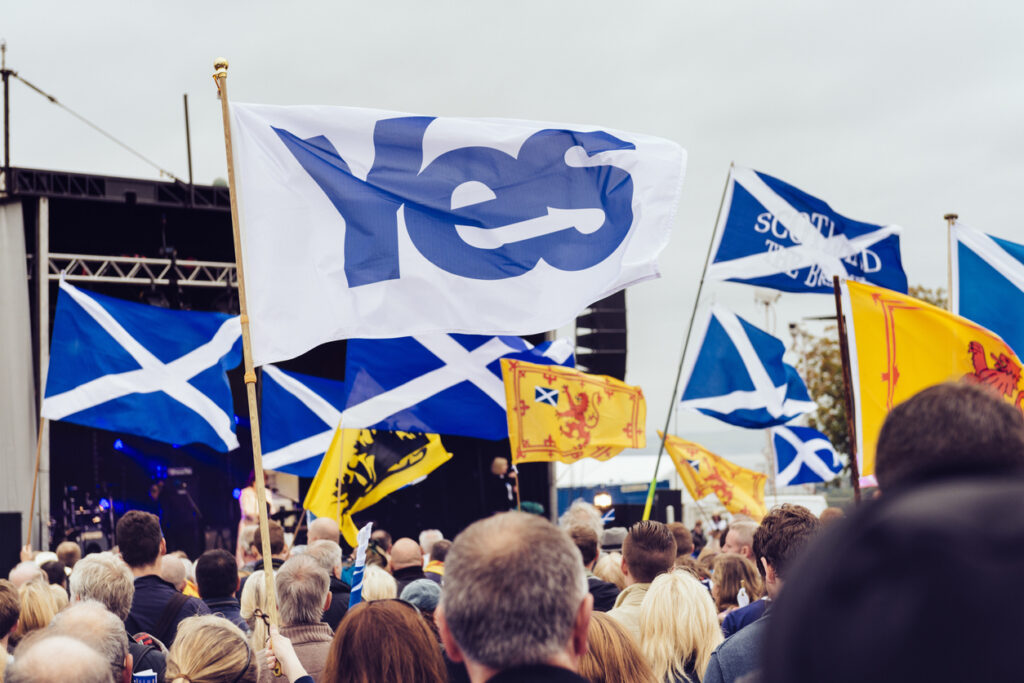
The question of Scottish independence is a central and enduring feature of Scottish and UK politics. The debate centres on whether Scotland should end the 300-year-old political union with England and become a sovereign state, independent from the United Kingdom.
While the 2014 independence referendum resulted in a 55.3% to 44.7% vote to remain in the UK, the issue has since been reinvigorated by the UK’s departure from the European Union, which a majority of Scottish voters opposed.
The power to hold a legally binding referendum on independence is not held by the Scottish Parliament. This was definitively established by the UK supreme court in a landmark ruling in November 2022.
Public opinion on the issue remains closely divided. A YouGov poll from March 2025 found that, excluding ‘don’t knows’, 54% would vote ‘No’ to independence in a referendum, while 46% would vote ‘Yes’. Polling consistently shows a significant generational divide, with the same poll indicating 59% of 16-24 year olds support independence, while 67% of those aged over 65 said they would vote against.
In 1999, the number of Scots that supported independence was reportedly as low as 27%.
The case for Scottish independence
Self-determination and political identity
The core argument for independence is the principle of self-determination. This is the idea that the people of Scotland, as a distinct nation, should make their own decisions. Proponents argue that being governed from Westminster means key decisions are made by UK governments that Scotland has not voted for.
Historically, Scotland was an independent country until the 1707 Acts of Union united Scotland with England and Wales as part of the Kingdom of Great Britain.
Political identity
Advocates for independence suggest that Scotland’s political values are different from those of the rest of the UK, particularly England. They argue that an independent Scotland could create a fairer, more equal society.
This argument has been sharpened since the 2016 Brexit referendum. Supporters of independence point to the fact that Scotland voted by 62% to remain in the EU, and argue that only through independence can Scotland’s desire to be part of the European project be realised.
Overall, the United Kingdom voted to leave the EU by 51.9% to 48.1%; England backed Brexit by 53.4% to 46.6%.
Nuclear weapons
The Scottish National Party (SNP), the main pro-independence party in Scotland, is unequivocal in its opposition to nuclear weapons, and the stationing of the UK nuclear deterrent at the Faslane naval base in Scotland, in particular. It is argued that Scottish independence would lead to the removal of nuclear weapons from Scotland.
The SNP’s manifesto for the 2024 general election stated that it had “never and will never support the retention or renewal of Trident, and will press the UK government to meet their international obligations on nuclear disarmament.”
An independent economy
Between 2022 and 2025, the Scottish government published a series of papers, titled Building a New Scotland, setting out the case for independence. One paper, professed to explain “plans for moving Scotland’s economy to one that is stronger and fairer under independence.”
The SNP argue that, with control over its own economy, an independent Scotland could create a more prosperous and equal future.
The case against Scottish independence
Economic uncertainty
The principal argument against independence focuses on economic risk and uncertainty. The rest of the UK is by far Scotland’s largest trading partner. In 2023, exports to the rest of the UK made up 60% of Scotland’s total exports, with an estimated value of £55.4 billion.
Opponents argue that creating a hard border between Scotland and England would damage this trade, harm businesses, and cost jobs.
Questions over which currency an independent Scotland would use, the country’s projected deficit, and how its share of the UK’s national debt would be calculated are central to the case for retaining the connection with the UK.
Reduced revenues from UK Funds
Calculated under the Barnett formula, the block grant for Scotland results in proportionally greater funding per head of population than in England. Opponents of Scottish independence use this statistic to argue that an independent Scotland would be financially worse off.
In 2024/25, the Barnett block grant totalled £45 billion for Scotland (before adjustments accounting for tax devolution).
Diminished international influence
It is argued that both Scotland and the remainder of the UK would have their influence diminished on the world stage. As part of the UK, Scotland benefits from its status as a member of the G7, the G20, and a permanent member of the UN Security Council. An independent Scotland would have to forge its own international path.
Re-joining the European Union
The path for an independent Scotland to re-join the EU is not guaranteed to be swift or straightforward. Under Article 49 of the Treaty on European Union, an applicant state must meet the ‘Copenhagen criteria’ concerning democracy, the rule of law, and a functioning market economy. The application would also require the unanimous agreement of all existing EU member states; some may be hesitant to encourage secessionist movements in their own countries.
Scotland’s internal security
Opponents of Scottish independence have also argued that an Independent Scotland would not be able to replicate the extensive security apparatus available to Scotland within the United Kingdom.
It is argued that an independent Scotland would lose access to the Five Eyes international security network to which the UK belongs, and the advanced cybersecurity capabilities provided by GCHQ and the Centre for the Protection of National Infrastructure.
The path to a referendum: current political and constitutional stance
The power to hold a referendum on independence rests with the UK parliament. In 2022, the Scottish government referred a prospective Referendum Bill to the UK supreme court to test its legality.
The court ruled unanimously that any legislation for a referendum on Scottish independence “relates to” the Union of the kingdoms and is therefore outside the legislative competence of the Scottish parliament. This judgment confirmed that the only lawful route to a referendum is via a “Section 30 order” from the UK government, granted ahead of the 2014 independence vote, which temporarily devolves the necessary power to Holyrood.
The SNP’s manifesto for the 2024 general election argued that independence is a “vital necessity for Scotland because decisions taken at Westminster have made life more difficult for people, families, communities and businesses across the country.”
It added: “At this election we are asking you to vote SNP for an independent Scotland. If the SNP wins a majority of Scottish seats, the Scottish government will be empowered to begin immediate negotiations with the UK government to give democratic effect to Scotland becoming an independent country.”
At the 2024 election, the SNP’s standing at Westminster collapsed from 48 seats to 9.
Since the election, the SNP’s strategy under first minister John Swinney is to build sustained and “demonstrable support” for independence among the Scottish public. Swinney has compared this to the 1997 referendum for a Scottish parliament, which was backed by 74% of Scots.
The aim is to create a political reality where refusing a referendum becomes democratically untenable for any UK government.
Evaluation question
Given the UK supreme court’s definitive ruling that Holyrood cannot hold a referendum, to what extent does the SNP’s strategy of building ‘demonstrable support’ represent a viable approach?
Swinney has also argued that it is “completely unacceptable” for the independence movement “to be thwarted by a Westminster government that just folds its arms and says ‘no’.”
Former Conservative cabinet minister Michael Gove has agreed with Swinney’s suggestion that there could be a second independence referendum if the public show “overwhelming” support for one. Gove stated that if there was “an overwhelming desire on the part of the Scottish people for [an independence referendum] then we’d have to review the decision.”
Keir Starmer, who took office as prime minister in July 2024, ruled out holding another independence referendum. The UK government has consistently argued that its focus is on economic priorities as opposed to constitutional questions.
In September 2025, Starmer said: “The point about independence for me is it’s a distraction tactic which is always deployed by the SNP when they don’t want a discussion about their record.”
He added: “We’re not having an independence referendum. It is a distraction. It won’t happen. It is a distraction from the record of the SNP.”
Andy Burnham, who took office as prime minister in July 2026, has also ruled out another indepednece referendum.
Issues to resolve should Scotland ever become independent
In the event that Scottish voters were given the opportunity to vote again on independence, and chose to support separation, a host of practical problems would result in lengthy negotiations between the rest of the UK and the newly independent Scotland.
These questions would likely focus on the following areas in particular:
Currency
A number of proposals have been made as to the approach that an Independent Scotland may adopt in relation to the currency it uses. Some have suggested that Scotland would keep the pound under an arrangement termed “adaptive sterlingisation”, whereby an independent Scotland would adopt a policy of unilateral use of the pound outside a currency union. Others have suggested that Scotland may seek to switch to the Euro.
The currency question, and the uncertainty surrounding it, was central to the anti-independence campaign at the time of the 2014 referendum.
The national debt
A settlement would be needed on how the UK’s national debt would be apportioned between an independent Scotland and the rest of the UK.
Evaluation question
How far would the complexities of untangling a 300-year-old union expose an independent Scotland to the risk of unfavourable terms regarding currency and national debt?
A technical note issued at the time of the 2014 referendum stated: “An independent Scottish state would become responsible for a fair and proportionate share of the UK’s current liabilities, but a share of the outstanding stock of debt instruments that have been issued by the UK would not be transferred to Scotland.”
The border
Arrangements would be needed for trade and travel across the Anglo-Scottish border. If an independent Scotland were to join the EU, this would become the EU’s external border with the rest of the UK, potentially requiring customs checks and infrastructure.
Defence and security
An independent Scotland would need to establish its own military and security services. Complex negotiations would be required over the extent to which a new Scottish government would retain access, if at all, to resources such as MI5 and GCHQ.
There would likely be tense discussions around the speed of the relocation of the UK’s nuclear deterrent away from Scotland. This may prove problematic, given the likely cost, time, and difficulties involved in establishing an alternative base for the UK’s nuclear arsenal.
Head of state
The SNP has proposed maintaining the king as head of state of an independent Scotland. Some in Scottish nationalist circles oppose this idea.
Upon the death of Queen Elizabeth II in September 2022, Swinney (as deputy first minister) was asked about the SNP’s position on the monarchy.
He responded: “As a representative of the mainstream opinion on the question of independence, my party’s position is that the monarch up until Thursday it was Her Majesty the queen it is now His Majesty the king should be the head of state of an independent Scotland.
“It’s what we argued in the referendum in 2014, and it’s what we will continue to argue.”
A Building a New Scotland paper published in June 2023 proposed a referendum on the question of the monarchy in the event of Scottish independence.
The document stated: “It is the Scottish government’s policy that independence in itself would not result in a change to the head of state, and that initially an independent Scotland would remain a constitutional monarchy.
“This would be the case for as long as the people of Scotland wish to retain the monarchy. The Scottish government believes that the constitutional convention is the appropriate place to consider other models for the head of state of an independent country.”
Humza Yousaf, the then first minister, then clarified that the conclusion of the constitutional convention could be “put to [the] people in a referendum”.
Further separatist waves
Any decision by the Scottish people to vote for independence would likely have a further de-stabilising effect on the remainder of the United Kingdom. It has been suggested that support for other independence causes, particularly Welsh independence and a United Ireland would gain momentum and draw inspiration from Scotland.
At the same time, it has also been suggested that separatist movements in the Orkney and Shetland islands may gain further impetus should an independent Scotland come into being. In July 2023, it was reported that Orkney council were looking into proposals to become a self-governing territory of Norway. This investigation ended in June 2025.
2014 Scottish independence referendum
The people of Scotland voted to remain part of the United Kingdom in the historic referendum on independence held on 18 September 2014. The ‘No’ campaign won with 2,001,926 votes (55.3%) against 1,617,989 votes (44.7%) for the ‘Yes’ campaign. The result was delivered on an exceptionally high national turnout of 84.6%.
The referendum was a central pledge of the SNP, which won an unprecedented overall majority in the Scottish parliament election of 2011. This mandate precipitated negotiations between the SNP-led administration and the UK Conservative-Liberal Democrat coalition government.
The 2012 Edinburgh Agreement, signed by prime minister David Cameron and first minister Alex Salmond, set out the legal framework (a Section 30 order) for the Scottish parliament to hold a single-question referendum. The agreement also provided for the franchise to be extended, for the first time, to 16 and 17-year-olds.
The question that appeared on the ballot paper, according to the Edinburgh Agreement, was as follows: “Should Scotland be an independent country?”.
Cameron did not want to be seen as frustrating the will of the Scottish people with regard to the referendum and its terms. He believed that acquiescing to Salmond’s demands, on the franchise and the referendum question, would portray a positive unionist position.
The ‘Yes Scotland’ or ‘Yes’ campaign was led by Salmond and the SNP. It combined an emotional appeal to Scottish nationhood with pledges to forge a more equitable society.
The cross-party ‘Better Together’ (‘No’) campaign, led by former chancellor Alistair Darling, included the Conservative, Labour, and Liberal Democrat parties. It launched a series of practical and economic arguments against Scottish independence.
George Osborne, the chancellor of the exchequer, insisted that Scotland would not be able to keep the pound in the event of independence. He ruled out an Anglo-Scottish monetary union, declaring: “The pound isn’t an asset to be divided up between two countries after a break-up like a CD collection.”
He added: “If Scotland walks away from the UK, it walks away from the UK pound.”
Salmond condemned the focus of the ‘No’ campaign as ‘project fear’.
In the final weeks of the campaign, the opinion polls showed ‘Yes’ gaining ground. This tightening provoked a series of panicked, if effective, tactics from the ‘No’ campaign . The leaders of the three main UK parties – Cameron, Ed Miliband and Nick Clegg – made a joint public pledge, known as “The Vow”. They promised the swift delivery of substantial new devolved powers to the Scottish parliament, ‘devo max’, if voters rejected independence.
The vow, published in the Daily Record, stated: “The Scottish parliament is permanent and extensive new powers for the parliament will be delivered by the process and to the timetable agreed and announced by our three parties, starting on 19th September.”
Cameron, Miliband and Clegg promised that a ‘No’ vote would deliver “faster, safer and better change” than independence.
Cameron was also able to secure an intervention from the queen. In the days before polling day, Elizabeth II said she hoped “people will think very carefully about the future”.
The sovereign’s comment came as she spoke to a member of the public outside the church at Crathie. When a well-wisher joked that they would not raise the referendum, the Queen remarked: “Well, I hope people will think very carefully about the future.”
Another notable intervention, from the great clunking fist of Gordon Brown, came on the final day of campaigning. In a passionate speech, Brown delivered a “patriotic” plea for Scots to vote for the union.
The former prime minister said the SNP’s main aim was to “break every single constitutional and political link with our neighbours and friends in the United Kingdom”.
The comfortable ‘No’ victory led to Salmond’s resignation as first minister and SNP leader. He was succeeded by his protégé (later nemesis) Nicola Sturgeon.
Cameron’s response to the referendum result was criticised. In speech on the steps of Downing Street, his remarks focused on the question of English votes for English laws (EVEL) – a proposed procedure whereby Scottish MPs at Westminster could be excluded from voting on matters relating specifically to England.
In late September, Cameron said the queen “purred down the line” when he informed her of the referendum result. The prime minister was overheard delivering the remark while in conversation with former New York mayor Michael Bloomberg.
Cameron told Bloomberg: “She purred down the line. I’ve never heard someone so happy.”
Historical context: the Anglo-Scottish Union of 1707
Scottish independence would involve the dissolution of the 1707 Anglo-Scottish Union.
The Kingdom of Great Britain was constituted on 1 May 1707. The new state’s flag, the Union Flag, combined the English cross of St George and the Scottish saltire of St Andrew.
It came after the Parliament of Scotland passed the Act of Union, ratifying the treaty that would formally unite the kingdoms of England and Scotland into a single state under one crown and with one parliament, on 16 January. That same month, the English Parliament passed the Union with Scotland Act 1706 (England).
The twin acts together established the Parliament of Great Britain at Westminster, with Scotland granted 45 members in the House of Commons and 16 representative peers in the House of Lords.
The road to this constitutional settlement, forged over two centuries ago, was complex and contentious. From the outset, the coalescence was tainted by well-founded accusations of bribery.
For England, the primary motivation for a full political union was to secure the Protestant supremacy created by the Glorious Revolution and prevent a Catholic Stuart monarch from using Scotland as a base to reclaim the crown.
For Scotland, the economic benefits of political union have been considered as a key motivation.
In 1698, the Scottish Parliament succumbed to a disastrous failure in attempting to set up an entrepôt for the East and West Indies on the Panama Isthmus. The scheme was abandoned in 1700 and estimated to have cost £200,000 and some 2000 lives.
On top of this, the Alien Act of 1705 (passed by the Westminster parliament) stipulated that unless the Scottish parliament returned to negotiations over a political union, then Scots would be considered as “foreign nationals” and therefore prevented from trading with or in England.
Article 15 of the union has been characterised as a straightforward sweetener, whereby a significant sum of money was set out to compensate Scotland, nominally, for her adoption of England’s national debt. The treaty stated that this money was to be paid to shareholders in the Company of Scotland – the company that had overseen the failed scheme to build a colony in Darien. Union became a way for investors to claw back money lost on the abortive colonial venture.
Political union, therefore, was a product of a series of cross-cutting religious, military, financial and imperial imperatives – as well as corruption and ineptitude. Historians continue to debate the weight that should be ascribed to each factor, especially from the Scottish perspective.
It also became an immediate source of political and social unrest.
Initial disaffection within Scotland towards the Treaty of 1707 was soon enhanced by breaches in both the spirit and letter of the union.
This resentment led to a concerted effort by Scottish politicians at Westminster to dissolve the union. In 1713, one such effort failed by only four proxy votes in the House of Lords.
The foremost beneficiary of this disaffection was Jacobitism, a complex political and religious ideology united by a shared belief in restoring the deposed Stuart dynasty (James VII of Scotland and II of England, and his descendants).
Jacobite forces mounted two serious challenges to the Union in 1715 and 1745.
History of the independence debate
The birth of the SNP (1934–1945)
The Scottish National Party (SNP) was founded at a meeting in Glasgow in April 1934, creating a single political entity dedicated to achieving self-government for Scotland. The new party was formed from the merger of the National Party of Scotland (founded 1928), a generally radical group supportive of Scottish self determination, and the more moderate Scottish Party (1932). The coalescence came after the parties collaborated in the 1933 Kilmarnock by-election, supporting the joint candidacy of Sir Alexander MacEwen.
The merger was intended to unite the home rule movement into a more coherent and effective political force. The writer and politician Robert Bontine Cunninghame Graham was appointed as the party’s first president, with MacEwen as its first chairman (leader).
The new party did not initially support the “revision of the Act of Union [1707]” (Scottish independence), instead advocating home rule/devolution. In January 1934, the National Party of Scotland and the Scottish Party agreed a resolution that committed both parties to the “establishment of a parliament in Scotland, which shall be the final authority on all Scottish affairs, including taxation and finance.”
Upon its founding, the SNP was a mostly fringe presence in Scottish politics. In its first test, the 1935 general election, the party contested eight seats, won none and lost five deposits with a combined total of 25,652 votes (1.3%). For decades, the SNP was beset by internal divisions over ideology, goals, policies and strategy. Its defining issue was whether to prioritise devolution, the moderate or gradualist position, or outright independence, the fundamentalist position.
John MacCormick, a supporter of the former position, left the party in 1942, having failed to convince the SNP of his stance. (MacCormick was also a member of the Labour Party – dual membership was permitted in the SNP until 1940). MacCormick went on to form the Scottish Covenant Association. The movement, which gathered two million signatures on a petition demanding home rule, was non-partisan and cross-party.
The pro-independence SNP won its first parliamentary seat in 1945 when Dr Robert McIntyre was returned at the Motherwell by‐election. Following the death of the constituency’s previous MP, James Walker, the main parties had agreed a truce – owing to the unusual wartime conditions.
The SNP and McIntyre, who led the SNP from 1947 to 1956, went on to lose Motherwell in the general election that followed 84 days later.
The Stone of Scone Christmas raid
In the early hours of Christmas morning 1950, four Scottish students from the University of Glasgow broke into Westminster Abbey and removed the Stone of Scone from the coronation chair.
The four conspirators – Ian Hamilton, Gavin Vernon, Kay Matheson and Alan Stuart – were members of the Scottish Covenant Association. By late 1950, however, the cause of Scottish devolution had stalled. The covenant failed to yield a parliament for Scotland. MacCormick, Rector of the University of Glasgow, helped plan the heist as an audacious assertion of Scotland’s ancient rights.
The Stone of Scone, also known as the Stone of Destiny, was the stone upon which Scottish monarchs had been crowned. In 1296, during the First War of Scottish Independence, King Edward I of England removed the stone from Scone Abbey. He transported the red sandstone block – a symbolic spoil of war – to Westminster, where it was fitted into the base of a specially commissioned carved-oak chair. King Edward’s Chair, with its spacious foundation, is still used at Westminster Abbey for the coronation of British monarchs.
In December 1950, Hamilton, Vernon, Matheson and Stuart drove from Glasgow to London in two Ford Anglias. The journey took a reported 18 hours. At approximately 4:00 am on 25 December, the three men entered Westminster Abbey via a works yard near Poet’s Corner. They pried the 336 lb (152 kg) sandstone block from the cavity beneath the King Edward’s Chair; during the extraction, however, the ancient stone split into two pieces. It was later established that the stone had been damaged by a Women’s Social and Political Union (WSPU) bomb, loaded with metal bolts and nuts, which exploded next to the coronation chair in June 1914.
Hamilton, improvising, dragged the smaller fragment to one of the waiting cars. When a policeman approached the vehicle, Hamilton and Matheson pretended to kiss. The officer, unaware that a piece of the coronation regalia was covered by a coat in the back seat, shared a cigarette with them. He then told them to move on.
The authorities soon discovered the coronation chair’s vacant chamber; roadblocks were erected and a nationwide search began. The border between Scotland and England was closed by police – for the first time in 400 years. The Dean of Westminster, Alan Don, described the theft as a “senseless crime” by “sacrilegious hands”.
The first clue that the stone was retrieved by Scottish nationalists lay in the discovery of the initials “JFS”, newly inscribed on the coronation chair. JFS was believed to stand for “Justice for Scotland”. The Scottish Covenant Association, however, denied involvement.
The stone remained missing for four months until 11 April 1951, when the students left the stone on the high altar of Arbroath Abbey – the site where the Declaration of Arbroath was issued in 1320. Two unsigned letters were placed on top of the stone, including one addressed to King George VI.
Following a police investigation, the four students were identified and interviewed. However, the attorney general, Hartley Shawcross, decided against prosecution.
Breakthrough: Hamilton and the development of Scottish nationalism
The SNP has had continuous parliamentary representation since 1967, when Winnie Ewing secured a famous victory in the Hamilton by-election. The SNP’s Hamilton breakthrough came a full 22 years after McIntyre took his seat as the MP for Motherwell.
In the 1966 general election, the SNP won 5% of the vote across Scotland, having contested just 23 of the 71 Scottish seats. Ahead of the Hamilton by-election, the SNP leadership reportedly told Ewing merely to “try to come a good second in order to encourage the members.”
Ewing, a Glasgow solicitor, ran an energetic 18-month campaign. The result, announced in the early hours of 3 November, shocked the political establishment. Ewing secured 18,397 votes (46.0%), defeating the Labour candidate, Alexander Wilson, who received 16,598 votes (41.5%).
In the wake of her victory, Ewing declared: “Stop the world, Scotland wants to get on.”
Ewing failed to retain Hamilton at the subsequent 1970 general election, losing by a majority of 8,582. But her 1967 victory had an immediate impact. It provided the SNP with hitherto elusive electoral credibility and publicity. In 1970, the SNP won its first seat in a general election. This came with Donald Stewart’s capture of the Western Isles constituency.
The SNP’s breakthrough in Hamilton – considered alongside Plaid Cymru’s success in Carmarthen – led to the establishment of the Royal Commission on the Constitution (the Kilbrandon Commission) by the Labour government in 1969. The commission’s work constituted the first major study of the constitutional challenges posed by multi-national governance and rising national consciousness.
Its terms of reference required it to examine “the present functions of the legislature and government in relation to the several countries, nations and regions of the United Kingdom” and to consider “whether any changes are desirable in those functions or in existing constitutional and economic relationships.”
The report, published in October 1973 after a four-year inquiry, rejected both independence and federalism for the constituent nations of the UK, instead recommending legislative devolution for Scotland and Wales in the form of elected assemblies.
The February 1974 election saw a surge in support for the nationalist parties. The SNP’s representation rose from one seat to seven seats; its share of the vote doubled to 21.9%. Plaid Cymru won seats (two) for the first time at a general election.
The October 1974 election returned Harold Wilson’s Labour government with a small majority, which withered over the course of the parliament. The SNP once again improved its standing, securing 11 MPs and 30% of the vote north of the border.
James Callaghan, who succeeded Wilson as prime minister in 1976, responded with the Scotland Act 1978 and the Wales Act 1978 – both of which provided for the establishment of devolved assemblies, subject to post-legislative referenda.
SNP MPs withdrew their support for James Callaghan’s minority Labour government in the aftermath of the 1979 Scottish devolution referendum – which was lost, effectively, on a technicality.
In Scotland, a narrow majority of 51.6% (1,230,937 votes) voted in favour of the proposed devolution scheme, with 48.4% (1,153,502) voting against. On a turnout of 63.8%, however, the ‘Yes’ vote represented only 32.9% of the electorate; this failed to meet the threshold set by the so-called “40% clause”, which required at least 40% of the total registered electorate to vote ‘Yes’ for the Scotland Act to be implemented.
A vote of no confidence followed, and with it the 1979 general election.
In that contest, the SNP was reduced to 9 seats.
The road to devolution: a Claim of Right
In the following decades, however, the cause was sustained by the growing strength of Labour’s pro‑devolution tendency, the policies of Margaret Thatcher’s Conservative government, and the ability of nationalist parties to maintain – and improve – their parliamentary standing.
On 30 March 1989, a wide coalition of politicians and civic leaders gathered in Edinburgh to sign “A Claim of Right for Scotland”. The gathering marked the beginning of a new phase in the long campaign for Scottish devolution/home rule.
The event, which took place in the General Assembly Hall of the Church of Scotland, channelled the growing political consensus that a new constitutional settlement was needed. A statement of principle, the Claim of Right explicitly acknowledged and asserted “the sovereign right of the Scottish people to determine the form of government best suited to their needs”.
The claim therefore, marked a political rupture with the Diceyan understanding of the UK’s constitutional settlement that sovereignty was vested solely in the parliament at Westminster. The principle of parliamentary sovereignty had featured at the forefront of the debates on devolution in the 1970s.
The claim also outlined a three-fold mandate for the new Scottish Constitutional Convention (SCC) to “prepare”, seek “approval for” and “implement” a devolution/home rule scheme.
To this pledge, MPs, MEPs and councillors of the Scottish Labour Party, Scottish Liberal Democrats, Social Democratic Party, Co-operative Party, Communist Party, Scottish Green Party, the Orkney and Shetland Movement and several civil society representatives signed their names in an act of astonishing political theatre.
Of Labour’s Scottish MPs, only veteran anti-devolutionist Tam Dalyell MP withheld his signature. Dalyell’s refusal meant 59 of Scotland’s 72 MPs had signed the document. Signatories therefore included two future Labour leaders, John Smith and Gordon Brown; other senior figures such as Robin Cook and Alistair Darling; privy counsellors Smith and Donald Dewar; and veteran anti-devolutionists like Brian Wilson, Bob Hughes and Eric Milligan.
This view of “the sovereign right of the Scottish people” was given historical meaning by theologian and ecumenical Methodist Canon Kenyon Wright, the new chair of the convention’s executive committee.
In his keynote address to the convention’s inaugural session, he declared: “It is exactly 300 years since the Scottish Parliament passed the first Claim of Right in Scottish history in 1689—not far from where we now meet. We are in the mainstream of Scottish Constitutional history. … The Claim of Right of 1689 stated that King James VII was deposed because he violated, and I quote, ‘the fundamental constitution of this Kingdom and altered it from a legal limited monarchy to an arbitrary despotic power’.
“The Claim of Right of 1989 is not so very different.”
Co-chaired by Liberal Democrat David Steel and Labour’s Harry Ewing, the SCC brought together representatives of the pro-devolution political parties, along with civil society organisations, churches, trade unions and business groups.
The Conservative Party opposed the process and the SNP, buoyed by the 1988 Glasgow Govan by-election, ultimately withdrew in protest at the convention’s refusal to consider independence as a constitutional option.
The SCC produced two reports, Towards Scotland’s Parliament (1992), and Scotland’s Parliament, Scotland’s Right (1995).
The latter contribution provided a blueprint for the devolution scheme adopted by New Labour in the late 1990s.
The anti-devolution element in Labour had effectively disappeared by the time of the 1997 pre-legislative referenda. Talk of a “parliament” in 1997 – as opposed to an “assembly” – reflected the rhetorical and practical development of the devolution argument.
The devolution era: a parliament re-convened
On 11 September 1997, Scotland voted emphatically in favour of a devolved parliament with tax-varying powers. The 1997 referendum also asked two separate questions: one to gauge opinion on the principle of a parliament and another to tackle its tax-raising powers.
On the first question, 1,775,045 voters (74.3%) voted ‘Yes’. 614,400 (25.7%) voted ‘No’.
On the second question regarding tax-varying powers, 1,512,889 voters (63.5%) voted ‘Yes’. 870,263 (36.5%) voted ‘No’.
Composed of 129 elected representatives and located opposite Holyrood Palace in Edinburgh, the Scottish Parliament gained the power to legislate across a range of policy areas. The first elections to the Scottish Parliament were held in May 1999. On 12 May, the Scottish parliament officially convened – or “re-convened” in the words of the mother of the new house and SNP icon Winnie Ewing.
Opening the session, the 79-year-old Ewing declared: “I want to start with the words that I have always wanted either to say or to hear someone else say – the Scottish Parliament, which adjourned on 25 March, 1707, is hereby reconvened.”
Donald Dewar was elected as the inaugural first minister of Scotland on 13 May by his fellow MSPs, during an early session of the newly established Scottish parliament at its temporary home in the Assembly Hall of the Church of Scotland in Edinburgh. To form a stable administration, Labour entered into a coalition partnership with the Liberal Democrats. The agreement, reached shortly before the vote, created a comfortable majority in the new parliament.
Dewar announced his first cabinet in May 1999, which included two Liberal Democrat MSPs. Jim Wallace became deputy first minister and minister for justice; fellow Liberal Democrat Ross Finnie served as minister for rural affairs.
This Lib-Lab partnership proved remarkably stable, lasting through two elections and three different Labour first ministers (Dewar, Henry McLeish, and Jack McConnell) until 2007.
From 1999 to 2007, the SNP served as the official opposition. The party, led by Alex Salmond, won 35 seats in the 1999 Scottish Parliament election.
The SNP ascendancy and the path to 2014
The SNP emerged as the largest party following the 2007 Scottish Parliament election, winning 47 seats.
Subsequently, in 2011, the SNP won an unprecedented overall majority in the Scottish parliament election, confounding pollsters and expectations. The SNP secured 69 of the 129 seats at Holyrood – a majority of four. It was an outcome that the parliament’s additional member voting system was designed to prevent. Under Holyrood’s additional member system (AMS), voters in Scotland are given two ballots: one to elect 73 constituency members under the first past the post (FPTP) system; and a second to elect 56 ‘additional’ MSPs, seven for each of eight regions. In 2011, the SNP took 45.4% of the constituency vote and 44.7% of the regional vote, increasing their number of MSPs by 22 (compared to the notional 2007 base, adjusted for boundary changes).
David Cameron, the prime minister, congratulated the SNP leader for an “emphatic win”.
The result fundamentally altered the constitutional debate in the UK, setting Scotland on a direct path to the 2014 independence referendum. In January 2012, after Cameron called for greater clarity as to the SNP’s intentions, Salmond set out his intention to hold an independence referendum in the autumn of 2014. The UK government did not stand in its Scottish counterpart’s way.
The defeat of the independence cause in 2014 precipitated Salmond’s resignation as SNP leader and first minister. He was replaced in both roles by Nicola Sturgeon.
Brexit and ‘IndyRef2’
The UK government established the Smith commission on 19 September 2014 with a view to fulfilling the “Vow”, set out during the referendum campaign. The commission was tasked convening “cross-party talks” to produce “recommendations for further devolution of powers to the Scottish Parliament”.
It proposed that the UK parliament grant significant new tax powers to the Scottish parliament and legislate to confirm the institution’s “permanence”.
The Scotland Act 2016 effectively enacted the recommendations of the Smith commission. The act stated that the Scottish parliament and the Scottish government are considered permanent parts of the UK’s constitutional arrangements. It also devolved significant new social security powers to the Scottish parliament.
The act also placed the ‘Sewel convention’ – the recognition that the UK parliament would not “normally legislate with regard to devolved matters without the consent of the Scottish parliament” – on a legislative footing.
The Scotland Act 2016 declared: “The Scottish Parliament and the Scottish government are a permanent part of the United Kingdom’s constitutional arrangements.”
In line with the recommendation of the Smith commission, this measure was an attempt to deliver a measure of entrenchment within the bounds of the UK constitution.
The SNP’s electoral surge continued through to the 2015 general election, when the party won 56 out of 59 available seats. Labour was the principal victim of this latest expression of nationalist sentiment; Miliband’s party collapsed from 40 seats in Scotland to just one.
Cameron survived the 2014 Scottish independence referendum, and secured a shock Conservative majority at the 2015 general election. However, his manifesto contained a promise to hold a potentially more tricky plebiscite.
In the 2016 referendum on Britain’s membership of the EU, Scotland supported the ‘Remain’ position. England and the United Kingdom as a whole voted by 52% to 48% in favour of ‘Leave’.
This precipitated Cameron’s resignation and a renewed push for a second independence referendum or IndyRef2. The SNP argued that the Brexit debate reflected England and Scotland’s divergent political cultures – arguably the key component of the independence case.
Evaluation question
To what extent did the 2016 Brexit vote fundamentally alter the constitutional context of the independence debate, justifying the SNP’s demand for a second referendum? Placement after “…cultures – arguably the key component of the independence case.”
From 2016 to 2024, the SNP remained electorally dominant in Scotland.
In the 2019 general election, the SNP secured 48 out of 59 seats.
Buoyed by polls that suggest that a majority of Scottish voters favoured independence, the SNP went into the 2021 Scottish Parliament elections actively campaigning for a second referendum on Scottish Independence. The SNP won 64 of the 129 seats, one short of an overall majority.
From 2021 to 2024, the SNP governed with the support of the pro-independence Scottish Green Party through a power-sharing deal known as the Bute House Agreement. Two Green MSPs, Patrick Harvie and Lorna Slater, were appointed as ministers. Under the deal, Green ministers attended cabinet meetings at least twice a year.
This coalition government, citing its electoral mandate, formally initiated its campaign for a second independence referendum. In June 2022, Sturgeon unveiled a series of papers titled Building a New Scotland, which were designed to build a fresh case for independence. She announced her intention to hold a consultative referendum on the 19th of October 2023.
However, the crucial question of the legality of the Scottish Parliament legislating for such a referendum without the consent of the UK parliament remained a significant obstacle. The Scotland Act 1998, which established the Scottish Parliament, reserves matters relating to the Union of the Kingdoms of Scotland and England to the UK Parliament in Westminster.
Setbacks from Sturgeon to Swinney
To proceed with a legally binding referendum, a Section 30 order from the UK government would be required, a power the Conservative government at Westminster, under successive prime ministers Boris Johnson, Liz Truss, and Rishi Sunak, consistently refused to grant.
In an attempt to circumvent this, the Scottish government sought a ruling from the UK’s supreme court on whether the Scottish parliament had the authority to legislate for a consultative referendum on its own. In November 2022, the Supreme Court delivered a unanimous verdict, ruling that the Scottish Parliament does not have the power to legislate for a referendum on Scottish independence without the consent of the UK parliament. The court determined that any referendum, even a consultative one, would relate to the reserved matter of the Union and was therefore outside the legislative competence of Holyrood.
Evaluation question
Is it right that the UK government can indefinitely refuse a Section 30 order – even if a pro-independence majority is repeatedly elected to the Scottish Parliament?
This ruling was a significant blow to the SNP’s strategy. In response, Nicola Sturgeon declared that the 2024 UK general election would be treated as a “de facto referendum” on Scottish independence. This new approach was met with some internal debate within the SNP.
The political landscape of Scottish nationalism saw a significant shift in February 2023, when Sturgeon, after eight years as first minister, announced her resignation. Her successor, Humza Yousaf, who won the SNP leadership contest in March 2023, pledged to continue the push for independence.
In April 2024, Yousaf’s decision to end the power-sharing agreement with the Scottish Greens led to a vote of no confidence, which he pre-empted by announcing his own resignation in early May 2024.
Following Yousaf’s brief tenure, John Swinney, a veteran of the SNP and a former deputy first minister under both Alex Salmond and Nicola Sturgeon, was elected as the new leader of the SNP and became Scotland’s first minister in May 2024 – just weeks before a UK general election was called for 4 July.
Swinney entered the campaign seeking to steady the ship. The SNP’s manifesto continued to foreground independence, with the first page declaring: “VOTE SNP FOR SCOTLAND TO BECOME AN INDEPENDENT COUNTRY.”
The official strategy, carried over from his predecessors, stated that winning a majority of the 57 Scottish seats at Westminster would empower the Scottish government to begin immediate negotiations with the UK government on independence.
The results of the 2024 general election marked a seismic shift in the Scottish political landscape and a severe setback for the independence movement. The SNP’s long-held electoral dominance crumbled as the party’s representation at Westminster was decimated, falling from 48 to just 9 seats. In a dramatic reversal of fortunes, the Labour Party surged back to prominence in its former heartland, winning 37 seats and becoming the largest Scottish party at Westminster for the first time since 2010. The SNP’s share of the vote fell by 15 points to 30%, while Labour’s rose by over 16 points to 35.3%.
In the wake of this crushing defeat, Swinney conceded that the SNP had “failed to convince people of the urgency of independence” and that the party’s strategy would have to be fundamentally rethought. The “de facto referendum” plan was rendered irrelevant, and the immediate prospect of another independence vote vanished.
The election result threw the future direction of the independence movement into question.
In the 2026 Scottish Parliament election, the SNP won 58 seats – a net loss of six. Scottish Labour lost five seats, winning a total of 17. The question of Scottish independence did not feature as a central campaign issue.
Quotes
“No one, absolutely no one, will do a better job of running Scotland than the people who live and work in Scotland. On September 18, we have the opportunity of a lifetime” – first minister Alex Salmond, 2014
“People can feel it is a bit like a general election, that you make a decision and five years later you can make another decision… if you’re fed up with the effing Tories give them a kick. This is totally different from a general election, this is a decision about not the next five years, it’s a decision about the next century.” – David Cameron, prime minister, 2014.
“The more I listen to the ‘Yes’ campaign, the more I worry about its minimisation and even denial of risks. Whenever the big issues are raised – our heavy reliance on oil revenue if we become independent, what currency we’ll use, whether we’ll get back into the EU – reasonable questions are drowned out by accusations of ‘scaremongering’” – Author JK Rowling, and supporter of the ‘No’ campaign in 2014.
“Huge day for Scotland today! No campaign negativity last few days totally swayed my view on it. Excited to see the outcome. Lets do this!” – Andy Murray, Scottish tennis player, 2014
“The United Kingdom has been an extraordinary partner to us – from the outside at least it looks like things have worked pretty well and we obviously have a deep interest in making sure that one of the closest allies that we will ever have remains [a] strong, robust, united and effective partner” – US president Barack Obama, 2014
“It is the Scots who have succeeded most in preserving the British idea of fairness and compassion in terms of state support and intervention. Ironically, it is England, since the 1980s, which has embarked on a separate journey” – Leading Scottish historian Tom Devine, 2014.
“Westminster rule over Scotland cannot be based on anything other than a consented, voluntary partnership. It is time to give people the democratic choice they have voted for, and then with independence to build a more prosperous, fairer country in a true partnership of equals between Scotland and our friends in the rest of the UK.” – Nicola Sturgeon, first minister, 2022.
“We believe the focus of the next parliament has to be clearing those NHS backlogs. Having that national emergency, the focus has got to be stopping the government’s addiction to waste.” – Anas Sarwar, leader of the Scottish Labour Party, 2025
Additional resources
- The Scottish Government – Building a New Scotland: https://www.gov.scot/newscotland/

