Scotland votes ‘No’ to independence in referendum
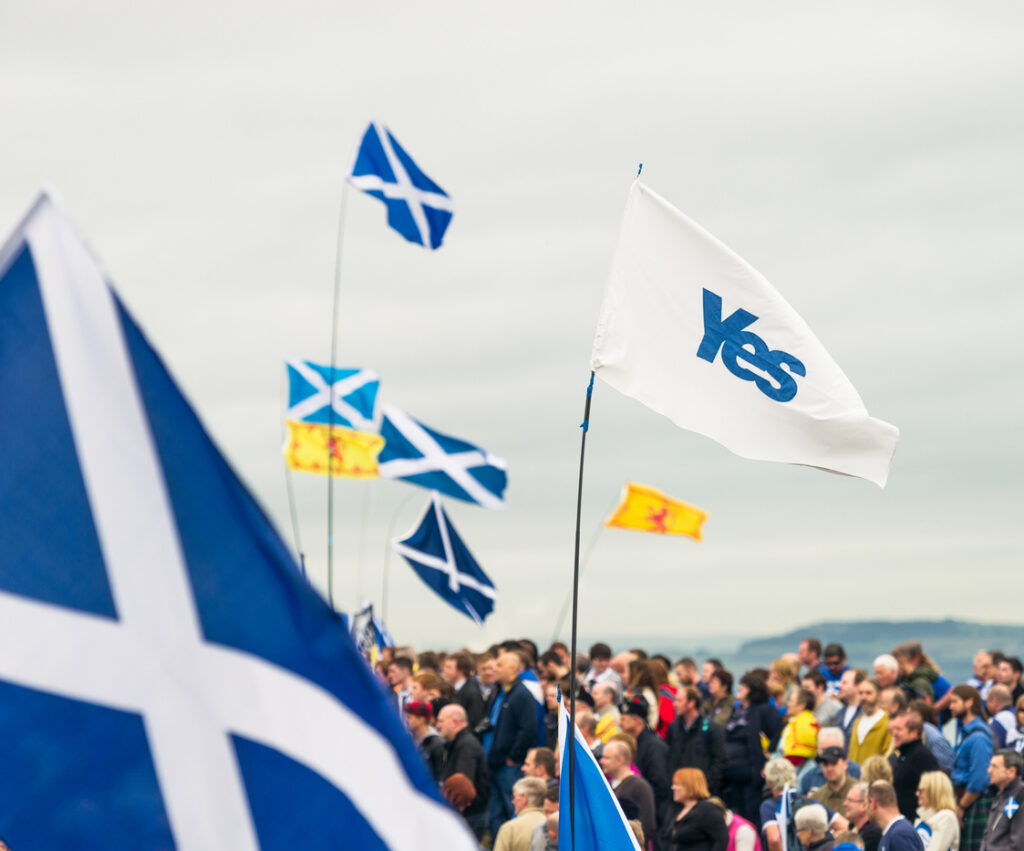
On 18 September 2014, the people of Scotland voted to remain part of the United Kingdom in a historic referendum on independence. The ‘No’ campaign won with 2,001,926 votes (55.3%) against 1,617,989 votes (44.7%) for the ‘Yes’ campaign.
The result was delivered on an exceptionally high national turnout of 84.6%.
The referendum was a central pledge of the Scottish National Party (SNP), which won an unprecedented overall majority in the Scottish parliament election of 2011. This mandate precipitated negotiations between the SNP-led administration and the UK Conservative-Liberal Democrat coalition government. David Cameron, the prime minister, congratulated Alex Salmond, the SNP leader and first minister, on an “emphatic win”.
The 2012 Edinburgh Agreement, signed by Cameron and first minister Alex Salmond, set out the legal framework (a Section 30 order) for the Scottish parliament to hold a single-question referendum. The agreement also provided for the franchise to be extended, for the first time, to 16 and 17-year-olds.
The question that appeared on the ballot paper, according to the Edinburgh Agreement, was as follows: “Should Scotland be an independent country?”.
Cameron did not want to be seen as frustrating the will of the Scottish Parliament with regard to the referendum and its terms. He believed that acquiescing to Salmond’s demands, on the franchise and the referendum question, would portray a positive unionist position.
The ‘Yes Scotland’ or ‘Yes’ campaign was led by Salmond and the SNP. It combined an emotional appeal to Scottish nationhood with pledges to forge a more equitable society.
The cross-party ‘Better Together’ (‘No’) campaign, led by former chancellor Alistair Darling, included the Conservative, Labour, and Liberal Democrat parties. It launched a series of practical and economic arguments against Scottish independence.
George Osborne, the chancellor of the exchequer, insisted that Scotland would not be able to keep the pound in the event of independence. He ruled out an Anglo-Scottish monetary union, declaring: “The pound isn’t an asset to be divided up between two countries after a break-up like a CD collection.”
He added: “If Scotland walks away from the UK, it walks away from the UK pound.”
Salmond condemned the focus of the ‘No’ campaign as ‘project fear’.
***
In the final weeks of the campaign, the opinion polls showed ‘Yes’ gaining ground. This tightening provoked a series of panicked, if effective, tactics from the ‘No’ campaign . The leaders of the three main UK parties – Cameron, Ed Miliband and Nick Clegg – made a joint public pledge, known as “The Vow”. They promised the swift delivery of substantial new devolved powers to the Scottish parliament, ‘devo max’, if voters rejected independence.
The vow, published in the Daily Record, stated: “The Scottish parliament is permanent and extensive new powers for the parliament will be delivered by the process and to the timetable agreed and announced by our three parties, starting on 19th September.”
Cameron, Miliband and Clegg promised that a ‘No’ vote would deliver “faster, safer and better change” than independence.
Cameron was also able to secure an intervention from the Queen. In the days before polling day, Elizabeth II said she hoped “people will think very carefully about the future”.
The sovereign’s comment came as she spoke to a member of the public outside the church at Crathie. When a well-wisher joked that they would not raise the referendum, the Queen remarked: “Well, I hope people will think very carefully about the future.”
It was seen as an endorsement of the ‘No’ campaign’s message of caution.
Another notable intervention, from the great clunking fist of Gordon Brown, came on the final day of campaigning. In a passionate speech, Brown delivered a “patriotic” plea for Scots to vote for the union.
The former prime minister said the SNP’s main aim was to “break every single constitutional and political link with our neighbours and friends in the United Kingdom”.
Brown declared: “At last, the world is hearing the voices of the real people of Scotland.
“The silent majority will be silent no more. And our patriotic vision, proud of our Scottish identity, proud of our distinctive Scottish institutions, proud of the Scottish Parliament that we, not the Nationalist party, created.”
He added: “Have confidence. Our stronger Scottish parliament meets the needs and aspirations of the Scottish people. Have confidence our future lies in co-operation and sharing, and not in separation and splitting apart, that unity is our strength.”
He warned that the SNP is leading Scotland into “a trap” – an “economic minefield where problems could implode at any time”.
Brown concluded: “Have confidence and say to our friends – for reasons of solidarity, sharing, justice, pride in Scotland, the only answer for Scotland’s sake and for Scotland’s future is vote ‘No’.”
***
The comfortable ‘No’ victory led to Salmond’s resignation as first minister and SNP leader. He was succeeded by his protégé, Nicola Sturgeon.
In his resignation statement, Salmond said: “I am immensely proud of the campaign which Yes Scotland fought and of the 1.6 million voters who rallied to that cause by backing an independent Scotland…
“But today the point is this. The real guardians of progress are not the politicians at Westminster, or even at Holyrood, but the energised activism of tens of thousands of people who I predict will refuse meekly to go back into the political shadows.
“For me right now, therefore there is a decision as to who is best placed to lead this process forward politically.
“I believe that in this new exciting situation, redolent with possibility, party, parliament and country would benefit from new leadership.”
He added: “It has been the privilege of my life to serve Scotland as first minister. But as I said often during the referendum campaign this is not about me or the SNP. It is much more important than that.
“The position is this. We lost the referendum vote but can still carry the political initiative. More importantly Scotland can still emerge as the real winner.”
Cameron’s response to the referendum result was criticised. In speech on the steps of Downing Street, his remarks focused on the question of English votes for English laws (EVEL) – a proposed procedure whereby Scottish MPs at Westminster could be excluded from voting on matters relating specifically to England.
The prime minister declared: “We have heard the voice of Scotland – and now the millions of voices of England must also be heard. The question of English votes for English laws – [Tam Dalyell’s] West Lothian question – requires a decisive answer.”
In late September, Cameron said the Queen “purred down the line” when he informed her of the referendum result. The prime minister was overheard delivering the remark while in conversation with former New York mayor Michael Bloomberg.
Cameron told Bloomberg: “She purred down the line. I’ve never heard someone so happy.”
The prime minister subsequently said he felt “extremely sorry and very embarrassed” about the remark.
***
The UK government established the Smith commission on 19 September 2014 with a view to fulfilling the “Vow”. The commission was tasked with convening “cross-party talks” to produce “recommendations for further devolution of powers to the Scottish Parliament”.
It proposed that the UK parliament grant significant new tax powers to the Scottish parliament and legislate to confirm the institution’s “permanence”.
The Scotland Act 2016 effectively enacted the recommendations of the Smith commission. The act declared that the Scottish parliament and the Scottish government are considered permanent parts of the UK’s constitutional arrangements. It also devolved significant new social security powers to the Scottish parliament.
The act also placed the ‘Sewell convention’ – the recognition that the UK parliament would not “normally legislate with regard to devolved matters without the consent of the Scottish parliament” – on a legislative footing.
The Scotland Act 2016 declared: “The Scottish Parliament and the Scottish government are a permanent part of the United Kingdom’s constitutional arrangements.”
In line with the recommendation of the Smith commission, this measure was an attempt to deliver a measure of entrenchment within the bounds of the UK constitution.
***
The SNP’s electoral surge continued through to the 2015 general election, when the party won 56 out of 59 available seats. Labour was the principal victim of this latest expression of nationalist sentiment; Miliband’s party collapsed from 40 seats in Scotland to just one.
Cameron survived the 2014 Scottish independence referendum, and secured a shock Conservative majority at the 2015 general election. However, his manifesto contained a promise to hold a potentially more tricky plebiscite.
In the 2016 referendum on Britain’s membership of the European Union (EU), Scotland supported the ‘Remain’ position. England and the United Kingdom as a whole voted by 52% to 48% in favour of ‘Leave’.
This precipitated Cameron’s resignation and a renewed push for a second independence referendum or IndyRef2. The SNP argued that the Brexit debate reflected England and Scotland’s divergent political cultures – arguably the key component of the independence case.
Politics.co.uk Newsletters
DAILY
Politics@Lunch
WEEKLY
Week in Review