SNP wins historic majority in Scottish Parliament election
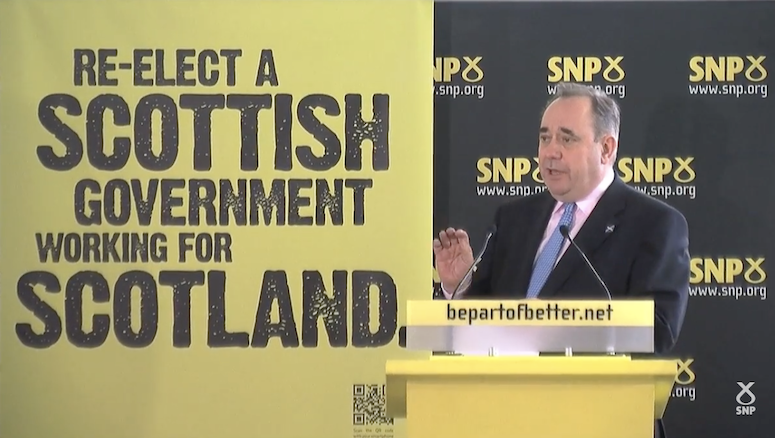
On 5 May 2011, the Scottish National Party (SNP), led by Alex Salmond as first minister, won an unprecedented overall majority in the Scottish parliament election, confounding pollsters and expectations.
The SNP secured 69 of the 129 seats at Holyrood – a majority of four. It was an outcome that the parliament’s additional member voting system was designed to prevent.
Under Holyrood’s additional member system (AMS), voters in Scotland are given two ballots: one to elect 73 constituency members under the first past the post (FPTP) system; and a second to elect 56 ‘additional’ MSPs, seven for each of eight regions. In 2011, the SNP took 45.4% of the constituency vote and 44.7% of the regional vote, increasing their number of MSPs by 22 (compared to the notional 2007 base, adjusted for boundary changes).
Turnout in the constituency vote was 50.3% and 50.4% in the regional vote.
***
From 1999 to 2007, the SNP served as the official opposition in the Scottish Parliament. In the 2007 Holyrood election, the SNP emerged as the largest party, winning 47 seats and unseating the Labour Party, which had governed Scotland since the dawn of devolution.
Salmond, the leader of the SNP since September 2004, was appointed as the first non-Labour first minister of Scotland. From 2007 to 2011, Salmond led a minority SNP government.
The 2011 result was a landmark achievement for the SNP and a triumph for its leader.
The SNP captured a series of traditional Labour heartlands and benefitted from a Scotland-wide collapse in support for the Liberal Democrats. Labour constituency seats fell to the SNP in Glasgow and the West of Scotland, while Liberal Democrat strongholds in the Highlands, Fife, and Edinburgh were also swept up by Salmond’s party.
Scottish Labour, which had been turfed out of office in 2007, lost seven seats on the night and saw its share of the vote fall further. It finished a distant second on 37 seats.
The Scottish Liberal Democrats, who were in a coalition government with the Conservatives at Westminster, were almost wiped out, being reduced from 17 seats to just five. The Scottish Conservatives lost two seats, securing 15 overall.
Salmond described his party’s performance as “a victory for a society and a nation”.
Delivering an address in Edinburgh, Salmond said: “I’ll govern for all of the ambitions for Scotland and all the people who imagine that we can live in a better land.
“This party, the Scottish party, the national party, carries your hope. We shall carry it carefully and make the nation proud.”
Salmond maintained that the result gave his party the “moral authority” to deliver a referendum on Scottish independence in the next five years. “Just as the Scottish people have restored trust in us, we must trust the people as well”, he said. “Which is why, in this term of the parliament, we will bring forward a referendum and trust the people on Scotland’s own constitutional future.”
Referring to one of the SNP’s predecessors, the National Party of Scotland (NPS), he added: “Some 70 years and more later, the SNP can finally say that we have lived up to that accolade as the national party of Scotland.
“We have reached out to every community across this country.”
Independence was mostly a minor issue during the campaign. The SNP capitalised on Salmond’s popularity with a quasi-presidential campaign – as well as its newfound reputation for competent administration.
***
David Cameron, the prime minister, congratulated the SNP leader for an “emphatic win”.
Cameron said: “I passionately believe in our United Kingdom, so I congratulate Alex Salmond on his emphatic win, but I will do everything obviously as British prime minister to work with the first minister of Scotland, as I always do, and treat the Scottish people and the Scottish government with the respect they deserve.
“But on the issue of the United Kingdom, if they want to hold a referendum, I will campaign to keep our United Kingdom together, with every single fibre that I have.”
The Scottish Labour campaign came in for considerable criticism. Henry McLeish, who served as first minister from 2000 to 2001, said his party had suffered “a drubbing”.
He added: “It has been the most negative campaign I have seen. What do we stand for? What are we offering Scotland? The obvious conclusion is that they didn’t want us.”
In the aftermath, all of the Labour, Liberal Democrat and Conservative Party leaders, Iain Gray, Tavish Scott and Annabel Goldie, announced their resignations.
The contest came on the same day as a UK-wide referendum on the use of the alternative vote (AV) for elections to the House of Commons.
The result fundamentally altered the constitutional debate in the UK, setting Scotland on a direct path to the 2014 independence referendum. In January 2012, after Cameron called for greater clarity as to the SNP’s intentions, Salmond set out his intention to hold an independence referendum in the autumn of 2014. The UK government did not stand in its Scottish counterpart’s way.
The people of Scotland voted to remain part of the United Kingdom in the Scottish independence referendum, a central pledge of the SNP. The ‘No’ campaign won with 2,001,926 votes (55.3%) against 1,617,989 votes (44.7%) for the ‘Yes’ campaign. The result was delivered on an exceptionally high national turnout of 84.6%.
The defeat of the independence cause in 2014 precipitated Salmond’s resignation as SNP leader and first minister. He was replaced in both roles by Nicola Sturgeon, the deputy first minister since 2007 and his political protege.
The 2011 Scottish Parliament result also presaged the collapse of Labour’s standing in Scotland at the 2015 general election.
The SNP won 56 out of 59 available seats in 2015. Labour collapsed from 40 seats in Scotland to just one.

Politics.co.uk Newsletters
DAILY
Politics@Lunch
WEEKLY
Week in Review
