Ukip tops poll in European elections in political ‘earthquake’
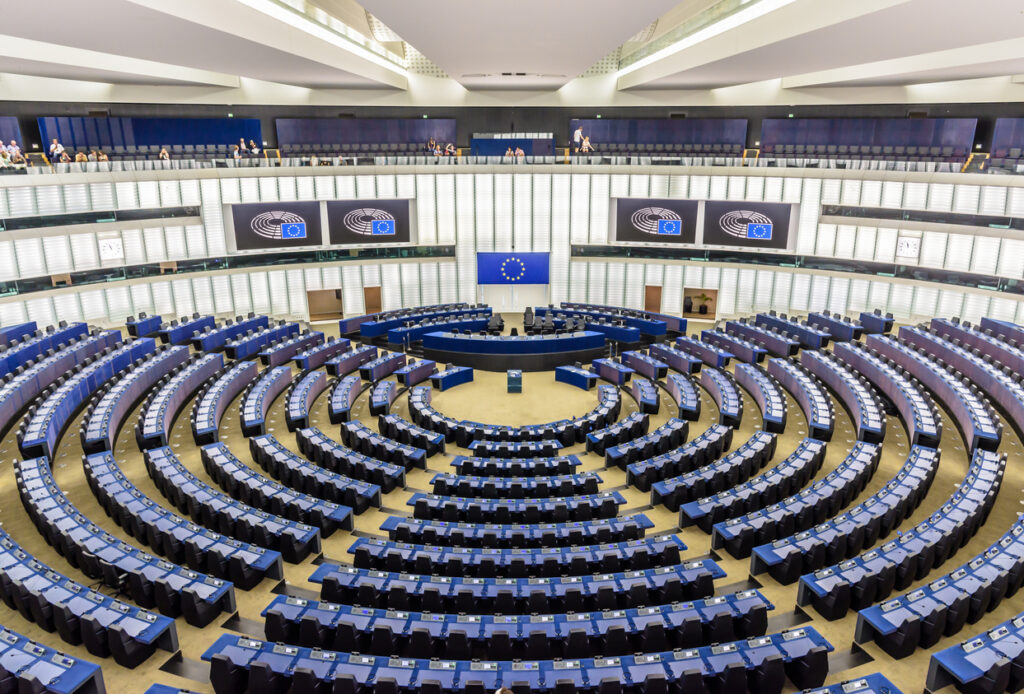
On 22 May 2014, the UK Independence Party (Ukip) secured the largest share of the vote in the European Parliament elections – a result that sent shockwaves through British politics. It was the first time in over a century (since 1910) that a national election had not been won by either the Conservative or Labour parties.
Ukip secured 27.5% of the vote, winning 24 of the UK’s 73 seats in the European parliament.
The European Parliament elections had long been a happy hunting ground for the party – on account of the proportional electoral system, the issues at hand and the apparent opportunity for voters to register a protest. In 1999, the party – founded six years previously – secured three MEPs, including one for a charismatic former commodities trader named Nigel Farage. At the 2004 European Parliament elections, Ukip increased its representation to 12 MEPs. In 2009, the party won 13 seats, supplanting Labour to finish in second place.
From 2010 to 2015, Ukip exerted considerable centrifugal pressure on the Conservative Party. This relationship was a critical factor in shaping David Cameron’s 2013 pledge to hold an “in-out” referendum on Britain’s membership of the European Union.
***
In the lead up to the election, Nick Clegg, the Liberal Democrat leader and deputy prime minister, clashed with Farage, the Ukip leader since 2010, across two hour-long debates over the UK’s membership of the European Union.
In the first debate, Clegg used his opening statement to accuse Farage of wanting to “cut ourselves off from Europe”.
The Liberal Democrat leader said he wanted “a Britain that leads in the world by standing tall in our own European backyard, a Britain prepared to work with other countries on the things we can’t possibly sort out on our own”.
Farage, in his opening remarks, stated: “This debate is between a tired status quo defending a crumbling EU that frankly isn’t working any more, and a fresh approach that says let’s be friendly with Europe, let’s trade with Europe, but let’s not be governed by their institutions.”
During the main exchanges, Clegg dismissed Farage’s claims about how many Romanians and Bulgarians might come to the UK as “simply not true”. It came as the deputy prime minister brandished a Ukip leaflet from the 2013 Eastleigh by-election, pointing to its claim that 29 million Romanians and Bulgarians were poised to come to the UK.
Farage responded: “I am not claiming 29 million have the right to come to Britain, I am saying 485 million people have the total, unconditional right to come to this country.”
The Ukip leader also hit out at the EU’s alleged role in the 2014 Russian annexation of Crimea, declaring: “We should hang our head in shame – we have given false hope – the EU does have on its hands in the Ukraine.”.
Subsequent polling indicated that a majority of voters believed Farage had outperformed Clegg in both debates.
Farage’s relationship with Russia came under scrutiny during the campaign. The Guardian reported that the Ukip leader had made 17 appearances on the state-owned Russia Today channel since December 2010. In one appearance, he claimed that Europe is governed not by elected democracies but instead “by the worst people we have seen in Europe since 1945”.
During the campaign Farage was asked by GQ which politician he most admired.
He replied: “As an operator, but not as a human being, I would say [Vladimir] Putin. The way he played the whole Syria thing. Brilliant. Not that I approve of him politically. How many journalists in jail now?”
At the time, Putin was blamed by the West for prolonging the Syrian conflict by supplying arms to dictator Bashar al-Assad.
Farage later defended his answer in a Chatham House event in London. “I said I don’t like him, I wouldn’t trust him and I wouldn’t want to live in his country”, he said, “but compared with the kids who run foreign policy in this country, I’ve more respect for him than our lot.”
Clegg addressed Farage’s relationship with Russia in their second debate, hosted by the BBC.
The deputy prime minister stated: “I just think it is utterly grotesque that Nigel Farage apparently admires… someone, Vladimir Putin, who has been the chief sponsor and protector of one of the most brutal dictators on the face of the planet, President Assad.”
***
In the end, Ukip’s success represented a 11-seat increase on its 2009 performance and marked the high point of its electoral success.
The Labour Party came second with 25.4% of the vote and 20 seats (up seven), while the governing Conservative Party was pushed into third place with 23.9% and 19 seats (down seven).
The Liberal Democrats, the junior partner in the coalition government, saw their support collapse to just 6.9%, losing 10 of their 11 MEPs. Clegg’s party was leapfrogged by the Green Party, which won three seats on 7.9% of the vote.
The turnout was 35.6%, up from 34.7% in 2009.
The result was a stunning victory for Ukip, which had campaigned on a platform of withdrawing the UK from the European Union and tightening immigration controls.
Ukip leader Nigel Farage hailed the outcome as a political “earthquake” that had broken the mould of two-party politics, “because never before in the history of British politics has a party seen to be an insurgent party ever topped the polls in a national election”.
Farage added: “We may well see one party leader forced out of his position and another to reconsider his policy of opposition to a referendum on Europe, and David Cameron will have to take a much tougher negotiating stance. It is now not beyond the bounds of possibility that we hold the balance of power in another hung parliament.”
Grant Shapps, the Conservative Party chairman, said the contest had been “a free hit election, and the general election [in 2015] will be anything but a free hit election”.
Labour had become the first official opposition party to fail to win a European parliament election since 1984.
Ed Miliband, the Labour leader, argued that his party was “making progress” but admitted it had “further to go.”
Miliband told BBC Radio 4’s Today programme: “I think there’s a deep sense, a deep question in people’s minds which is: ‘Can politics, can any political party provide the answers? Should we protest by voting Ukip? Can any political party answer the questions the country faces?’
“Now, I believe deeply that there is discontent and I understand the reasons for that and we can solve these problems. But that’s part of the battle ahead and it’s a battle I relish.”
The Labour leader declined to label Farage as “racist”.
He stated: “Our politics is disagreeable enough without political leaders saying about other political leaders that they are a racist. I disagree profoundly with what Nigel Farage says. I disagree with his vision for the country, whether it is about pulling out of the EU or saying he wants to keep the flame of Thatcherism alive.”
***
Mere months later, Ukip gained its first MP in the form of Conservative defector Douglas Carswell. Carswell triggered a by-election in his Clacton constituency – and won it.
Carswell resigned from the Conservative Party at a Ukip press conference in August 2014.
In a televised statement, he said: “The problem is that many of those at the top of the Conservative Party are simply not on our side. They aren’t serious about the change that Britain so desperately needs.”
Carswell was followed by Mark Reckless, the MP for Rochester and Strood.
At the 2015 general election, Farage’s party secured 12.6% of the vote, finishing third in terms of votes cast. However, due to the first past the post electoral system, this translated into only one seat (Carswell in Clacton).
Farage himself failed to win the South Thanet constituency.
After 2016, with Farage seeking to step back as Ukip leader, the party descended into bitter internal disputes. Under Gerard Batten’s leadership, the party’s focus shifted towards criticising Islam. Ukip also forged close ties with far-right activist Tommy Robinson. This move prompted a wave of resignations, including that of Farage.
By the end of 2018, only 9 MEPs – including Batten – remained affiliated to Ukip.
A host of former Ukip MEPs subsequently joined the Brexit Party, which topped the poll in Britain at the 2019 European Parliament elections.
Politics.co.uk Newsletters
DAILY
Politics@Lunch
WEEKLY
Week in Review