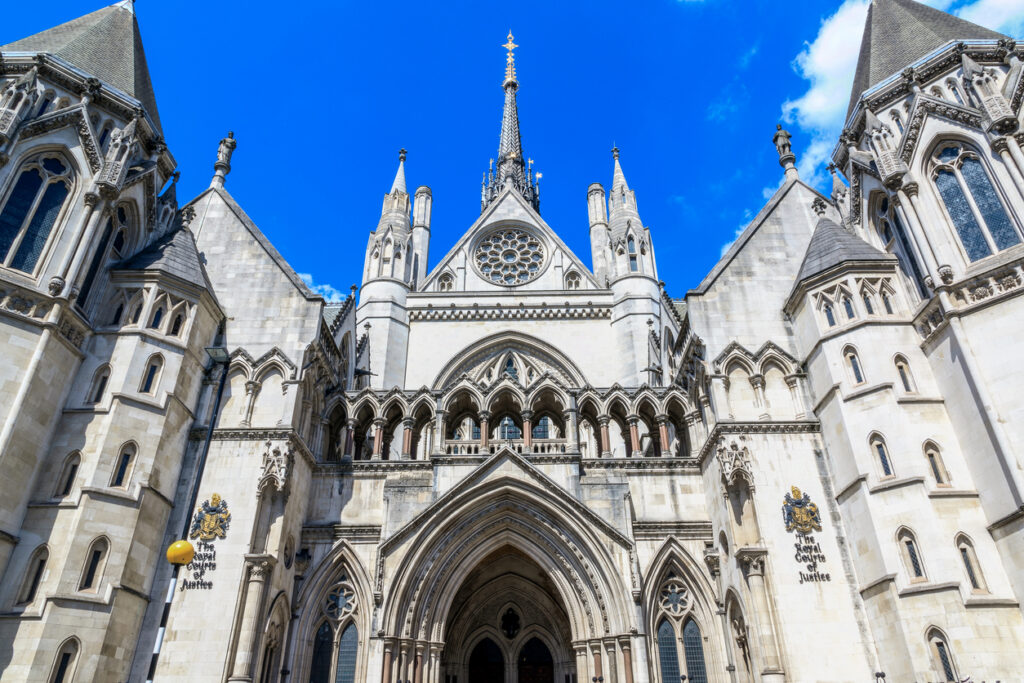
Judicial review is a legal process where a judge examines the lawfulness of a decision or action taken by a public body. The process ensures that government ministers and other public authorities operate lawfully and within the limits of their powers.
The purpose of judicial review is not for the court to decide whether a decision was “correct” or explain its own view on a contentious issue. Instead, the court’s role is supervisory; it reviews the way in which the decision was made.
It is a cornerstone of the rule of law, upholding the principle that no one, including the government itself, is above the law.
The grounds for judicial review
A court can find a decision to be unlawful on three main grounds. Lord Diplock summarised these grounds in the famous case Council of Civil Service Unions v Minister for the Civil Service (1985).
Illegality
This means the public body acted beyond its legal powers (known as acting ultra vires), meaning it did something it had no power to do, used its power for an improper purpose, or took into account irrelevant factors in its decision-making. In Lord Diplock’s assessment, this ground means that the decision maker “must understand correctly the law that regulates his decision-making power and must give effect to it”.
Irrationality
This means the decision was so unreasonable that no public body, acting reasonably, could have possibly made it. This is a high threshold for a claimant to meet and is often referred to as “Wednesbury unreasonableness”.
The term originates from a 1948 case (Associated Provincial Picture Houses Ltd. v Wednesbury Corporation) and applies to a decision that is deemed to be so “outrageous in its defiance of logic or of accepted moral standards that no sensible person who had applied his mind to the question to be decided could have arrived at it.”
It is rare that a court grants judicial review on this basis.
Procedural impropriety
This means the decision-making process was unfair. This can happen if a public body fails to follow the correct procedures set out in law or if the “rules of natural justice” have not been adhered to. For example, a decision may be procedurally improper if affected individuals were not adequately consulted, or if there is an appearance of bias on the part of the decision-maker.
The judicial review process
A person or group wishing to challenge a decision must first apply for permission from the administrative court. A judge will only grant permission if the claimant has a sufficient interest in the case, and if the case is arguable and has a reasonable chance of success. There are strict time limits, and a claim must normally be brought promptly.
If permission is granted, the case proceeds to a full hearing where a judge considers the arguments from both sides.
If the court finds the decision was unlawful, it can grant one of several remedies, including:
- A quashing order: nullifying the decision.
- A mandatory order: compelling the public body to do something.
- A prohibiting order: stopping the public body from taking an unlawful action that it has not yet taken.
- A declaration: a formal statement of the law or the rights of the parties, where this is disputed
- A declaration of incompatibility: a formal statement that an act of parliament is incompatible with the European Convention on Human Rights (ECHR), as incorporated into UK law by the Human Rights Act 1998. (Such a declaration does not invalidate or strike down the legislation, nor is it legally binding on parliament. It serves as an invitation to ministers and MPs to amend the law so that it is compatible).
Evaluation question
Is the Human Rights Act 1998 too weak to effectively restrain a determined government? Placement after “…amend the law so that it is compatible).”
Recent reforms to judicial review
The Conservative 2019 general election manifesto included a pledge to ensure judicial review was not “abused to conduct politics by another means.”
The manifesto stated: “We will ensure that judicial review is available to protect the rights of the individuals against an overbearing state, while ensuring that it is not abused to conduct politics by another means or to create needless delays.”
This led to the independent review of administrative law (IRAL) and the subsequent passing of the Judicial Review and Courts Act 2022.
The Judicial Review and Courts Act 2022 introduced reforms to give courts more flexibility in the remedies they can issue, including the power to issue a “suspended quashing order” and a “prospective-only quashing order”.
A suspended quashing order declares a decision unlawful but suspends the effect of the order to give the public body time to correct the error with minimal disruption.
A prospective-only quashing order declares that a decision is quashed only for the future, meaning that any actions taken under the unlawful policy prior to the court’s judgment remain legally valid.
Judicial review and government
Judicial review is often used to challenge the legality of government policy.
Landmark cases concerning Brexit (Miller I and Miller II) tested the constitutional relationship between the government, parliament and the courts.
If a court rules against the government, this can lead to political tension. Critics have argued that judges are unduly interfering in political matters.
The 2023 Rwanda scheme judgment
In November 2023, the UK supreme court delivered a unanimous ruling upholding the court of appeal’s decision that the government’s Rwanda deportations scheme was unlawful.
The Migration and Economic Development Partnership, known as the Rwanda scheme, was first announced in April 2022 under the premiership of Boris Johnson. The policy faced significant political and legal challenges from its inception; the inaugural deportation flight, scheduled for 14 June 2022, was grounded at the eleventh hour after an intervention by the European Court of Human Rights (ECHR). The ECHR issued an interim measure (or ‘Rule 39 order’), which are only produced in “exceptional circumstances” where there is an “imminent risk of irreparable harm”.
This ruling led to a protracted legal struggle over the Rwanda scheme, which lasted three prime ministers and several home secretaries. Attempts to operationalise the deportations plan also pitted the Conservative Party against itself.
On 15 November 2023, supreme court found that there were “substantial grounds for believing” that asylum seekers sent to Rwanda faced a “real risk of ill-treatment as a consequence of refoulement” – the practice of being returned to a country where they might face persecution or human rights abuses.
The ruling of the court of appeal on 29 June 2023 was upheld.
Lord Reed, the president of the court, said: “The evidence shows that there are substantial grounds for believing that there is a real risk that asylum claims will not be determined properly, and that asylum seekers will therefore be at risk of being returned directly or indirectly to their country of origin.”
He said that “the changes and capacity-building needed to eliminate that risk may be delivered in the future”, but that they were not currently in place.
This decision represented a major setback for Sunak, who had pledged to “stop the boats” as one of his government’s five priorities and repeatedly stressed his commitment to the scheme.
The supreme court’s judgment cited evidence regarding deficiencies in Rwanda’s asylum system, including its failure to adhere to an earlier agreement with Israel concerning the removal of asylum seekers. “Despite the terms of the agreement… asylum seekers were frequently moved to another country from which they were likely to be refouled”, Reed said.
Lee Anderson, the Conservative deputy chair, called on the government to “ignore the law” and start flights anyway.
Anderson said: “I think the British people have been very patient, I’ve been very patient, and now they’re demanding action.
“And this has sort of forced our hand a little bit now. My take is we should just put the planes in the air now and send them to Rwanda and show strength. It’s time for the Government to show real leadership and send them back, same day”
In response to the judgment in a Downing Street press conference, Sunak stated: “I do not agree with this decision – but I respect it and I accept it.”
Sunak unveiled a two-pronged strategy to overcome the court ruling: first, negotiate a new international treaty with Rwanda that would provide a legally binding guarantee against refoulement; and second, introduce emergency legislation that would enable parliament to confirm Rwanda as a safe country under UK law.
The Safety of Rwanda Bill thereby received royal assent on 25 April 2024.
The prime minister, however, went on to call a general election for 4 July 2024. It meant the Rwanda deportations scheme was never fully operationalised.
The 2017 supreme court Article 50 judgment (Miller I)
In 2017, the supreme court ruled that the government could not notify the Council of the European Union of the UK’s intention to withdraw from the EU (formally triggering the process set out in Article 50 of the Treaty on European Union) under the royal prerogative.
Gina Miller, a business owner and transparency campaigner, had brought the case before the high court in 2016, arguing that the executive could not use the royal prerogative to effectively nullify previous acts of parliament relating to European integration. The government, led in court by the attorney general, Jeremy Wright, maintained that the 2016 referendum result represented a clear mandate for the executive to exercise prerogative powers.
On 24 January 2017, the supreme court ruled by a majority of eight to three that because the European Communities Act 1972 had incorporated EU law, only an act of parliament could authorise its removal. Delivering the verdict, Lord Neuberger, the president of the supreme court, said: “Withdrawal effects a fundamental change by cutting off the source of EU law, as well as changing legal rights.
“The UK’s constitutional arrangements require such changes to be clearly authorised by parliament.”
The 2019 supreme court prorogation judgment (Miller II)
One high-profile case in which the supreme court ruled against the government came in 2019 over the prorogation controversy.
The government, led by Boris Johnson as prime minister, announced that it had advised Queen Elizabeth II to prorogue parliament in August 2019. The Queen, acting on the prime minister’s advice at a privy council meeting at Balmoral, approved an Order in Council to suspend parliament for five weeks. The prorogation – typically an uncontroversial and insignificant procedure – was scheduled to begin between 9-12 September and last until a state opening on 14 October. Since 1979, parliament had not been prorogued for more than three weeks. The five-week prorogation would have been the longest since 1930.
Prorogation in order to secure a ‘no deal’ Brexit – the default legal position under EU law’s Article 50 process – had been a point of debate in the 2019 Tory leadership contest. This strategy, it was suggested, would prevent MPs from legislating to block a no deal Brexit, tabling a vote of no confidence in the government, or introducing a motion to trigger an early election.
But the approach was denounced by critics, including those within the Conservative Party, as an anti-democratic, unconstitutional ploy to bypass MPs – at a time when the parliamentary arithmetic was finely balanced.
Prorogation occurred formally in the early hours of 10 September; Black Rod entered the commons at around 1:00 am, signalling the start of the official prorogation ceremony. Opposition MPs surrounded the speaker’s chair, displaying signs that read “silenced”.
The controversy culminated on 24 September 2019, when the supreme court, in the landmark Miller/Cherry case, unanimously ruled that the prime minister’s advice to the Queen was unlawful.
Eleven justices, led by Lady Hale, ruled that the prorogation was “void and of no effect”, meaning parliament could be reconvened the following day.
The prorogation, it was found, “had the effect of frustrating or preventing, without reasonable justification, the ability of parliament to carry out its constitutional functions as a legislature and as the body responsible for the supervision of the executive.”
The court noted its historical role in protecting “parliamentary sovereignty from threats posed to it by the use of the prerogative powers and in doing so have demonstrated that prerogative powers are limited by the principle of parliamentary sovereignty”.
The court added: “The sovereignty of parliament would, however, be undermined as the foundational principle of our constitution if the executive could, through the use of the prerogative, prevent Parliament from exercising its legislative authority for as long as it pleased.”
On the legality of prorogation, the court concluded: “It is impossible for us to conclude, on the evidence which has been put before us, that there was any reason – let alone a good reason – to advise Her Majesty to prorogue parliament for five weeks, from 9th or 12th September until 14th October.
“We cannot speculate, in the absence of further evidence, upon what such reasons might have been. It follows that the decision was unlawful.”

